Maratha Administration: Central & Revenue Systems (Chauth & Sardeshmukhi) - History | UPSC Learning
Topics
0 topics • 0 completed
🔍
No topics match your search
Maratha Administration: Central & Revenue Systems (Chauth & Sardeshmukhi)
Medium⏱️ 7 min read
history
📖 Introduction
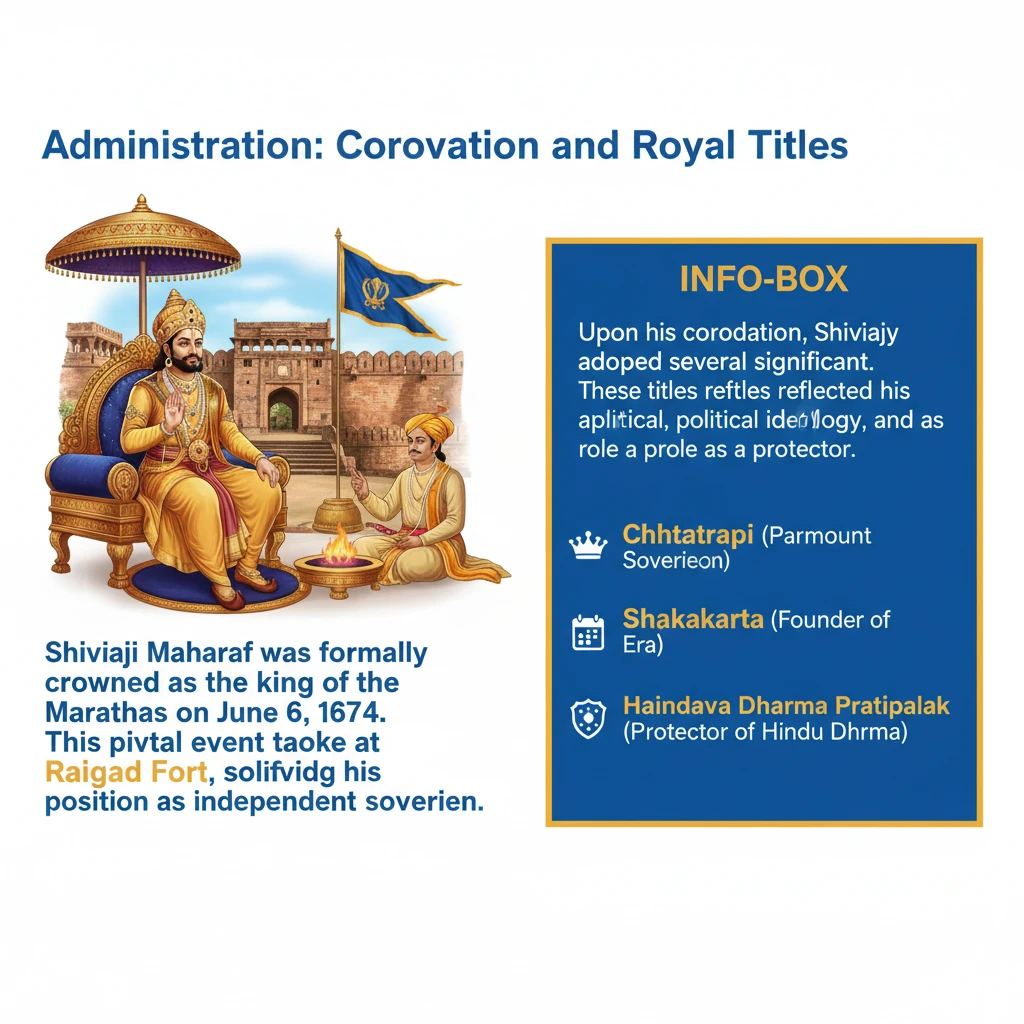
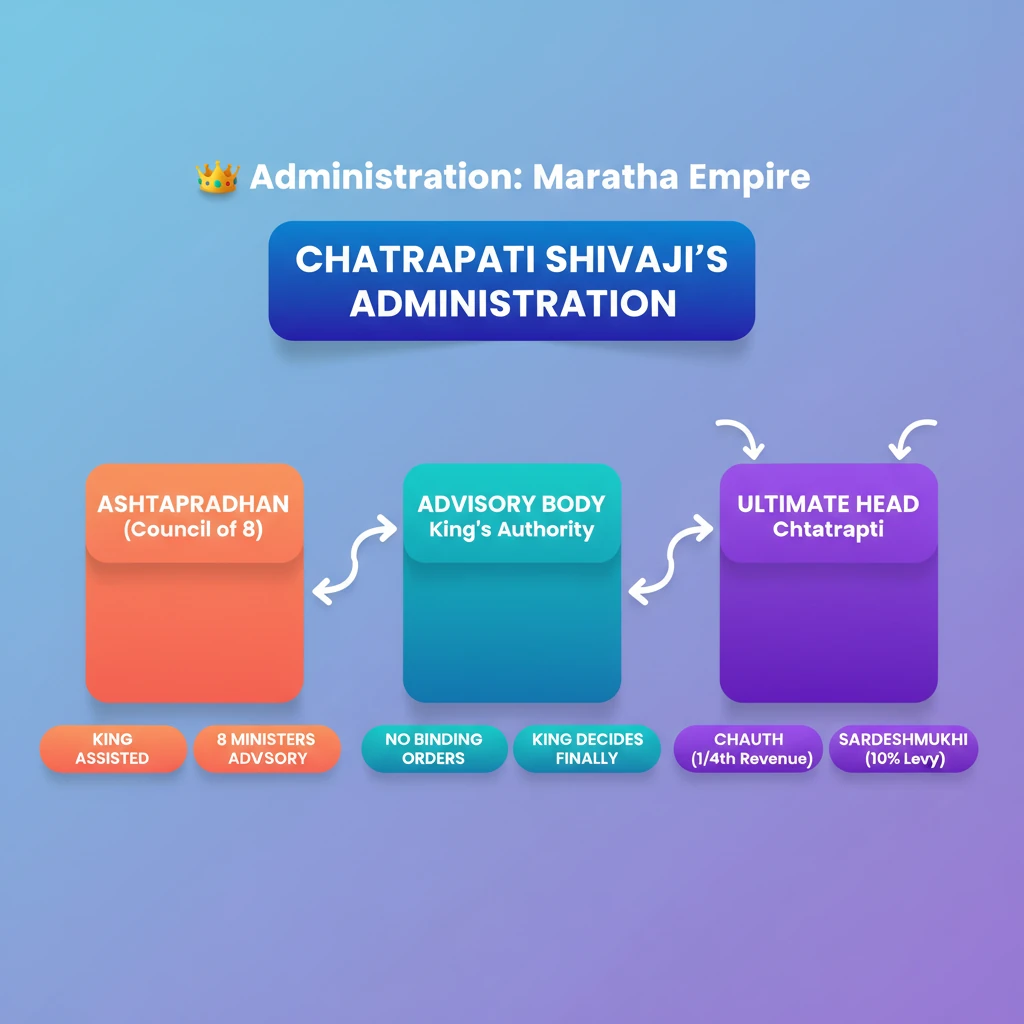
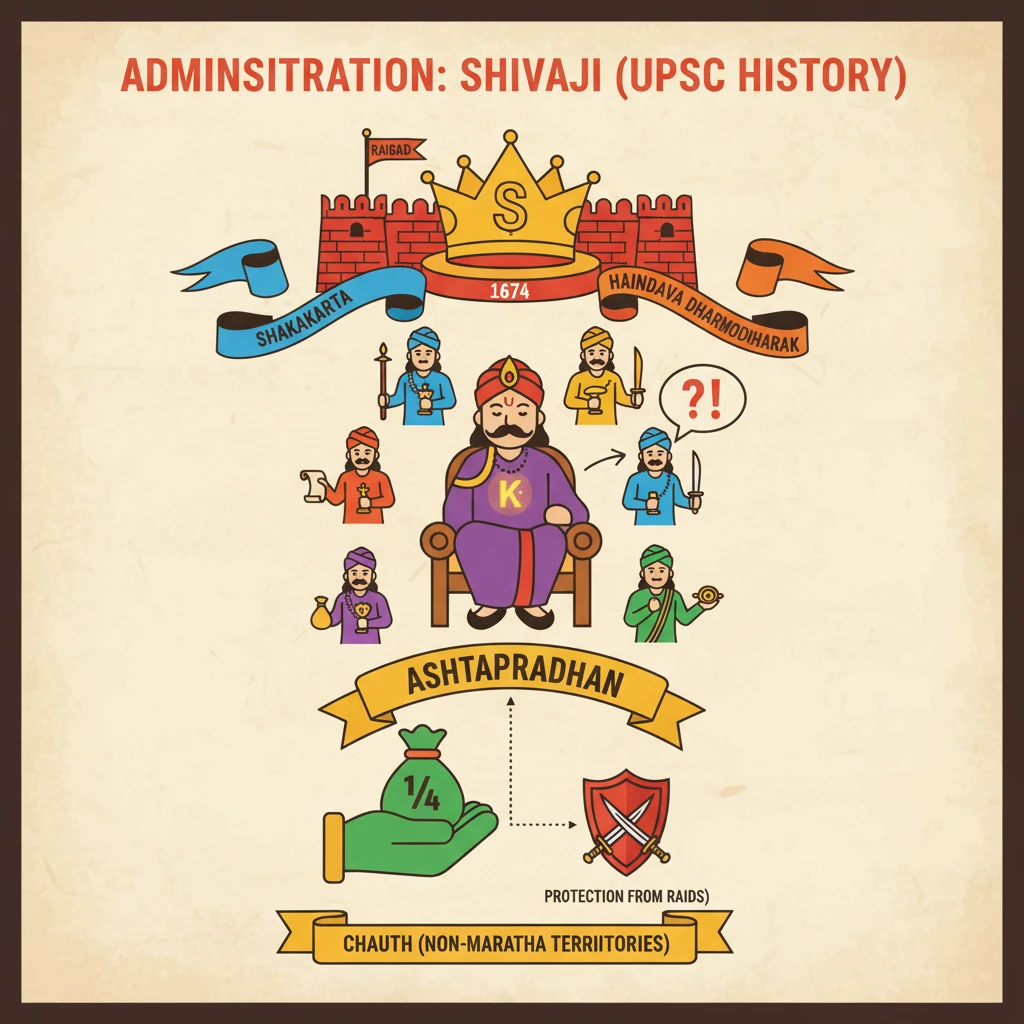
<h4>Maratha Administration: Core Components</h4><p>The <strong>Maratha administration</strong>, particularly under <strong>Chhatrapati Shivaji Maharaj</strong>, was a well-structured system designed for efficient governance and resource mobilization. It played a crucial role in the expansion and consolidation of the Maratha Empire.</p><div class='key-point-box'><p>Understanding Maratha administration is vital for grasping the dynamics of state formation and revenue systems in medieval India.</p></div><h4>Central Administration: The King and His Council</h4><p>At the apex of the <strong>Maratha state</strong> was the <strong>King</strong>, who served as the supreme head. His authority was absolute, encompassing all legislative, executive, and judicial functions.</p><p>To assist the <strong>King</strong> in the complex affairs of governance, a council of eight ministers was established. This council was famously known as the <strong>'Ashtapradhan'</strong>.</p><div class='info-box'><p>The <strong>Ashtapradhan Mandal</strong> comprised eight key ministers, each responsible for a specific department. This system aimed at distributing administrative responsibilities efficiently.</p></div><h4>Revenue Administration: Pillars of Maratha Economy</h4><p>The financial backbone of the <strong>Maratha Empire</strong> was its robust <strong>revenue administration</strong>. Key sources of income included land revenue and special levies imposed on both Maratha and non-Maratha territories.</p><p>Among the most significant revenue demands were <strong>Chauth</strong> and <strong>Sardeshmukhi</strong>. These levies were instrumental in financing the extensive military campaigns and maintaining the state apparatus.</p><h4>Chauth: The Protection Tax</h4><p><strong>Chauth</strong> was a distinctive revenue demand collected by the <strong>Marathas</strong>. It constituted a significant portion of the total revenue generated from territories that were not directly under Maratha rule.</p><div class='info-box'><p><strong>Definition of Chauth:</strong> It amounted to <strong>1/4th</strong> (one-fourth) of the total <strong>revenue demand</strong> from a territory. This payment was made by non-Maratha regions to the Marathas.</p></div><p>The primary purpose of paying <strong>Chauth</strong> was to safeguard these non-Maratha territories. It acted as a protection money against potential raids and plunder by <strong>Shivaji's forces</strong> or other Maratha contingents.</p><h4>Sardeshmukhi: The Hereditary Claim Levy</h4><p>In addition to <strong>Chauth</strong>, the <strong>Marathas</strong> also imposed another important levy known as <strong>Sardeshmukhi</strong>. This tax was based on a claim of hereditary rights over certain lands.</p><div class='info-box'><p><strong>Definition of Sardeshmukhi:</strong> It was an <strong>additional levy of 10%</strong> (one-tenth) imposed on lands over which the <strong>Marathas</strong> claimed to be the <strong>hereditary head (Sardeshmukh)</strong>.</p></div><p>The collection of <strong>Sardeshmukhi</strong> reinforced the <strong>Maratha's</strong> assertion of paramountcy and their traditional rights over these territories, even if they were not directly administered by them.</p><div class='exam-tip-box'><p>For UPSC, distinguish clearly between <strong>Chauth</strong> and <strong>Sardeshmukhi</strong> in terms of their purpose, amount, and the basis of their imposition. This is a frequent point of confusion in <strong>Prelims</strong> and can be a comparative point in <strong>Mains</strong> answers.</p></div>
💡 Key Takeaways
- •Maratha central administration was headed by the King, assisted by the 'Ashtapradhan' (council of eight ministers).
- •Key revenue sources were Chauth and Sardeshmukhi, crucial for Maratha military and state finance.
- •Chauth was 1/4th of the revenue demand, paid by non-Maratha territories for protection against raids.
- •Sardeshmukhi was an additional 10% levy on lands where Marathas claimed hereditary rights.
- •Shivaji Maharaj established the foundation of this robust administrative and revenue system.
- •The system balanced central authority with delegated ministerial responsibilities.
🧠 Memory Techniques
95% Verified Content
📚 Reference Sources
•Satish Chandra, 'History of Medieval India'
•Jadunath Sarkar, 'Shivaji and His Times'
•NCERT History Textbooks (Class XI & XII)