Muslim League and Rise of Communal Politics in India - History | UPSC Learning
Topics
0 topics • 0 completed
🔍
No topics match your search
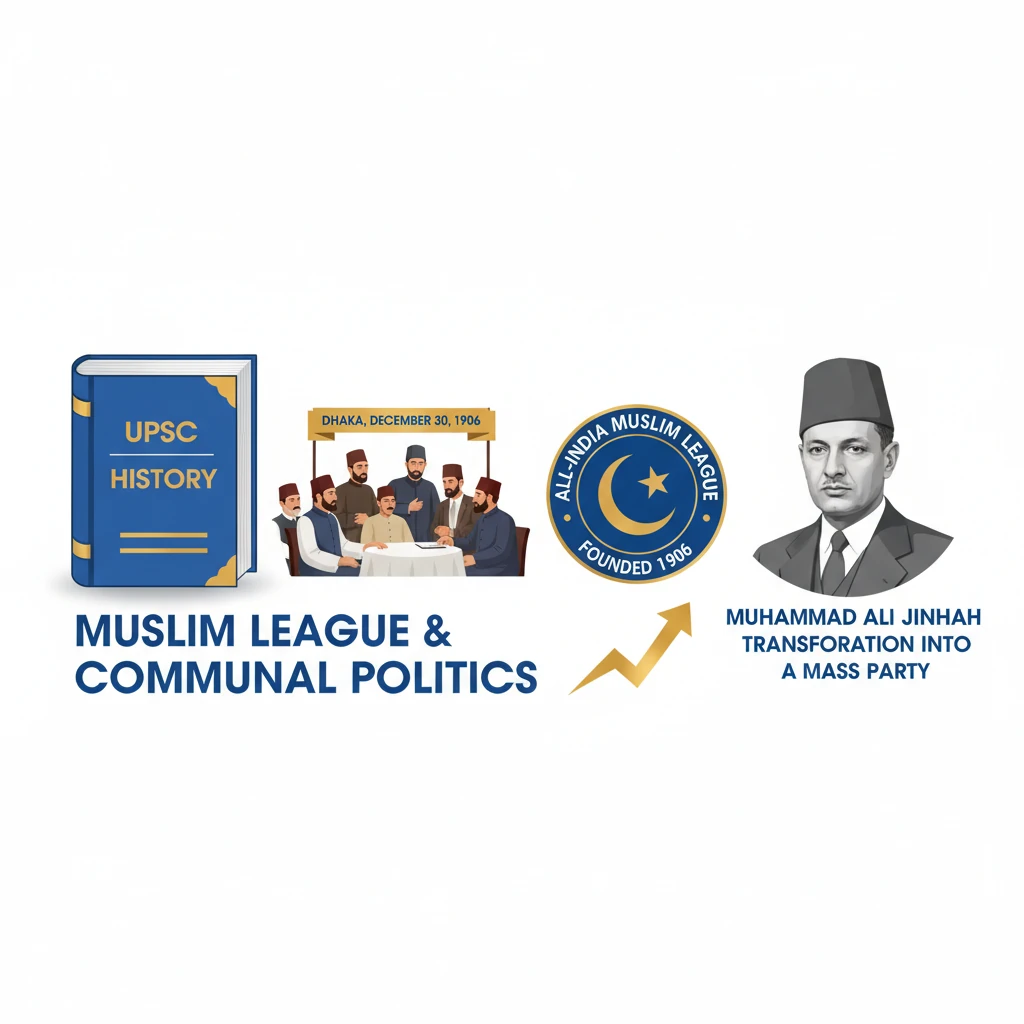
Muslim League and Rise of Communal Politics in India
Medium⏱️ 10 min read
history
📖 Introduction
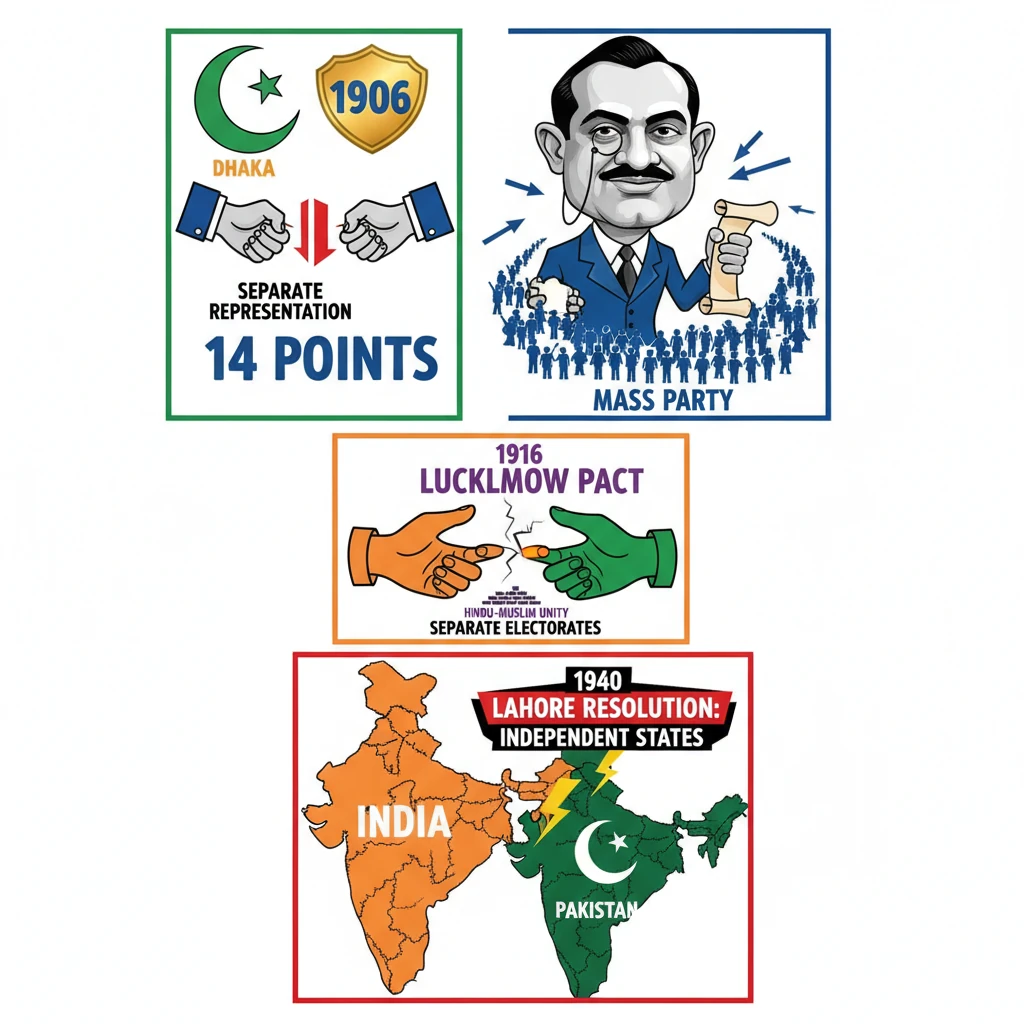
<h4>Founding of the All-India Muslim League</h4><p>The <strong>All-India Muslim League</strong> was established on <strong>December 30, 1906</strong>, in <strong>Dhaka</strong>. This marked the beginning of a significant political organization that would profoundly influence India's future.</p><p>Initially, it comprised a group of <strong>elite Muslim men</strong>. Over time, it transformed into a mass political party, particularly under the leadership of <strong>Muhammad Ali Jinnah</strong>, ultimately advocating for the creation of <strong>Pakistan</strong>.</p><div class='info-box'><p><strong>Founders:</strong> Key figures included <strong>Nawab Salimullah of Dhaka</strong>, <strong>Nawab Viqar-ul-Mulk</strong>, <strong>Nawab Mohsin Ul-Mulk</strong>, and <strong>Aga Khan</strong>.</p></div><h4>Precursors to Formation</h4><p>The formation of the League was influenced by earlier movements and events that highlighted Muslim political aspirations and concerns.</p><ul><li><strong>Aligarh Movement:</strong> This movement, led by <strong>Sir Syed Ahmed Khan</strong>, focused on modern education for Muslims and fostering their political awareness.</li><li><strong>Simla Deputation (1906):</strong> A delegation of Muslim leaders met <strong>Lord Minto II (1905-1910)</strong> to articulate their demand for <strong>special representation</strong> in legislative bodies.</li></ul><h4>Initial Objectives of the League</h4><p>The primary goals of the <strong>All-India Muslim League</strong> at its inception were centered on safeguarding Muslim interests.</p><div class='key-point-box'><ul><li>To protect the <strong>political and religious rights of Muslims</strong> in British India.</li><li>To secure <strong>separate representation</strong> for Muslims in legislative bodies, a demand that significantly shaped future communal politics.</li></ul></div><h4>Emergence of Jinnah's Leadership</h4><p><strong>Muhammad Ali Jinnah</strong> played a crucial role in transforming the League from an elite body into a powerful mass political force.</p><p>His influence grew significantly after the articulation of his <strong>Fourteen Points in 1929</strong>, which clearly outlined the Muslim community's political demands.</p><div class='info-box'><p><strong>Jinnah's Fourteen Points (1929):</strong> These demands included calls for <strong>federalism</strong>, robust <strong>minority safeguards</strong>, and provincial <strong>autonomy</strong>, among others, reflecting Muslim political aspirations.</p></div><h4>Key Agreements and Resolutions</h4><h4>The Lucknow Pact (1916)</h4><p>The <strong>Lucknow Pact</strong> represented a rare moment of cooperation between the <strong>Indian National Congress</strong> and the <strong>All-India Muslim League</strong>.</p><p>Leaders like <strong>Bal Gangadhar Tilak</strong> (Congress) and <strong>Muhammad Ali Jinnah</strong> (League) signed this pact, agreeing to work together for India's independence.</p><div class='key-point-box'><p>Crucially, the <strong>Congress accepted separate electorates for Muslims</strong>, a long-standing demand of the League. While a sign of unity, this also inadvertently fueled the rise of <strong>communal politics</strong>.</p></div><p>The pact advocated for increased <strong>Indian representation</strong> in legislative and executive councils, marking a high point of <strong>Hindu-Muslim unity</strong> in the freedom struggle.</p><h4>The Lahore Resolution (1940)</h4><p>By <strong>1940</strong>, under <strong>Jinnah's</strong> leadership, the Muslim League had adopted a clear stance favoring the <strong>Partition of India</strong>.</p><p>At its session in <strong>Lahore</strong> in <strong>1940</strong>, the League passed a resolution demanding "<strong>Independent States</strong>" for Muslims in the northwestern and eastern regions where they formed a majority.</p><div class='highlight-box'><p>This resolution, later famously known as the <strong>Pakistan Resolution</strong>, became the fundamental ideological basis for the eventual creation of <strong>Pakistan in 1947</strong>.</p></div><h4>Direct Action Day (1946)</h4><p>Observed on <strong>August 16, 1946</strong>, <strong>Direct Action Day</strong> was a communal strike called by the <strong>All-India Muslim League</strong>, led by <strong>Muhammad Ali Jinnah</strong>.</p><p>The League's objective was to forcefully press its demand for the creation of <strong>Pakistan</strong> through mass action.</p><div class='exam-tip-box'><p>This event led to widespread <strong>communal riots</strong>, particularly in <strong>Calcutta</strong>, resulting in thousands of deaths and extensive property destruction. It significantly deepened the <strong>Hindu-Muslim divide</strong> and accelerated the demand for <strong>Partition</strong>.</p></div><h4>Role in Partition and Post-Partition Status</h4><p>Under <strong>Jinnah's</strong> leadership, the <strong>Muslim League</strong> spearheaded the demand for <strong>Pakistan</strong>, arguing that Muslims would not receive fair treatment in a Hindu-majority independent India.</p><p>This persistent advocacy culminated in the <strong>1947 Partition</strong>, leading to the creation of two independent nations: <strong>India</strong> and <strong>Pakistan</strong>.</p><p>Post-Partition, the League became the dominant political party in <strong>Pakistan</strong> but eventually fragmented into various factions. Its influence in <strong>India</strong> largely waned, with some remnants forming regional political groups.</p>
💡 Key Takeaways
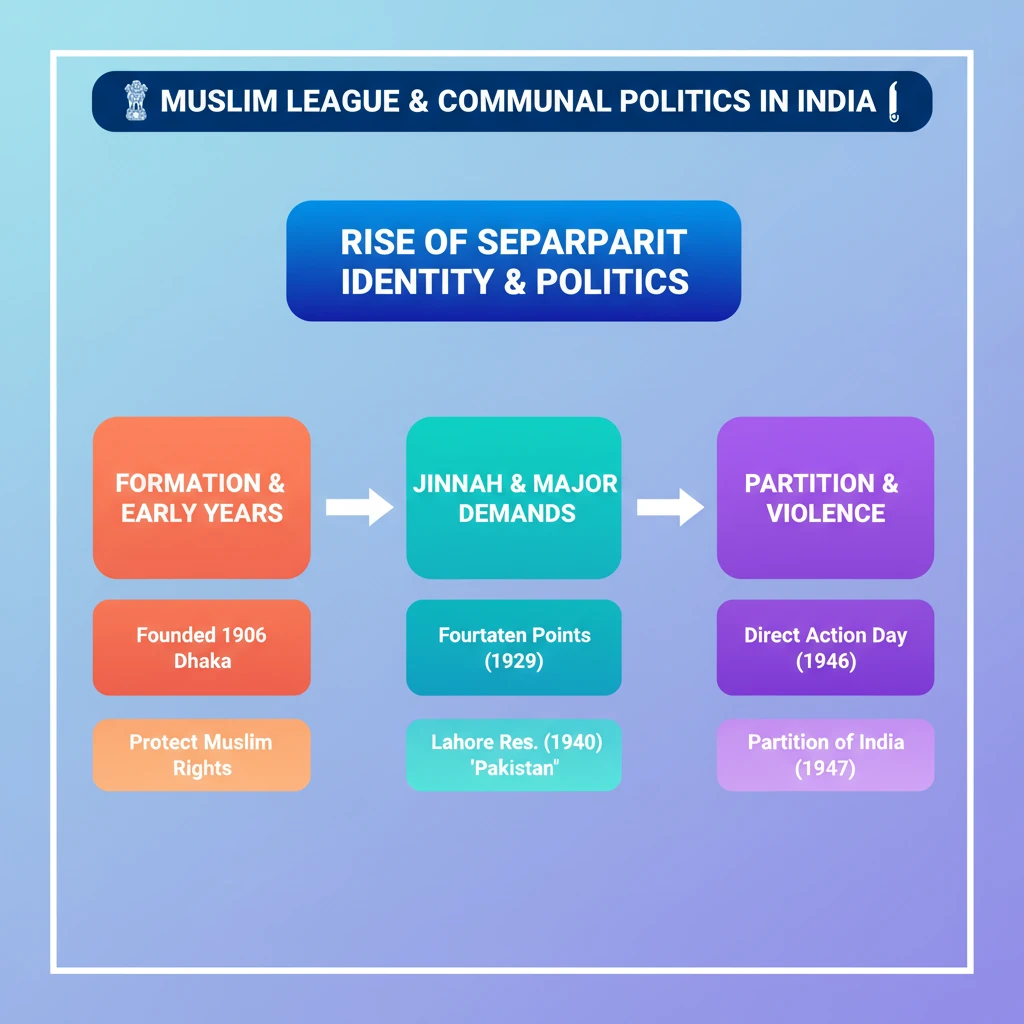
- •The All-India Muslim League was founded in 1906 in Dhaka to protect Muslim rights and demand separate representation.
- •Under Muhammad Ali Jinnah, the League transformed into a mass party, advocating for Muslim political demands, notably through his Fourteen Points (1929).
- •The Lucknow Pact (1916) showed Hindu-Muslim unity but legitimized separate electorates, inadvertently fueling communal politics.
- •The Lahore Resolution (1940) formally demanded 'Independent States' for Muslims, becoming the basis for Pakistan.
- •Direct Action Day (1946) led to severe communal violence, deepening divisions and accelerating the Partition of India in 1947.
🧠 Memory Techniques
95% Verified Content