Hirakud Dam Canal System Renovation - Geography | UPSC Learning
Topics
0 topics • 0 completed
🔍
No topics match your search
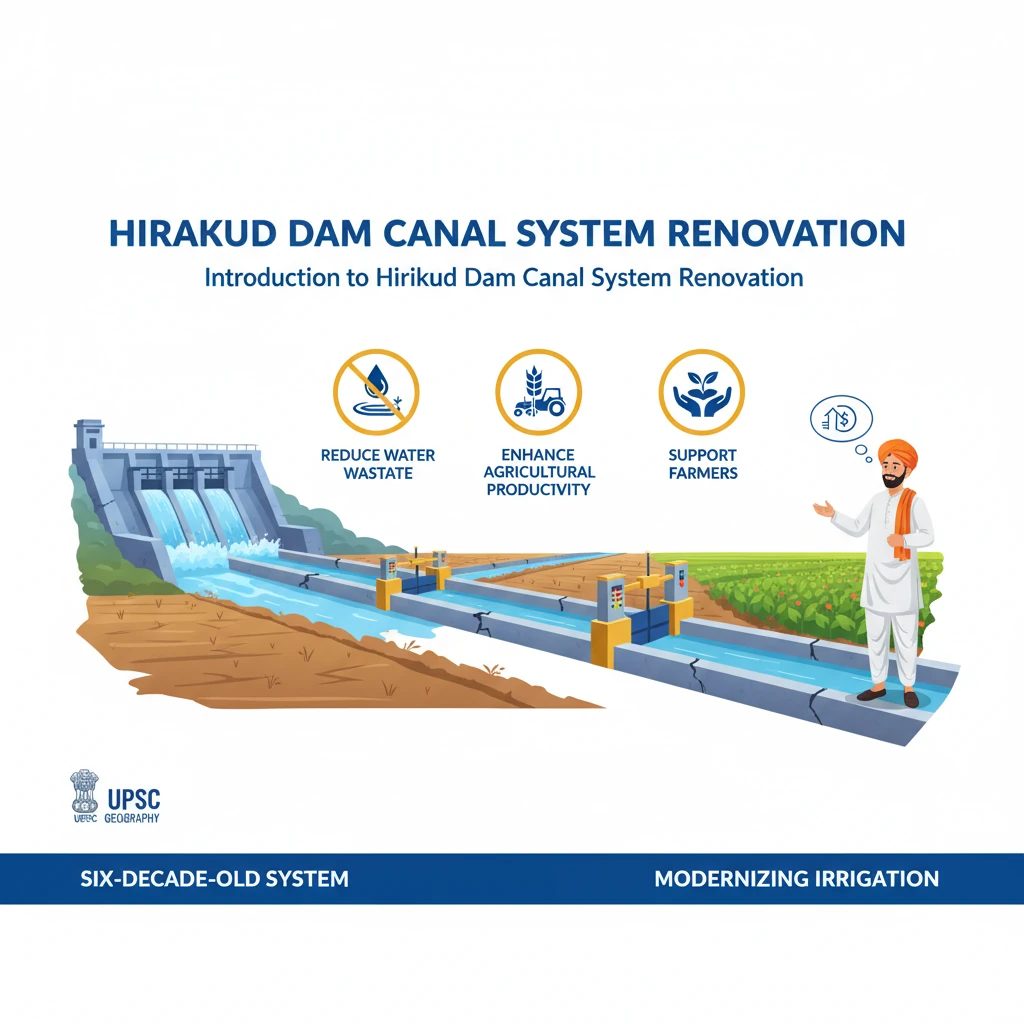
Hirakud Dam Canal System Renovation
Medium⏱️ 8 min read
geography
📖 Introduction
<h4>Introduction to Hirakud Dam Canal System Renovation</h4><p>The <strong>six-decade-old canal system</strong> connected to <strong>Odisha’s Hirakud Dam</strong> is undergoing a significant renovation. This initiative is crucial for modernizing vital irrigation infrastructure.</p><p>The primary goals include reducing <strong>water wastage</strong>, enhancing <strong>agricultural productivity</strong>, and providing much-needed support to <strong>farmers</strong> in the region.</p><h4>Need for Renovation</h4><p>Many parts of the existing canal infrastructure, including the <strong>Bargarh</strong> and <strong>Sasan main canals</strong>, are in a state of disrepair. This deterioration leads to significant inefficiencies.</p><p>The current <strong>earthen canals</strong> are a major cause of <strong>water loss</strong> through seepage, which severely reduces overall irrigation efficiency and impacts water availability.</p><p>Furthermore, extensive <strong>water seepage</strong> makes some adjacent farmland unsuitable for cultivation, posing considerable challenges for local farmers and hindering agricultural output.</p><h4>Key Features of the Renovation Project</h4><p>A central aspect of the renovation is the conversion of all existing <strong>earthen water courses</strong> to durable <strong>concrete paths</strong>. This change is designed to improve water distribution and management significantly.</p><p>The project aims to enhance <strong>water availability</strong>, especially in <strong>tail-end areas</strong> of the canal system. This ensures better and more equitable access for farmers across the entire command area.</p><div class="key-point-box"><p><strong>Key Objectives of Renovation:</strong></p><ul><li>Modernize <strong>irrigation infrastructure</strong>.</li><li>Reduce <strong>water wastage</strong>.</li><li>Enhance <strong>agricultural productivity</strong>.</li><li>Improve <strong>water distribution</strong> and access for farmers.</li></ul></div><h4>Impact on Local Farmers</h4><p>The renovation project is specifically designed to reduce the significant gap between <strong>irrigation potential</strong> and <strong>actual usage</strong>. This means more land can be effectively irrigated.</p><p>Enhanced irrigation capabilities will directly benefit thousands of farmers, leading to more reliable water supply and substantial increases in <strong>crop yields</strong>, thereby improving livelihoods.</p><div class="exam-tip-box"><p><strong>UPSC Insight:</strong> Renovation projects like <strong>Hirakud Dam Canal System</strong> are examples of sustainable water management and infrastructure upgrade, relevant for <strong>GS-III (Agriculture, Infrastructure)</strong> and <strong>GS-I (Geography)</strong>.</p></div><h4>About the Hirakud Dam</h4><p>The <strong>Hirakud Dam</strong> is a monumental <strong>multipurpose scheme</strong> that was initially conceived by <strong>Er. M. Visvesvaraya</strong> in <strong>1937</strong>. Its conceptualization followed a series of devastating floods in the <strong>Mahanadi River</strong>.</p><p>Constructed primarily between <strong>1952-53</strong>, it stands as one of <strong>India’s first major multipurpose river valley projects</strong> post-independence, symbolizing the nation's developmental aspirations.</p><div class="info-box"><p><strong>Hirakud Dam Key Facts:</strong></p><ul><li><strong>Conceived by:</strong> <strong>Er. M. Visvesvaraya</strong> in <strong>1937</strong>.</li><li><strong>Construction Period:</strong> Around <strong>1952-53</strong>.</li><li><strong>Inaugurated by:</strong> Then Prime Minister <strong>Jawaharlal Nehru</strong> in <strong>1957</strong>.</li><li><strong>Location:</strong> Across the <strong>Mahanadi River</strong>, <strong>Odisha</strong>.</li></ul></div><h4>Key Features and Significance of Hirakud Dam</h4><p>The <strong>Hirakud Dam</strong> holds the distinction of being the <strong>longest major earthen dam globally</strong>, with an impressive stretch of <strong>25.8 km</strong> across the <strong>Mahanadi River</strong>.</p><p>It impounds the waters to form the vast <strong>Hirakud Reservoir</strong>, also famously known as <strong>Hirakud Lake</strong>, which is recognized as one of the <strong>largest artificial lakes in Asia</strong>.</p><p>In <strong>2021</strong>, the <strong>Hirakud Reservoir</strong> was officially declared a <strong>Ramsar site</strong>, highlighting its ecological importance as a wetland of international significance.</p><h4>Purpose and Benefits of Hirakud Dam</h4><p>The dam serves multiple crucial purposes, including <strong>hydroelectric power generation</strong>. It has an installed capacity of <strong>359.8 MW</strong>, significantly contributing to the region's energy supply.</p><p>Additionally, the reservoir provides irrigation to a vast area of approximately <strong>436,000 hectares of land</strong>, directly benefiting numerous farmers and supporting agricultural activities in its command area.</p><div class="info-box"><p><strong>Unique Feature: Cattle Island</strong></p><p><strong>Cattle Island</strong> is a distinctive geographical feature located at one of the extreme points of the <strong>Hirakud Reservoir</strong>. It is notable for being inhabited by a large herd of <strong>wild cattle</strong>.</p></div>
💡 Key Takeaways
- •Hirakud Dam canal system is undergoing renovation to modernize irrigation and reduce water wastage.
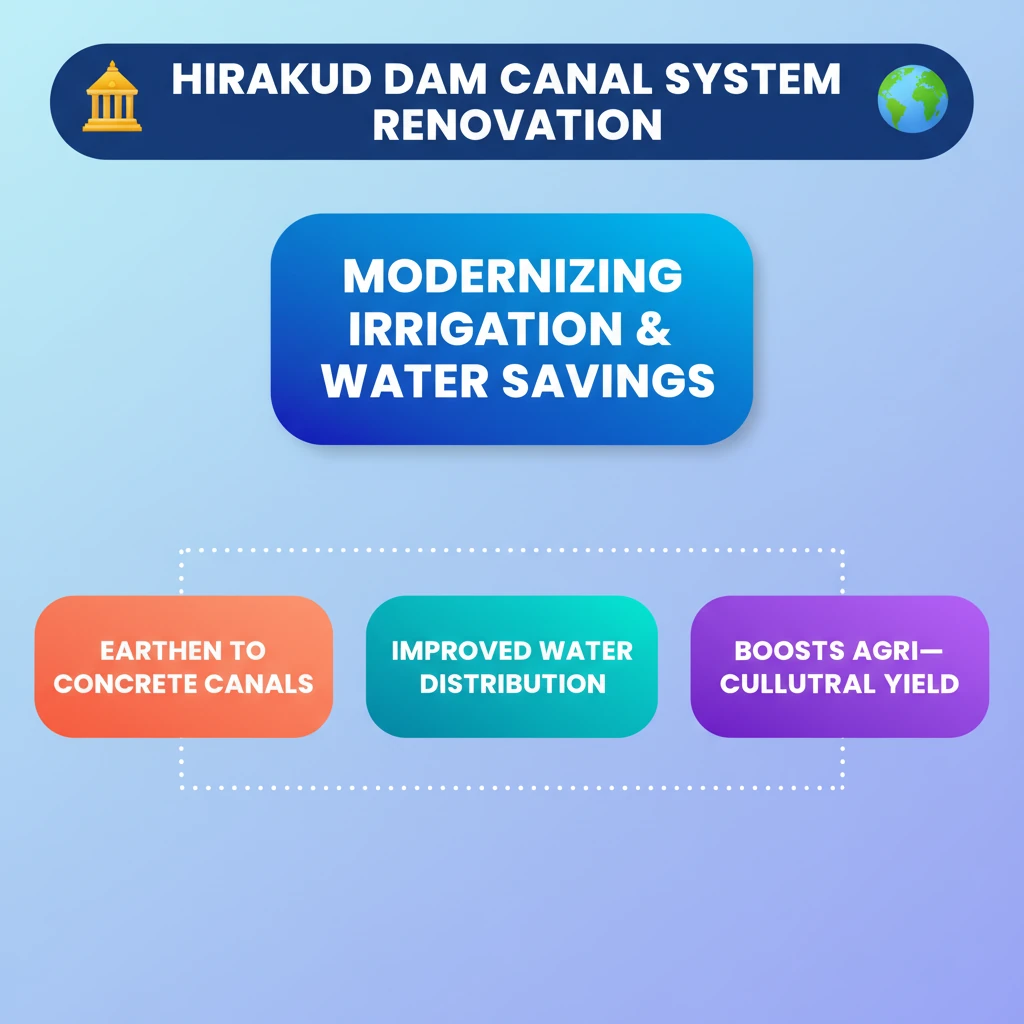
- •The renovation aims to convert earthen canals to concrete, improve water distribution, and boost agricultural productivity.
- •Hirakud Dam, conceived by Er. M. Visvesvaraya in 1937, is one of India's first major post-independence multipurpose projects (1952-53).
- •It is the longest major earthen dam globally (25.8 km) and its reservoir is a Ramsar site since 2021.
- •The project is crucial for farmer welfare, water conservation, and upgrading aging national infrastructure.
🧠 Memory Techniques

95% Verified Content
📚 Reference Sources
•Ministry of Water Resources, Government of India official reports
•Odisha Water Resources Department publications
•Ramsar Sites Information Service (for Hirakud Reservoir status)