India Joins Sri Lanka in Seabed Mining Race - Geography | UPSC Learning
Topics
0 topics • 0 completed
🔍
No topics match your search
India Joins Sri Lanka in Seabed Mining Race
Medium⏱️ 7 min read
geography
📖 Introduction
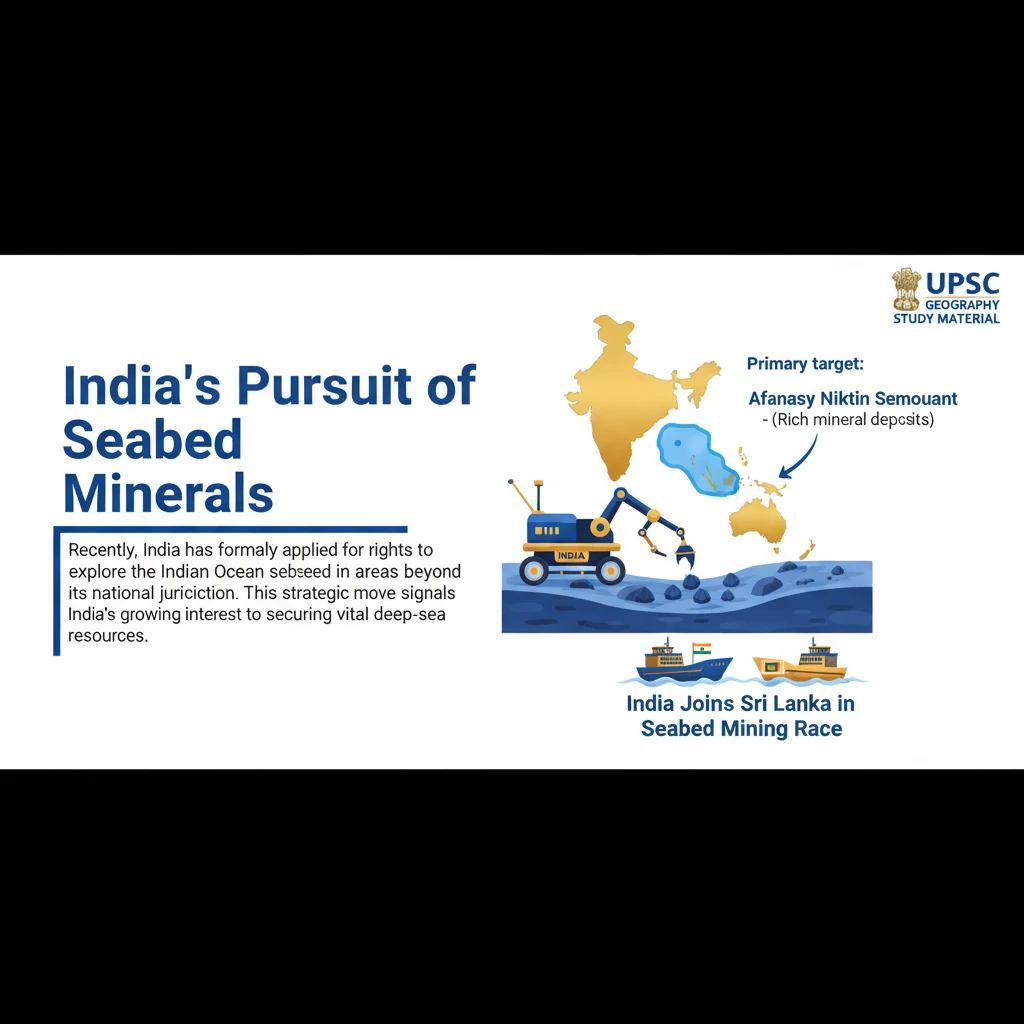
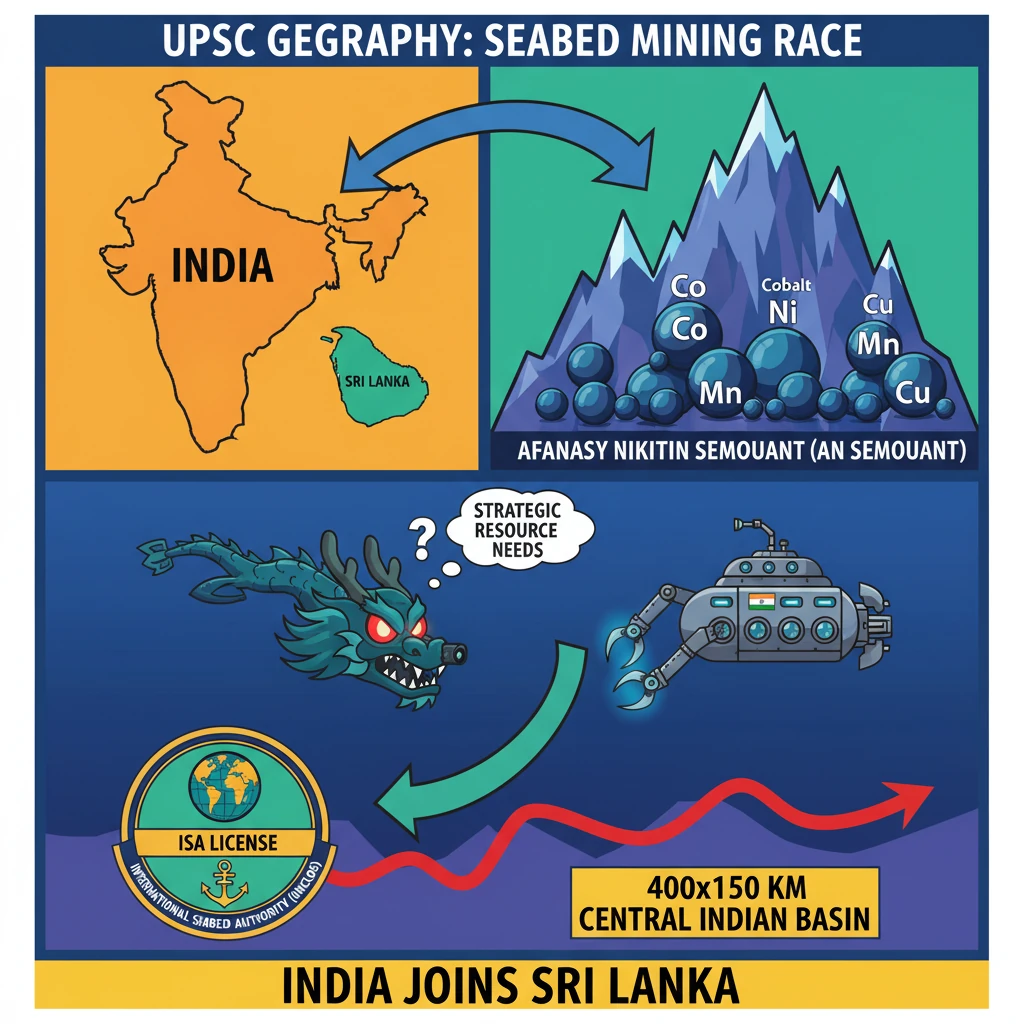
<h4>India's Pursuit of Seabed Minerals</h4><p>Recently, <strong>India</strong> has formally applied for rights to explore the <strong>Indian Ocean seabed</strong> in areas beyond its national jurisdiction. This strategic move signals India's growing interest in securing vital deep-sea resources.</p><p>The primary target for India's exploration is the <strong>Afanasy Nikitin Seamount (AN Seamount)</strong>, known for its rich mineral deposits. This application underscores India's proactive approach to resource security.</p><h4>Strategic Motivations and Geopolitical Context</h4><p>India's heightened interest in seabed exploration is significantly influenced by geopolitical concerns. There have been reports of <strong>Chinese vessels</strong> conducting reconnaissance activities in the same region, prompting India to accelerate its own efforts.</p><div class='exam-tip-box'><p><strong>UPSC Insight:</strong> The 'Why in News' section often highlights contemporary geopolitical shifts. Understanding the motivations behind such actions (e.g., resource security, countering rival influence) is crucial for <strong>GS-II (International Relations)</strong> and <strong>GS-III (Economy, Security)</strong>.</p></div><p>Complicating the situation, <strong>Sri Lanka</strong> has already laid claim to rights in parts of this region under a separate set of international laws. This creates a potential overlap of interests in the resource-rich Indian Ocean basin.</p><h4>Understanding the Afanasy Nikitin Seamount (AN Seamount)</h4><div class='info-box'><ul><li><strong>Location:</strong> The <strong>AN Seamount</strong> is a significant structural feature situated in the <strong>Central Indian Basin</strong>.</li><li><strong>Distance:</strong> It lies approximately <strong>1,500 km</strong> away from <strong>India's coast</strong>.</li><li><strong>Dimensions:</strong> The seamount is roughly <strong>400 km long</strong> and <strong>150 km wide</strong>.</li><li><strong>Depth Profile:</strong> It rises from an oceanic depth of about <strong>4,800 meters</strong> to approximately <strong>1,200 meters</strong> below the surface.</li><li><strong>Mineral Riches:</strong> The <strong>AN Seamount</strong> is particularly rich in valuable mineral deposits, including <strong>cobalt, nickel, manganese</strong>, and <strong>copper</strong>.</li></ul></div><h4>Regulatory Framework for Seabed Mining</h4><p>To proceed with the extraction of minerals from the deep seabed, any interested party or country must first secure an <strong>exploration license</strong>. This license is issued by the <strong>International Seabed Authority (ISA)</strong>.</p><div class='key-point-box'><p>The <strong>International Seabed Authority (ISA)</strong> is an autonomous intergovernmental body established under the <strong>United Nations Convention on the Law of the Sea (UNCLOS)</strong>. It is responsible for organizing, regulating, and controlling all mineral-related activities in the international seabed area beyond the limits of national jurisdiction.</p></div><p>These exploration and extraction rights are specifically applicable to areas designated as the <strong>open ocean</strong>, also known as the <strong>high seas</strong>. These regions fall outside the exclusive economic zones of individual nations.</p><p>The <strong>open ocean</strong> constitutes approximately <strong>60%</strong> of the world's seas. While these vast areas are believed to hold significant mineral wealth, the practical challenges and prohibitive costs associated with deep-sea extraction remain substantial barriers.</p>
💡 Key Takeaways
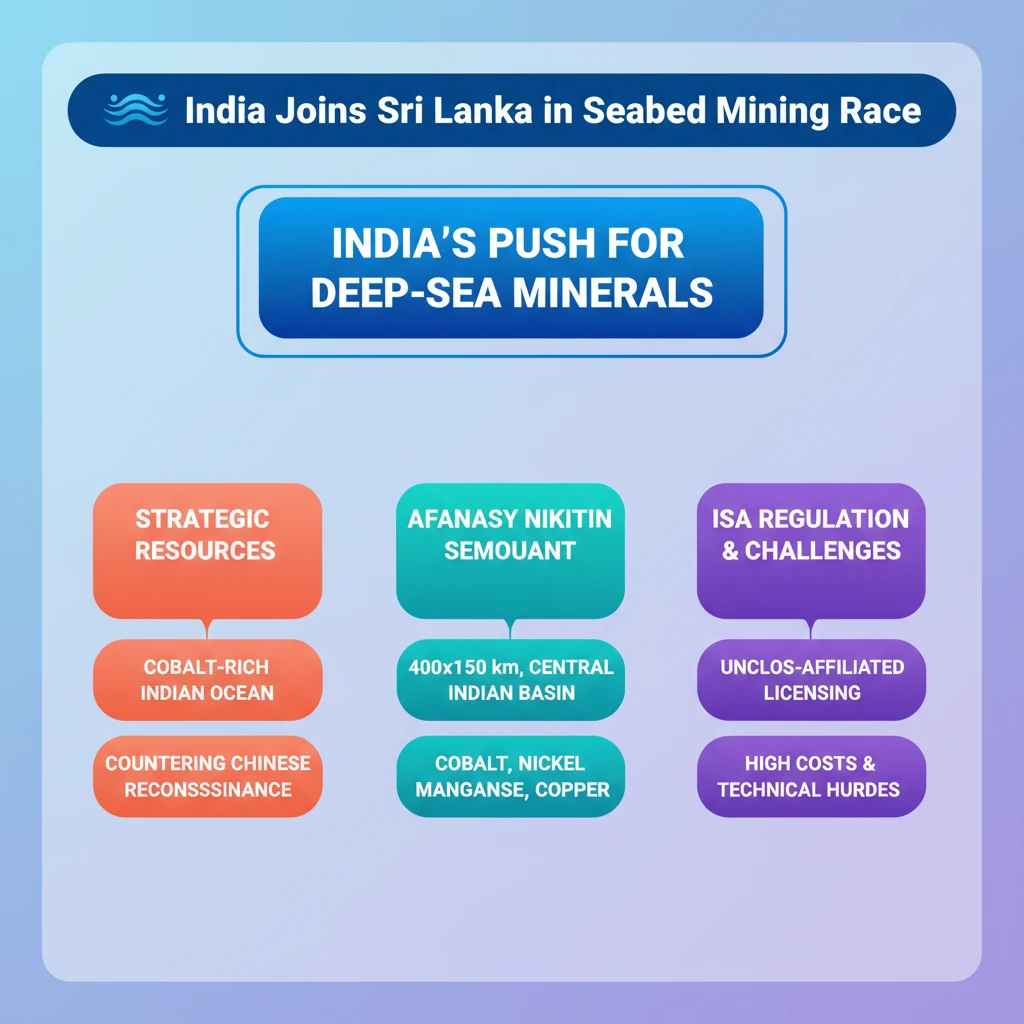
- •India applied to ISA for seabed exploration rights in the Indian Ocean, targeting the cobalt-rich Afanasy Nikitin Seamount (AN Seamount).
- •The move is driven by strategic resource needs and concerns over Chinese reconnaissance in the region.
- •AN Seamount is a 400x150 km feature in the Central Indian Basin, 1500 km from India's coast, rich in cobalt, nickel, manganese, and copper.
- •Exploration requires a license from the International Seabed Authority (ISA), an autonomous body under UNCLOS.
- •Seabed mining in the open ocean (60% of world's seas) is challenging due to high costs and technical complexities.
🧠 Memory Techniques
95% Verified Content
📚 Reference Sources
•United Nations Convention on the Law of the Sea (UNCLOS) official documentation
•International Seabed Authority (ISA) official website
•Ministry of Earth Sciences (MoES) documentation on Deep Ocean Mission