Jhelum Basin of the Kashmir Himalayas - Geography | UPSC Learning
Topics
0 topics • 0 completed
🔍
No topics match your search
Jhelum Basin of the Kashmir Himalayas
Medium⏱️ 8 min read
geography
📖 Introduction
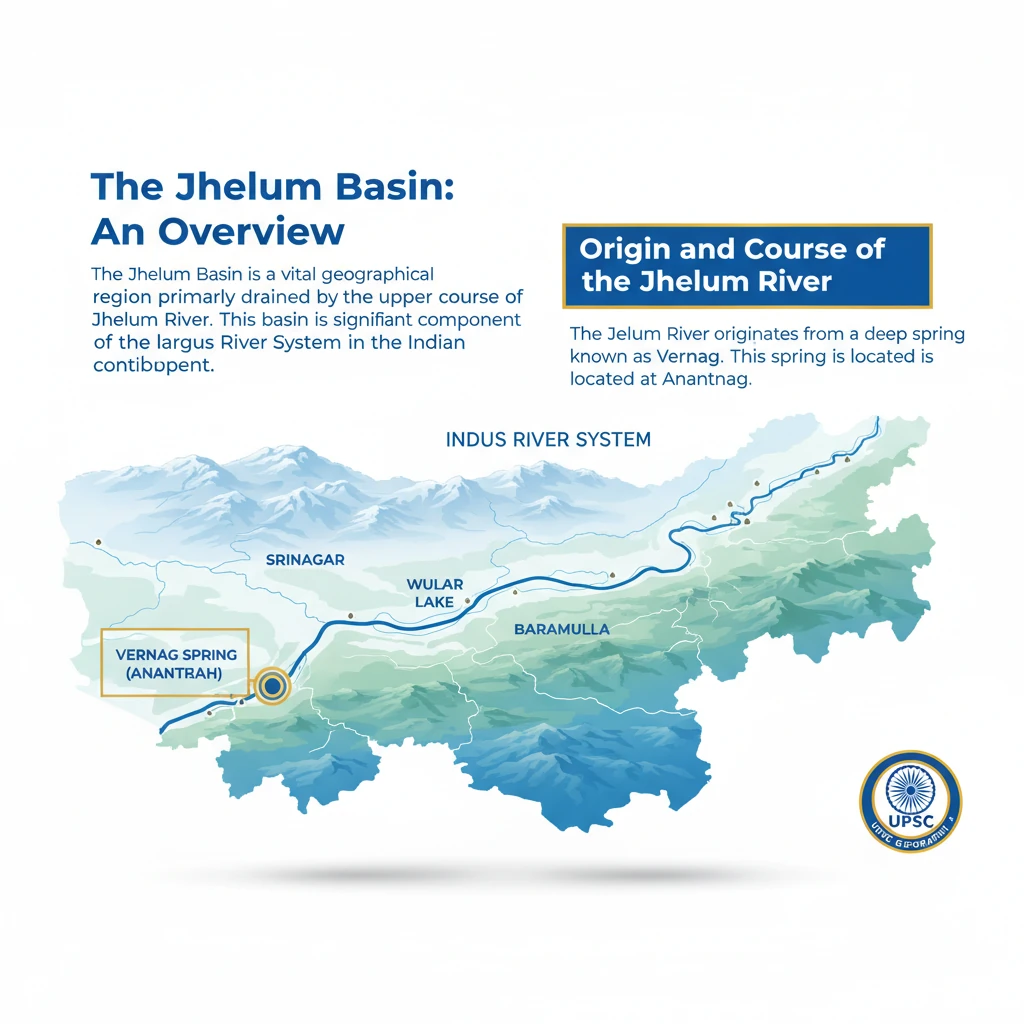
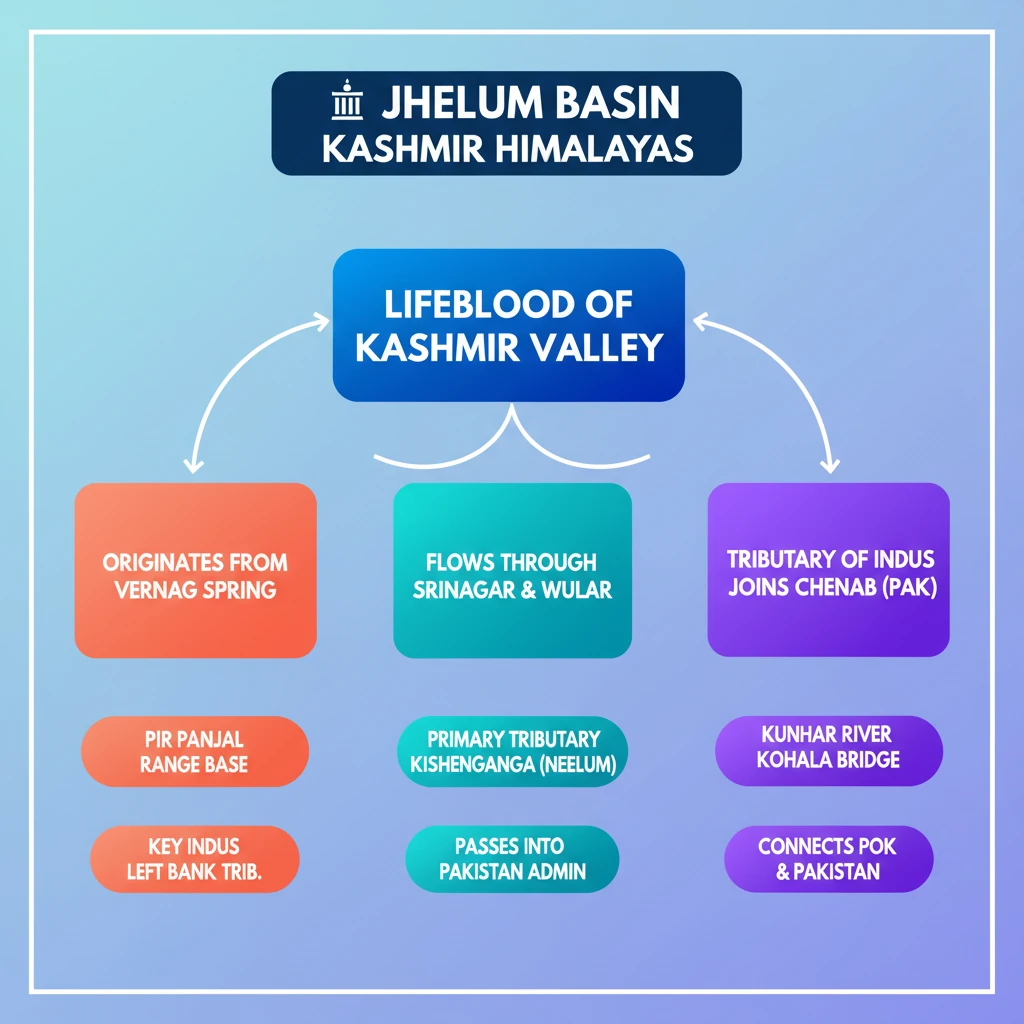
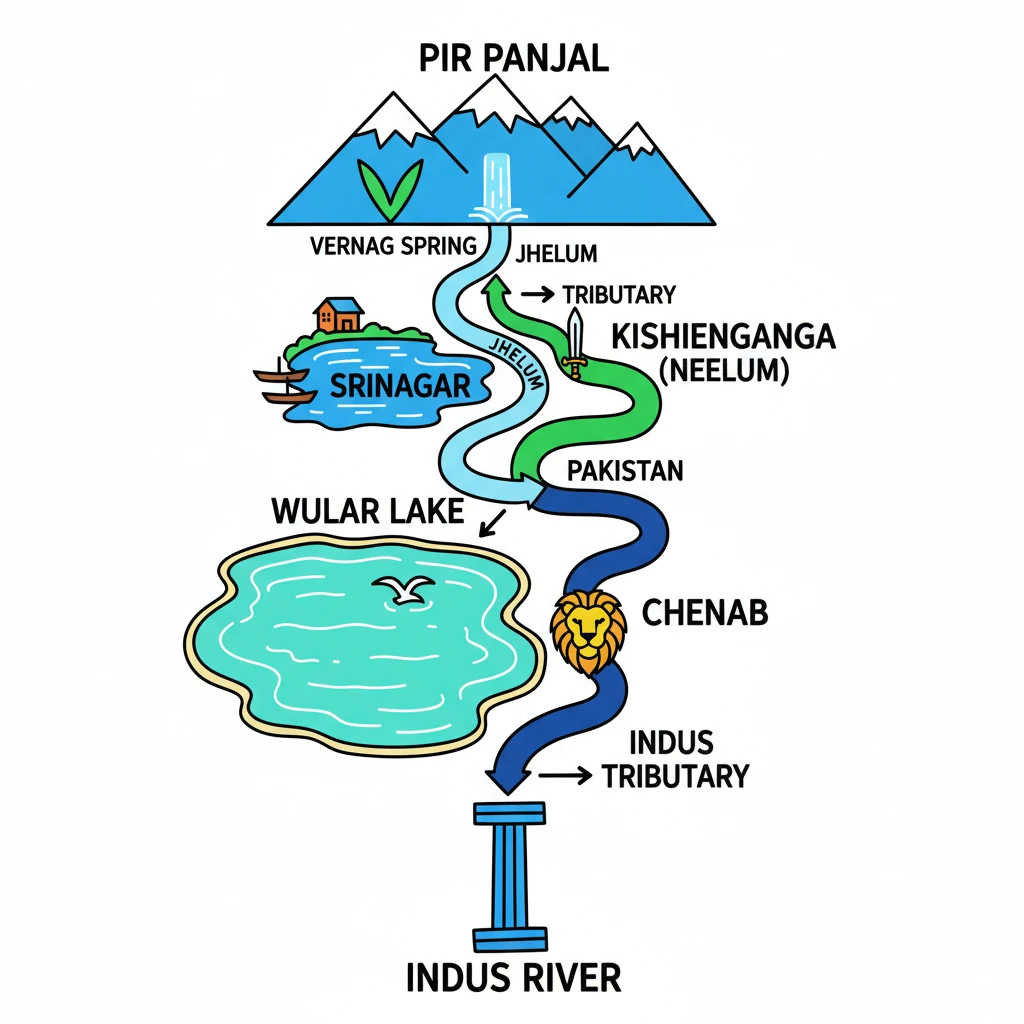
<h4>The Jhelum Basin: An Overview</h4><p>The <strong>Jhelum Basin</strong> is a vital geographical region primarily drained by the upper course of the <strong>Jhelum River</strong>. This basin is a significant component of the larger <strong>Indus River System</strong> in the Indian subcontinent.</p><h4>Origin and Course of the Jhelum River</h4><p>The <strong>Jhelum River</strong> originates from a deep spring known as <strong>Vernag</strong>. This spring is located at <strong>Anantnag</strong>, nestled at the base of the <strong>Pir Panjal range</strong> within the picturesque <strong>Kashmir Valley</strong>.</p><p>After its origin, the river flows through several key locations. It notably passes through the city of <strong>Srinagar</strong> and the vast <strong>Wular Lake</strong>, a prominent freshwater lake in India.</p><div class='info-box'><p><strong>Key Route:</strong> <strong>Vernag</strong> (Origin) ➡️ <strong>Anantnag</strong> ➡️ <strong>Srinagar</strong> ➡️ <strong>Wular Lake</strong> ➡️ Enters <strong>Pakistan</strong>.</p></div><h4>Jhelum's Role in the Indus River System</h4><p>The <strong>Jhelum River</strong> is an important <strong>tributary of the Indus River</strong>. Its waters contribute significantly to the overall volume and flow of the Indus, which is crucial for the regional hydrology.</p><p>The river traverses through <strong>Jammu and Kashmir</strong> in India before crossing into <strong>Pakistan</strong>. In Pakistan, it eventually converges with the <strong>Chenab River</strong>, another major tributary of the Indus.</p><div class='key-point-box'><p>The <strong>Jhelum</strong> is one of the "Western Rivers" allocated to Pakistan under the <strong>Indus Waters Treaty</strong>, though India has certain usage rights on its upper reaches.</p></div><h4>Key Tributaries of the Jhelum River</h4><p>The <strong>Jhelum River</strong> is fed by several tributaries that enhance its flow and extend its basin area. These tributaries are crucial for the ecological and hydrological balance of the region.</p><ul><li>The primary and most significant tributary is the <strong>Kishenganga River</strong>, also known as the <strong>Neelum River</strong>.</li><li>Another notable tributary is the <strong>Kunhar River</strong>. This river holds strategic importance as it connects <strong>Pakistan-occupied Kashmir (PoK)</strong> with mainland <strong>Pakistan</strong>.</li></ul><div class='info-box'><p>The <strong>Kunhar River</strong> facilitates this connection via the <strong>Kohala Bridge</strong>, situated in the <strong>Kandian subzone</strong>, highlighting its role in regional connectivity.</p></div><div class='exam-tip-box'><p>Understanding the origin, course, and tributaries of the <strong>Jhelum River</strong> is crucial for questions related to <strong>Indian Geography</strong>, especially regarding <strong>Himalayan River Systems</strong> and <strong>Jammu & Kashmir</strong>'s physical geography. Pay attention to the specific locations like <strong>Vernag</strong>, <strong>Srinagar</strong>, and <strong>Wular Lake</strong>.</p></div>
💡 Key Takeaways
- •The Jhelum River originates from Vernag spring at the base of Pir Panjal range.
- •It flows through Srinagar and Wular Lake before entering Pakistan.
- •Jhelum is a key tributary of the Indus River, joining the Chenab in Pakistan.
- •Its primary tributary is the Kishenganga (Neelum) River.
- •The Kunhar River connects PoK and Pakistan via Kohala Bridge.
- •Historically known as Vitasta, it was the site of Alexander's Battle of Hydaspes.
- •The basin holds strategic, economic, and environmental significance for India and Pakistan.
🧠 Memory Techniques
95% Verified Content
📚 Reference Sources
•NCERT Geography Textbooks (Class XI, XII)
•Official reports on Indus Waters Treaty
•Ramsar Sites information