UNCCD’s Drought Atlas - Geography | UPSC Learning
Topics
0 topics • 0 completed
🔍
No topics match your search
UNCCD’s Drought Atlas
Medium⏱️ 8 min read
geography
📖 Introduction
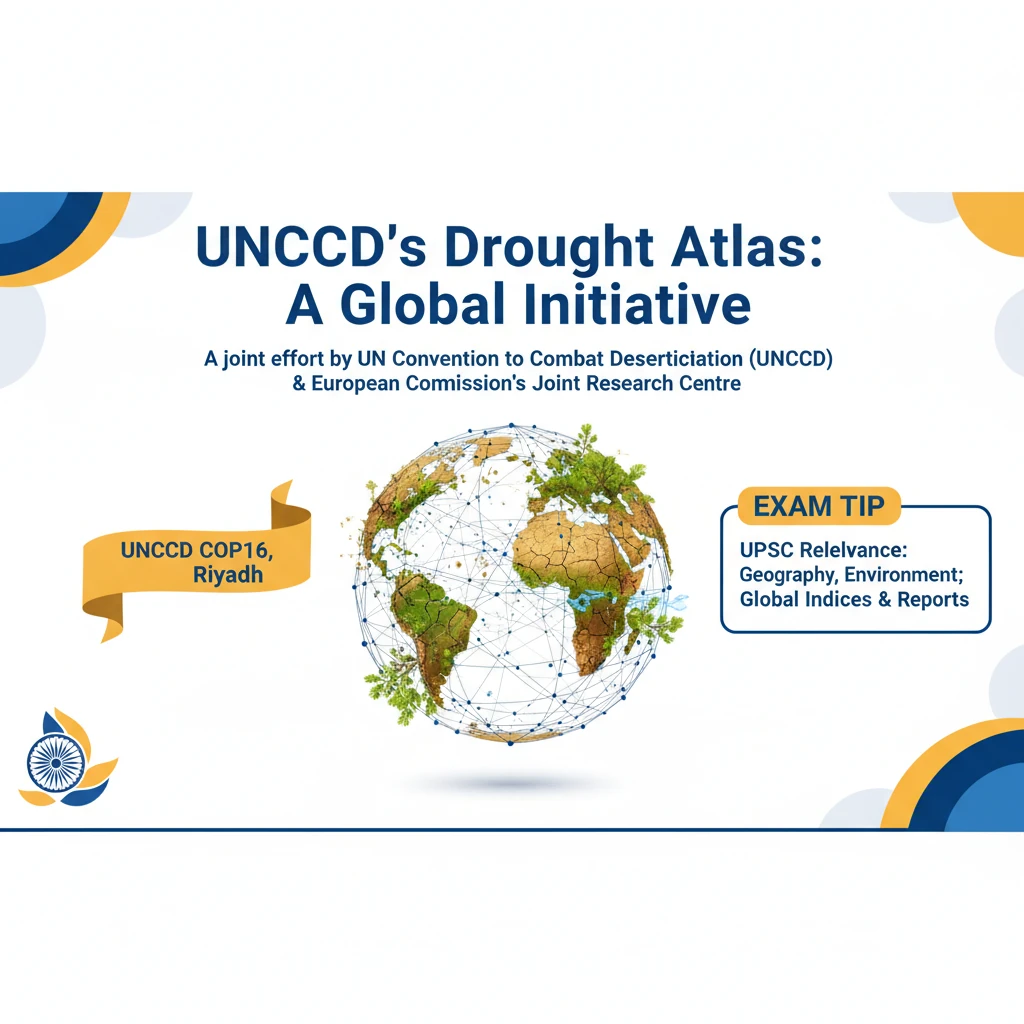
<h4>UNCCD's Drought Atlas: A Global Initiative</h4><p>At the recent <strong>UNCCD COP16</strong> in <strong>Riyadh</strong>, a significant global publication was launched. The <strong>World Drought Atlas</strong>, a joint effort by the <strong>UN Convention to Combat Desertification (UNCCD)</strong> and the <strong>European Commission’s Joint Research Centre</strong>, provides comprehensive insights into drought risks and potential solutions.</p><div class='exam-tip-box'><p><strong>UPSC Relevance:</strong> This topic is crucial for <strong>GS Paper 1 (Geography)</strong>, <strong>GS Paper 3 (Environment & Disaster Management)</strong>. Questions may focus on international conventions, drought management strategies, and climate change impacts.</p></div><h4>Understanding the UN Convention to Combat Desertification (UNCCD)</h4><p>The <strong>UNCCD</strong> was established in <strong>1994</strong> as a pivotal international treaty. It is the <strong>only legally binding international agreement</strong> that integrates environmental and developmental goals with sustainable land management practices.</p><div class='info-box'><p><strong>Key Focus Areas:</strong> The Convention primarily targets <strong>arid, semi-arid, and dry sub-humid regions</strong>, collectively known as <strong>drylands</strong>. These areas are home to some of the world's most vulnerable ecosystems and communities.</p></div><p>With <strong>197 member countries</strong>, the UNCCD fosters global collaboration. Its objectives include improving living conditions in drylands, restoring land and soil productivity, and mitigating the adverse impacts of drought.</p><div class='key-point-box'><p><strong>Interconnected Rio Conventions:</strong> The UNCCD works in synergy with two other critical Rio Conventions to address the intertwined challenges of land, climate, and biodiversity:</p><ul><li><strong>Convention on Biological Diversity (CBD)</strong></li><li><strong>United Nations Framework Convention on Climate Change (UNFCCC)</strong></li></ul></div><h4>Defining Droughts</h4><p><strong>Droughts</strong> are characterized by extended periods of significantly reduced water availability. This reduction leads to imbalances in water supply, quality, and demand, impacting various sectors.</p><p>These periods can vary in duration, from brief spells to several years. Their effects include hindering plant growth and causing a substantial lowering of water tables.</p><div class='info-box'><p><strong>Causes of Droughts:</strong> Droughts originate from a combination of factors:</p><ul><li><strong>Climate Factors:</strong> Primarily low precipitation.</li><li><strong>Human Activities:</strong> Excessive water extraction, unsustainable water usage, and poor land management practices.</li></ul></div><p>While droughts can occur naturally due to weather patterns, <strong>climate change</strong> is increasingly recognized as a factor. It contributes to both the rising frequency and enhanced severity of drought events globally.</p><h4>Drought Scenario in India</h4><p>India faces a significant challenge from droughts, as highlighted by the <strong>Drought Atlas of India (1901–2020)</strong>. This report indicates that approximately <strong>two-thirds of the nation is susceptible to drought conditions</strong>.</p><p>Given India's agrarian economy and large population of <strong>1.4 billion people</strong>, droughts have profound impacts on agricultural productivity and food security.</p><div class='info-box'><p><strong>Historical Impact (1901-2020):</strong></p><ul><li>Around <strong>56% of India’s total area</strong> experienced moderate to exceptional drought conditions.</li><li>This affected an estimated <strong>300 million people</strong> and <strong>150 million cattle</strong>.</li><li>Crop damage during this period led to an approximate economic loss of <strong>USD 4.7 billion</strong>, resulting in a <strong>3.1% reduction in agricultural GDP</strong>.</li></ul></div><h4>Global and National Initiatives to Combat Drought</h4><p>Several initiatives have been launched to address the growing threat of droughts and enhance resilience.</p><div class='key-point-box'><p><strong>Integrated Drought Management Programme (IDMP):</strong> This is a joint initiative by the <strong>Global Water Partnership (GWP)</strong> and the <strong>World Meteorological Organization (WMO)</strong>. It provides policy, technical, and management guidance to governments and stakeholders for effective drought management.</p></div><p>The <strong>UNCCD’s Drought Initiative</strong> specifically focuses on establishing robust drought preparedness systems worldwide. This proactive approach aims to minimize the impacts of future drought events.</p><div class='info-box'><p><strong>World Day to Combat Desertification and Drought (WDCDD):</strong> Celebrated annually on <strong>June 17th</strong>, this day raises global awareness about the urgency of addressing desertification and drought.</p></div><p>The <strong>UNCCD’s Drought Resilience, Adaptation and Management Policy (DRAMP) framework</strong> promotes continuous collaboration between science and policy. It emphasizes understanding drought risks, collecting vital data, and designing equitable solutions to build resilience for economies, societies, and ecosystems.</p>
💡 Key Takeaways
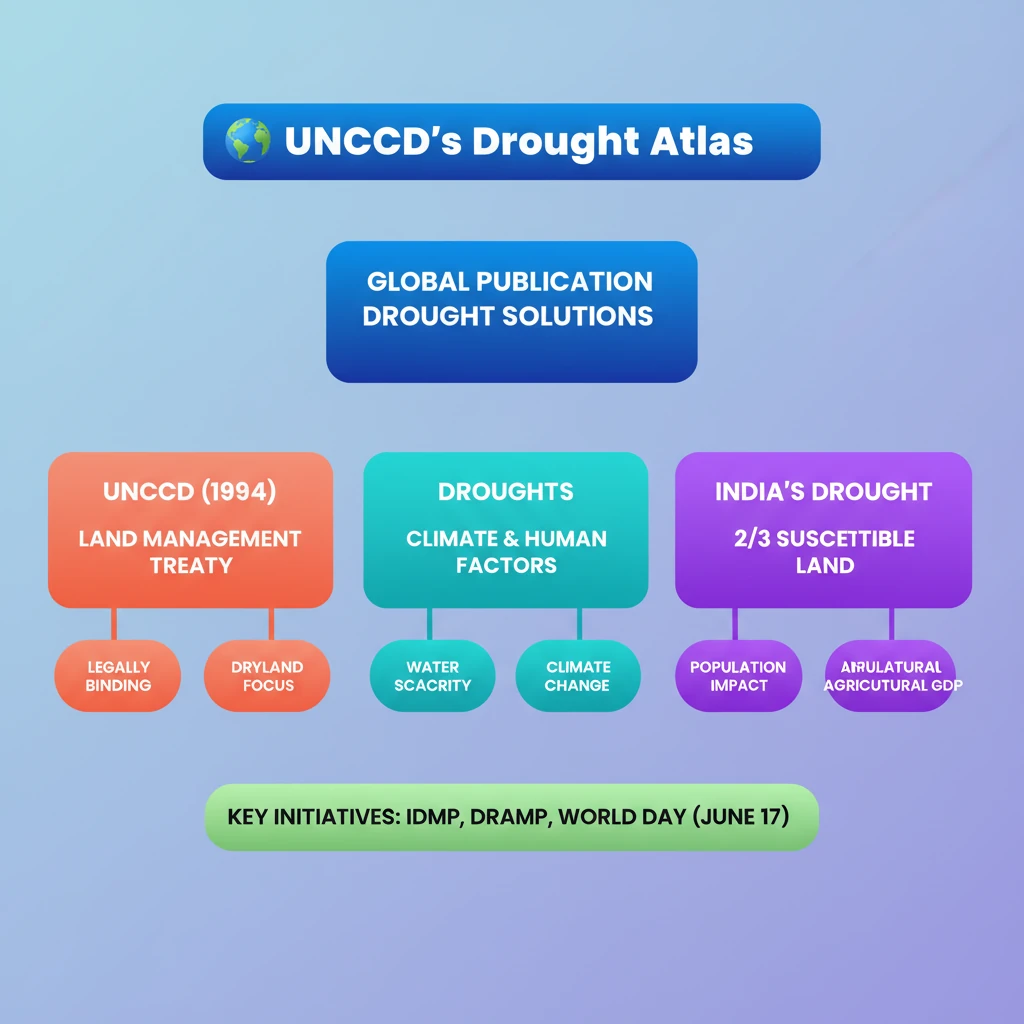
- •The World Drought Atlas, launched at UNCCD COP16, is a global publication on drought risks and solutions.
- •UNCCD (1994) is the only legally binding international treaty focused on sustainable land management in drylands.
- •Droughts are extended periods of water scarcity, caused by climate factors and human activities, intensified by climate change.
- •Two-thirds of India is drought-susceptible, with significant historical impacts on population, cattle, and agricultural GDP.
- •Key initiatives include IDMP, UNCCD's Drought Initiative, World Day to Combat Desertification and Drought (June 17), and the DRAMP framework.
- •UNCCD collaborates with CBD and UNFCCC, highlighting the interconnectedness of land, climate, and biodiversity.
🧠 Memory Techniques
95% Verified Content
📚 Reference Sources
•Official website of the UN Convention to Combat Desertification (UNCCD)
•European Commission’s Joint Research Centre (JRC) publications on drought
•World Meteorological Organization (WMO) resources on drought management