Arctic Sea Ice Impact on Indian Monsoon - Geography | UPSC Learning
Topics
0 topics • 0 completed
🔍
No topics match your search
Arctic Sea Ice Impact on Indian Monsoon
Medium⏱️ 7 min read
geography
📖 Introduction
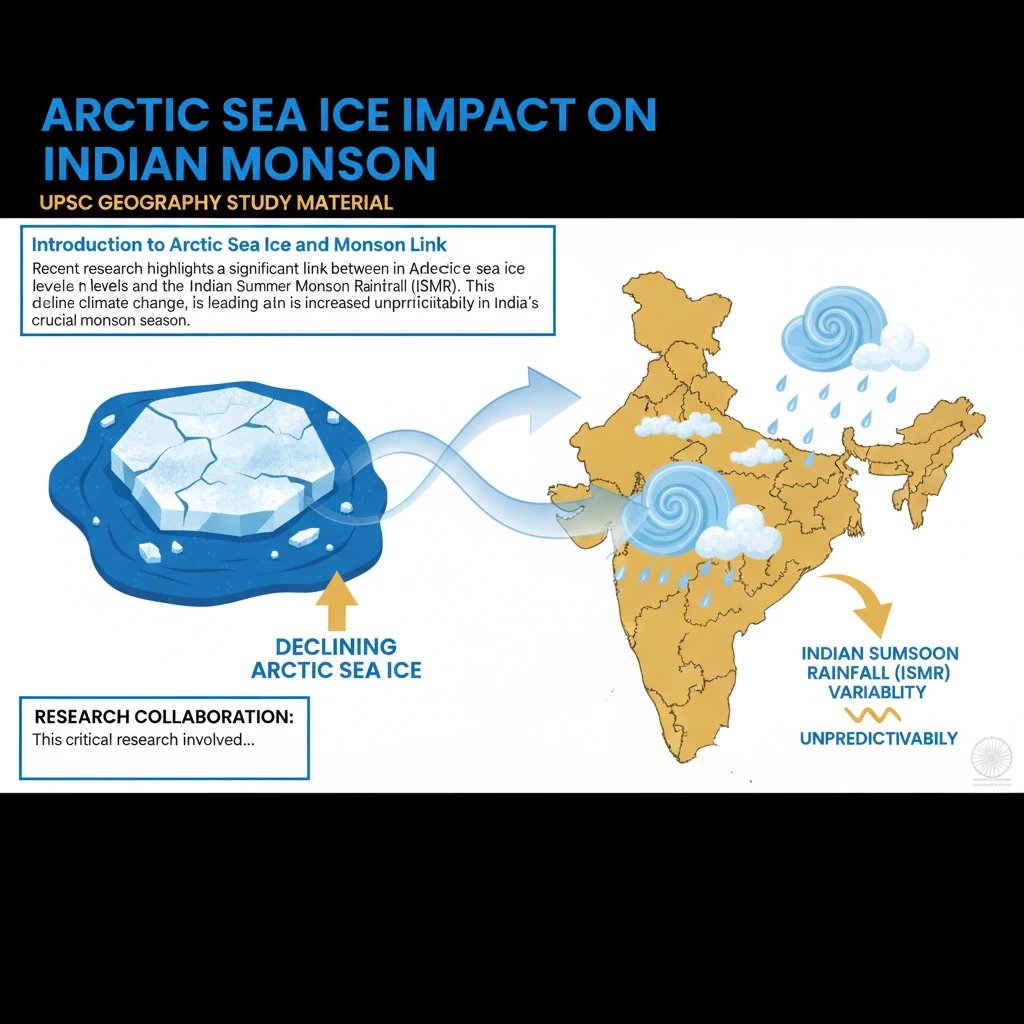
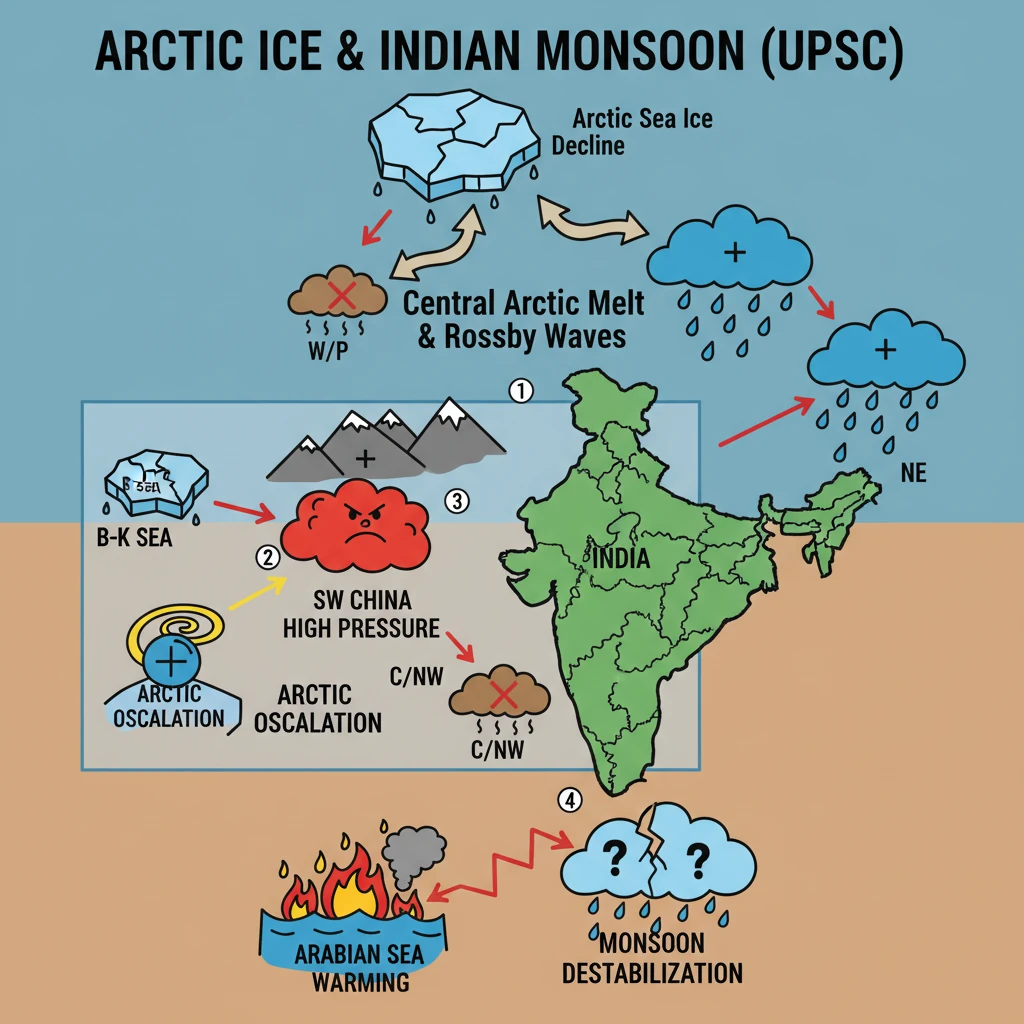
<h4>Introduction to Arctic Sea Ice and Monsoon Link</h4><p>Recent research highlights a significant link between the decline in <strong>Arctic sea ice levels</strong> and the variability of the <strong>Indian Summer Monsoon Rainfall (ISMR)</strong>.</p><p>This decline, primarily driven by <strong>climate change</strong>, is leading to increased unpredictability in India's crucial monsoon season.</p><div class='info-box'><p><strong>Research Collaboration:</strong> This critical research involved scientists from <strong>India’s National Centre for Polar and Ocean Research (NCPOR)</strong>, under the Ministry of Earth Sciences, and <strong>South Korea’s Korea Polar Research Institute</strong>.</p></div><h4>Impact of Central Arctic Sea Ice Decline</h4><p>A decline in <strong>Central Arctic Sea Ice</strong> generally leads to <strong>reduced rainfall</strong> in <strong>western and peninsular India</strong>, but <strong>increased rainfall</strong> in <strong>central and northern India</strong>.</p><div class='key-point-box'><p><strong>Underlying Mechanism:</strong> The reduced ice cover facilitates greater <strong>heat transfer</strong> from the ocean to the atmosphere. This intensification strengthens <strong>Rossby waves</strong>, which are large-scale atmospheric waves influencing global weather patterns.</p></div><p>These strengthened <strong>Rossby waves</strong> contribute to a high-pressure zone over <strong>northwest India</strong> and a low-pressure zone over the <strong>Mediterranean</strong>.</p><p>This atmospheric configuration shifts the <strong>subtropical easterly jet</strong> northward, which can result in more rain over <strong>western and peninsular India</strong> under specific conditions.</p><h4>Influence of Low Sea Ice in Barents-Kara Sea Region</h4><p>Low sea ice levels in the <strong>Barents-Kara Sea region</strong> also significantly affect monsoon patterns.</p><p>This condition results in higher atmospheric pressure over <strong>southwest China</strong> and contributes to a positive phase of the <strong>Arctic Oscillation</strong>, impacting global weather.</p><div class='info-box'><p><strong>Arctic Oscillation (AO):</strong> A climate pattern characterized by opposing atmospheric pressure anomalies in the Arctic and mid-latitudes, influencing Northern Hemisphere weather.</p></div><p>The heat released from the ice-free <strong>Barents-Kara Sea</strong> creates calm, clear atmospheric conditions over <strong>northwest Europe</strong>.</p><p>This disruption in turn affects the upper atmospheric conditions in <strong>subtropical Asia and India</strong>.</p><p>The outcome is typically <strong>high rainfall</strong> over <strong>northeastern India</strong>, while <strong>central and northwest regions</strong> experience <strong>less rain</strong>.</p><h4>Climate Change's Exacerbating Role</h4><p>The overall impact is further complicated by <strong>climate change</strong>, which leads to a warming <strong>Arabian Sea</strong>.</p><p>Increased moisture from surrounding water bodies, combined with these factors, further destabilizes weather patterns.</p><p>This exacerbates the <strong>variability and unpredictability</strong> of the <strong>Indian monsoon rainfall</strong>.</p><div class='exam-tip-box'><p>Understanding the intricate links between <strong>Arctic climate change</strong> and the <strong>Indian monsoon</strong> is crucial for <strong>UPSC Mains GS Paper 1 (Geography)</strong> and <strong>GS Paper 3 (Environment)</strong>. Focus on mechanisms and regional impacts.</p></div>
💡 Key Takeaways
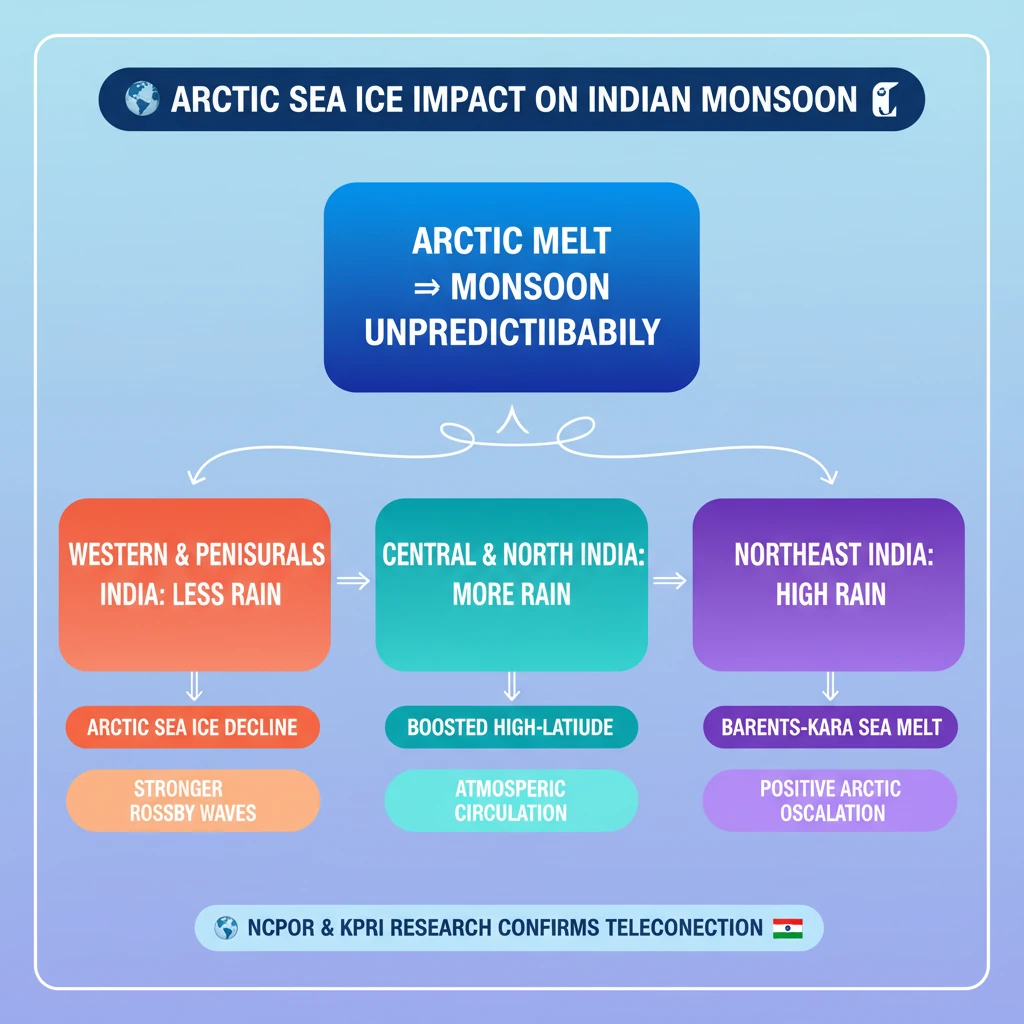
- •Arctic sea ice decline increases Indian Monsoon variability and unpredictability.
- •Central Arctic melt affects western/peninsular (reduced rain) and central/northern India (increased rain) via strengthened Rossby waves.
- •Barents-Kara Sea melt leads to high pressure over SW China and a positive Arctic Oscillation, impacting NE India (high rain) and central/NW India (less rain).
- •Climate change, including a warming Arabian Sea, further exacerbates monsoon destabilization.
- •Research by India's NCPOR and South Korea's KPRI confirms this critical Arctic-monsoon teleconnection.
🧠 Memory Techniques
90% Verified Content