Arctic Ocean: Geography, Resources, and Climate Change Impacts - Geography | UPSC Learning
Topics
0 topics • 0 completed
🔍
No topics match your search
Arctic Ocean: Geography, Resources, and Climate Change Impacts
Medium⏱️ 8 min read
geography
📖 Introduction
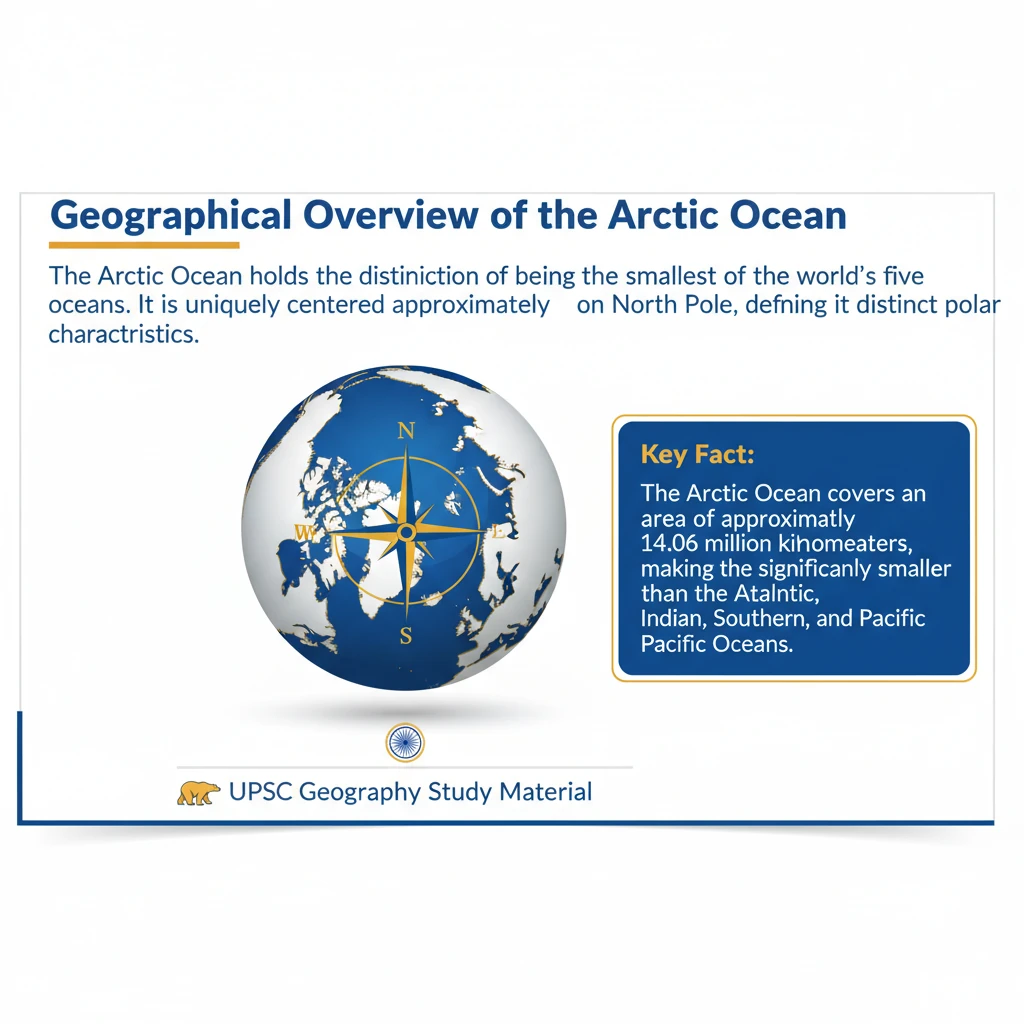
<h4>Geographical Overview of the Arctic Ocean</h4><p>The <strong>Arctic Ocean</strong> holds the distinction of being the <strong>smallest</strong> of the world’s five oceans. It is uniquely centered approximately on the <strong>North Pole</strong>, defining its distinct polar characteristics.</p><div class='info-box'><p><strong>Key Fact:</strong> The Arctic Ocean covers an area of approximately 14.06 million square kilometers, making it significantly smaller than the Atlantic, Indian, Southern, and Pacific Oceans.</p></div><h4>Bordering Countries and Key Seas</h4><p>The Arctic Ocean is encircled by several nations, giving it immense geopolitical significance. These countries have direct access and interests in the region.</p><ul><li><strong>Canada</strong></li><li><strong>Greenland</strong> (a constituent country of Denmark)</li><li><strong>Iceland</strong></li><li><strong>Norway</strong></li><li><strong>Sweden</strong></li><li><strong>Finland</strong></li><li><strong>Russia</strong></li><li><strong>United States</strong> (via Alaska)</li></ul><p>Within its expanse, the Arctic Ocean encompasses several important marginal seas, each with unique characteristics and strategic value.</p><ul><li><strong>Barents Sea</strong></li><li><strong>Kara Sea</strong></li><li><strong>Laptev Sea</strong></li><li><strong>East Siberian Sea</strong></li><li><strong>Beaufort Sea</strong></li></ul><h4>Ice Coverage and Environmental Dynamics</h4><p>Historically, the Arctic Ocean has been predominantly covered by a thick layer of <strong>sea ice</strong>. This ice cover exhibits distinct patterns of <strong>seasonal melting and freezing</strong>, influencing regional climate and ecosystems.</p><div class='key-point-box'><p><strong>Critical Environmental Change:</strong> The Arctic is experiencing <strong>rapid warming</strong>, leading to a significant diminution of its permanent <strong>ice cover</strong>. This phenomenon is a direct consequence of global <strong>climate change</strong>.</p></div><h4>Emerging Shipping Routes and Economic Opportunities</h4><p>The shrinking ice cover has profound implications, particularly for global trade and navigation. It is opening up previously inaccessible maritime pathways.</p><ul><li>One prominent example is the <strong>Northern Sea Route (NSR)</strong>, which offers a shorter shipping passage between Europe and Asia compared to traditional routes via the Suez Canal.</li></ul><p>This development has sparked increased interest in the Arctic for its vast, untapped natural resources.</p><h4>Strategic Resources of the Arctic</h4><p>The Arctic region is believed to hold substantial reserves of critical energy resources, making it a focal point for future resource exploration.</p><div class='info-box'><p><strong>Resource Estimates:</strong> The Arctic is estimated to contain approximately <strong>13% of the world’s undiscovered oil</strong> and <strong>30% of its natural gas reserves</strong>. These figures highlight the region's immense economic potential.</p></div><div class='exam-tip-box'><p>For <strong>UPSC Mains (GS-I Geography & GS-III Environment)</strong>, understanding the physical geography, geopolitical significance, and environmental vulnerabilities of the Arctic Ocean is crucial. Focus on the impact of <strong>climate change</strong> and the implications of new <strong>shipping routes</strong> and <strong>resource exploitation</strong>.</p></div>
💡 Key Takeaways
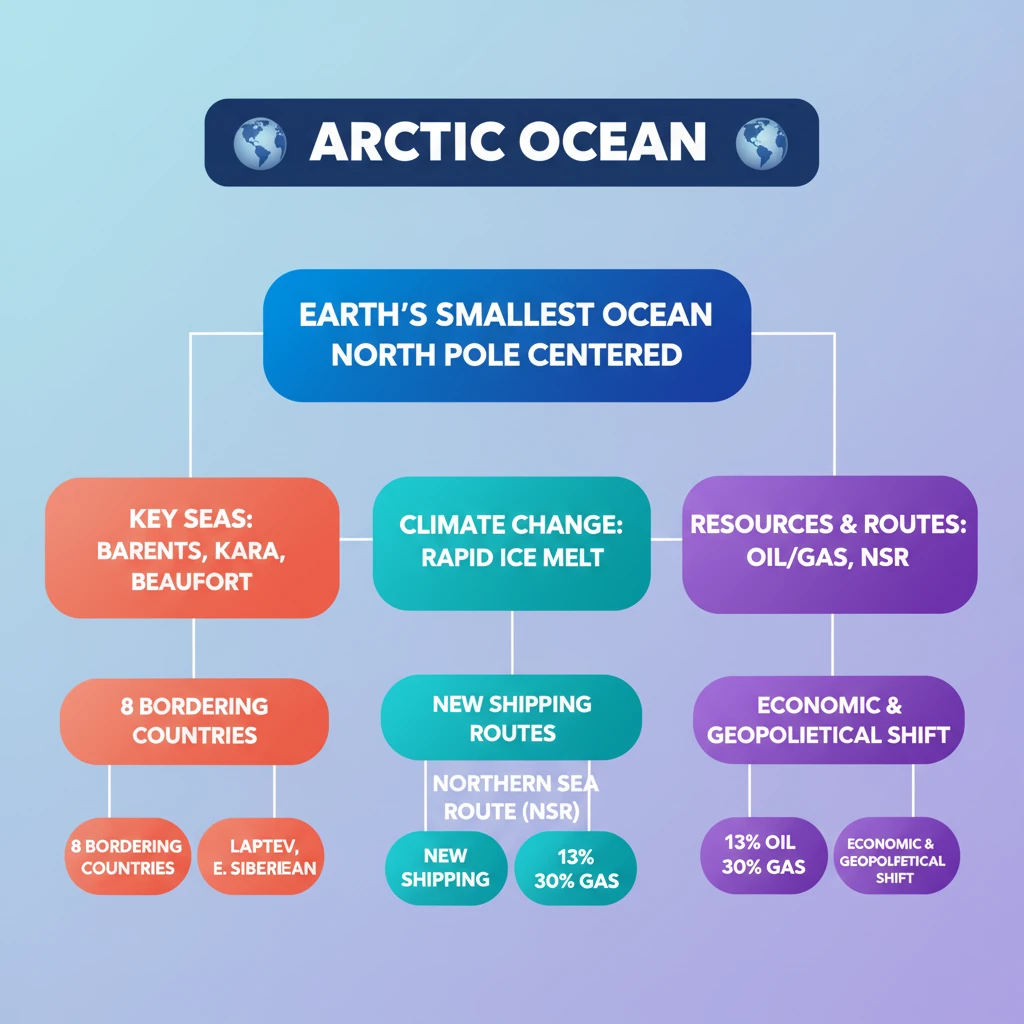
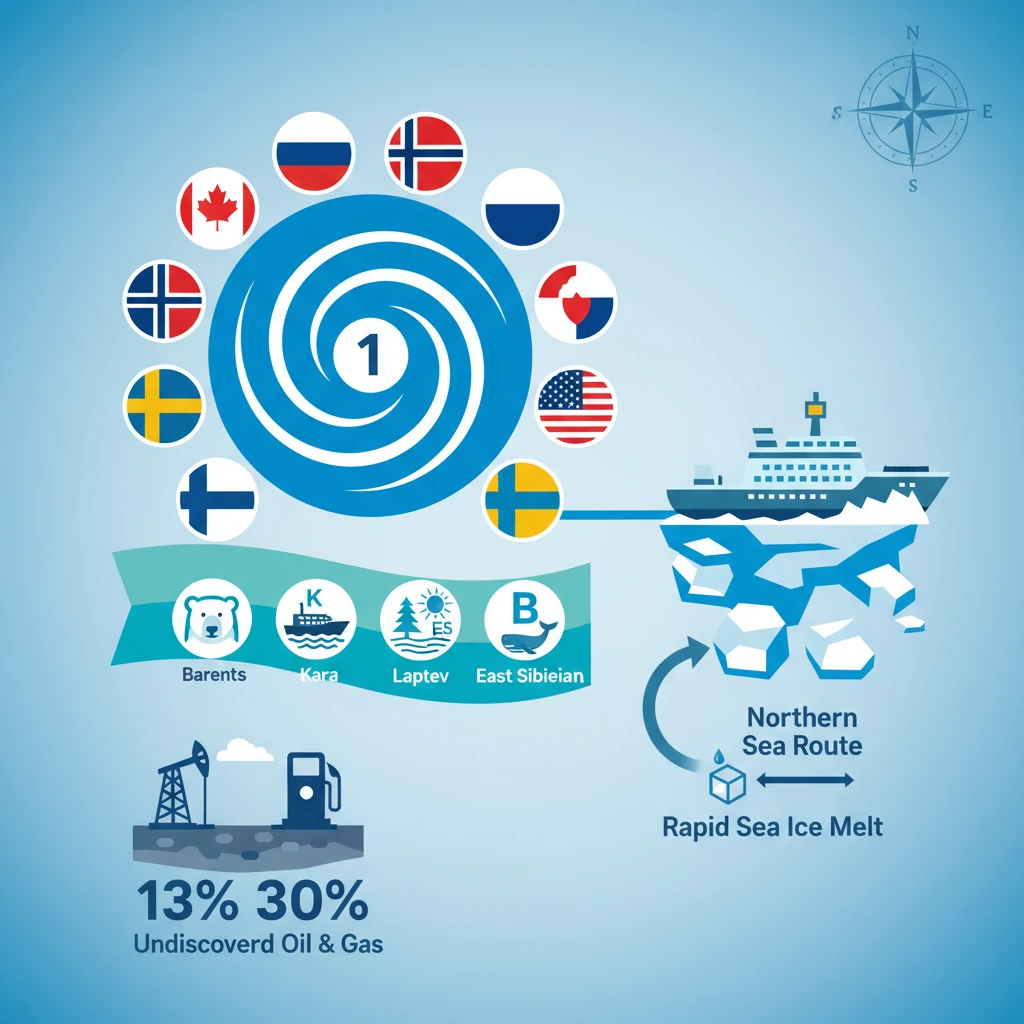
- •The Arctic Ocean is the smallest ocean, centered on the North Pole, bordered by 8 countries.
- •Key seas include Barents, Kara, Laptev, East Siberian, and Beaufort Seas.
- •Rapid climate change is causing significant sea ice melt, opening new shipping routes like the Northern Sea Route.
- •The region holds an estimated 13% of undiscovered oil and 30% of natural gas reserves.
- •Its transformation creates both economic opportunities (shipping, resources) and environmental/geopolitical challenges.
🧠 Memory Techniques
98% Verified Content
📚 Reference Sources
•National Geographic (for geographical facts)
•U.S. Geological Survey (for resource estimates)
•Arctic Council (for governance and environmental aspects)