Magnetic Fossils in Bay of Bengal - Geography | UPSC Learning
Topics
0 topics • 0 completed
🔍
No topics match your search
Magnetic Fossils in Bay of Bengal
Medium⏱️ 8 min read
geography
📖 Introduction
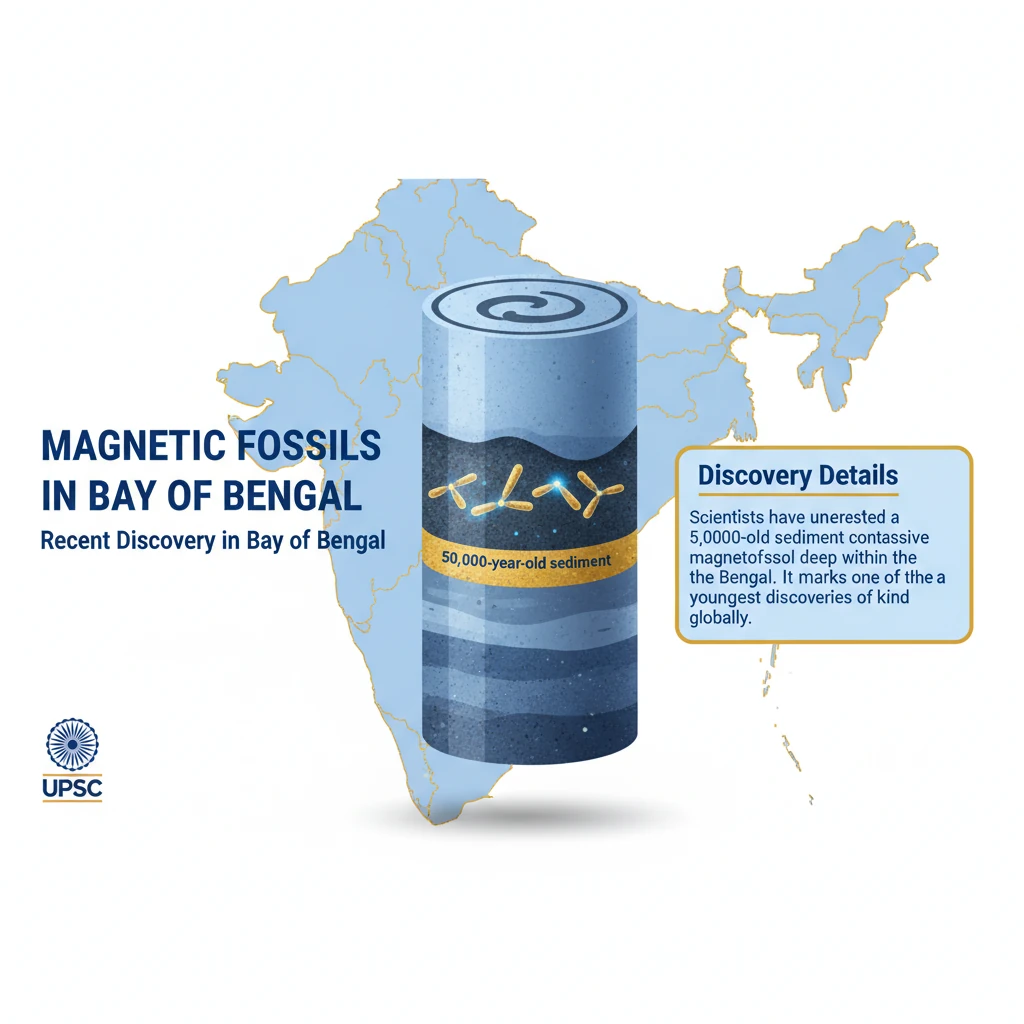
<h4>Recent Discovery in Bay of Bengal</h4><p>Scientists have recently unearthed a significant geological find: a <strong>50,000-year-old sediment</strong> containing a massive <strong>magnetofossil</strong>. This discovery was made deep within the <strong>Bay of Bengal</strong>.</p><p>It marks one of the <strong>youngest discoveries</strong> of its kind globally, providing new insights into the formation of these unique geological structures.</p><div class='info-box'><p><strong>Discovery Details:</strong></p><ul><li><strong>Age:</strong> Approximately <strong>50,000 years old</strong></li><li><strong>Type:</strong> Massive <strong>magnetofossil</strong> within sediment</li><li><strong>Location:</strong> Deep in the <strong>Bay of Bengal</strong> (specifically, southwestern Bay of Bengal)</li><li><strong>Significance:</strong> One of the <strong>youngest discoveries</strong> of giant magnetofossils</li></ul></div><h4>Scientific Investigation</h4><p>The research was conducted by scientists at <strong>CSIR-National Institute of Oceanography</strong>. They employed advanced analytical techniques to study the sediment sample.</p><p>Their methodology involved detailed <strong>magnetic analyses</strong> and high-resolution <strong>electron microscopy</strong> to characterize the magnetofossil.</p><h4>Understanding Magnetofossil Origin</h4><p>Historically, most giant magnetofossils have been found in sediments from two specific geological time periods known for significant global warming events.</p><div class='info-box'><p><strong>Previous Major Discovery Periods:</strong></p><ul><li><strong>Paleocene-Eocene Thermal Maximum:</strong> Approximately <strong>56 million years ago</strong></li><li><strong>Middle Eocene Climatic Optimum:</strong> About <strong>40 million years ago</strong></li></ul></div><p>These periods were characterized by a notable <strong>rise in global temperature</strong>, leading to the assumption that magnetofossils formed exclusively during times of <strong>extreme warming</strong>.</p><h4>Challenging Previous Assumptions</h4><p>The recent discovery of giant magnetofossils from the <strong>Bay of Bengal</strong> has been dated to the <strong>late Quaternary period</strong>, approximately <strong>50,000 years ago</strong>.</p><p>This makes them the <strong>youngest giant magnetofossils discovered to date</strong>. Crucially, this finding directly challenges the long-held assumption that these fossils form <em>only</em> during periods of extreme global warming.</p><div class='key-point-box'><p>The discovery from the <strong>Bay of Bengal</strong> suggests that the formation of giant magnetofossils might occur under a wider range of climatic conditions than previously understood, not solely during periods of <strong>extreme warming</strong>.</p></div><div class='exam-tip-box'><p>For UPSC, understand the <strong>scientific method</strong> used (magnetic analyses, electron microscopy) and the <strong>implications</strong> of the discovery (challenging existing theories on climate and fossil formation). Connect it to <strong>paleoclimate studies</strong> and <strong>geological time scales</strong>.</p></div>
💡 Key Takeaways
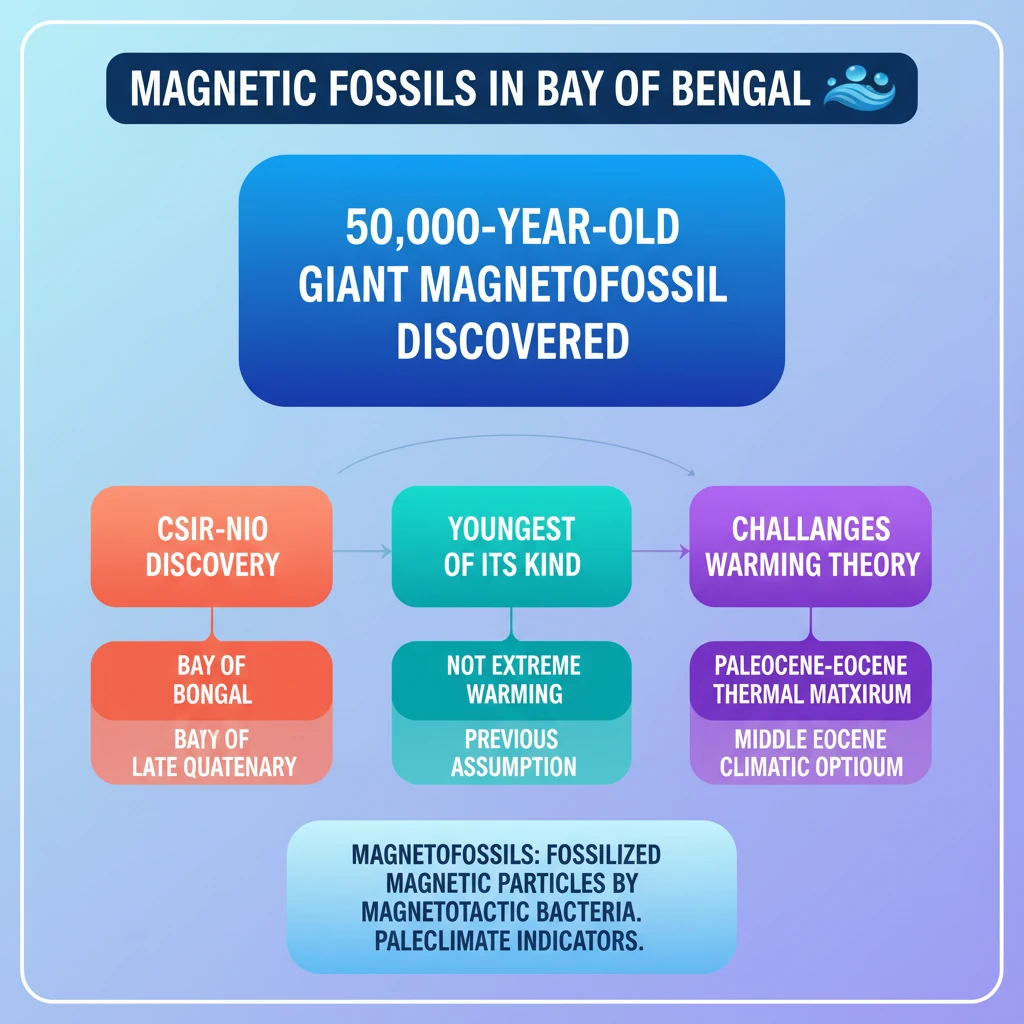
- •A 50,000-year-old massive magnetofossil was discovered in the Bay of Bengal.
- •This discovery, made by CSIR-National Institute of Oceanography, is one of the youngest of its kind.
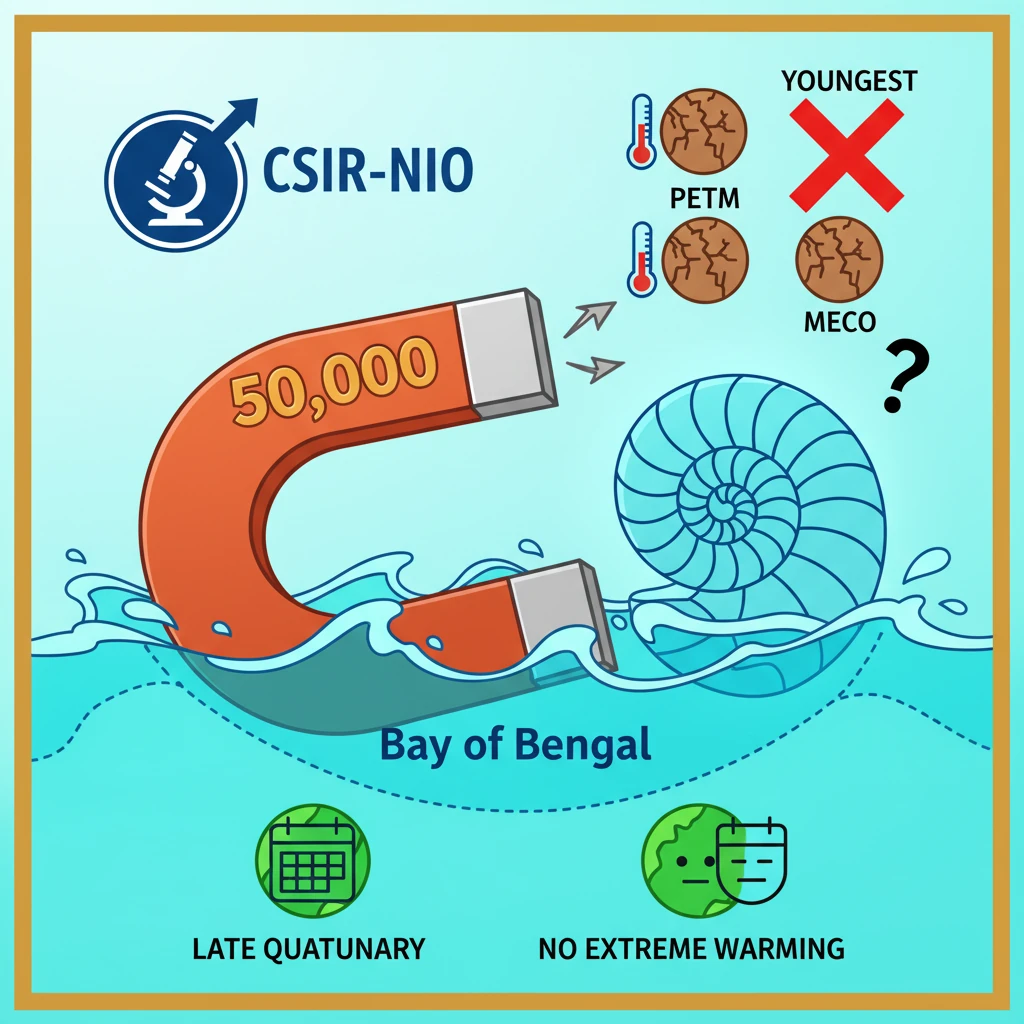
- •It challenges the previous assumption that giant magnetofossils form only during periods of extreme global warming (e.g., Paleocene-Eocene Thermal Maximum, Middle Eocene Climatic Optimum).
- •The Bay of Bengal magnetofossil dates to the late Quaternary period, which was not an extreme warming event.
- •Magnetofossils are fossilized magnetic particles produced by magnetotactic bacteria, serving as valuable paleomagnetic and paleoclimate indicators.
🧠 Memory Techniques
95% Verified Content
📚 Reference Sources
•CSIR-National Institute of Oceanography (implied primary research source)