World’s Deepest Blue Hole - Geography | UPSC Learning
Topics
0 topics • 0 completed
🔍
No topics match your search
World’s Deepest Blue Hole
Medium⏱️ 8 min read
geography
📖 Introduction
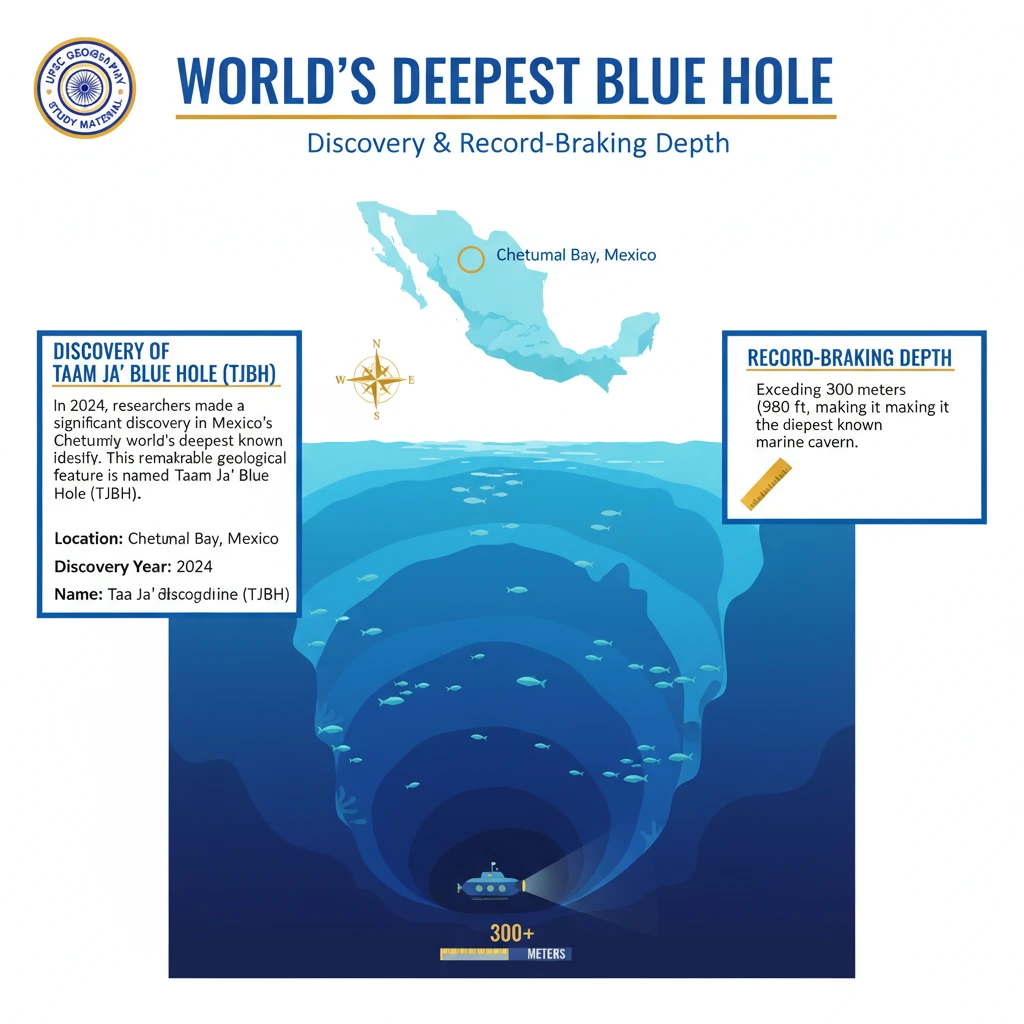
<h4>Discovery of the World's Deepest Blue Hole</h4><p>In <strong>2024</strong>, researchers made a significant discovery in <strong>Mexico's Chetumal Bay</strong>, identifying the world's deepest known blue hole. This remarkable geological feature is named <strong>Taam Ja’ Blue Hole (TJBH)</strong>.</p><div class='info-box'><p><strong>Location:</strong> Chetumal Bay, Mexico</p><p><strong>Discovery Year:</strong> 2024</p><p><strong>Name:</strong> Taam Ja’ Blue Hole (TJBH)</p></div><h4>Record-Breaking Depth and Mesopelagic Zone</h4><p>Initially, <strong>TJBH</strong> was thought to be the second deepest blue hole. However, recent and more precise measurements have revealed its true extent, confirming its status as the deepest.</p><p>The new measurements indicate that <strong>TJBH</strong> exceeds <strong>420 meters below sea level (mbsl)</strong>. This depth surpasses all previously known blue holes globally.</p><div class='key-point-box'><p>The depth of <strong>TJBH</strong> reaches into the <strong>mesopelagic zone</strong>, also known as the "twilight zone." In this zone, sunlight is significantly reduced, yet it supports a high concentration of unique marine life.</p></div><p>This makes <strong>TJBH</strong> considerably deeper than other prominent blue holes such as the <strong>Sansha Yongle Blue Hole</strong> in the <strong>South China Sea</strong> (301 mbsl) and the <strong>Dean’s Blue Hole</strong> in the <strong>Bahamas</strong> (202 mbsl).</p><h4>Ecological Significance: Biological Hotspots</h4><p>Blue holes are recognized as crucial <strong>biological hotspots</strong>. They host an incredibly diverse array of marine life, thriving in their unique environments.</p><ul><li><strong>Corals</strong></li><li><strong>Sponges</strong></li><li><strong>Molluscs</strong></li><li><strong>Sea turtles</strong></li><li><strong>Sharks</strong></li></ul><div class='key-point-box'><p>These diverse ecosystems make blue holes vital areas for <strong>marine biodiversity</strong> and scientific study, offering insights into adaptation in extreme conditions.</p></div><h4>Challenges in Exploration</h4><p>Despite their ecological importance, the exploration of blue holes remains significantly limited. This is primarily due to challenging access conditions.</p><p>Most blue holes feature relatively <strong>small openings</strong> that are located several hundred feet underwater. This structural characteristic makes them largely inaccessible for conventional automated submersibles.</p><div class='exam-tip-box'><p>Understanding the challenges of exploration can be relevant for questions on <strong>oceanography</strong> and <strong>technological limitations</strong> in deep-sea research. It highlights the vast unknown within our oceans.</p></div><h4>Blue Holes vs. Deep Trenches: A Comparison</h4><p>It is important to distinguish blue holes from deep oceanic trenches, as they differ fundamentally in their formation, location, and characteristics.</p><table class="info-table"><tr><th>Feature</th><th>Blue Holes</th><th>Deep Trenches</th></tr><tr><td><strong>Formation</strong></td><td><strong>Cave collapse</strong></td><td><strong>Subduction of tectonic plates</strong></td></tr><tr><td><strong>Location</strong></td><td><strong>Continental shelves</strong>, reefs, etc.</td><td><strong>Convergent plate boundaries</strong></td></tr><tr><td><strong>Depth</strong></td><td>Variable, from shallow to very deep (e.g., <strong>TJBH</strong> >420 mbsl)</td><td>Deepest parts of the ocean (e.g., <strong>Mariana Trench</strong> ≈ 36,000 ft / 11,000 m)</td></tr></table>
💡 Key Takeaways
- •Taam Ja’ Blue Hole (TJBH) in Mexico is the world's deepest known blue hole, exceeding 420 mbsl.
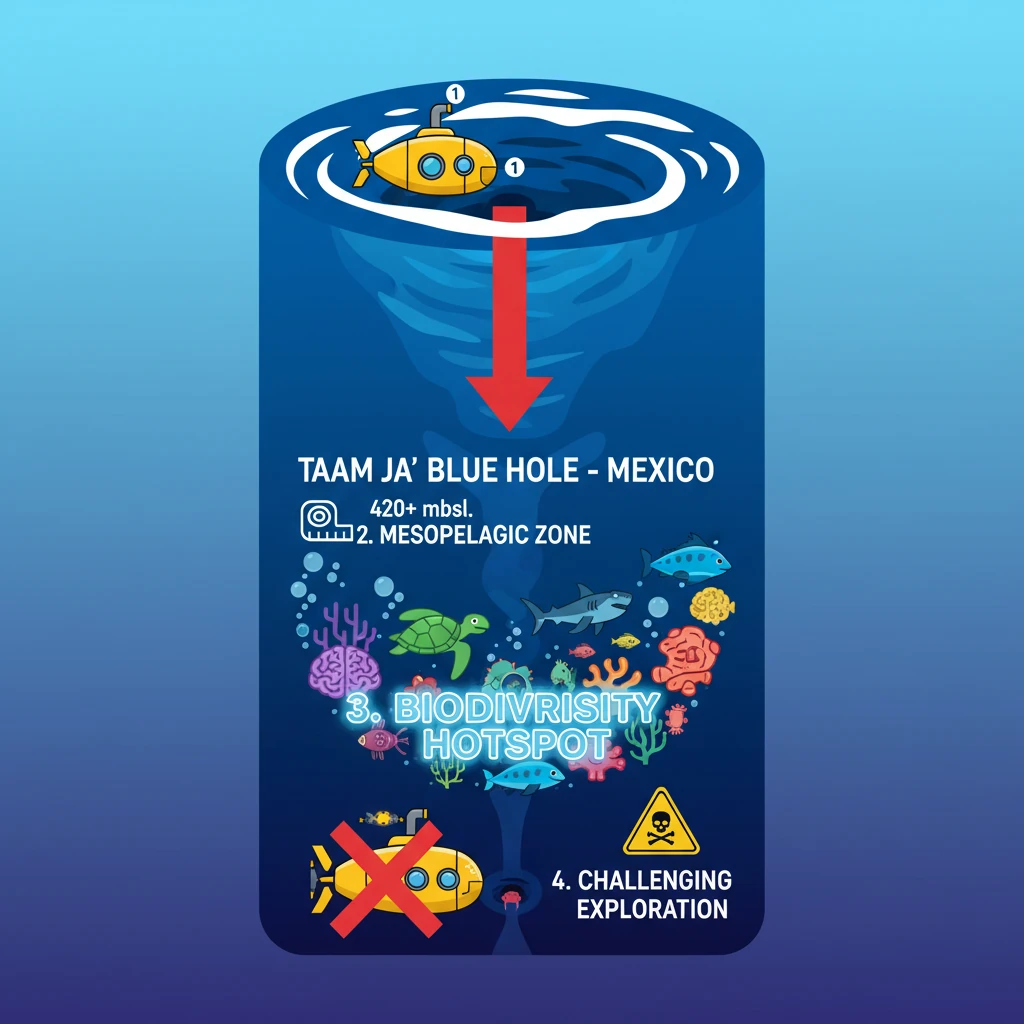
- •TJBH's depth reaches the mesopelagic zone, a unique environment for marine life.
- •Blue holes are vital biological hotspots, hosting diverse species like corals, sharks, and sea turtles.
- •Exploration of blue holes is challenging due to small, deep openings inaccessible to many submersibles.
- •Blue holes form from cave collapse in carbonate rock, fundamentally differing from deep ocean trenches formed by tectonic subduction.
🧠 Memory Techniques
95% Verified Content