What is El Nino-Southern Oscillation? - Geography | UPSC Learning
Topics
0 topics • 0 completed
🔍
No topics match your search
What is El Nino-Southern Oscillation?
Medium⏱️ 8 min read
geography
📖 Introduction
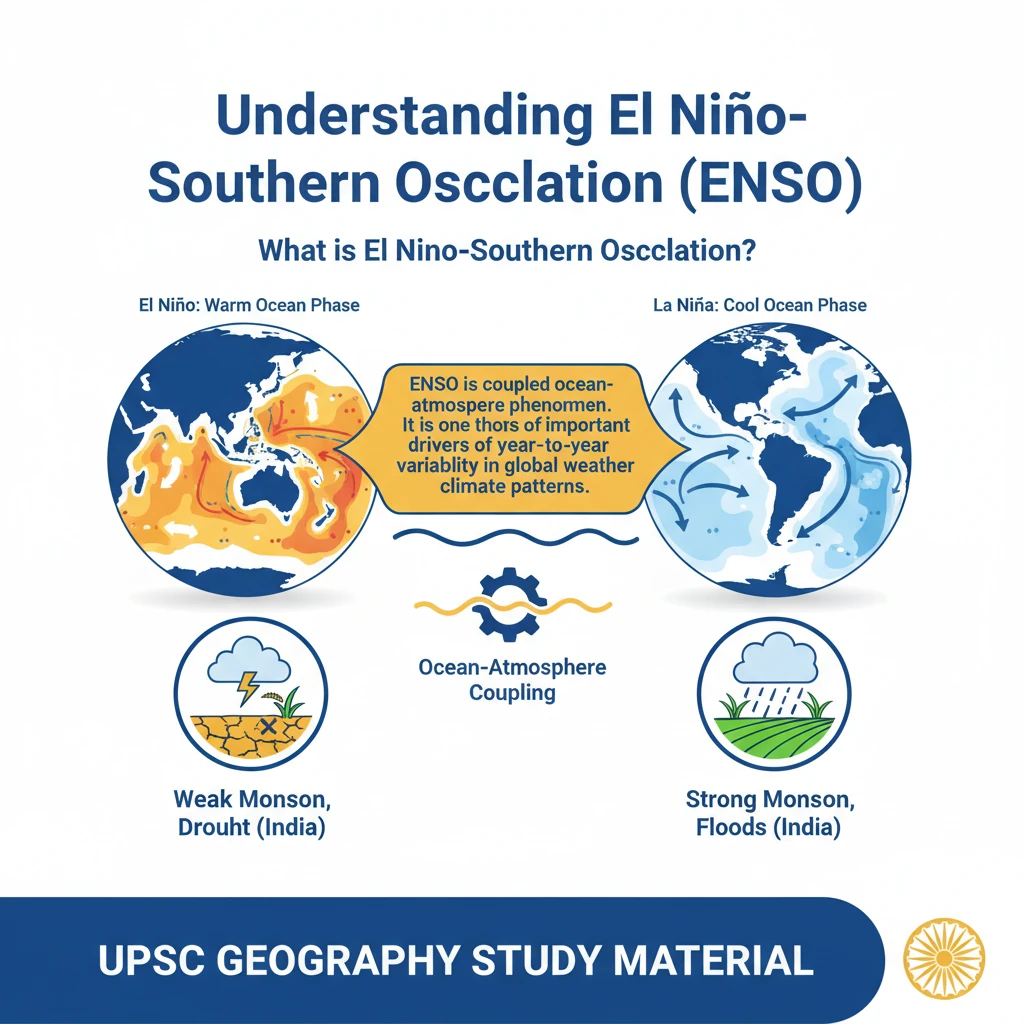
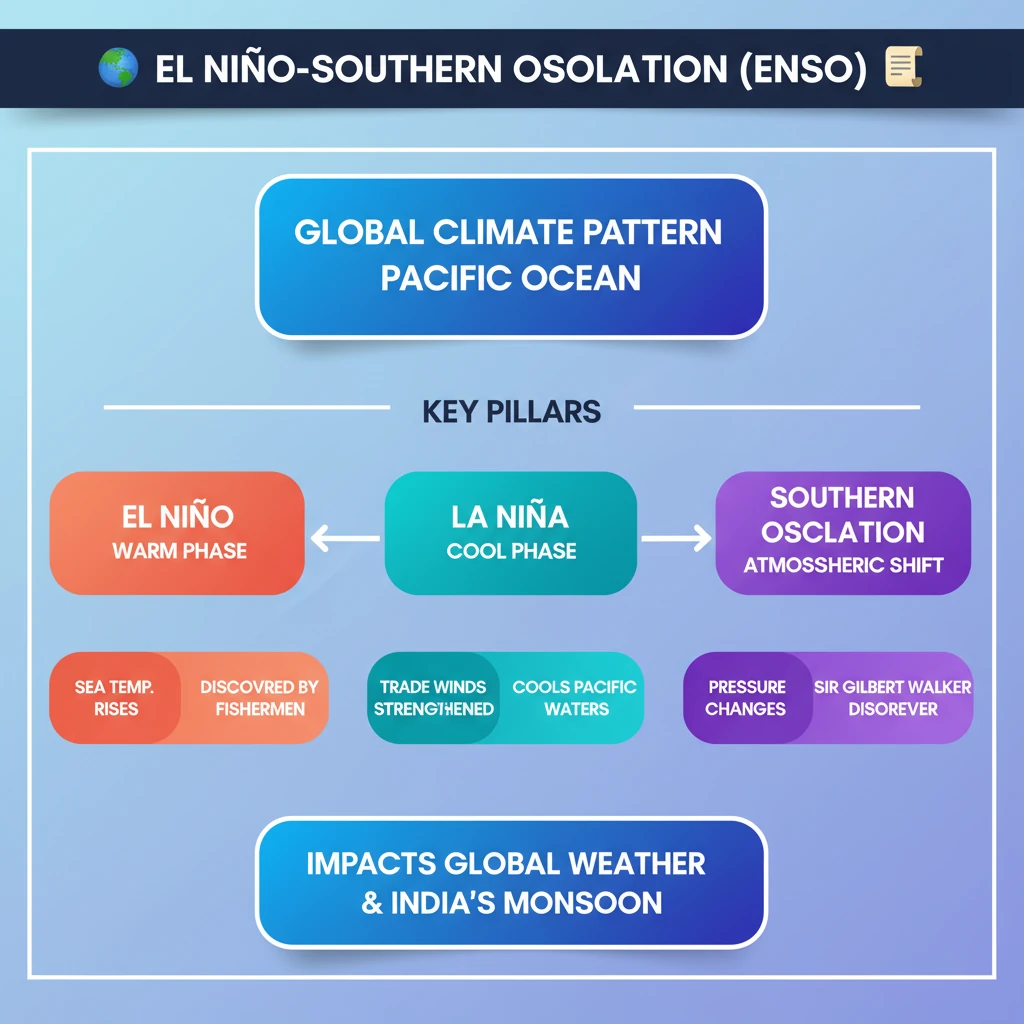
<h4>Understanding El Niño-Southern Oscillation (ENSO)</h4><p>The <strong>El Niño-Southern Oscillation (ENSO)</strong> is a significant and recurring climate pattern. It involves periodic changes in the temperature of the waters in the <strong>central and eastern tropical Pacific Ocean</strong>.</p><div class='key-point-box'><p><strong>ENSO</strong> is a coupled ocean-atmosphere phenomenon. It is one of the most important drivers of year-to-year variability in global weather and climate patterns.</p></div><h4>The Core Concept of ENSO</h4><p>ENSO is characterized by three phases: <strong>El Niño</strong> (warm phase), <strong>La Niña</strong> (cool phase), and <strong>Neutral</strong>. These phases significantly influence atmospheric circulation, rainfall, and temperature across the globe.</p><div class='info-box'><ul><li><strong>El Niño:</strong> Refers to the warming of sea surface temperatures in the central and eastern tropical Pacific.</li><li><strong>La Niña:</strong> Characterized by the cooling of sea surface temperatures in the same region.</li><li><strong>Southern Oscillation:</strong> Describes the atmospheric pressure changes that accompany these ocean temperature shifts.</li></ul></div><h4>Historical Naming and Discovery</h4><p>The term <strong>El Niño</strong>, meaning "The Little Boy" or "Christ Child," was historically used by <strong>South American fishermen</strong>. They observed the appearance of unusually warm waters off the coast of Peru and Ecuador around <strong>Christmas time</strong>.</p><p>This phenomenon disrupted their fishing activities, as the warm waters led to a decrease in fish populations.</p><h4>Scientific Link: Southern Oscillation</h4><p>The atmospheric component, known as the <strong>Southern Oscillation</strong>, was discovered by <strong>Sir Gilbert Walker</strong> in the <strong>1960s</strong>. He identified a seesaw pattern of atmospheric pressure between the eastern and western tropical Pacific Ocean.</p><div class='info-box'><p><strong>Sir Gilbert Walker</strong> linked these sea pressure changes to broader atmospheric conditions, recognizing a crucial connection between ocean temperatures and atmospheric circulation. This groundbreaking work eventually led to the combined term <strong>El Niño-Southern Oscillation (ENSO)</strong>.</p></div><h4>Evolution of Terminology</h4><p>While <strong>El Niño</strong> was an older term, the concepts of <strong>La Niña</strong> (the cold phase) and the <strong>Neutral</strong> phase became widely recognized and used in scientific discourse primarily in the <strong>1980s</strong>. This completed the understanding of the full ENSO cycle.</p><div class='exam-tip-box'><p>For UPSC, understanding the <em>interconnectedness</em> of ocean temperatures and atmospheric pressure is key. Focus on the <em>mechanisms</em> and <em>global impacts</em> of each ENSO phase.</p></div>
💡 Key Takeaways
- •ENSO is a recurring climate pattern in the central and eastern tropical Pacific Ocean.
- •It involves periodic changes in sea surface temperature and atmospheric pressure.
- •El Niño is the warm phase, La Niña is the cool phase, and Southern Oscillation is the atmospheric component.
- •El Niño was first noted by South American fishermen; Southern Oscillation discovered by Sir Gilbert Walker.
- •ENSO significantly impacts global weather, including India's monsoon, and has widespread socio-economic effects.
🧠 Memory Techniques
95% Verified Content
📚 Reference Sources
•National Oceanic and Atmospheric Administration (NOAA) - ENSO Basics
•Bureau of Meteorology, Australia - About ENSO
•NCERT Geography Textbooks (Class XI & XII)