Aurorae in Ladakh - Geography | UPSC Learning
Topics
0 topics • 0 completed
🔍
No topics match your search
Aurorae in Ladakh
Medium⏱️ 8 min read
geography
📖 Introduction
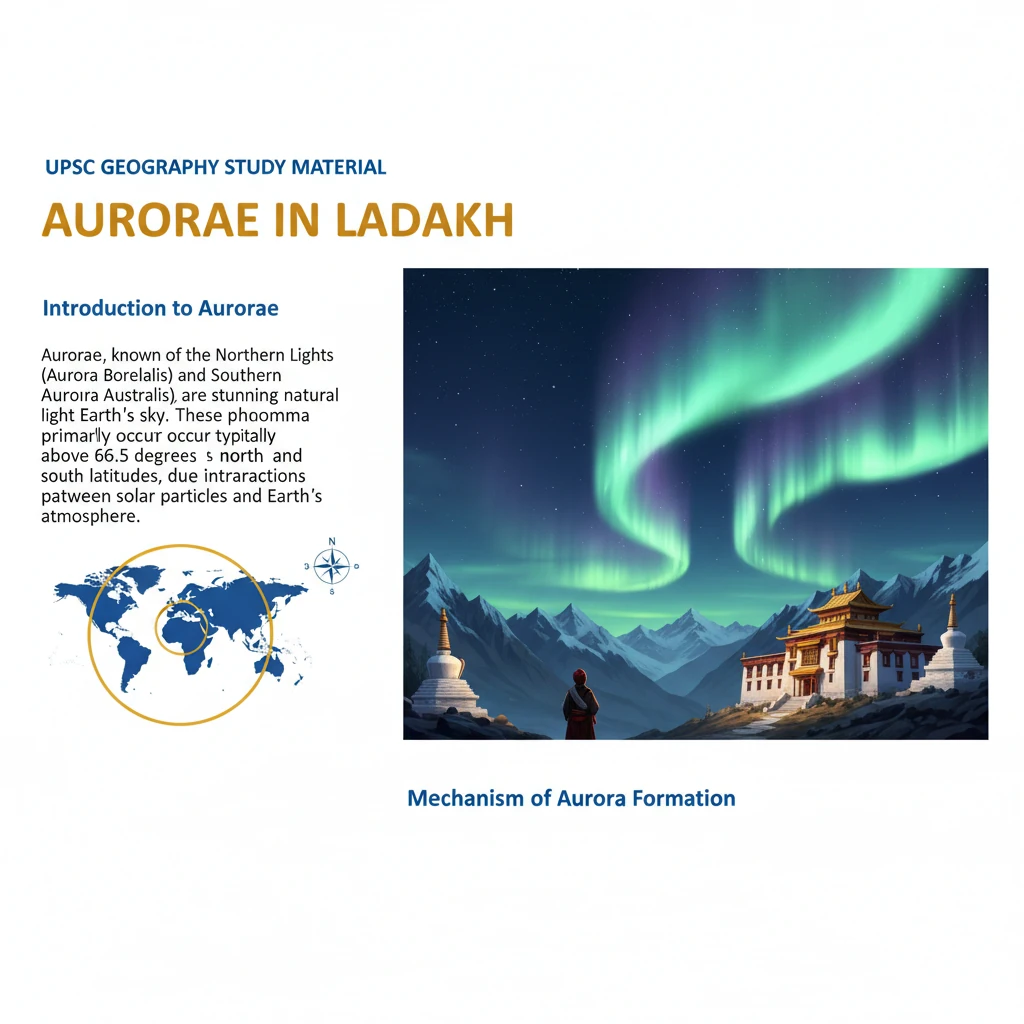
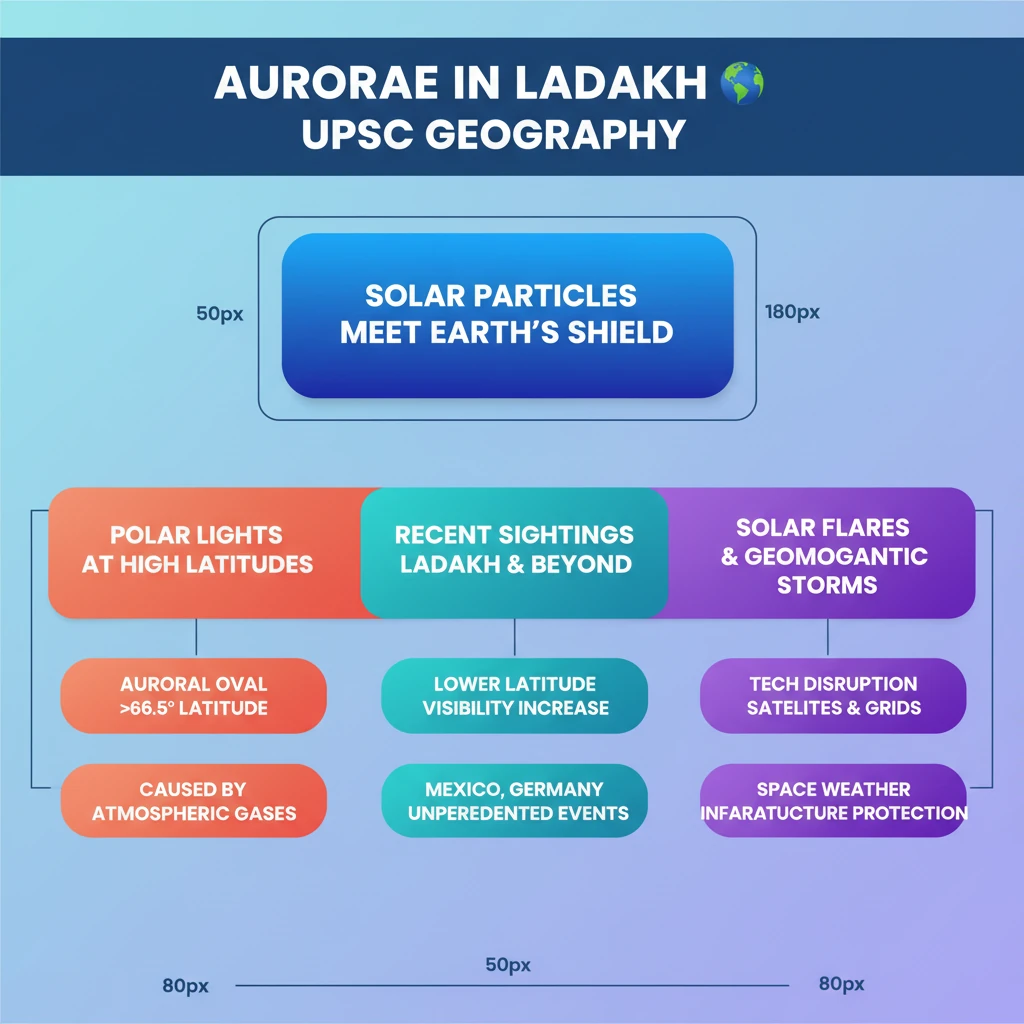
<h4>Introduction to Aurorae</h4><p><strong>Aurorae</strong>, also known as the <strong>Northern Lights (Aurora Borealis)</strong> and <strong>Southern Lights (Aurora Australis)</strong>, are stunning natural light displays in the Earth's sky.</p><p>These phenomena primarily occur in the <strong>polar regions</strong>, typically above <strong>66.5 degrees north and south latitudes</strong>, due to interactions between solar particles and Earth's atmosphere.</p><h4>Mechanism of Aurora Formation</h4><p>The formation of aurorae begins with the <strong>Sun's activity</strong>, specifically <strong>solar flares</strong> and <strong>coronal mass ejections (CMEs)</strong>, which release charged particles into space.</p><p>These particles, primarily <strong>electrons</strong> and <strong>protons</strong>, travel towards Earth as part of the <strong>solar wind</strong>.</p><div class="info-box"><p>Upon reaching Earth, these <strong>charged particles</strong> are guided by the planet's <strong>magnetic field lines</strong> towards the <strong>magnetic poles</strong>. As they enter the upper atmosphere (<strong>ionosphere</strong>), they collide with atmospheric gases.</p></div><p>The collisions excite atoms and molecules of gases like <strong>oxygen</strong> and <strong>nitrogen</strong>. When these excited particles return to their lower energy states, they emit light, creating the vibrant auroral displays.</p><div class="key-point-box"><p>The color of the aurora depends on the type of gas involved and the altitude of the collision. <strong>Oxygen</strong> typically produces <strong>green</strong> and <strong>red</strong> light, while <strong>nitrogen</strong> contributes to <strong>blue</strong> and <strong>purple</strong> hues.</p></div><h4>Significance of Lower-Latitude Sightings</h4><p>Recently, aurorae have been sighted in <strong>lower-latitude regions</strong>, significantly below the typical polar zones. This includes locations like <strong>Hanle</strong> and <strong>Merak</strong> in <strong>Ladakh, India</strong>, as well as parts of <strong>Mexico</strong> and <strong>Germany</strong>.</p><div class="info-box"><p>The standard range for aurora sightings is within the <strong>auroral ovals</strong>, which are concentrated around the magnetic poles. Sightings outside these ovals are less common.</p></div><p>The occurrence of aurorae in these lower-latitude areas is a direct indication of <strong>heightened solar activity</strong>. When solar storms are exceptionally strong, they can cause the <strong>Earth's magnetosphere</strong> to be significantly disturbed.</p><p>This disturbance allows charged particles to penetrate the atmosphere at lower latitudes than usual, expanding the auroral oval and making the displays visible further from the poles.</p><div class="exam-tip-box"><p>UPSC often asks about the implications of scientific phenomena. The sighting of aurorae at lower latitudes is a key indicator of intense <strong>space weather events</strong>, which have implications for satellites and communication systems. This links to <strong>GS Paper III: Science and Technology</strong>.</p></div><h4>Aurorae in Ladakh: A Recent Event</h4><p>The sighting of aurorae in <strong>Hanle</strong> and <strong>Merak</strong> in <strong>Ladakh</strong> marks a rare and significant event for India. These regions are located in the <strong>Himalayan range</strong> and are not typically associated with auroral displays.</p><p>This specific event underscores the powerful nature of the recent <strong>solar storm</strong> and its extensive reach across Earth's magnetic field.</p><div class="highlight-box"><p>The observation in <strong>Ladakh</strong> highlights the global impact of solar activity and the dynamic nature of our planet's interaction with the Sun's emissions.</p></div>
💡 Key Takeaways
- •Aurorae are natural light displays caused by solar particles interacting with Earth's magnetic field and atmosphere.
- •They typically occur in polar regions (above 66.5 degrees latitude).
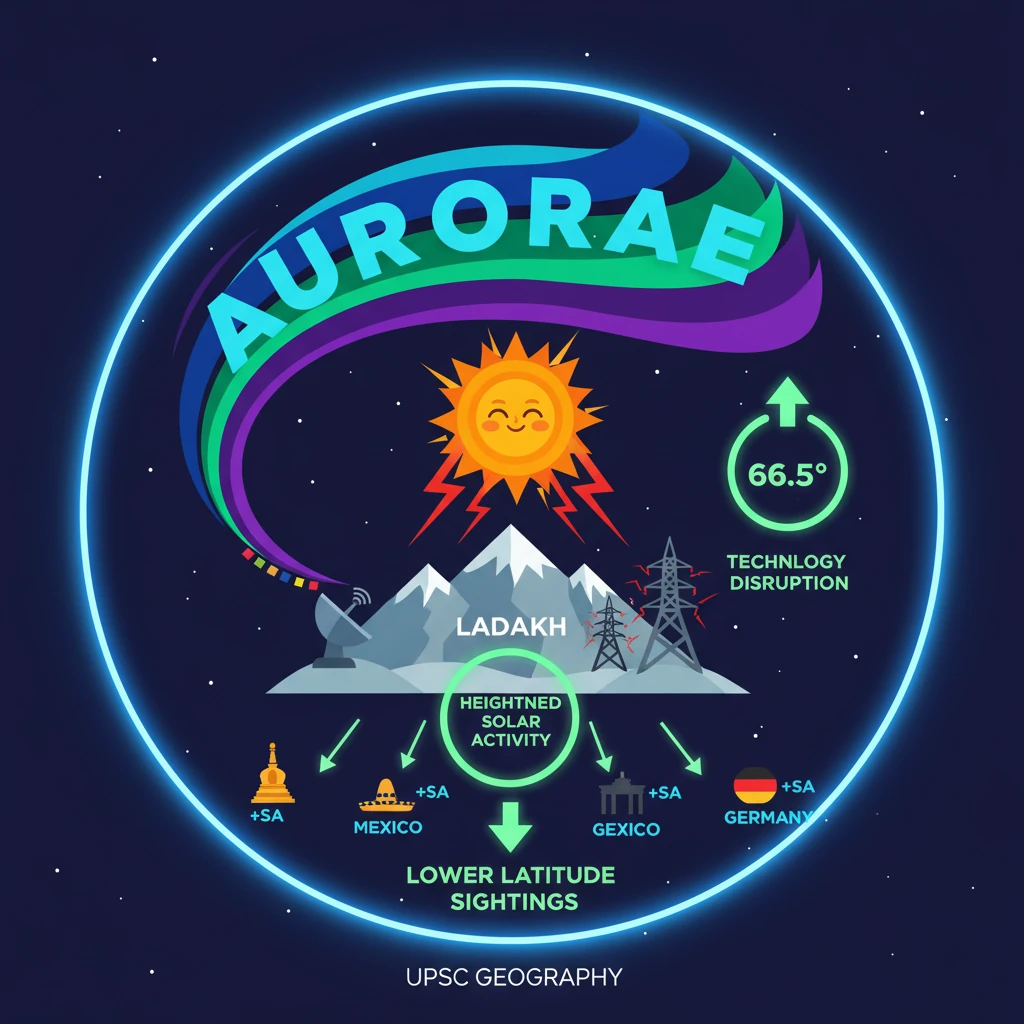
- •Recent sightings in lower latitudes (Ladakh, Mexico, Germany) indicate heightened solar activity.
- •Heightened solar activity can disrupt technology like satellites and power grids.
- •Understanding space weather is crucial for protecting modern infrastructure.
🧠 Memory Techniques
95% Verified Content
📚 Reference Sources
•NASA Space Weather Research
•European Space Agency (ESA) Aurora Information
•National Oceanic and Atmospheric Administration (NOAA) Space Weather Prediction Center