Volcanic Eruption and Ionospheric Disturbances - Geography | UPSC Learning
Topics
0 topics • 0 completed
🔍
No topics match your search
Volcanic Eruption and Ionospheric Disturbances
Medium⏱️ 8 min read
geography
📖 Introduction
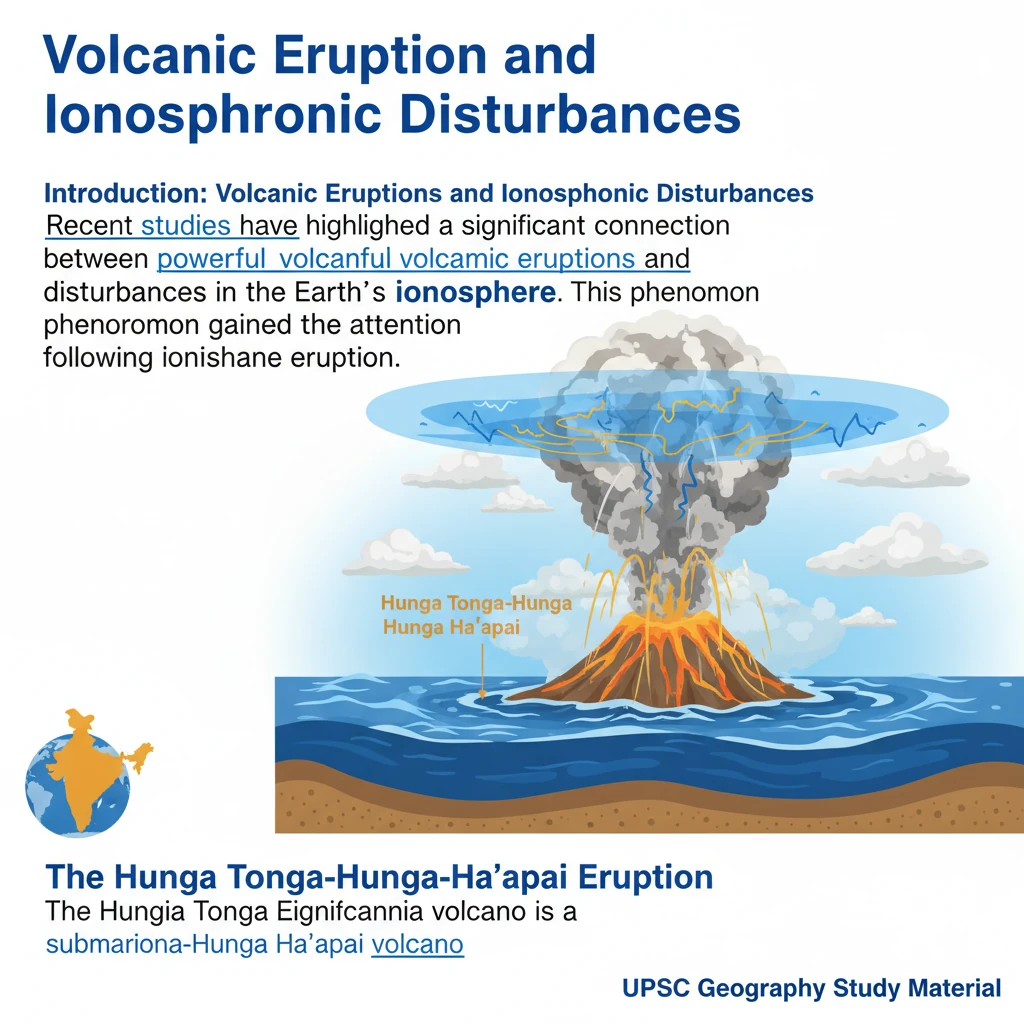
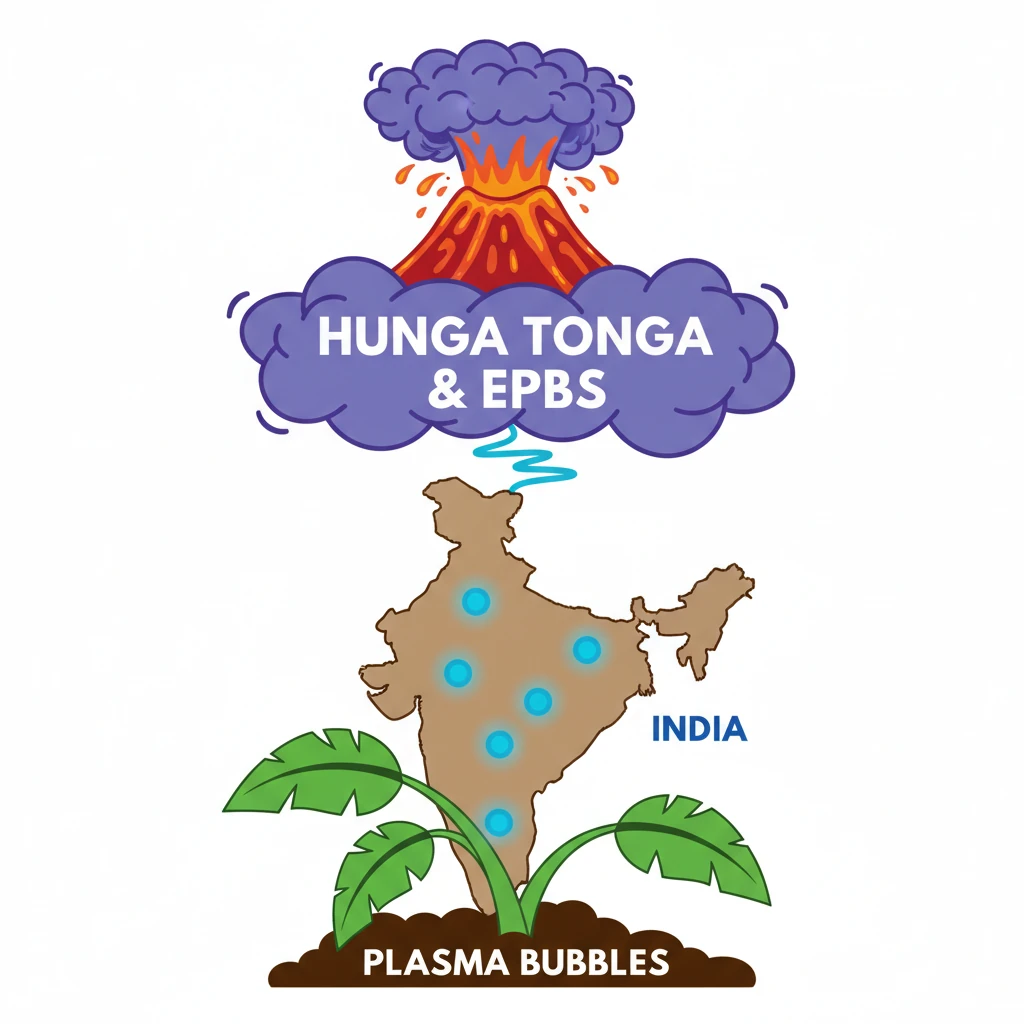
<h4>Introduction: Volcanic Eruptions and Ionospheric Disturbances</h4><p>Recent studies have highlighted a significant connection between powerful <strong>volcanic eruptions</strong> and disturbances in the Earth's <strong>ionosphere</strong>.</p><p>This phenomenon gained attention following the <strong>Hunga Tonga-Hunga Ha'apai volcano eruption</strong>.</p><h4>The Hunga Tonga-Hunga Ha'apai Eruption</h4><p>The <strong>Hunga Tonga-Hunga Ha'apai volcano</strong> is a <strong>submarine volcano</strong> located in the <strong>South Pacific Ocean</strong>.</p><div class="info-box"><p>A new study recently revealed a direct link between this eruption and the formation of <strong>Equatorial Plasma Bubbles (EPBs)</strong> over the <strong>Indian subcontinent</strong>.</p></div><h4>Understanding Volcanic Emissions: The Bad</h4><p>Volcanic eruptions release various substances into the atmosphere, many of which have detrimental effects.</p><ul><li><strong>Ash:</strong> Causes <strong>respiratory problems</strong> and can trigger <strong>lightning</strong>.</li><li><strong>H2O (Water Vapour):</strong> While natural, it is the largest contributor to the <strong>greenhouse gas effect</strong> on Earth.</li><li><strong>CO2 (Carbon Dioxide):</strong> Toxic in large amounts (above 10%) and significantly contributes to <strong>global warming</strong>.</li><li><strong>SO2 (Sulfur Dioxide):</strong> Dissolves in water vapour to form damaging <strong>acid rain</strong>.</li><li><strong>H2S (Hydrogen Sulfide):</strong> A highly <strong>toxic gas</strong> known for its characteristic smell of rotten eggs.</li></ul><h4>Benefits of Volcanic Activity: The Good</h4><p>Despite their destructive potential, volcanoes also offer several advantages.</p><ul><li><strong>Source of Materials:</strong> They are a rich source of valuable materials, including <strong>metals</strong>, <strong>precious gems</strong>, and <strong>construction materials</strong>.</li><li><strong>Power Generation:</strong> Volcanic regions provide opportunities for <strong>geothermal</strong> and <strong>hydroelectric power generation</strong>.</li><li><strong>Rich Volcanic Soils:</strong> The ash and minerals deposited by eruptions create exceptionally fertile soils, ideal for agriculture, famously for <strong>coffee cultivation</strong>.</li></ul><h4>Key Facts and Historical Impacts of Volcanoes</h4><div class="info-box"><ul><li><strong>Deadliest Eruption:</strong> Approximately <strong>92,000 people</strong> were killed in the deadliest volcano eruption in <strong>Indonesia</strong> in <strong>1815</strong>.</li><li><strong>Active Volcanoes:</strong> On average, about <strong>20 volcanoes</strong> are erupting globally at any given moment.</li><li><strong>Supervolcanoes:</strong> Eruptions from <strong>supervolcanoes</strong> have the potential to plunge the world into an <strong>ice age</strong>.</li><li><strong>Krakatoa Eruption (1883):</strong> This powerful eruption ruptured eardrums within a <strong>50 KM radius</strong>.</li><li><strong>Mount St. Helens (1980):</strong> Erupted <strong>twice more ash by weight</strong> than the entire US produces in gas damage in one year.</li><li><strong>Krakatoa Energy Waste:</strong> The <strong>1883 Krakatoa volcano</strong> eruption in <strong>Indonesia</strong> wasted an estimated <strong>$2.2 Billion</strong> worth of electrical energy.</li></ul></div><div class="exam-tip-box"><p>Understanding both the destructive and constructive aspects of volcanic activity is crucial for <strong>UPSC Mains GS Paper I (Geography)</strong> and <strong>GS Paper III (Disaster Management)</strong>.</p></div>

💡 Key Takeaways
- •The <strong>Hunga Tonga-Hunga Ha'apai eruption</strong> was linked to <strong>Equatorial Plasma Bubbles (EPBs)</strong> over India, showing global atmospheric coupling.
- •Volcanoes emit harmful gases (ash, CO2, SO2, H2S) causing respiratory issues, acid rain, and global warming, but also provide valuable resources and fertile soil.
- •Historical eruptions like <strong>Krakatoa (1883)</strong> and the <strong>1815 Indonesian eruption</strong> demonstrate immense destructive power and widespread effects.
- •The <strong>Deccan Traps</strong> are a significant example of ancient, massive volcanic activity in India, influencing its geography.
- •Understanding volcanic-ionospheric links is crucial for <strong>space weather forecasting</strong> and refining <strong>climate models</strong>.
🧠 Memory Techniques
95% Verified Content