Kallakkadal: Coastal Flooding in Kerala - Causes and Impact - Geography | UPSC Learning
Topics
0 topics • 0 completed
🔍
No topics match your search
Kallakkadal: Coastal Flooding in Kerala - Causes and Impact
Medium⏱️ 6 min read
geography
📖 Introduction
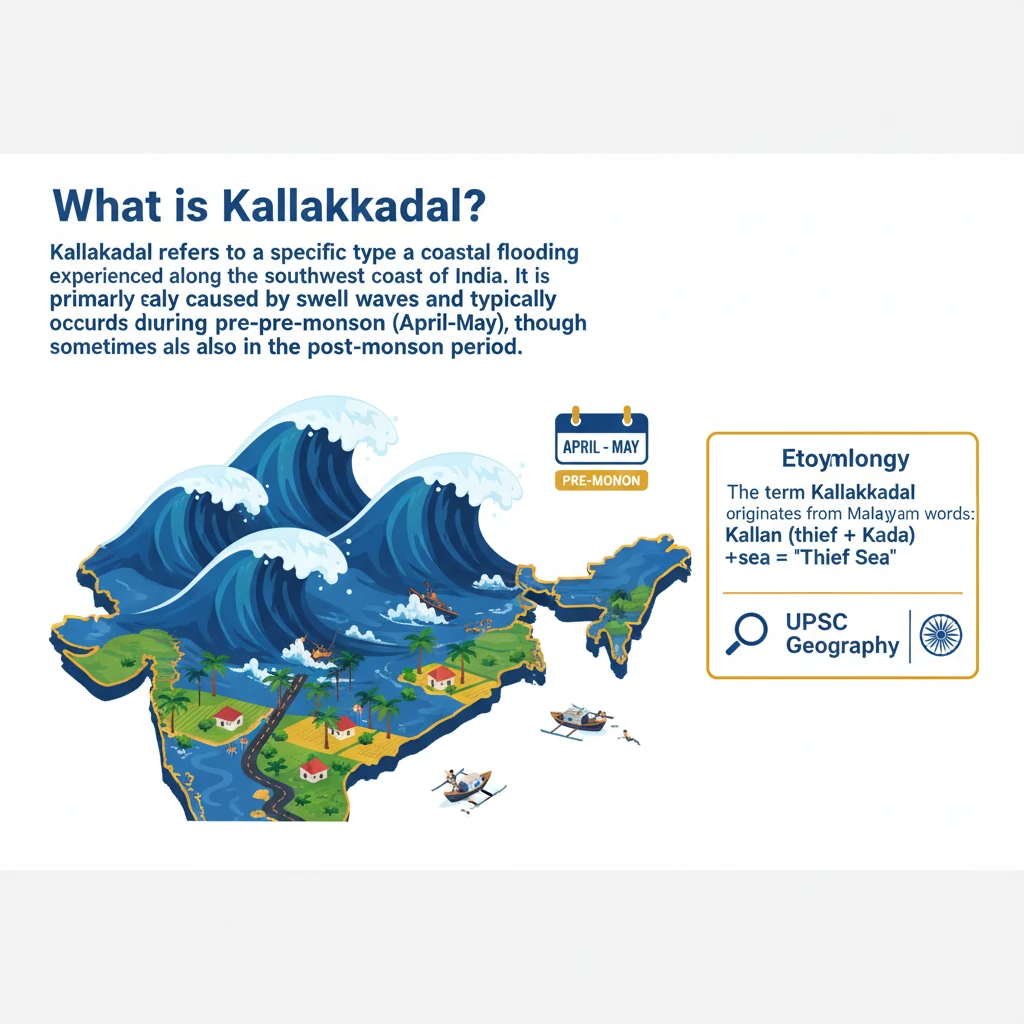
<h4>What is Kallakkadal?</h4><p><strong>Kallakkadal</strong> refers to a specific type of <strong>coastal flooding</strong> experienced along the <strong>southwest coast of India</strong>. It is primarily caused by <strong>swell waves</strong> and typically occurs during the <strong>pre-monsoon season</strong> (April-May), though sometimes also in the post-monsoon period.</p><div class='info-box'><p>The term <strong>Kallakkadal</strong> originates from Malayalam words: <strong>Kallan</strong> (thief) and <strong>Kadal</strong> (sea). It literally means <strong>“ocean that arrives as a thief”</strong>, highlighting its sudden and unannounced nature.</p></div><h4>Causes of Kallakkadal</h4><p><strong>Kallakkadal</strong> is triggered by <strong>ocean swells</strong>. These swells are waves that form from <strong>distant storms</strong>, such as hurricanes or prolonged periods of intense gale winds, usually originating in the <strong>southern part of the Indian Ocean</strong>.</p><p>These powerful storms transfer significant energy from the atmosphere into the ocean, generating extremely high waves. These waves then travel vast distances across the ocean, far from their storm origin, until they eventually reach the shoreline.</p><h4>Affected Regions</h4><p>The phenomenon of <strong>Kallakkadal</strong> primarily impacts the <strong>southwest coast of India</strong>. Notably, <strong>Kerala</strong> is frequently affected, leading to flooding in numerous coastal houses. Other regions often experiencing this phenomenon include the coasts of <strong>Lakshadweep</strong> and <strong>Tamil Nadu</strong>.</p><h4>Challenges and Early Warning Systems</h4><p>One of the main challenges with <strong>Kallakkadal</strong> is its occurrence without any local wind activity or immediate precursors. This makes it very difficult for coastal populations to receive advance warning, leading to significant damage and disruption.</p><div class='exam-tip-box'><p>To address this, the <strong>Indian National Centre for Ocean Information Services (INCOIS)</strong> launched the <strong>Swell Surge Forecast System</strong> in <strong>2020</strong>. This system provides forewarning about swell surges up to <strong>seven days in advance</strong>, significantly aiding disaster preparedness.</p></div><h4>Kallakkadal vs. Tsunami</h4><p>After the devastating <strong>2004 tsunami</strong>, <strong>Kallakkadal</strong> gained more attention and is often mistakenly identified as a tsunami. However, there are fundamental differences between the two phenomena.</p><div class='info-box'><p><ul><li>A <strong>tsunami</strong> is a series of enormous waves generated by an <strong>underwater disturbance</strong>, typically associated with <strong>earthquakes</strong> occurring below or near the ocean floor.</li><li><strong>Ocean waves</strong>, like those causing <strong>Kallakkadal</strong>, have relatively short wavelengths, usually around <strong>30 or 40 meters</strong>.</li><li>In contrast, <strong>tsunamis</strong> possess extremely long wavelengths, often extending for <strong>hundreds of kilometers</strong>.</li></ul></p></div>
💡 Key Takeaways
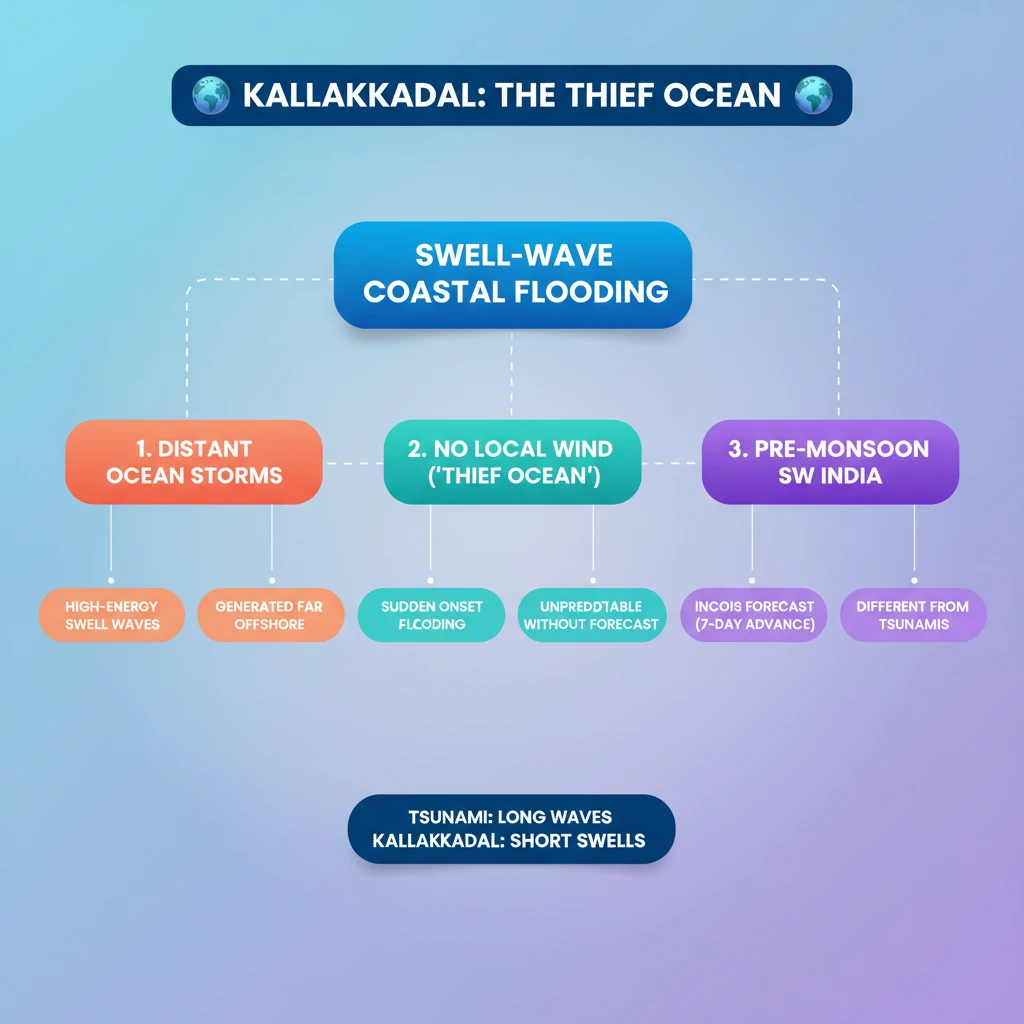
- •Kallakkadal is coastal flooding by swell waves, primarily pre-monsoon, along India's southwest coast.
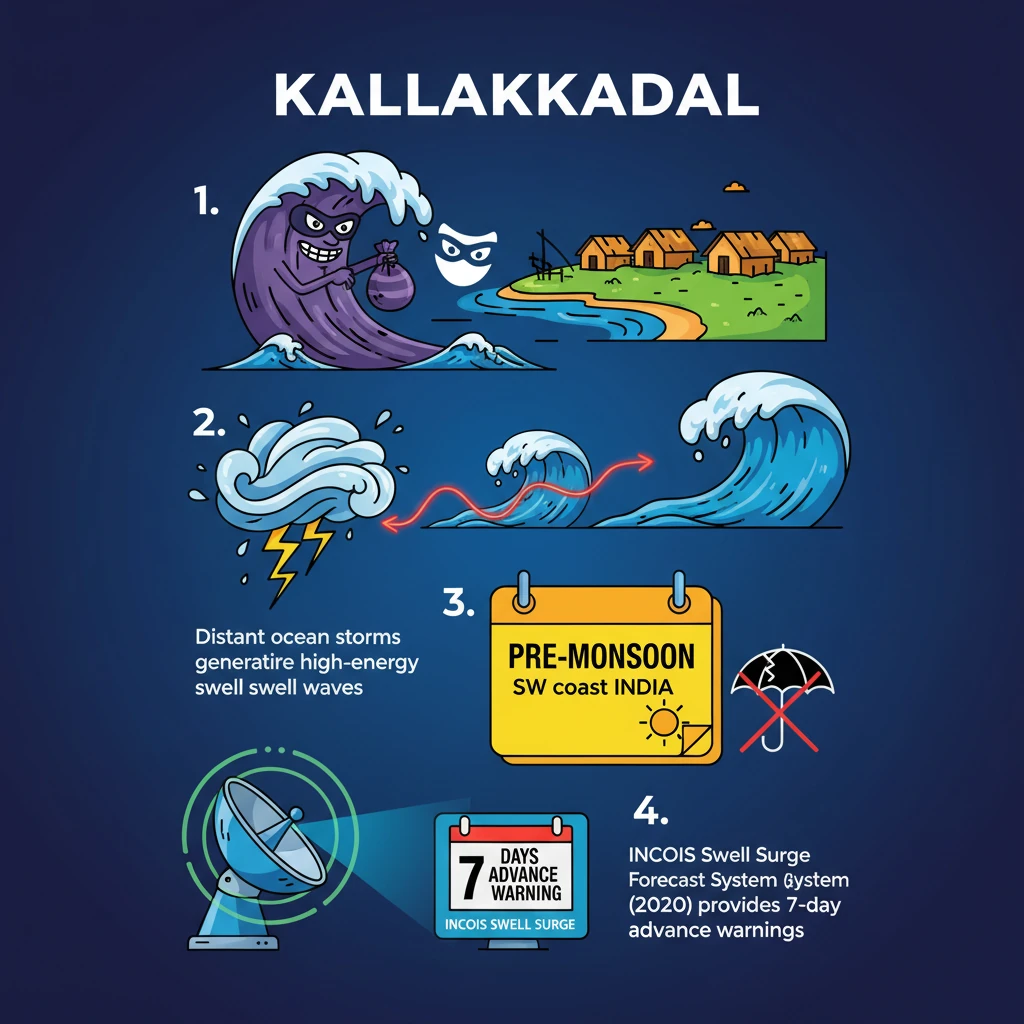
- •It's caused by distant ocean storms generating high-energy swell waves.
- •Term means 'ocean that arrives as a thief' due to its sudden nature without local wind.
- •INCOIS's Swell Surge Forecast System (2020) provides 7-day advance warnings.
- •Distinct from tsunamis: Kallakkadal involves short-wavelength ocean swells; tsunamis are long-wavelength waves from underwater disturbances (e.g., earthquakes).
🧠 Memory Techniques
95% Verified Content