What are Magento Fossils? - Geography | UPSC Learning
Topics
0 topics • 0 completed
🔍
No topics match your search
What are Magento Fossils?
Medium⏱️ 6 min read
geography
📖 Introduction
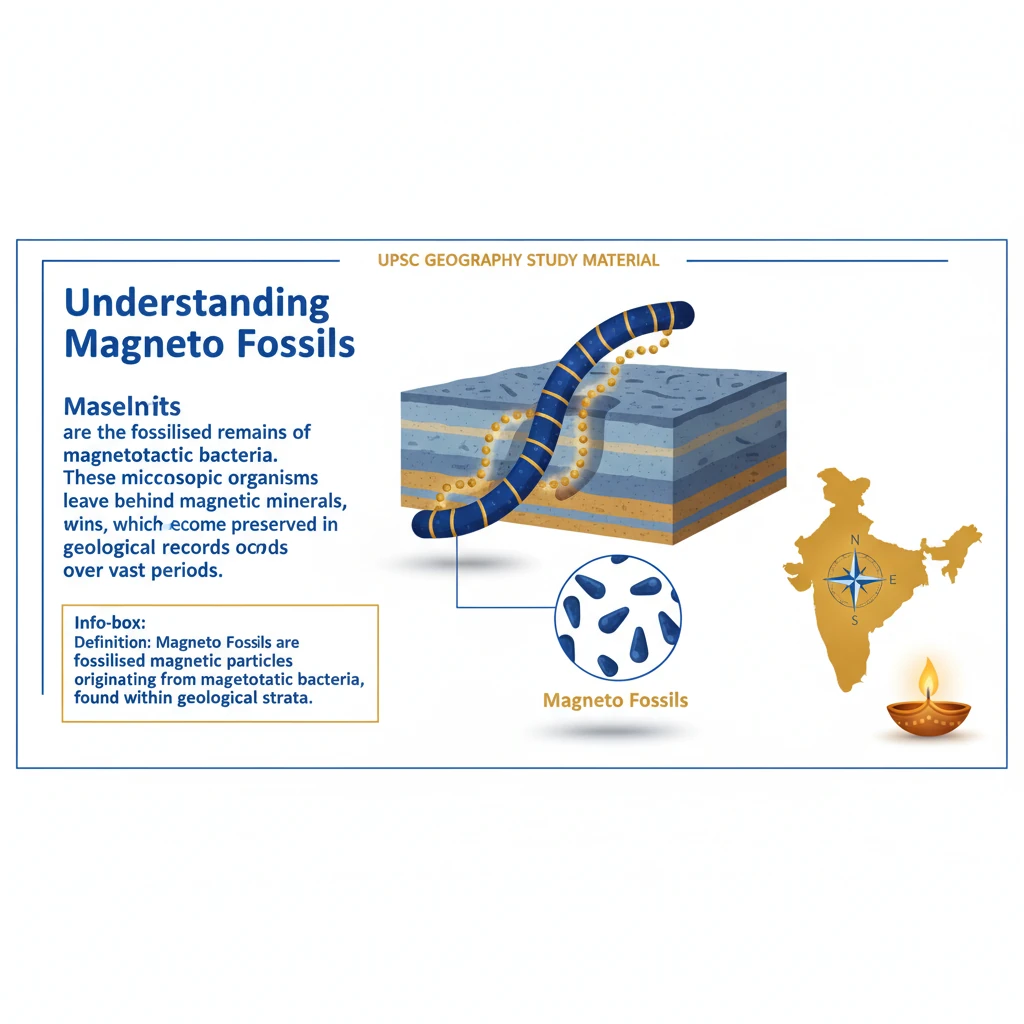
<h4>Understanding Magneto Fossils</h4><p><strong>Magneto Fossils</strong> are the fossilised remains of <strong>magnetotactic bacteria</strong>. These microscopic organisms leave behind magnetic minerals, which become preserved in geological records over vast periods.</p><div class='info-box'><p><strong>Definition:</strong> <strong>Magneto Fossils</strong> are fossilised magnetic particles originating from <strong>magnetotactic bacteria</strong>, found within geological strata.</p></div><h4>Magnetotactic Bacteria: The Originators</h4><p><strong>Magnetotactic bacteria</strong> are primarily <strong>prokaryotic organisms</strong>. A defining characteristic is their ability to align themselves along the <strong>Earth's magnetic field</strong>.</p><p>This fascinating ability was first observed by <strong>Salvatore Bellini</strong> in <strong>1963</strong>, marking a significant discovery in microbiology and geomicrobiology.</p><h4>Navigation and Mineral Formation</h4><p>These bacteria utilize the Earth's magnetic field for navigation, a process known as <strong>magnetotaxis</strong>. This helps them locate environments with optimal <strong>oxygen concentration</strong>, crucial for their survival.</p><p>Their navigation is facilitated by the presence of <strong>iron-rich crystals</strong> located within their cellular structure. These internal magnets act as biological compasses.</p><div class='key-point-box'><p><strong>Key Function:</strong> <strong>Magnetotactic bacteria</strong> create tiny crystals of <strong>magnetite</strong> (Fe₃O₄) or <strong>greigite</strong> (Fe₃S₄) within their cells. These crystals enable them to navigate varying <strong>oxygen levels</strong> and <strong>sediment saturation</strong> in aquatic environments.</p></div><h4>Crystal Arrangement and Types</h4><p>The magnetic crystals within <strong>magnetotactic bacteria</strong> are typically arranged in a unique <strong>chain configuration</strong>. This specific alignment enhances their magnetic moment and navigational efficiency.</p><p>While most <strong>magneto fossils</strong> are produced by bacteria, there are also <strong>rare giant magneto fossils</strong>. These larger forms are believed to be produced by <strong>eukaryotes</strong>, rather than the more common prokaryotic bacteria.</p><div class='exam-tip-box'><p>For <strong>UPSC Prelims</strong>, remember the key terms: <strong>Magnetotactic bacteria</strong>, <strong>magnetite/greigite</strong>, <strong>Salvatore Bellini</strong>, and their role in <strong>paleomagnetism</strong>. Understanding the distinction between bacterial and eukaryotic origins for different sizes of fossils is also important.</p></div>
💡 Key Takeaways
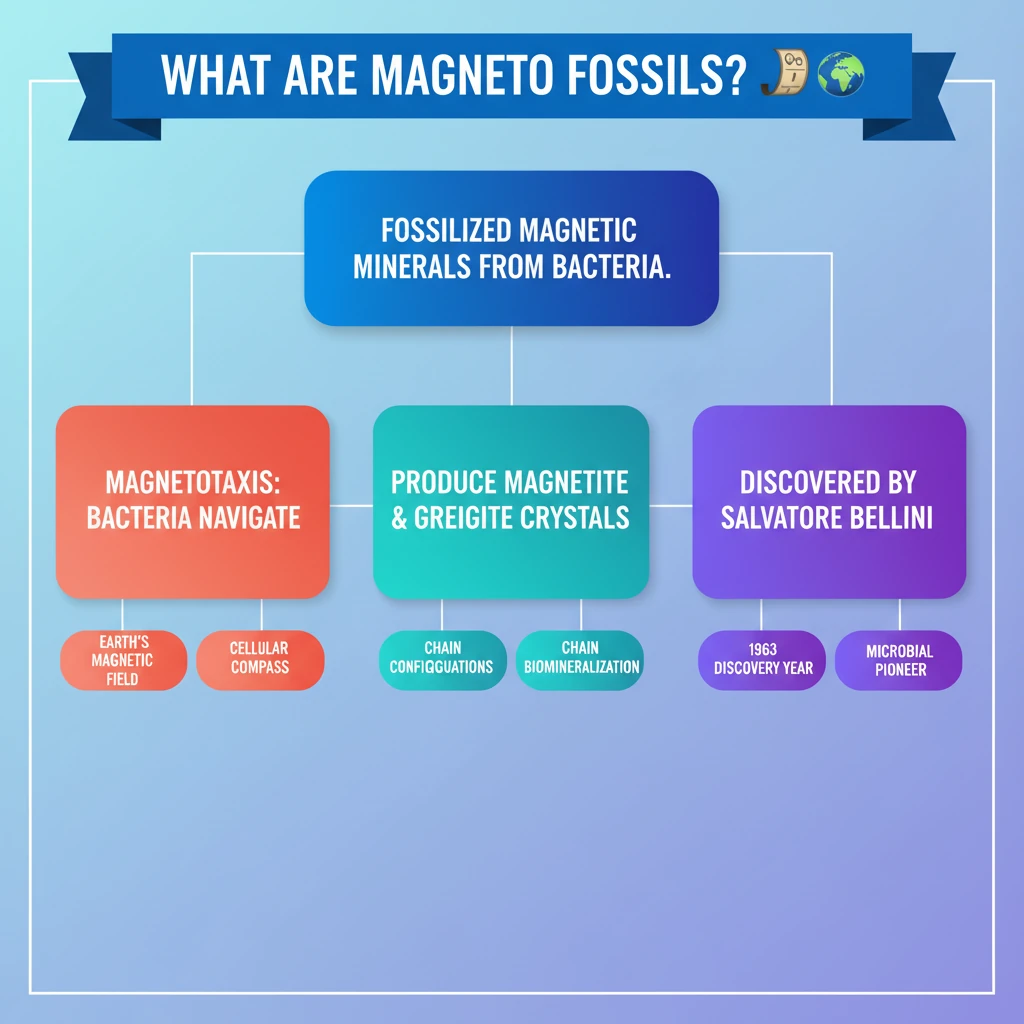
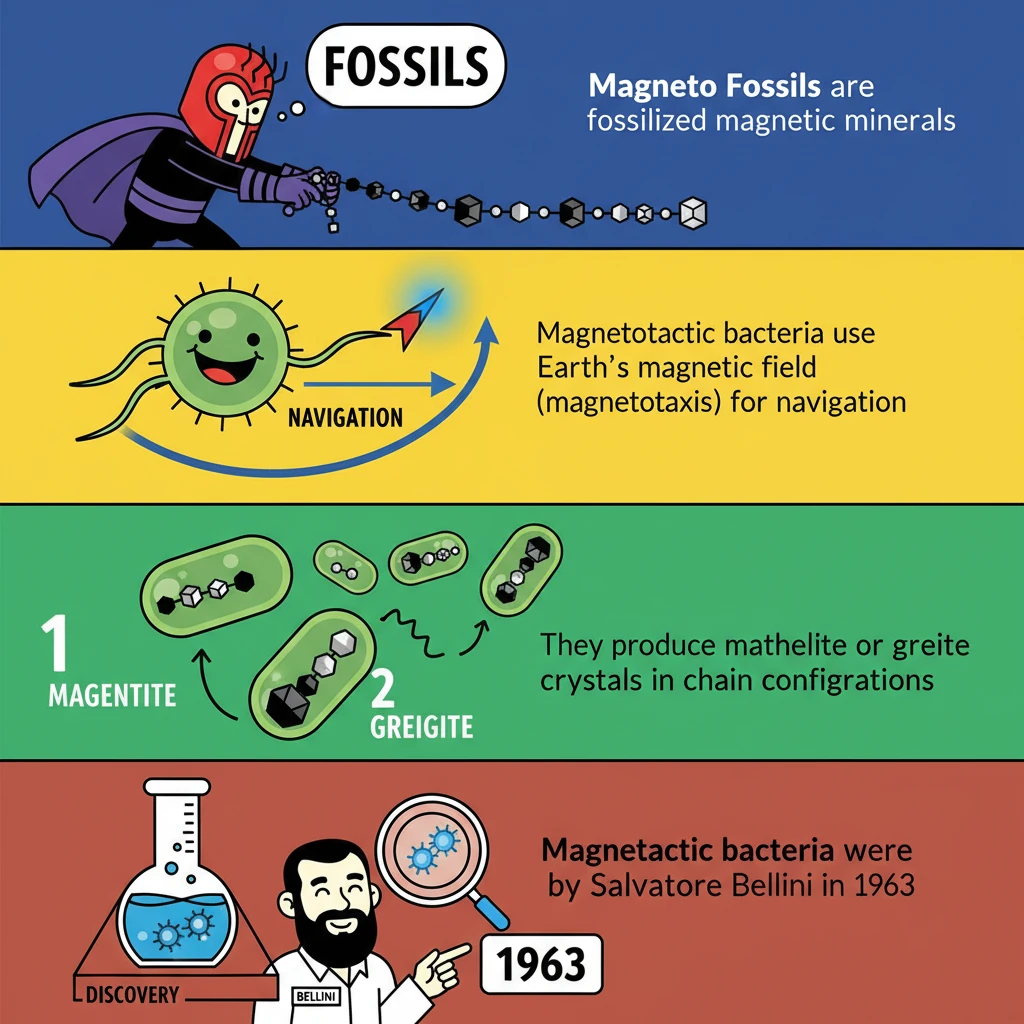
- •Magneto Fossils are fossilized magnetic minerals from magnetotactic bacteria.
- •Magnetotactic bacteria use Earth's magnetic field (magnetotaxis) for navigation.
- •They produce magnetite or greigite crystals in chain configurations.
- •Magnetotactic bacteria were discovered by Salvatore Bellini in 1963.
- •Magneto fossils are crucial for paleomagnetic studies, paleoclimate reconstruction, and astrobiology.
- •Rare giant magneto fossils are likely produced by eukaryotes.
🧠 Memory Techniques
95% Verified Content
📚 Reference Sources
•General scientific literature on magnetotactic bacteria and magnetofossils