What is Subduction? - Geography | UPSC Learning
Topics
0 topics • 0 completed
🔍
No topics match your search
What is Subduction?
Medium⏱️ 9 min read
geography
📖 Introduction
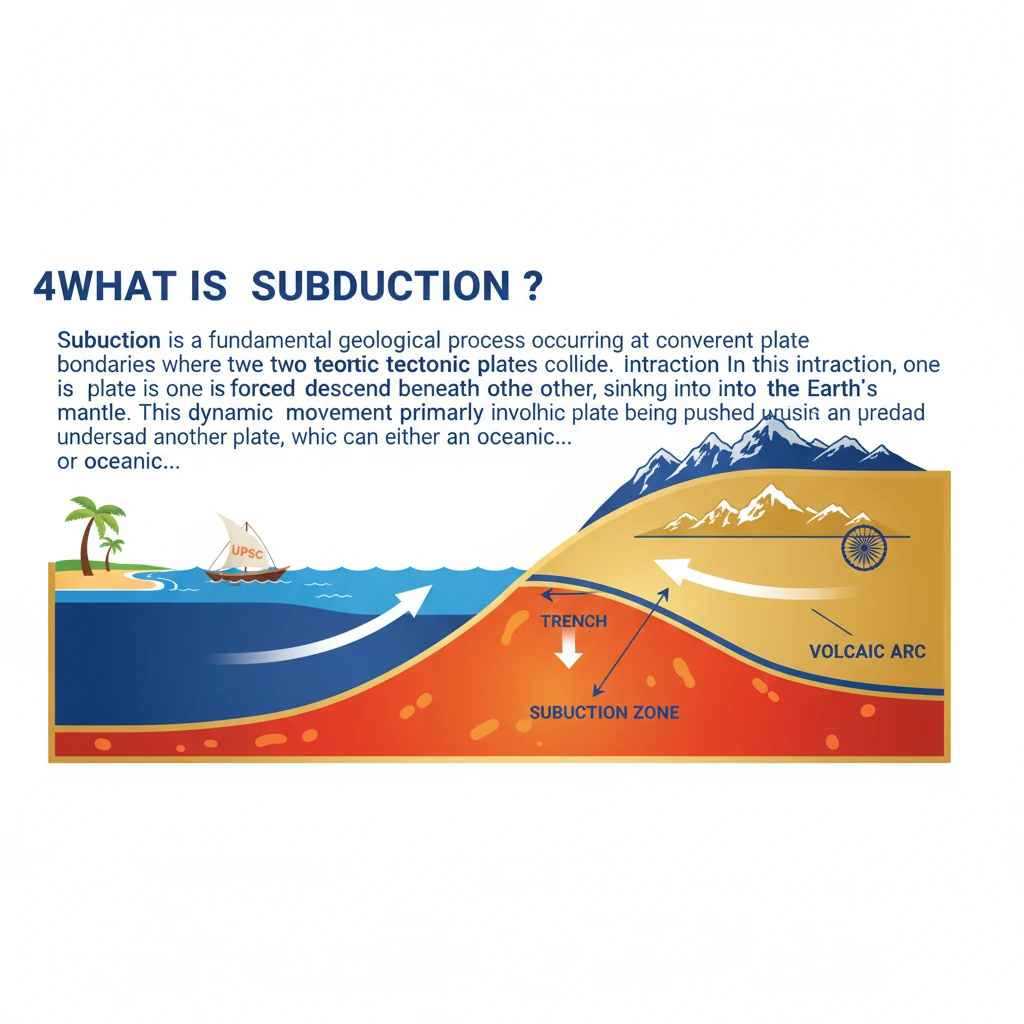
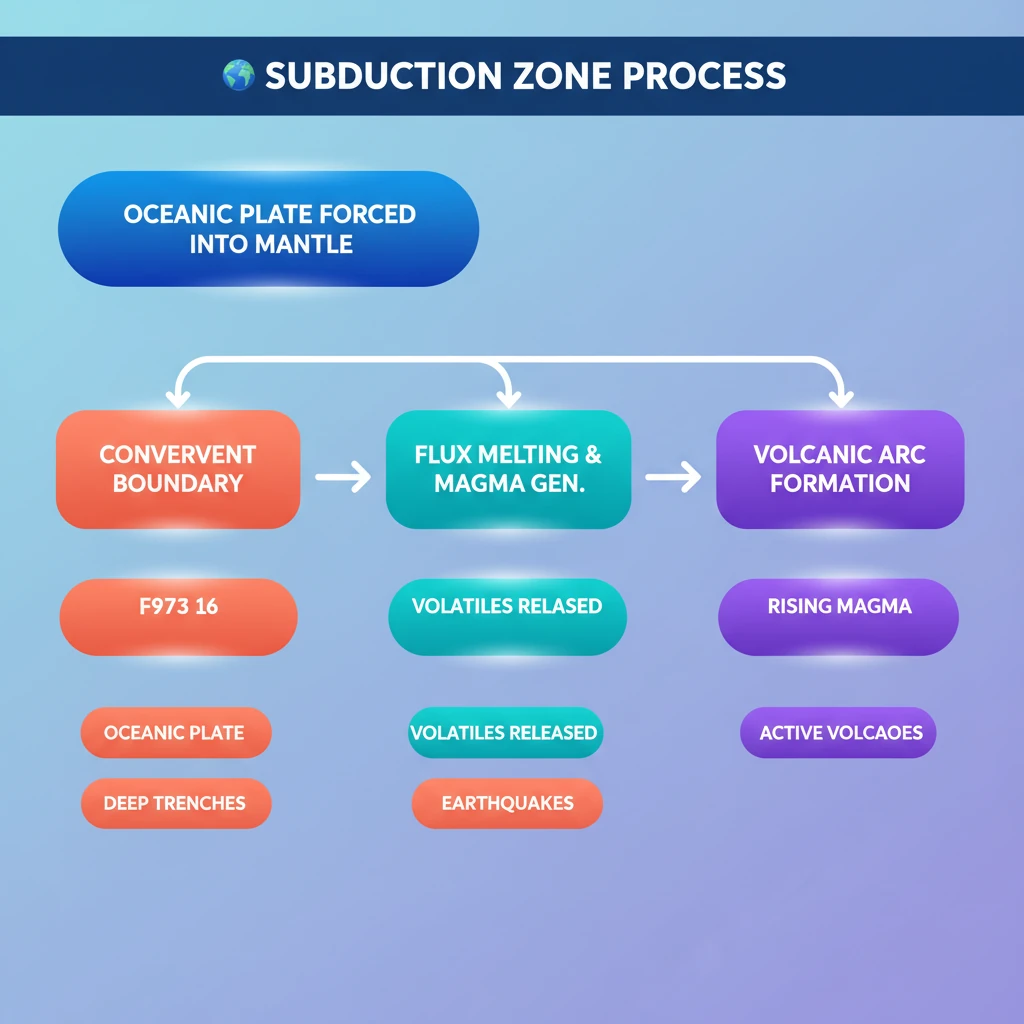
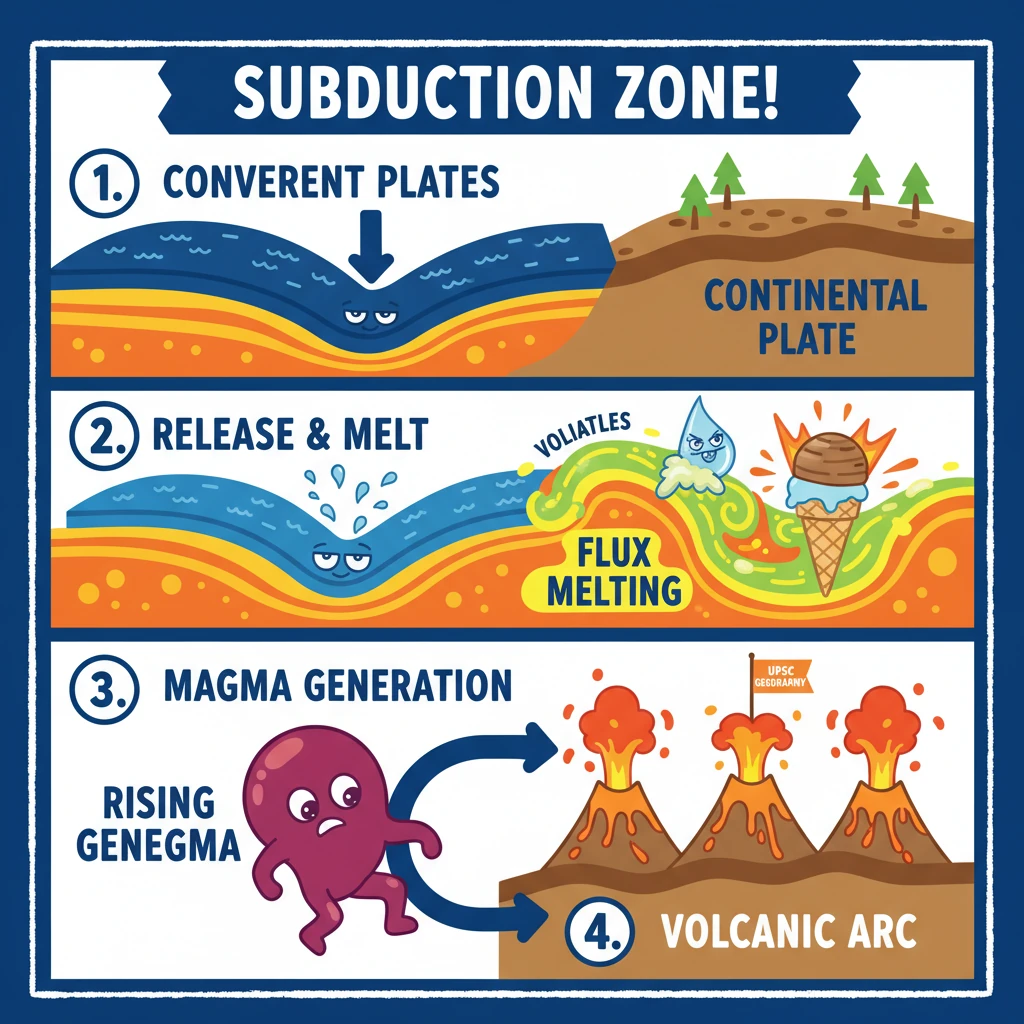
<h4>What is <strong>Subduction</strong>?</h4><p><strong>Subduction</strong> is a fundamental geological process occurring at <strong>convergent plate boundaries</strong> where two <strong>tectonic plates</strong> collide. In this interaction, one plate is forced to descend beneath the other, sinking into the Earth's <strong>mantle</strong>.</p><p>This dynamic movement primarily involves an <strong>oceanic plate</strong> being pushed underneath another plate, which can be either an <strong>oceanic plate</strong> or a <strong>continental plate</strong>. It represents one of the most powerful forces shaping our planet's surface.</p><div class='key-point-box'><p>The process of <strong>subduction</strong> involves the downward movement of a relatively cooler, denser <strong>oceanic lithosphere</strong> into the hotter, less dense <strong>asthenosphere</strong> (upper mantle).</p></div><h4>Mechanism of <strong>Subduction</strong> and its Effects</h4><p>As the 'downgoing' <strong>oceanic plate</strong> descends into the hotter <strong>mantle</strong>, it undergoes significant physical and chemical changes. The increasing temperature and pressure cause trapped water and other <strong>volatile elements</strong> within the plate to be released.</p><p>These <strong>volatile elements</strong>, primarily water, lower the melting point of the surrounding <strong>mantle</strong> rocks. This leads to a process known as <strong>flux melting</strong>, generating new <strong>magma</strong>.</p><div class='info-box'><p>This phenomenon is sometimes referred to as '<strong>mineral transmutation</strong>' in simpler terms, describing the transformation of minerals under extreme heat and pressure, contributing to <strong>magma</strong> generation.</p></div><p>The newly formed <strong>magma</strong>, being less dense than the surrounding solid rock, rises buoyantly through the overlying plate. If it reaches the surface, it erupts, leading to the formation of <strong>volcanoes</strong> and <strong>volcanic arcs</strong>.</p><h4>Understanding <strong>Subduction Zones</strong></h4><p>A <strong>subduction zone</strong> is the specific geological location where this collision and descent occur. These zones are characterized by intense geological activity, including frequent <strong>earthquakes</strong> and active <strong>volcanism</strong>.</p><div class='info-box'><p><strong>Subduction zones</strong> are often described as the 'biggest crash scenes on Earth' due to the immense forces involved in the collision and descent of <strong>tectonic plates</strong>. They are responsible for creating some of Earth's most dramatic topographical features.</p></div><p>When two <strong>tectonic plates</strong> meet at a <strong>subduction zone</strong>, one plate bends and slides underneath the other, curving down into the <strong>mantle</strong>. This downward curving creates deep oceanic trenches, which are the deepest parts of the ocean floor.</p><div class='exam-tip-box'><p>Understanding <strong>subduction</strong> is crucial for <strong>UPSC GS Paper I Geography</strong>, particularly for topics related to <strong>Geomorphology</strong>, <strong>Plate Tectonics</strong>, <strong>Volcanism</strong>, and <strong>Earthquakes</strong>. Focus on the mechanism and associated landforms.</p></div>
💡 Key Takeaways
- •Subduction is the process where one tectonic plate is forced beneath another into the Earth's mantle.
- •It occurs at convergent plate boundaries, typically involving an oceanic plate.
- •The descending plate releases volatiles, causing flux melting and magma generation.
- •Rising magma leads to volcanic activity and the formation of volcanic arcs.
- •Subduction zones are characterized by deep oceanic trenches, frequent earthquakes, and active volcanoes.
- •It is a fundamental process for crustal recycling and shapes major Earth features like mountain ranges and island arcs.
🧠 Memory Techniques
98% Verified Content
📚 Reference Sources
•NCERT Class XI Fundamentals of Physical Geography
•Physical Geography by Savindra Singh
•USGS (United States Geological Survey) publications on Plate Tectonics