Golan Heights: Geography, History, and Strategic Importance - Geography | UPSC Learning
Topics
0 topics • 0 completed
🔍
No topics match your search
Golan Heights: Geography, History, and Strategic Importance
Medium⏱️ 7 min read
geography
📖 Introduction
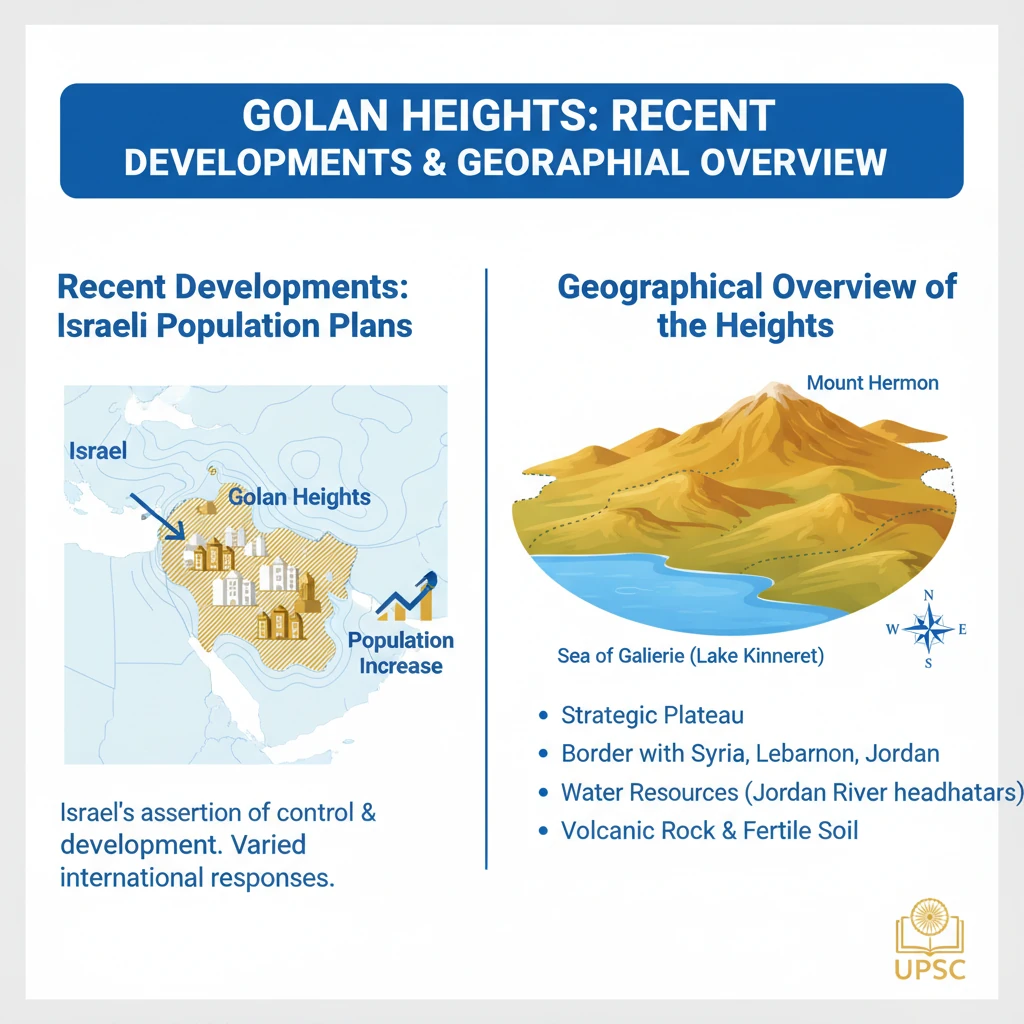
<h4>Why the Golan Heights is in News?</h4><p>The <strong>Golan Heights</strong> has recently gained significant international attention. This is due to <strong>Israel's</strong> announced plans to substantially increase its population in this strategically vital region.</p><div class='exam-tip-box'><p><strong>UPSC Insight:</strong> Recent developments often form the basis of current affairs questions in <strong>Prelims</strong> and can be crucial for understanding geopolitical dynamics in <strong>Mains Paper 2 (International Relations)</strong>.</p></div><h4>Geography of the Golan Heights</h4><p>The <strong>Golan Heights</strong> is a distinctive <strong>1,200-square-kilometre rocky plateau</strong> located in southwestern <strong>Syria</strong>. Its elevated position offers a commanding view over the <strong>Jordan River Valley</strong>.</p><p>The name <strong>Golan</strong> is historically linked to the biblical city of refuge, <strong>Golan in Bashan</strong>, as mentioned in ancient texts.</p><div class='info-box'><p><strong>Geographical Boundaries:</strong></p><ul><li><strong>North:</strong> Mount Hermon</li><li><strong>South:</strong> Yarmūk River</li><li><strong>West:</strong> Jordan River and Sea of Galilee</li><li><strong>East:</strong> Seasonal Wadi al-Ruqqād</li></ul></div><p>This area is a critical source of water for a naturally arid region. Rainwater collected from the <strong>Golan's catchment area</strong> flows directly into the <strong>Jordan River</strong>, highlighting its ecological and economic importance.</p><h4>Historical Context and Conflicts</h4><p><strong>Israel</strong> initially captured the majority of the <strong>Golan Heights</strong> from <strong>Syria</strong> during the <strong>1967 Six-Day War</strong>. This marked a significant shift in regional control.</p><p>In <strong>1973</strong>, <strong>Syria</strong> attempted to reclaim the territory during the <strong>Yom Kippur War</strong>, but this effort ultimately failed to dislodge Israeli forces.</p><p>Following the <strong>Yom Kippur War</strong>, the <strong>Agreement on Disengagement</strong> was signed between <strong>Israel</strong> and <strong>Syria</strong> in <strong>1974</strong>. This agreement established a ceasefire line.</p><div class='info-box'><p><strong>Key Historical Events:</strong></p><ul><li><strong>1967:</strong> Israel seizes Golan Heights (Six-Day War)</li><li><strong>1973:</strong> Syria's failed attempt to recapture Golan (Yom Kippur War)</li><li><strong>1974:</strong> Agreement on Disengagement signed</li><li><strong>1981:</strong> Israel annexes Golan Heights</li><li><strong>2019:</strong> US acknowledges Israeli sovereignty over Golan</li></ul></div><p>The <strong>1974 Agreement</strong> also led to the establishment of the <strong>United Nations Disengagement Observer Force (UNDOF)</strong>. Its mandate is to monitor the ceasefire line in the <strong>Golan Heights</strong>.</p><p><strong>Israel</strong> formally annexed the region in <strong>1981</strong>. However, this annexation has not been recognized by the international community. The <strong>United States</strong>, in <strong>2019</strong>, acknowledged Israeli sovereignty over the area, a move that was largely isolated.</p><p><strong>Syria</strong> continues to demand the return of the <strong>Golan Heights</strong>, viewing it as occupied territory under international law.</p><h4>Military Presence and Strategic Significance</h4><p>The <strong>Golan Heights</strong> remains divided by a <strong>United Nations-monitored demilitarized zone (DMZ)</strong>. <strong>Israeli</strong> and <strong>Syrian forces</strong> are separated by an <strong>“Area of Separation,”</strong> which is a buffer zone established under the <strong>1974 Agreement</strong>.</p><p>Militarily, the <strong>Golan Heights</strong> is considered a <strong>vital security buffer zone</strong> for <strong>Israel</strong>. Its presence here acts as a significant deterrent against potential threats emanating from <strong>Syria</strong> and other regional actors.</p><p>The plateau's high elevation provides <strong>Israel</strong> with a crucial advantage. It allows for effective monitoring of military movements and other activities in both <strong>Syria</strong> and <strong>Lebanon</strong>, enhancing its regional security posture.</p><h4>India's Stance on Golan Heights</h4><div class='exam-tip-box'><p>In <strong>December 2024</strong>, <strong>India</strong> voted in favor of a <strong>United Nations General Assembly (UNGA) resolution</strong>. This resolution explicitly demanded <strong>Israel's withdrawal</strong> from the occupied <strong>Syrian Golan Heights</strong>.</p><p>The resolution further emphasized the illegality of <strong>Israeli settlement construction</strong> and other activities in the occupied <strong>Syrian Golan</strong> since <strong>1967</strong>. This highlights <strong>India's consistent position</strong> on adherence to international law regarding occupied territories, relevant for <strong>Mains Paper 2 (International Relations)</strong>.</p></div>
💡 Key Takeaways
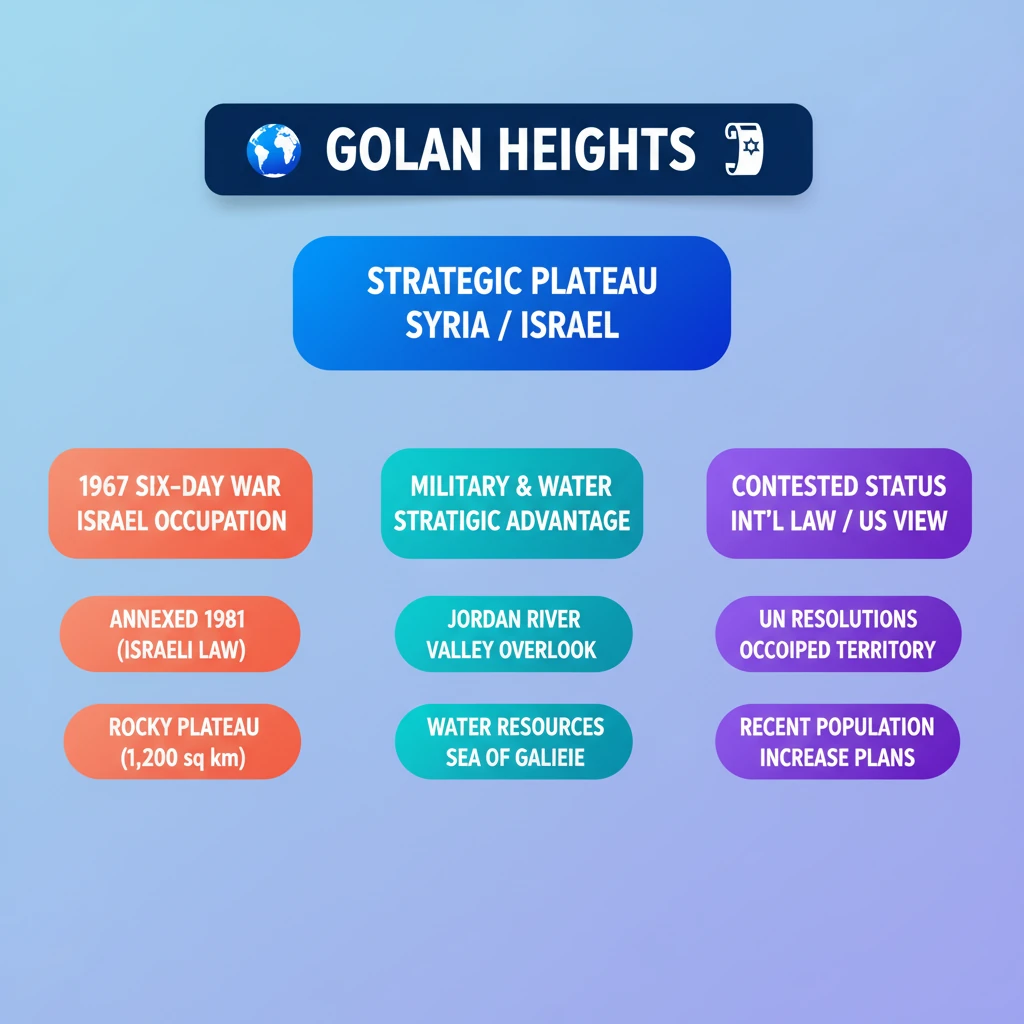
- •The Golan Heights is a 1,200 sq km rocky plateau, strategically located between Syria and Israel, overlooking the Jordan River Valley.
- •Israel captured most of the Golan Heights from Syria in the 1967 Six-Day War and annexed it in 1981, a move largely unrecognized internationally.
- •The area is a vital security buffer for Israel and a key source of water for the arid region.
- •The 1974 Agreement on Disengagement established a ceasefire line monitored by the UN Disengagement Observer Force (UNDOF).
- •Recent Israeli plans to double its population in the Golan Heights have drawn international condemnation, including a UNGA resolution supported by India, demanding Israel's withdrawal.
🧠 Memory Techniques
95% Verified Content
📚 Reference Sources
•United Nations official documents regarding UNDOF and resolutions on Golan Heights
•Reputable news sources for recent developments (e.g., Reuters, BBC, Al Jazeera)