What are the Other Ways to Study the Interior of the Earth? - Geography | UPSC Learning
Topics
0 topics • 0 completed
🔍
No topics match your search
What are the Other Ways to Study the Interior of the Earth?
Medium⏱️ 8 min read
geography
📖 Introduction
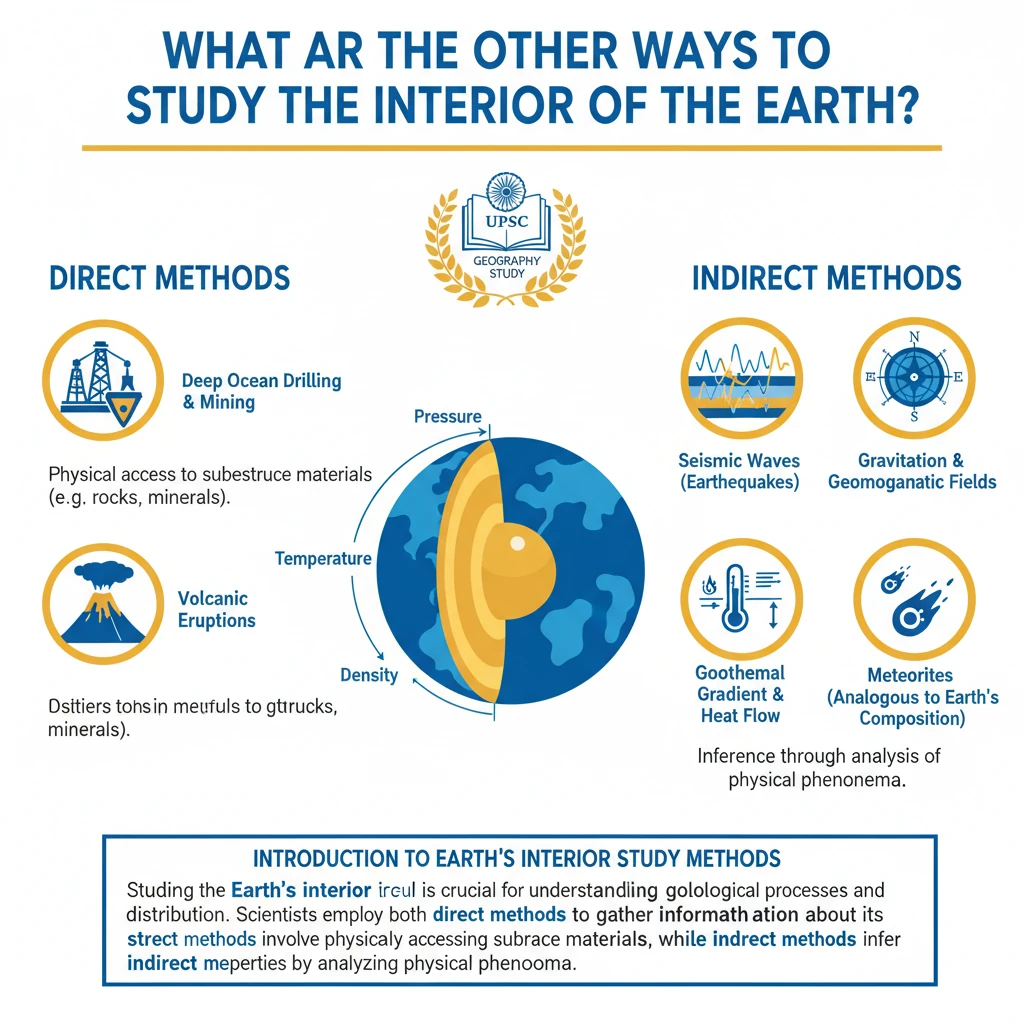
<h4>Introduction to Earth's Interior Study Methods</h4><p>Studying the <strong>Earth's interior</strong> is crucial for understanding geological processes and resource distribution. Scientists employ both <strong>direct</strong> and <strong>indirect methods</strong> to gather information about its structure and composition.</p><p><strong>Direct methods</strong> involve physically accessing subsurface materials, while <strong>indirect methods</strong> infer properties by analyzing physical phenomena.</p><h4>Direct Methods: Drilling Techniques</h4><p><strong>Direct methods</strong> primarily involve drilling into the Earth's crust to obtain samples and data. These techniques provide tangible evidence of subsurface geology.</p><h5>Rotary Drilling</h5><p><strong>Rotary drilling</strong> is a fundamental direct method used to penetrate deep into the Earth.</p><p>It employs a <strong>rotating drill bit</strong> designed to cut through various <strong>rock formations</strong>.</p><div class='info-box'><p>The <strong>drill bit</strong> is attached to a <strong>drill string</strong>, which is rotated by a specialized <strong>drilling rig</strong> on the surface.</p></div><p>During the process, <strong>drilling mud</strong> is continuously circulated. This mud serves to cool the bit and efficiently carry <strong>rock cuttings</strong> back to the surface for geological analysis.</p><h5>Percussion Drilling (Air Hammering)</h5><p><strong>Percussion drilling</strong>, also known as <strong>Air Hammering</strong>, offers a distinct approach to rock penetration.</p><p>This method uses <strong>high-pressure air</strong> to power a hammer, which rapidly impacts a <strong>drill bit</strong>.</p><div class='info-box'><p>The rapid impacts efficiently break rock, and the high-pressure air flushes out the resulting <strong>cuttings</strong>.</p></div><p>It is valued for its <strong>speed</strong>, <strong>cost-effectiveness</strong>, and <strong>versatility</strong>, especially in drilling through <strong>hard rock applications</strong>.</p><p>Common uses include <strong>mineral exploration</strong>, establishing <strong>water wells</strong>, and developing <strong>geothermal energy</strong> projects.</p><div class='key-point-box'><p>While highly efficient, percussion drilling can be quite <strong>noisy</strong> and is generally best suited for <strong>shallower depths</strong> compared to some other methods.</p></div><h5>Soyo Drilling Technique</h5><p>The <strong>Soyo drilling technique</strong> represents an advanced, hybrid approach to subsurface exploration.</p><div class='info-box'><p>It uniquely combines the strengths of both <strong>mud rotary drilling</strong> and <strong>percussion drilling (air hammering)</strong>.</p></div><p>This integration allows for enhanced efficiency and adaptability, making it suitable for a wider range of challenging geological conditions.</p><h5>Hydraulic Fracturing (Fracking)</h5><p><strong>Hydraulic Fracturing</strong>, commonly referred to as <strong>Fracking</strong>, is a specialized technique used to create or enlarge fractures within rock formations.</p><p>It involves injecting fluid at extremely <strong>high pressure</strong> into targeted subterranean rock layers.</p><div class='info-box'><p>The primary purpose is to enhance the flow of fluids, which is critical for <strong>sampling subsurface materials</strong> or stimulating <strong>resource production</strong> in various extraction operations.</p></div><p>This method is particularly significant in the recovery of unconventional oil and gas resources.</p><h4>Indirect Methods: Geophysical Surveys</h4><p><strong>Indirect methods</strong> infer the properties of the Earth's interior by analyzing physical measurements taken at the surface or from boreholes. These methods are non-invasive and cover vast areas.</p><h5>Geophysical Surveys Overview</h5><p><strong>Geophysical surveys</strong> are crucial indirect methods that map <strong>subsurface structures</strong> without direct physical penetration.</p><p>They employ a range of techniques, including <strong>seismic</strong>, <strong>magnetic</strong>, and <strong>gravitational methods</strong>.</p><div class='info-box'><p>These surveys are vital for identifying potential <strong>drilling targets</strong> and providing continuous data both before and during drilling operations.</p></div><p>They optimize exploration efforts and reduce the risks associated with drilling.</p><h5>Seismic Waves Analysis</h5><p>The study of <strong>seismic waves</strong> is arguably the most informative indirect method for understanding Earth's interior.</p><p>These waves are primarily generated by natural events like <strong>earthquakes</strong> or artificial sources, and they travel through the Earth's interior.</p><div class='key-point-box'><p>The behavior of seismic waves, specifically their <strong>refraction</strong> (bending) and <strong>reflection</strong> (bouncing back), provides critical insights.</p></div><p>By analyzing these behaviors, scientists can infer the <strong>composition</strong>, <strong>density</strong>, and <strong>physical properties</strong> of the Earth's different layers, including the <strong>crust</strong>, <strong>mantle</strong>, and <strong>core</strong> boundaries.</p><h5>Gravitational and Magnetic Field Measurements</h5><p>Variations in the Earth's natural <strong>gravitational field</strong> and <strong>magnetic field</strong> offer additional valuable information about its interior.</p><p>These measurements can indicate changes in the <strong>density</strong> and <strong>composition</strong> of the Earth's crust and deeper layers.</p><div class='info-box'><p>They are instrumental in identifying the boundaries between the Earth’s major concentric layers: the <strong>core</strong>, <strong>mantle</strong>, and <strong>crust</strong>.</p></div><p>Anomalies in these fields often point to geological structures or mineral deposits.</p><h5>Heat Flow Measurements</h5><p>Measuring the <strong>heat flow</strong> emanating from the Earth's interior provides crucial clues about its thermal state.</p><p>This outward flow of heat helps scientists understand the <strong>temperature distribution</strong> and <strong>thermal properties</strong> of the Earth's deep structure.</p><div class='key-point-box'><p>It contributes significantly to models of <strong>mantle convection</strong>, the driving force behind plate tectonics, and the overall dynamics of the Earth's internal heat engine.</p></div>
💡 Key Takeaways
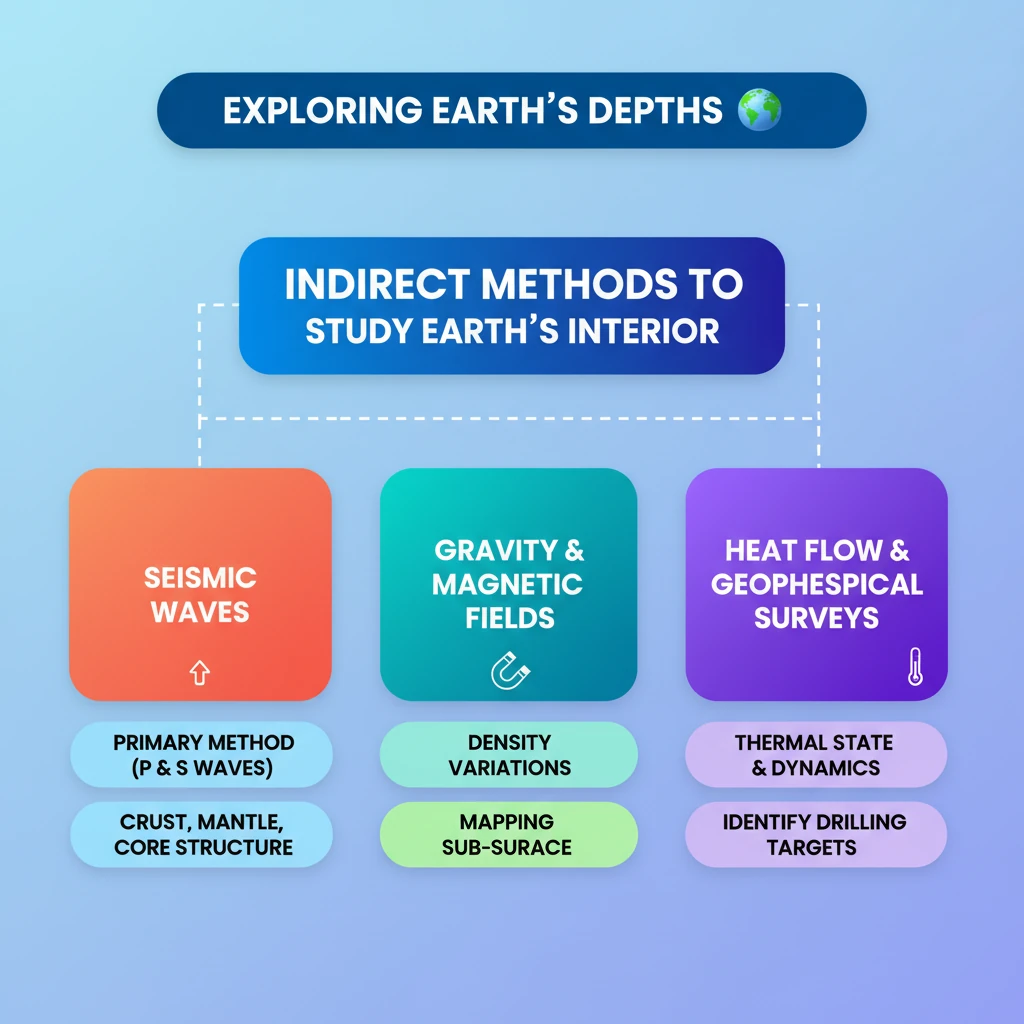
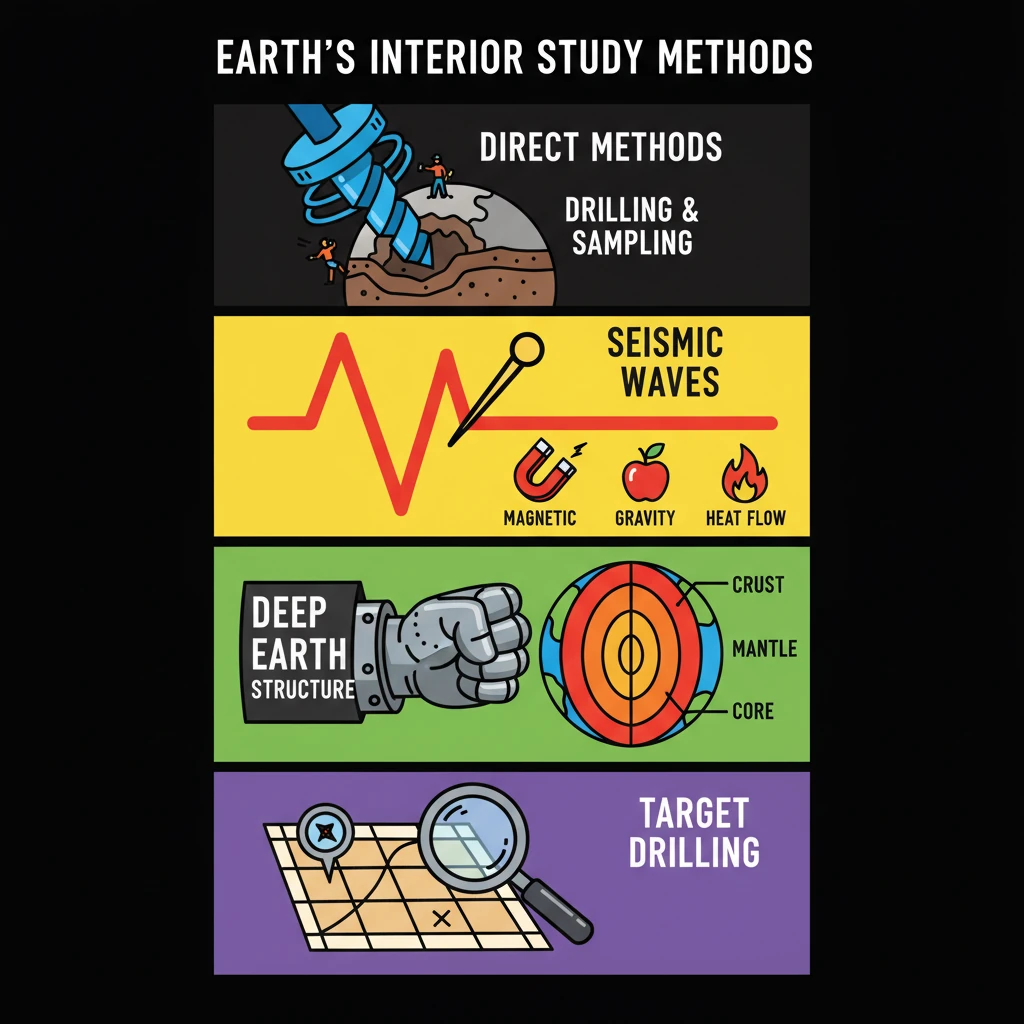
- •Earth's interior is studied via direct (drilling, sampling) and indirect (seismic, gravity, magnetic, heat flow) methods.
- •Direct methods like rotary, percussion, Soyo drilling, and hydraulic fracturing provide physical samples but are depth-limited.
- •Indirect methods, especially seismic wave analysis, are primary for understanding deep Earth structure (crust, mantle, core).
- •Geophysical surveys (seismic, magnetic, gravity) map subsurface structures and identify drilling targets.
- •Heat flow measurements provide insights into Earth's thermal state and internal dynamics.
- •These methods are critical for resource exploration, disaster management, and renewable energy development.
🧠 Memory Techniques
95% Verified Content