Anoxic Marine Basins - Geography | UPSC Learning
Topics
0 topics • 0 completed
🔍
No topics match your search
Anoxic Marine Basins
Medium⏱️ 7 min read
geography
📖 Introduction
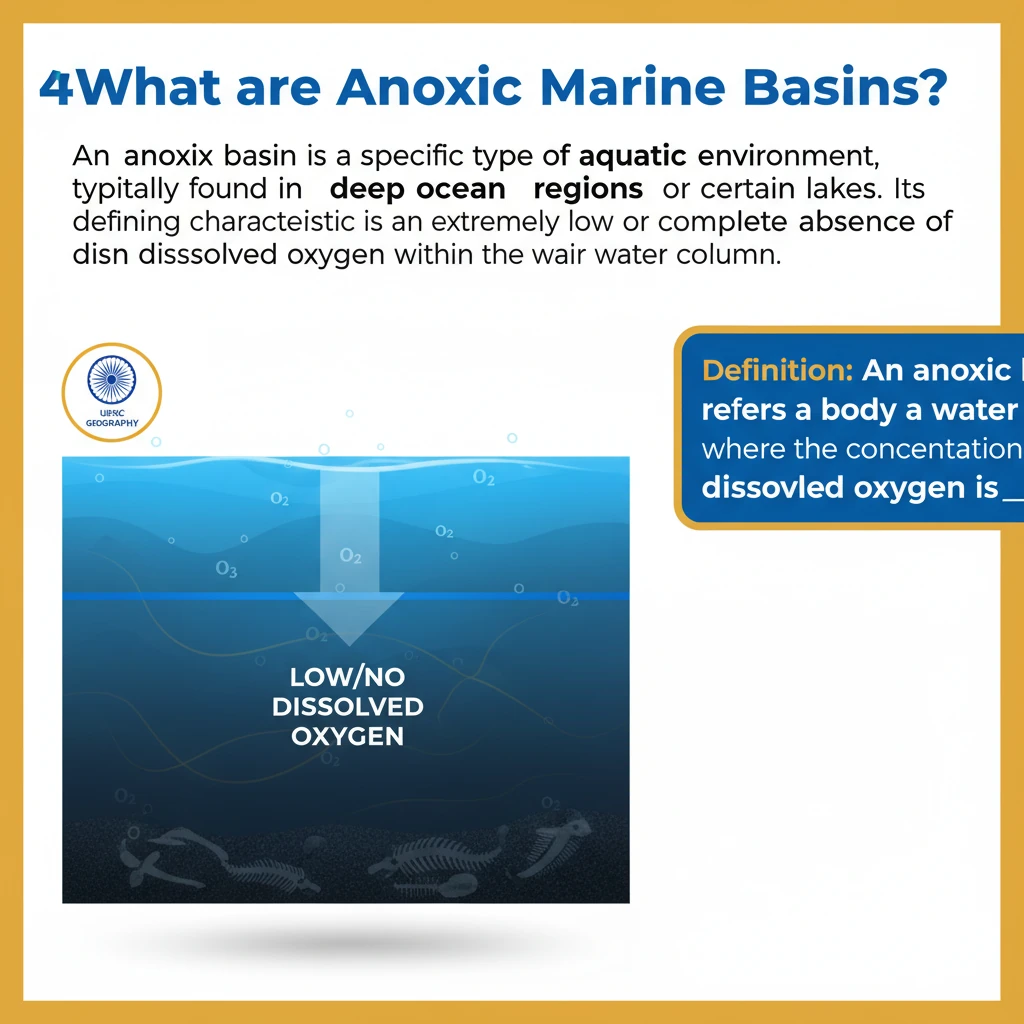
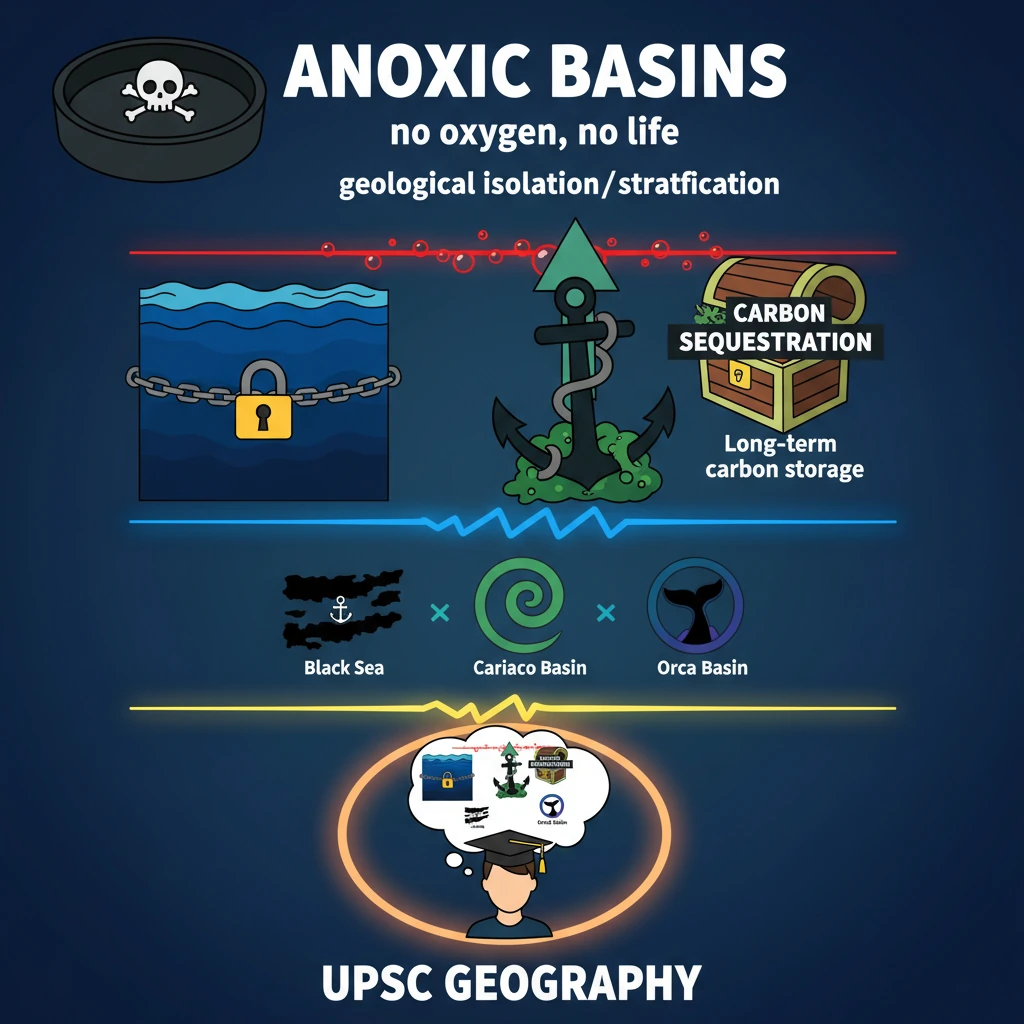
<h4>What are Anoxic Marine Basins?</h4><p>An <strong>anoxic basin</strong> is a specific type of aquatic environment, typically found in <strong>deep ocean regions</strong> or certain lakes. Its defining characteristic is an extremely low or complete absence of <strong>dissolved oxygen</strong> within the water column.</p><div class='info-box'><p><strong>Definition:</strong> An <strong>anoxic basin</strong> refers to a body of water where the concentration of <strong>dissolved oxygen</strong> is near zero (anoxia), making it inhospitable for most aerobic life forms.</p></div><h4>Conditions for Formation</h4><p>The lack of oxygen in these basins often results from their isolation from <strong>oxygen-rich surface waters</strong>. This isolation can be due to geological features, strong stratification, or limited water circulation.</p><p>Such conditions prevent the survival of most <strong>aerobic organisms</strong>, which require oxygen for respiration. However, specialized <strong>anaerobic microbes</strong> and certain fungi are adapted to thrive in these oxygen-depleted environments.</p><h4>Ecological Impact</h4><p>The unique chemistry of anoxic basins supports a distinct ecosystem. While most complex marine life cannot survive, a specialized microbial community plays crucial roles in nutrient cycling.</p><p>These environments are often considered extreme, yet they are vital for understanding ancient Earth conditions and the limits of life.</p><h4>Role in Carbon Sequestration</h4><div class='key-point-box'><p><strong>Carbon Sequestration:</strong> Anoxic basins are significant sites for <strong>long-term carbon sequestration</strong>. The extremely low oxygen levels drastically slow down the decay of <strong>organic material</strong>.</p></div><p>This reduced decomposition leads to the preservation of carbon-rich sediments. By trapping carbon in the deep sea, these basins contribute to reducing atmospheric <strong>carbon dioxide (CO2)</strong> levels over geological timescales.</p><h4>Examples of Anoxic Marine Basins</h4><div class='info-box'><ul><li><strong>Black Sea:</strong> One of the most prominent examples, with a vast anoxic zone below 150-200 meters.</li><li><strong>Cariaco Basin:</strong> Located in the <strong>Caribbean Sea</strong>, it is a deep-water anoxic basin with significant scientific importance.</li><li><strong>Orca Basin:</strong> Found in the <strong>northwest Gulf of Mexico</strong>, known for its hypersaline and anoxic conditions.</li></ul></div><h4>Distinction: Anoxic Basins vs. Dead Zones</h4><p>While related, it's important to differentiate between <strong>anoxic basins</strong> and <strong>dead zones</strong>. Anoxic basins are naturally occurring, often deep-sea features with persistent oxygen depletion.</p><p><strong>Dead zones</strong>, on the other hand, are typically <strong>hypoxic areas</strong> (low oxygen, but not entirely absent) in oceans and large lakes. They are often seasonal and primarily caused by human activities, such as nutrient runoff leading to eutrophication.</p><div class='info-box'><p><strong>Hypoxic Areas (Dead Zones):</strong> Regions where <strong>oxygen levels</strong> are too low to support most marine life, often occurring closer to coasts and linked to anthropogenic factors.</p></div>
💡 Key Takeaways
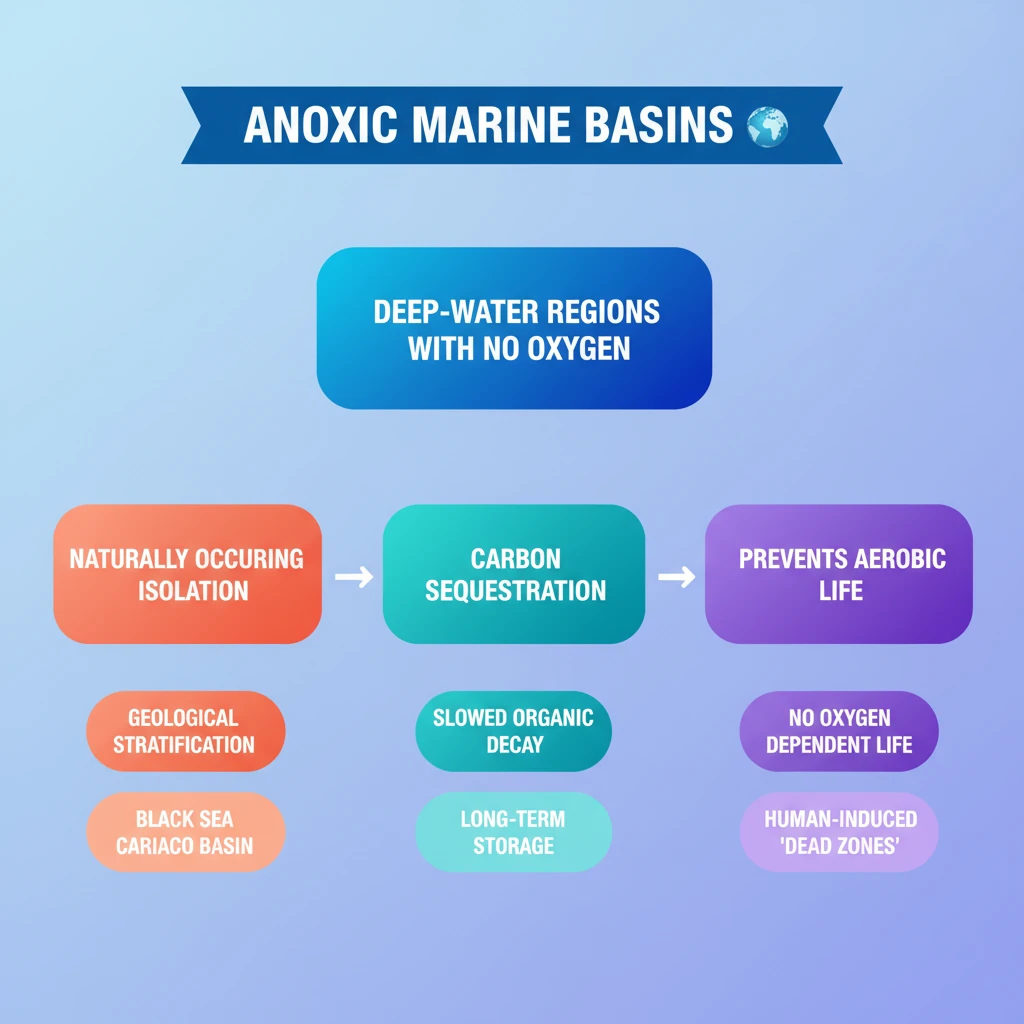
- •Anoxic basins are deep-water regions with extremely low or no dissolved oxygen, preventing aerobic life.
- •They are naturally occurring, often due to geological isolation or strong water stratification.
- •Anoxic basins are significant sites for long-term carbon sequestration due to slowed organic matter decay.
- •Examples include the Black Sea, Cariaco Basin, and Orca Basin.
- •Dead zones are human-induced hypoxic (low oxygen) areas, primarily caused by eutrophication.
- •Historical anoxic events (OAEs) indicate past climate-driven ocean deoxygenation.
- •Current relevance includes their role in climate regulation and the increasing threat of human-caused dead zones.
🧠 Memory Techniques
98% Verified Content
📚 Reference Sources
•National Oceanic and Atmospheric Administration (NOAA) resources on dead zones
•Oceanography textbooks (e.g., Tomczak & Godfrey, Open University)
•Scientific articles on anoxic basins (e.g., Black Sea, Cariaco Basin studies)