Gulf Stream and Climate Sensitivity - Geography | UPSC Learning
Topics
0 topics • 0 completed
🔍
No topics match your search
Gulf Stream and Climate Sensitivity
Medium⏱️ 8 min read
geography
📖 Introduction
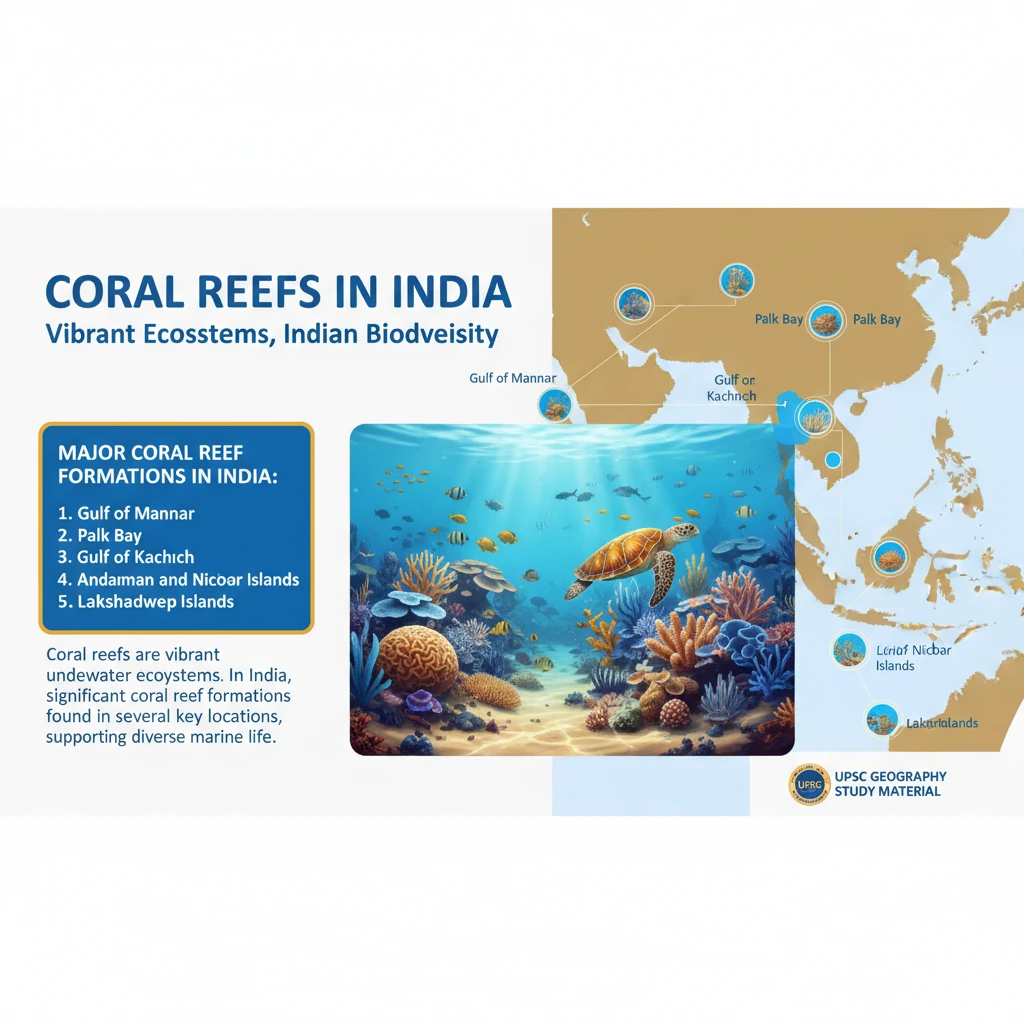
<h4>Coral Reefs in India</h4><p><strong>Coral reefs</strong> are vibrant underwater ecosystems. In India, significant <strong>coral reef formations</strong> are found in several key locations, supporting diverse marine life.</p><div class='info-box'><p>Major <strong>coral reef formations</strong> in India include:</p><ul><li><strong>Gulf of Mannar</strong></li><li><strong>Palk Bay</strong></li><li><strong>Gulf of Kachchh</strong></li><li><strong>Andaman and Nicobar Islands</strong></li><li><strong>Lakshadweep Islands</strong></li></ul></div><h4>Importance of Coral Reefs</h4><p><strong>Coral reefs</strong> are incredibly important for global marine biodiversity and human well-being. They play a critical role despite covering a small area of the oceans.</p><div class='info-box'><p><strong>Ecological Significance:</strong></p><ul><li>Cover only <strong>1%</strong> of the world's oceans.</li><li>Provide habitat for at least <strong>25%</strong> of the world's marine species.</li></ul></div><div class='key-point-box'><p><strong>Medicinal Value:</strong> Many drugs are being developed from <strong>reef organisms</strong> to treat serious diseases like <strong>cancer</strong>, <strong>arthritis</strong>, and various <strong>infections</strong>.</p><p><strong>Shoreline Protection:</strong> <strong>Coral reefs</strong> act as natural barriers, protecting shorelines by mitigating the impact of <strong>waves</strong>, <strong>storms</strong>, and <strong>floods</strong>. They also contribute to <strong>beach formation</strong>.</p><p><strong>Ecosystem Services:</strong> They host important <strong>filter feeders</strong>, such as <strong>sponges</strong>, which cleanse oceans of toxins. They also support extensive <strong>plant life</strong> that absorbs <strong>carbon dioxide</strong> and releases <strong>oxygen</strong>.</p></div><h4>Coral Bleaching Explained</h4><p><strong>Coral bleaching</strong> is a severe threat to coral reefs globally. It occurs when corals expel the symbiotic algae living in their tissues, leading to a loss of color and increased vulnerability.</p><div class='info-box'><p><strong>Process of Coral Bleaching:</strong></p><ul><li><strong>Stress Factors:</strong> Corals become stressed due to factors like increased <strong>ocean temperature</strong> or <strong>pollution</strong>.</li><li><strong>Algae Expulsion:</strong> The symbiotic algae, known as <strong>zooxanthellae</strong>, leave the coral's tissue.</li><li><strong>Color Loss:</strong> Without the algae, corals lose their vibrant colors, turning <strong>white</strong> or very <strong>pale</strong>.</li><li><strong>Vulnerability:</strong> Bleached corals become more susceptible to <strong>disease</strong> and their food supply is disrupted, often leading to death if conditions do not improve.</li></ul></div><h4>Gulf Stream and Climate Sensitivity: Why in News?</h4><p>A recent study has brought the <strong>Gulf Stream's</strong> dynamics and its sensitivity to climate change into focus. This research provides crucial insights into past and future climate patterns.</p><div class='info-box'><p><strong>Recent Study Findings:</strong></p><ul><li>A study published in <strong>Nature</strong> revealed the <strong>Gulf Stream</strong> was significantly stronger during the <strong>last ice age</strong> (approximately <strong>20,000 years ago</strong>).</li><li>This increased strength was attributed to more powerful <strong>winds</strong> across the <strong>subtropical North Atlantic</strong>.</li></ul></div><div class='exam-tip-box'><p><strong>UPSC Insight:</strong> This finding highlights the <strong>Gulf Stream’s sensitivity</strong> to changes in <strong>wind patterns</strong>. Any future weakening of these winds due to <strong>climate change</strong> could have significant impacts on global climate, a key topic for <strong>GS Paper I (Geography)</strong> and <strong>GS Paper III (Environment)</strong>.</p></div><h4>Understanding the Gulf Stream</h4><p>The <strong>Gulf Stream</strong> is a vital component of the global ocean circulation system, playing a significant role in regional climate regulation.</p><div class='info-box'><p>The <strong>Gulf Stream</strong> is a powerful, warm <strong>ocean current</strong> originating in the <strong>Gulf of Mexico</strong>. It flows along the eastern coast of <strong>North America</strong>.</p></div><p>After flowing northwards, it extends across the <strong>Atlantic Ocean</strong> towards <strong>Western Europe</strong>. This current significantly influences the climate of <strong>Western Europe</strong>, making it much warmer than it would otherwise be at similar latitudes.</p><h4>Atlantic Meridional Overturning Circulation (AMOC)</h4><p>The <strong>Atlantic Meridional Overturning Circulation (AMOC)</strong> is a critical part of the global ocean conveyor belt, essential for distributing heat and nutrients across the planet.</p><h4>What is AMOC?</h4><div class='info-box'><p>The <strong>AMOC</strong> is a major system of <strong>ocean currents</strong> that forms part of the global <strong>ThermoHaline Circulation (THC)</strong>. It is responsible for distributing <strong>heat</strong> and <strong>nutrients</strong> across the world's oceans.</p></div><p>The <strong>AMOC</strong> operates by transporting warm surface waters from the <strong>tropics</strong> to the <strong>Northern Hemisphere</strong>. As this water cools, it becomes denser and sinks.</p><p>It then returns as a bottom current through the <strong>South Atlantic</strong>, eventually spreading to all ocean basins via the <strong>Antarctic Circumpolar Current (ACC)</strong>, which is the only current circulating the entire globe.</p><h4>Implications of AMOC Decline</h4><p>A weakening of the <strong>AMOC</strong>, including the <strong>Gulf Stream</strong>, could have profound and widespread consequences for global climate patterns and regional weather.</p><div class='key-point-box'><p><strong>Potential Impacts of Weakened AMOC:</strong></p><ul><li><strong>Europe:</strong> Could experience significantly colder temperatures.</li><li><strong>Rainfall:</strong> Reduction in rainfall across various regions.</li><li><strong>El Niño:</strong> Potential influence on the <strong>El Niño Southern Oscillation (ENSO)</strong> phenomenon.</li><li><strong>Monsoons:</strong> Possible shifts in <strong>monsoon patterns</strong> in <strong>South America</strong> and <strong>Africa</strong>.</li></ul></div><h4>Causes of AMOC Decline</h4><p>Scientists predict that <strong>global warming</strong> is a primary driver behind the potential weakening of major ocean systems like the <strong>AMOC</strong>.</p><ul><li><strong>Melting Ice:</strong> Freshwater input from melting <strong>Greenland ice</strong> and the <strong>“Last Ice Area”</strong> reduces water <strong>salinity</strong> and <strong>density</strong>.</li><li><strong>Impeded Flow:</strong> This decrease in density impedes the normal sinking process and flow of the <strong>AMOC</strong>.</li><li><strong>Precipitation and Runoff:</strong> Increased precipitation and river runoff, particularly in the <strong>Indian Ocean</strong>, may also contribute to impacting the <strong>AMOC</strong>.</li></ul><h4>Crucial Role of AMOC</h4><div class='key-point-box'><p>The <strong>AMOC</strong> is critically important for <strong>redistributing heat</strong> around the globe and effectively <strong>regulating global weather patterns</strong>, making its stability vital for climate stability.</p></div>
💡 Key Takeaways
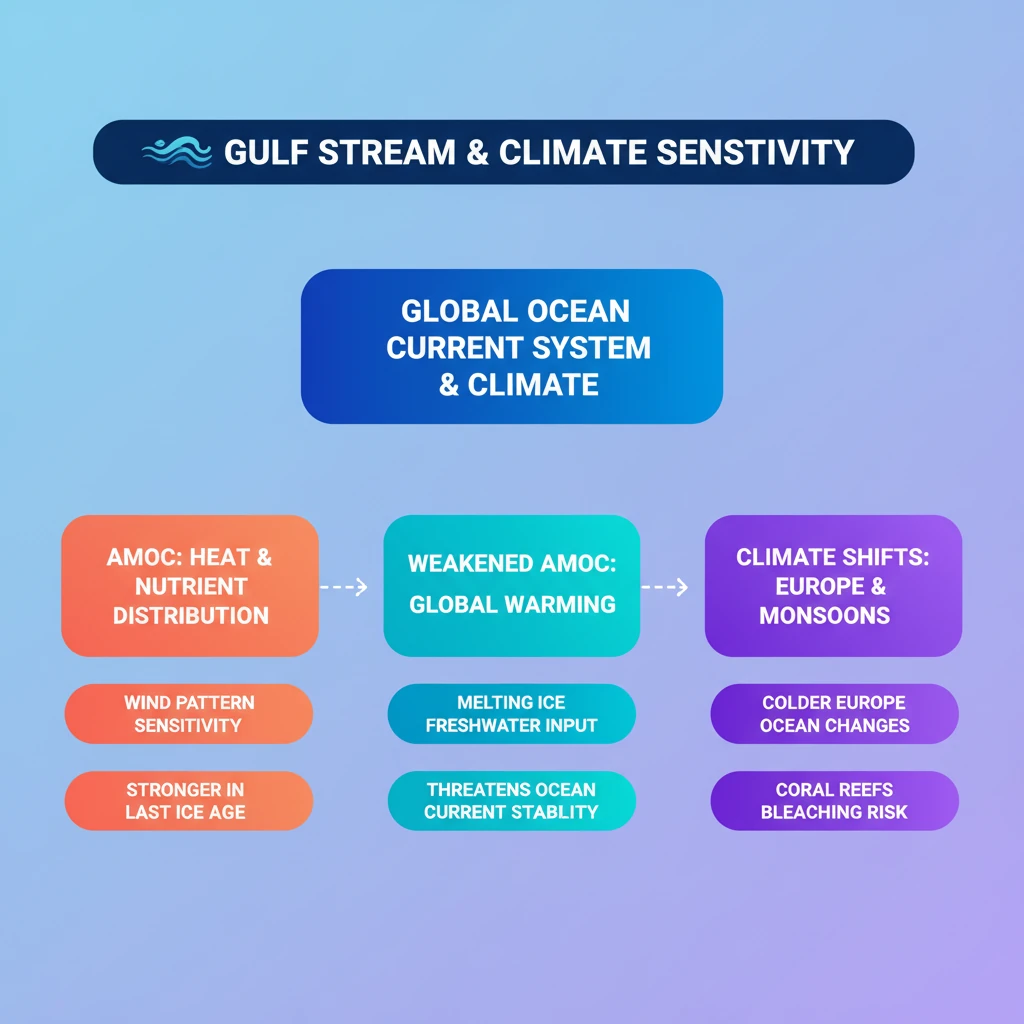
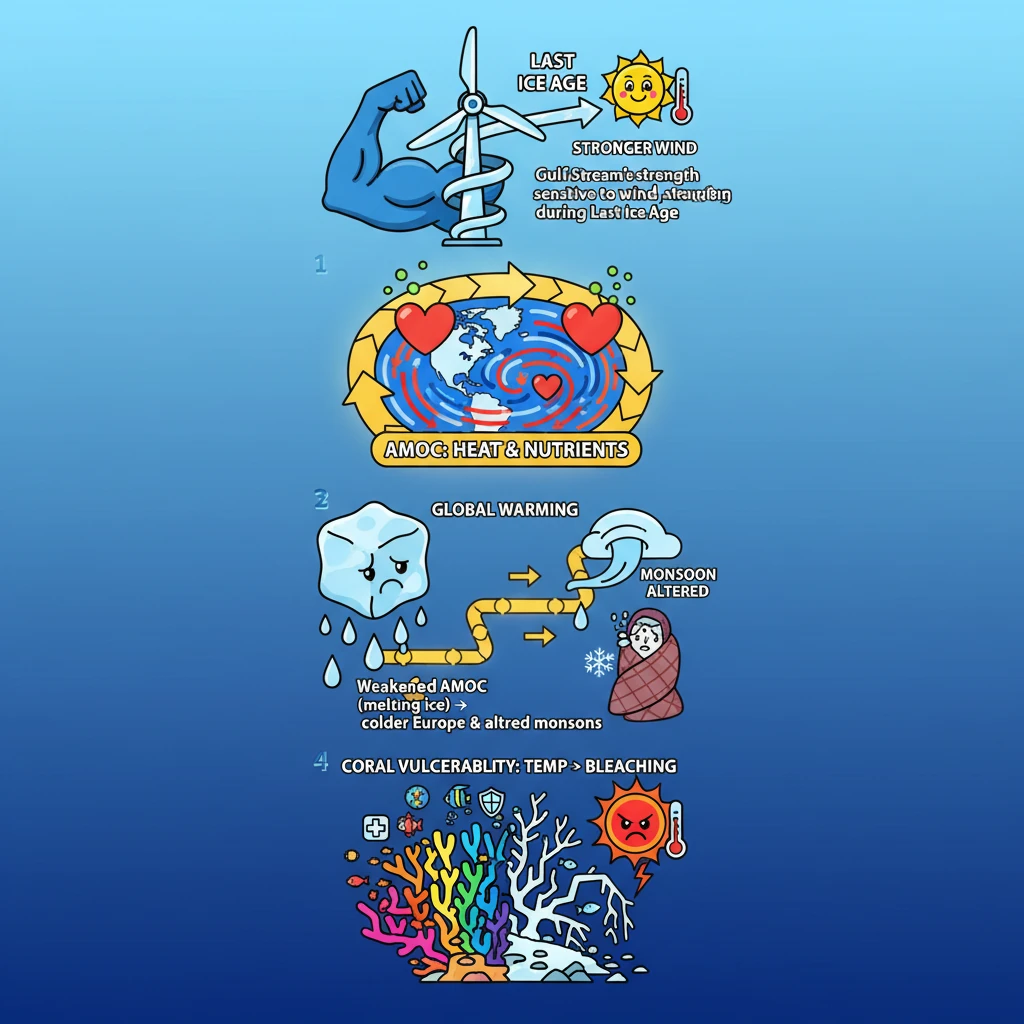
- •The Gulf Stream's strength is sensitive to wind patterns, as evidenced by its stronger flow during the Last Ice Age.
- •The Atlantic Meridional Overturning Circulation (AMOC) is a vital global ocean current system distributing heat and nutrients.
- •A weakened AMOC, driven by global warming and freshwater input from melting ice, could cause significant climate shifts, including colder Europe and altered monsoons.
- •Coral reefs are crucial marine ecosystems, providing habitat, medicinal resources, and shoreline protection, but are highly vulnerable to temperature-induced bleaching.
- •Climate change poses a serious threat to the stability of major ocean currents and coral reef health, with far-reaching global consequences.
🧠 Memory Techniques
95% Verified Content
📚 Reference Sources
•Nature (journal) - referenced study on Gulf Stream during last ice age