Artesian Well in Rajasthan and Tethys Sea - Geography | UPSC Learning
Topics
0 topics • 0 completed
🔍
No topics match your search
Artesian Well in Rajasthan and Tethys Sea
Medium⏱️ 10 min read
geography
📖 Introduction
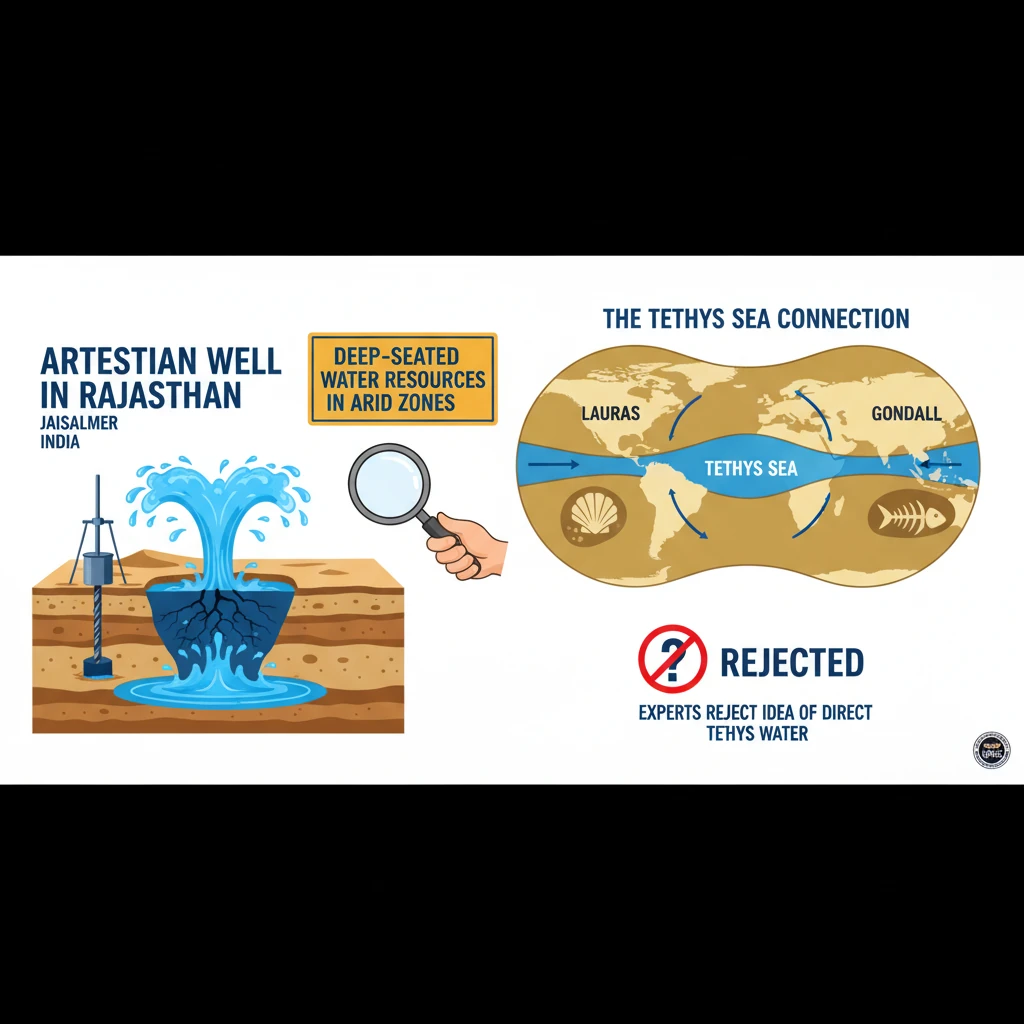
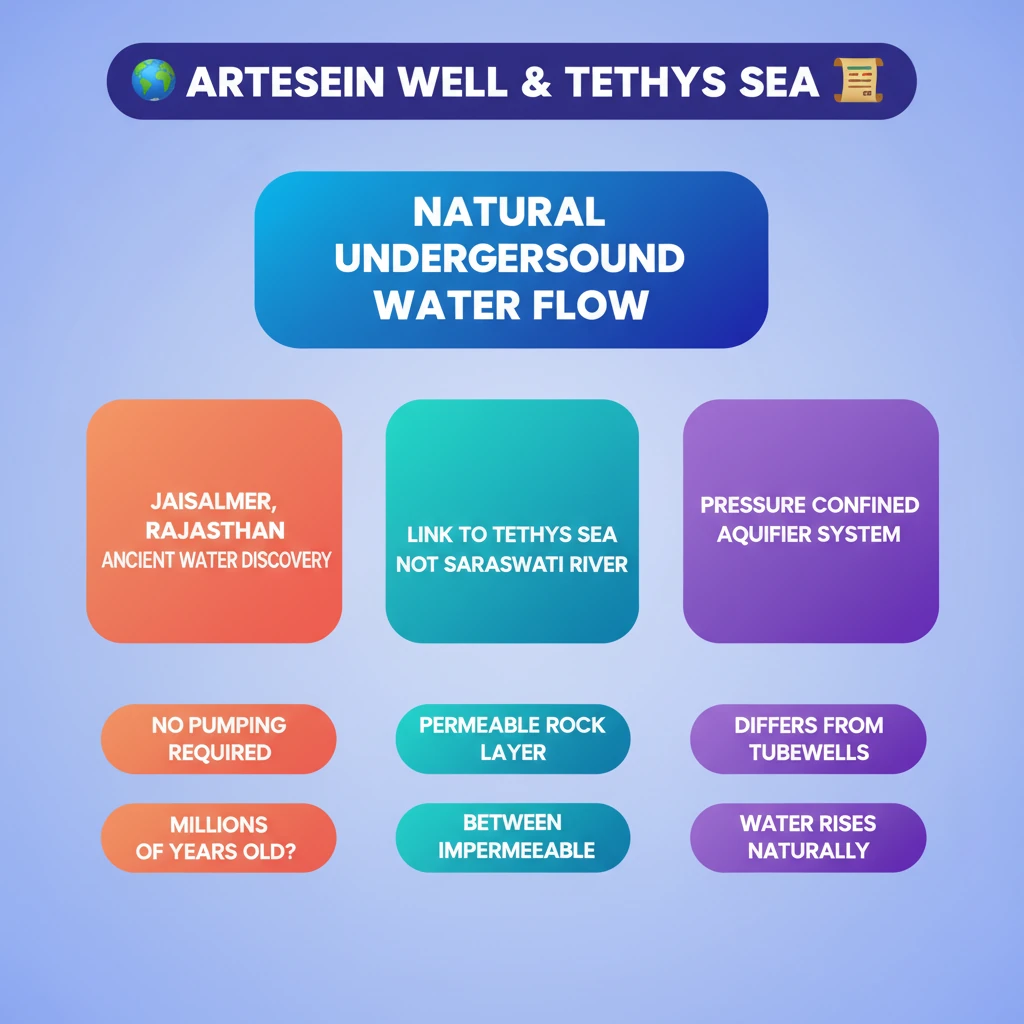
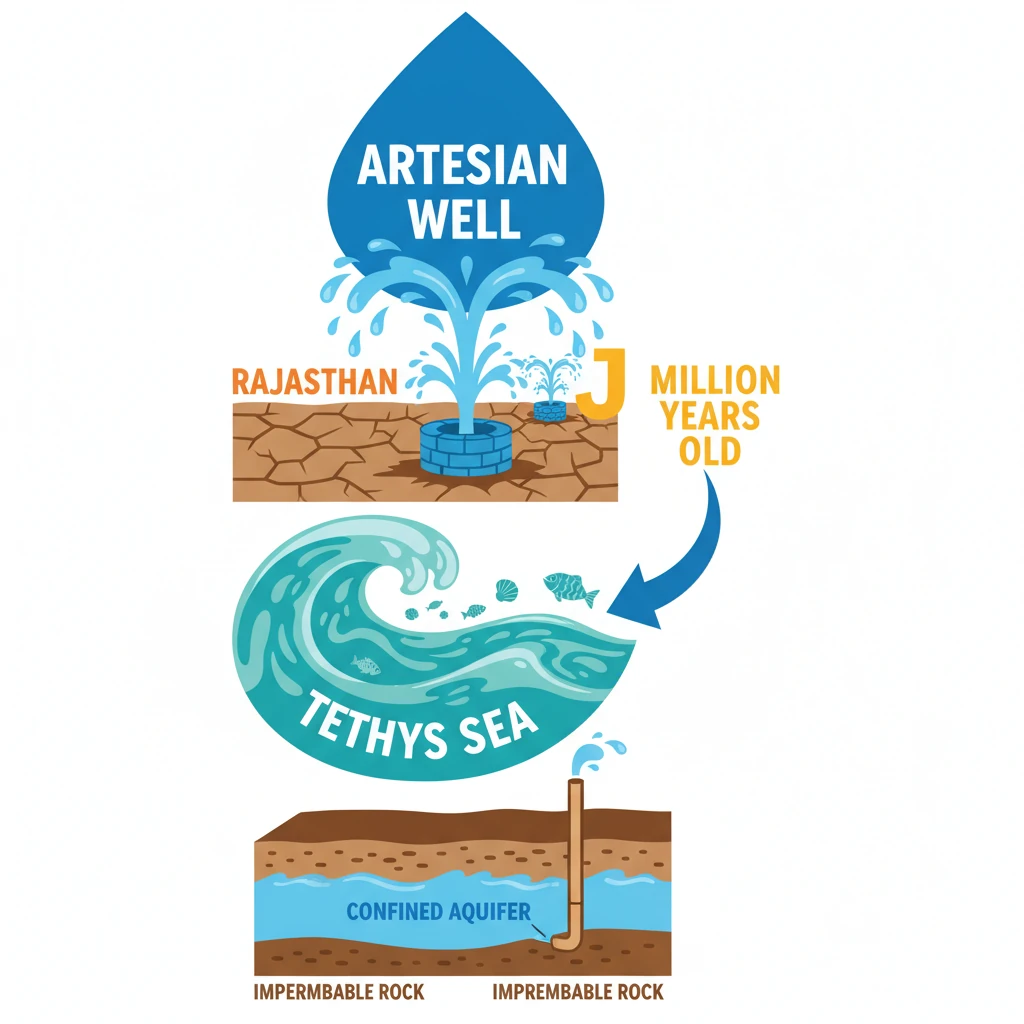
<h4>Introduction: Artesian Well in Rajasthan</h4><p>Recently, a significant amount of water began gushing out from underground in <strong>Jaisalmer, Rajasthan</strong>. This phenomenon has been attributed to the presence of an <strong>Artesian Well</strong> in the region.</p><div class='key-point-box'><p>The discovery has sparked interest regarding <strong>deep-seated water resources</strong> in India's arid zones.</p></div><h4>The Tethys Sea Connection</h4><p>Experts have rejected the idea that this gushing water is linked to the ancient <strong>Saraswati river</strong>.</p><p>Instead, they suggest the water may be <strong>millions of years old</strong>, originating from the ancient <strong>Tethys Sea</strong>, which existed in pre-Vedic times.</p><div class='exam-tip-box'><p>Understanding the distinction between historical rivers and ancient geological formations like the <strong>Tethys Sea</strong> is crucial for <strong>UPSC Geography</strong>.</p></div><h4>What is an Artesian Well?</h4><div class='info-box'><p>An <strong>artesian well</strong> is a unique type of well where water rises naturally to the surface under its own <strong>pressure</strong>.</p><p>Crucially, it does not require any <strong>external pumping</strong> to bring the water up.</p></div><p>This natural flow occurs when water is trapped within a <strong>confined aquifer</strong>, where it is subjected to significant <strong>hydrostatic pressure</strong>.</p><p>The water within such an aquifer is often described as <strong>“confined”</strong> because it is enclosed by layers of hardy, impermeable materials both above and below it.</p><h4>Formation of Artesian Wells</h4><p><strong>Artesian wells</strong> are formed when a bore or well penetrates a <strong>confined aquifer</strong>.</p><div class='info-box'><p>A <strong>confined aquifer</strong> is essentially a layer of <strong>permeable rock or sediment</strong> (like sandstone or limestone) that is capable of holding water.</p><p>This permeable layer is typically sandwiched between two layers of <strong>impermeable rock or sediment</strong>, such as <strong>clay or shale</strong>, which prevent the water from escaping vertically.</p></div><h4>Global Locations of Famous Artesian Wells</h4><ul><li>The <strong>Great Artesian Basin</strong>, located primarily in <strong>Australia</strong>, is one of the largest and most famous artesian systems globally.</li><li>The <strong>Dakota aquifer</strong> in the <strong>United States</strong> is another prominent example of a significant confined aquifer.</li><li>Various regions across <strong>Africa</strong> also feature notable <strong>artesian wells</strong>, providing vital water resources.</li></ul><h4>Artesian Wells vs. Tube Wells: A Comparison</h4><div class='info-box'><p><strong>Artesian water</strong> can naturally rise to the surface on its own due to inherent pressure.</p><p>It is typically found much <strong>deeper</strong> beneath the Earth’s surface compared to conventional groundwater sources.</p><p>In contrast, <strong>tube wells</strong> always require <strong>external power</strong>, such as electric pumps, to draw water to the surface.</p></div><h4>Etymology: Origin of the Term 'Artesian'</h4><p>The name <strong>Artesian</strong> has historical roots, derived from the town of <strong>Artois</strong> in <strong>France</strong>.</p><p>This region was historically known as the old <strong>Roman city of Artesium</strong>.</p><p>It was in <strong>Artois</strong> during the <strong>Middle Ages</strong> that some of the earliest and best-known flowing <strong>artesian wells</strong> were successfully drilled, lending the phenomenon its enduring name.</p>
💡 Key Takeaways
- •Artesian wells are naturally flowing wells where water rises under pressure from a confined aquifer without pumping.
- •A recent discovery in Jaisalmer, Rajasthan, is attributed to an artesian well, with water potentially millions of years old.
- •Experts link the Jaisalmer water's origin to the ancient Tethys Sea, rejecting the Saraswati river connection.
- •Artesian wells form when a well penetrates a permeable aquifer sandwiched between impermeable rock layers.
- •They differ from tube wells, which require external power for water extraction.
- •Such discoveries are crucial for water security in arid regions and highlight the importance of deep geological studies.
🧠 Memory Techniques
95% Verified Content
📚 Reference Sources
•NCERT Geography textbooks (Class XI - Fundamentals of Physical Geography)
•Geological Survey of India (GSI) reports on Rajasthan's hydrogeology
•Reputable news articles on the Jaisalmer discovery (e.g., The Hindu, Indian Express)