How are Landslides in Himalayan Region Different from Landslides in Western Ghats? - Geography | UPSC Learning
Topics
0 topics • 0 completed
🔍
No topics match your search
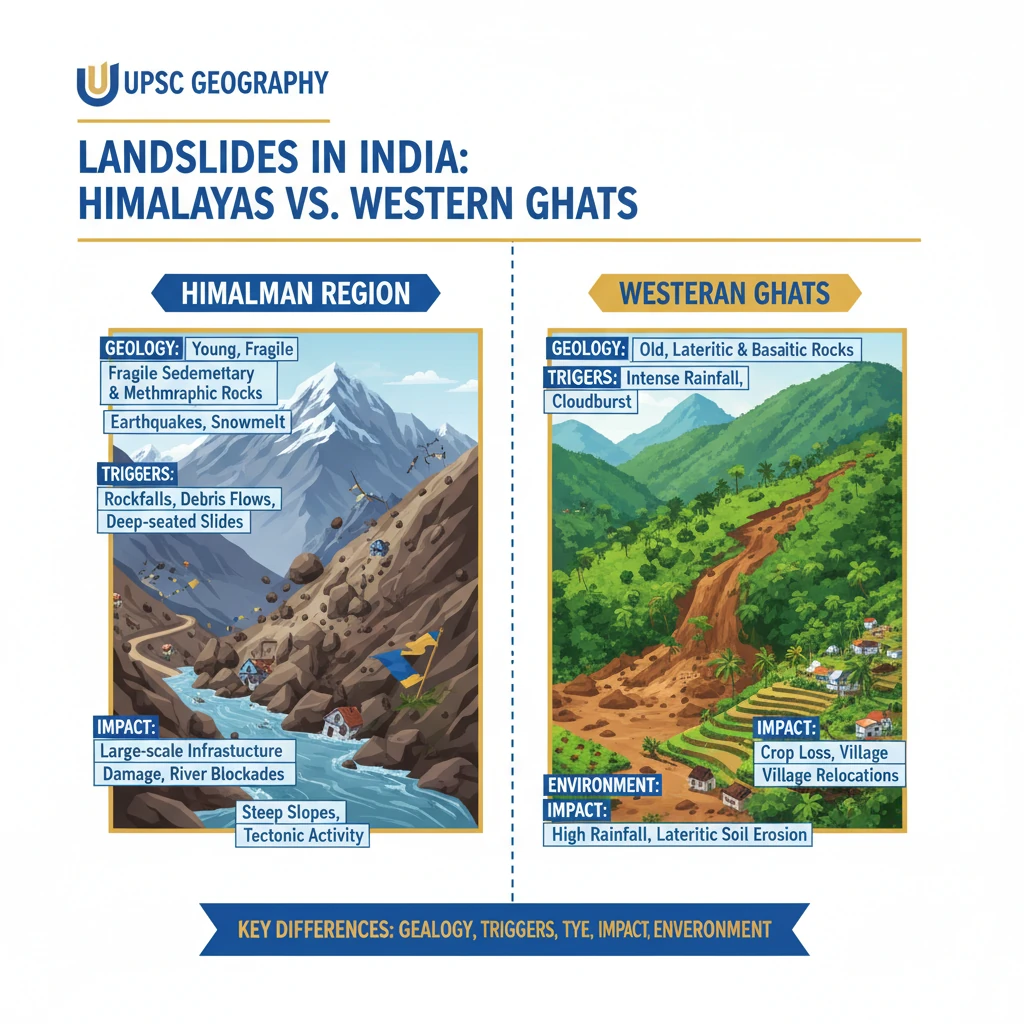
How are Landslides in Himalayan Region Different from Landslides in Western Ghats?
Medium⏱️ 10 min read
geography
📖 Introduction
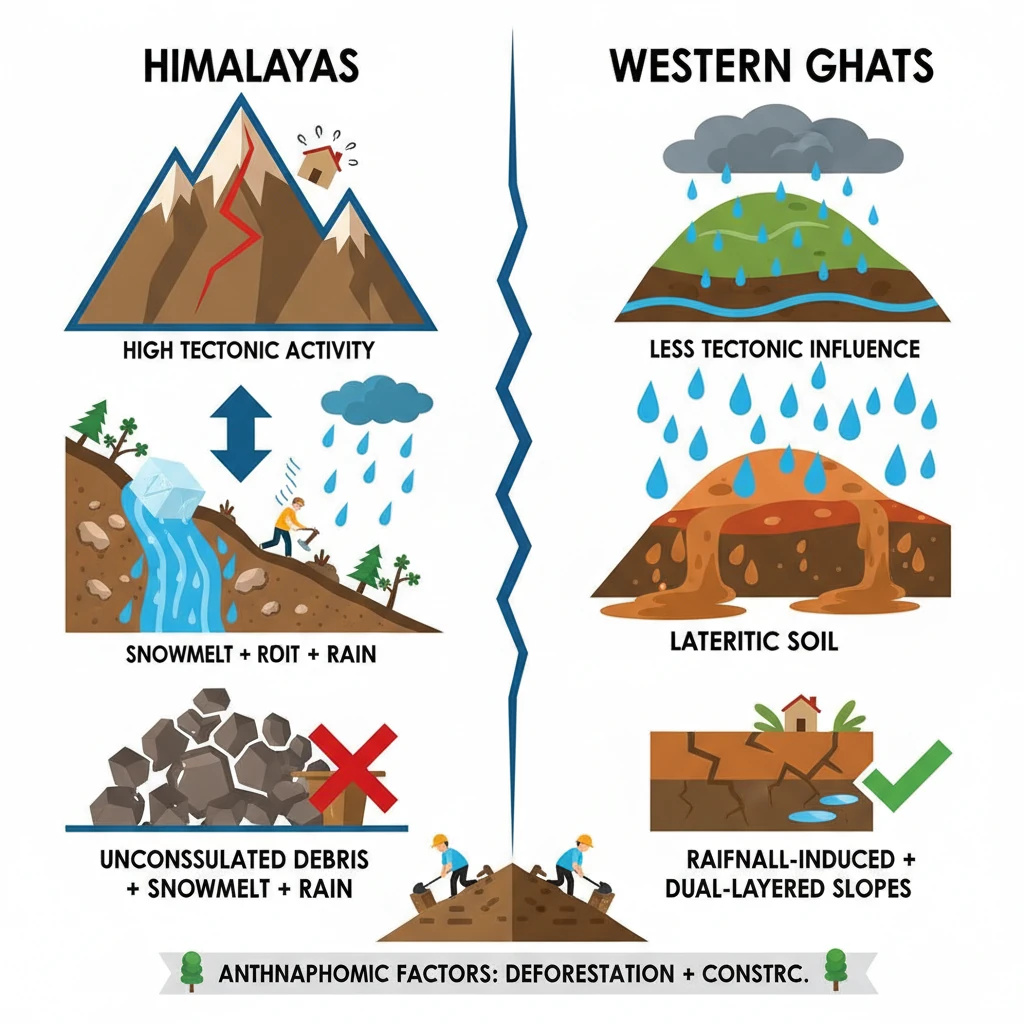
<h4>Introduction to Landslides</h4><p>A <strong>landslide</strong> is a form of <strong>mass wasting</strong> that involves the movement of a mass of rock, debris, or earth down a slope. These natural hazards are significantly influenced by a combination of geological, climatic, and anthropogenic factors, leading to distinct characteristics across different geographical regions.</p><p>In India, the <strong>Himalayan region</strong> and the <strong>Western Ghats</strong> are two prominent zones highly susceptible to landslides. However, the underlying causes and manifestations of these events differ considerably between the two.</p><h4>Anthropogenic Factors</h4><p><strong>Anthropogenic factors</strong> play a crucial role in exacerbating slope instability in both the Himalayas and the Western Ghats. Human activities often disrupt the natural equilibrium of slopes, increasing landslide risks.</p><p><strong>Deforestation</strong> is a primary concern. The removal of vegetation and tree roots significantly destabilizes slopes by eliminating the natural reinforcement provided by root systems and impairing the soil's capacity for water drainage.</p><p>Activities such as <strong>mining</strong>, <strong>road construction</strong>, and <strong>urban development</strong> further contribute to the problem. These activities disrupt natural drainage patterns and alter the load distribution on slopes, substantially raising the likelihood of landslides.</p><h4>Geological Factors</h4><p><strong>Geological factors</strong> are fundamental in determining the inherent stability of slopes. These include the <strong>material composition</strong>, <strong>structure</strong>, and degree of <strong>weathering</strong> of the rocks and soil present in a region.</p><p>The <strong>Western Ghats</strong>, for instance, are characterized by steep, dual-layered terrain. This geological structure makes them particularly prone to landslides when heavy monsoon rainwater saturates the soil, which increases its weight and simultaneously reduces its overall stability.</p><h4>Comparative Analysis: Himalayas vs. Western Ghats</h4><p>Landslides in India exhibit distinct characteristics based on their geographical location. A comparative analysis of the <strong>Himalayan region</strong> and the <strong>Western Ghats</strong> reveals significant differences in their underlying causes and manifestations.</p><div class='key-point-box'><p>Understanding these regional variations is crucial for effective <strong>disaster management</strong> and <strong>mitigation strategies</strong>.</p></div><table class='info-table'><tr><th>Cause</th><th>Himalayas</th><th>Western Ghats</th></tr><tr><td><strong>Slope and Terrain</strong></td><td><strong>Steep</strong>, <strong>rugged terrain</strong> with high-altitude, unstable slopes.</td><td><strong>Less steep</strong> and more <strong>gradual slopes</strong>, which generally reduces landslide risk compared to the Himalayas.</td></tr><tr><td><strong>Tectonic Activity</strong></td><td>Highly <strong>tectonically active region</strong> due to the ongoing collision of the <strong>Indian and Eurasian plates</strong>. This frequently triggers <strong>earthquakes</strong>, which are major landslide initiators.</td><td><strong>Less tectonic activity</strong>, resulting in minimal earthquake-triggered landslides.</td></tr><tr><td><strong>Rainfall and Snowmelt</strong></td><td>Heavy <strong>monsoon rainfall</strong> combined with rapid <strong>snowmelt from glaciers</strong>. This significantly increases soil saturation and instability, leading to frequent landslides.</td><td>Heavy rainfall during the <strong>monsoon season</strong> is a primary trigger. However, there is <strong>no snowmelt</strong> component, which differentiates the landslide triggers from the Himalayas.</td></tr><tr><td><strong>Soil and Rock Composition</strong></td><td>Characterized by <strong>unconsolidated debris</strong> (such as <strong>scree</strong> and <strong>moraine</strong>) and fragile rock formations. These are inherently prone to displacement and collapse.</td><td>Composed of more <strong>stable soil</strong> and <strong>rock types</strong>, which generally reduces the frequency of landslide occurrences.</td></tr><tr><td><strong>Deforestation</strong></td><td>High rates of <strong>deforestation</strong> for agriculture, timber, and fuel. This widespread removal of forest cover significantly weakens soil cohesion and stability.</td><td>Comparatively <strong>less deforestation</strong> than the Himalayas. However, it remains a significant environmental concern and a contributing factor to landslides in localized areas.</td></tr></table><div class='exam-tip-box'><p>For UPSC Mains, a comparative table like this is an excellent way to present information concisely and score well. Remember to highlight the <strong>underlying geological and climatic differences</strong>.</p></div>
💡 Key Takeaways
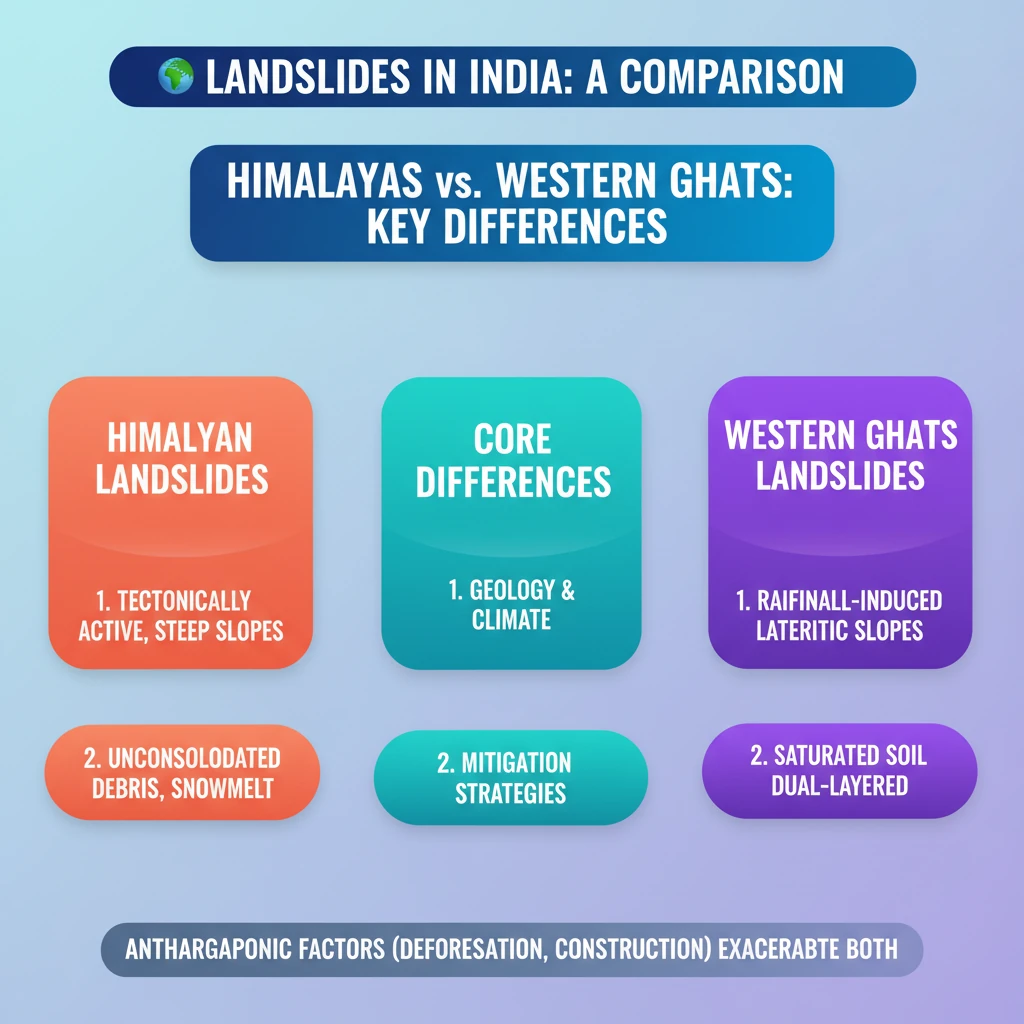
- •Himalayan landslides are driven by high tectonic activity, steep slopes, unconsolidated debris, and snowmelt, in addition to heavy rainfall and deforestation.
- •Western Ghats landslides are primarily rainfall-induced on less steep but dual-layered, lateritic slopes, with less tectonic influence.
- •Anthropogenic factors like deforestation and construction exacerbate landslide risks in both regions.
- •Soil and rock composition (fragile in Himalayas, stable but saturated in Western Ghats) are key differentiating geological factors.
- •Effective mitigation requires region-specific strategies, integrating geological, climatic, and human factors.
🧠 Memory Techniques
95% Verified Content
📚 Reference Sources
•Geological Survey of India (GSI) publications on Landslides
•NCERT Geography Textbooks (Class XI - Physical Geography)
•Drishti IAS Summary (provided as source material)