Lake-Effect Snow - Geography | UPSC Learning
Topics
0 topics • 0 completed
🔍
No topics match your search
Lake-Effect Snow
Medium⏱️ 4 min read
geography
📖 Introduction
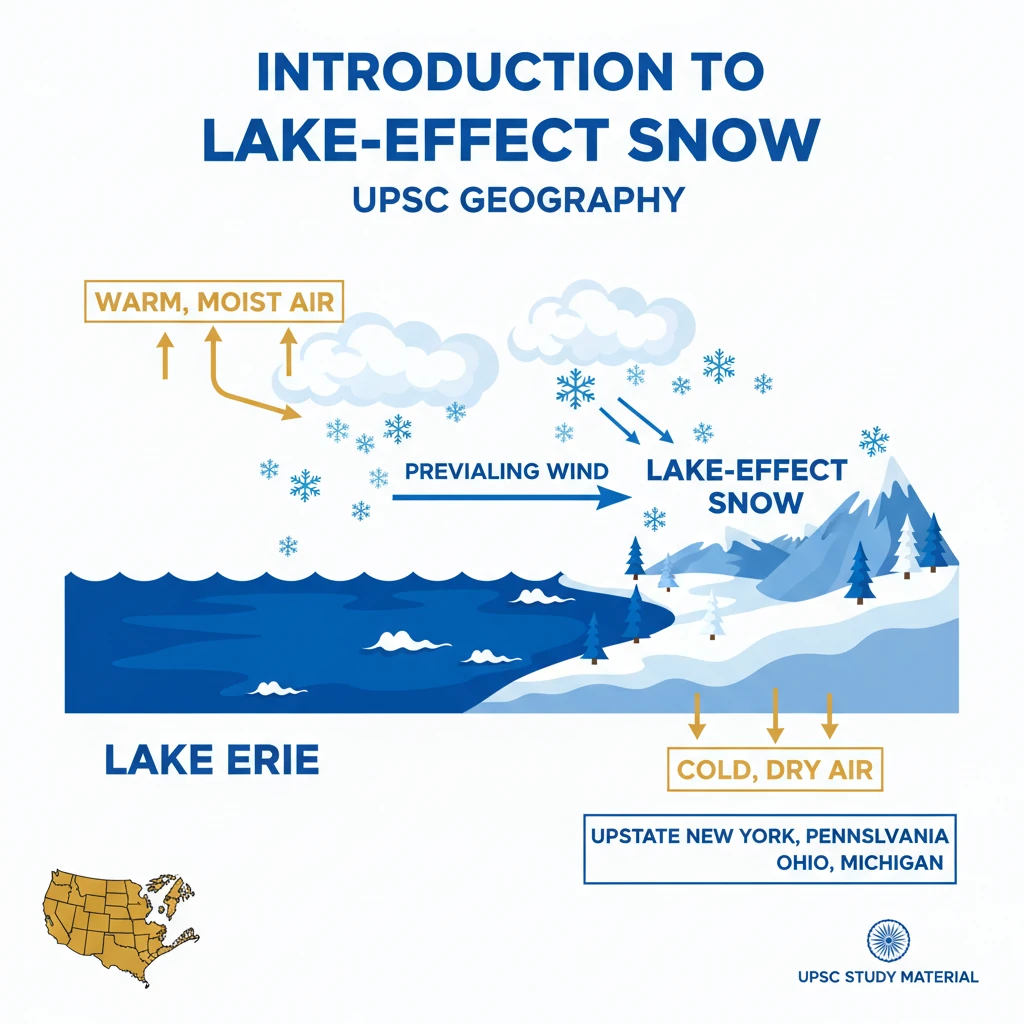
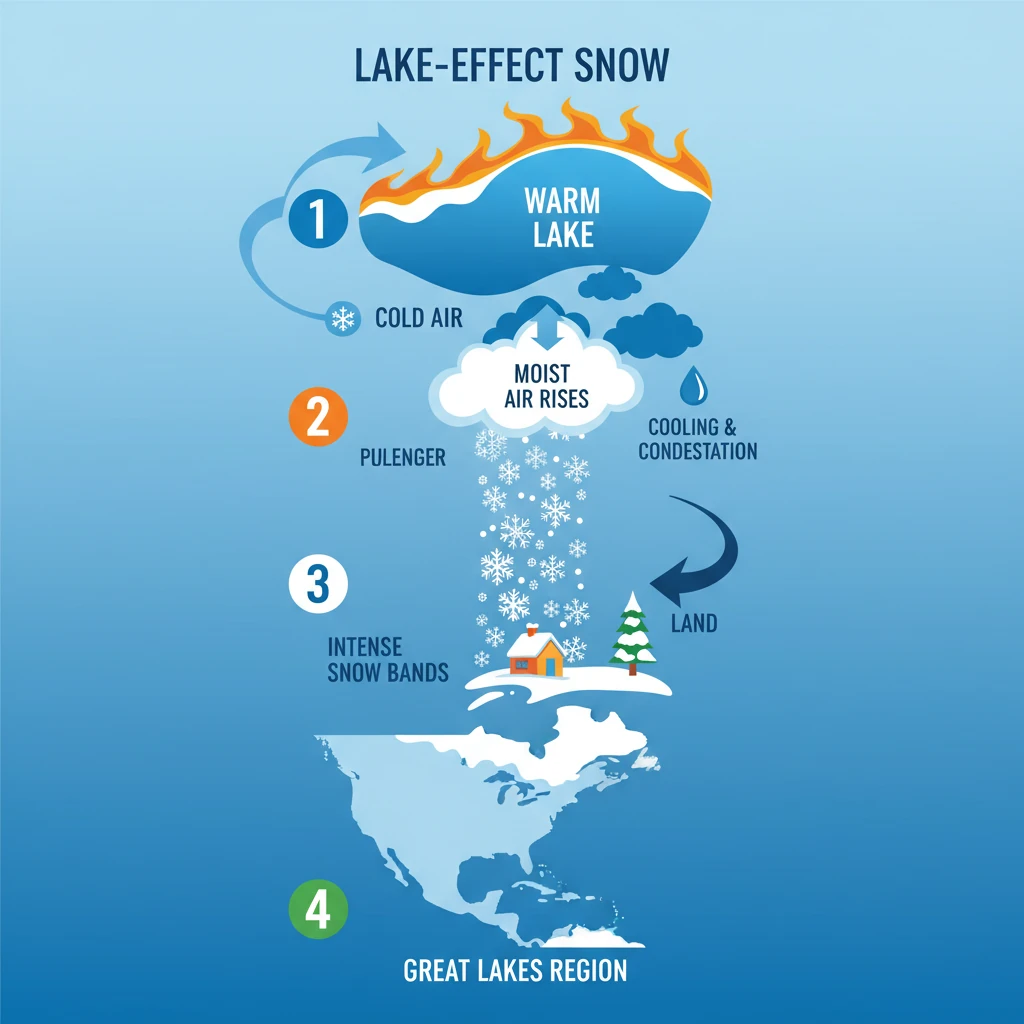
<h4>Introduction to Lake-Effect Snow</h4><p>Recently, parts of <strong>upstate New York</strong>, <strong>Pennsylvania</strong>, <strong>Ohio</strong>, and <strong>Michigan</strong> experienced a significant weather event. These regions, situated along the <strong>Great Lakes of North America</strong>, witnessed what is known as <strong>“lake-effect snow.”</strong></p><p>A particularly heavy snowstorm, caused by this phenomenon near <strong>Lake Erie</strong> in <strong>New York</strong>, transformed homes into ice-covered structures. This highlights the intense and localized nature of lake-effect snow events.</p><h4>What is Lake-Effect Snow?</h4><div class='info-box'><p><strong>Definition:</strong> <strong>Lake-effect snow</strong> is a localized weather phenomenon characterized by heavy snowfall. It occurs near large bodies of water, most notably the <strong>Great Lakes in North America</strong>.</p></div><p>This phenomenon typically manifests during the <strong>colder months</strong> of the year. It happens when significantly <strong>cold air masses</strong> pass over the relatively <strong>warmer surfaces</strong> of large, unfrozen lakes.</p><div class='key-point-box'><p>The interaction between the cold air and warmer lake water results in the formation of intense and narrow bands of snowfall, often leading to rapid accumulation.</p></div><h4>Mechanism of Lake-Effect Snow Formation</h4><p>The formation of lake-effect snow involves a specific sequence of atmospheric processes. Understanding these steps is crucial for comprehending this unique weather pattern.</p><h5>Cold Air Movement and Moisture Transfer</h5><p>The process begins with the movement of <strong>cold air</strong>, frequently originating from <strong>Canada</strong>, flowing over the unfrozen, warmer waters of the <strong>Great Lakes</strong> in <strong>North America</strong>.</p><p>As this cold air passes over the lake, the warmer lake surface transfers both <strong>heat</strong> and <strong>moisture</strong> into the overlying colder air. This transfer occurs primarily at the surface of the lake.</p><h5>Cloud Formation</h5><p>The newly warmed and moistened air, being less dense, begins to <strong>rise rapidly</strong> into the colder atmosphere above. As it ascends, it cools quickly due to expansion and interaction with the colder upper air.</p><p>This rapid cooling causes the water vapor within the air to <strong>condense</strong>, leading to the formation of <strong>clouds</strong>. These clouds are typically organized into distinct, narrow bands parallel to the wind direction.</p><h5>Intense Snowfall</h5><p>These developing cloud bands are highly efficient at producing precipitation. They generate <strong>intense snowfall</strong>, which can accumulate very quickly on land downwind of the lakes.</p><div class='info-box'><p><strong>Snowfall Rates:</strong> Lake-effect snow often produces high snowfall rates, frequently exceeding <strong>2–3 inches (5-7.5 cm) or more per hour</strong>, leading to significant accumulations in a short period.</p></div><div class='exam-tip-box'><p>For <strong>UPSC Geography (Paper I)</strong>, understanding the conditions (cold air, warm lake, fetch, instability) and the process of <strong>lake-effect snow</strong> is important. It can be asked in questions related to <strong>climatology</strong>, <strong>atmospheric phenomena</strong>, or <strong>regional geography</strong> of North America.</p></div>
💡 Key Takeaways
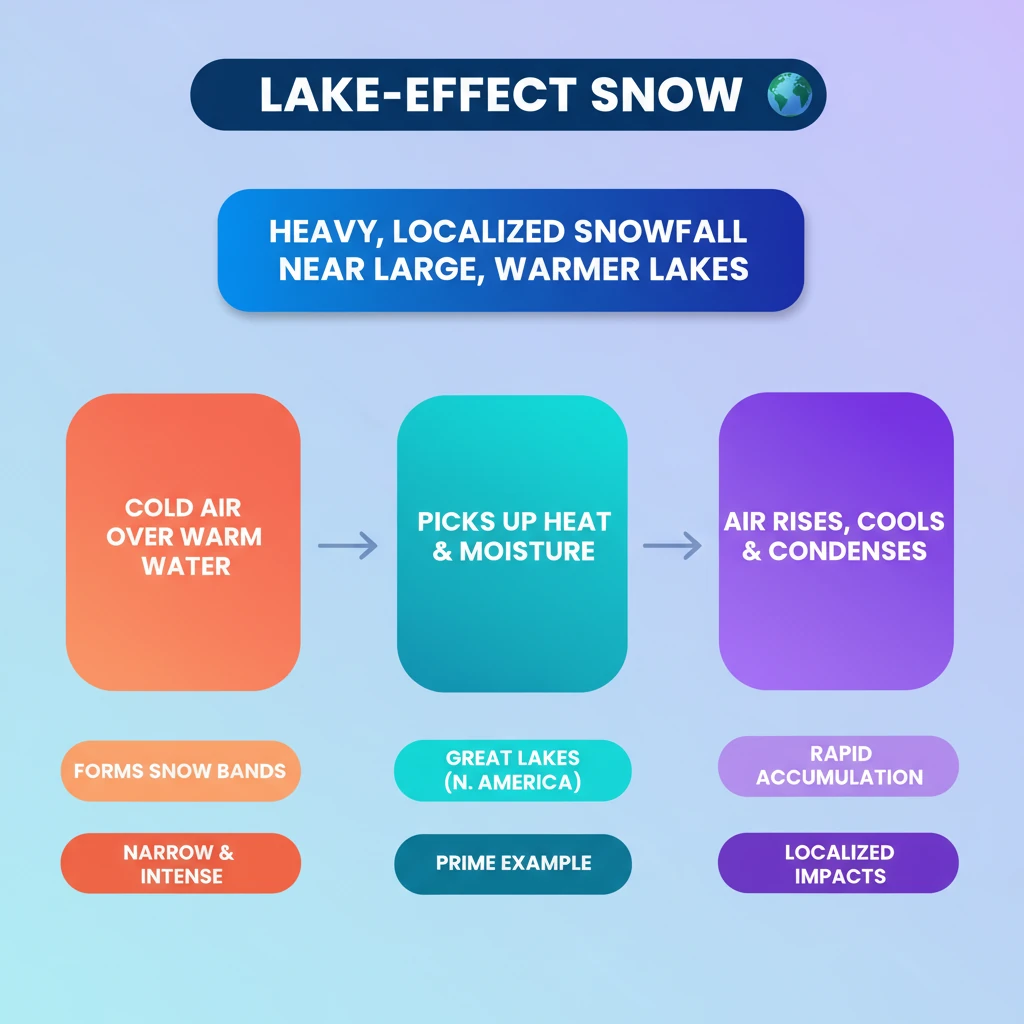
- •Lake-effect snow is heavy, localized snowfall near large, warmer water bodies during cold periods.
- •It forms when cold air passes over warm lake water, picking up heat and moisture.
- •The warm, moist air rises, cools, condenses, and forms intense, narrow snow bands.
- •The Great Lakes region of North America is a prime example of where it occurs.
- •It leads to rapid snow accumulation and significant localized impacts on communities.
🧠 Memory Techniques
98% Verified Content
📚 Reference Sources
•General Meteorological and Geographical Knowledge