What are Atmospheric Rivers? - Geography | UPSC Learning
Topics
0 topics • 0 completed
🔍
No topics match your search
What are Atmospheric Rivers?
Medium⏱️ 8 min read
geography
📖 Introduction
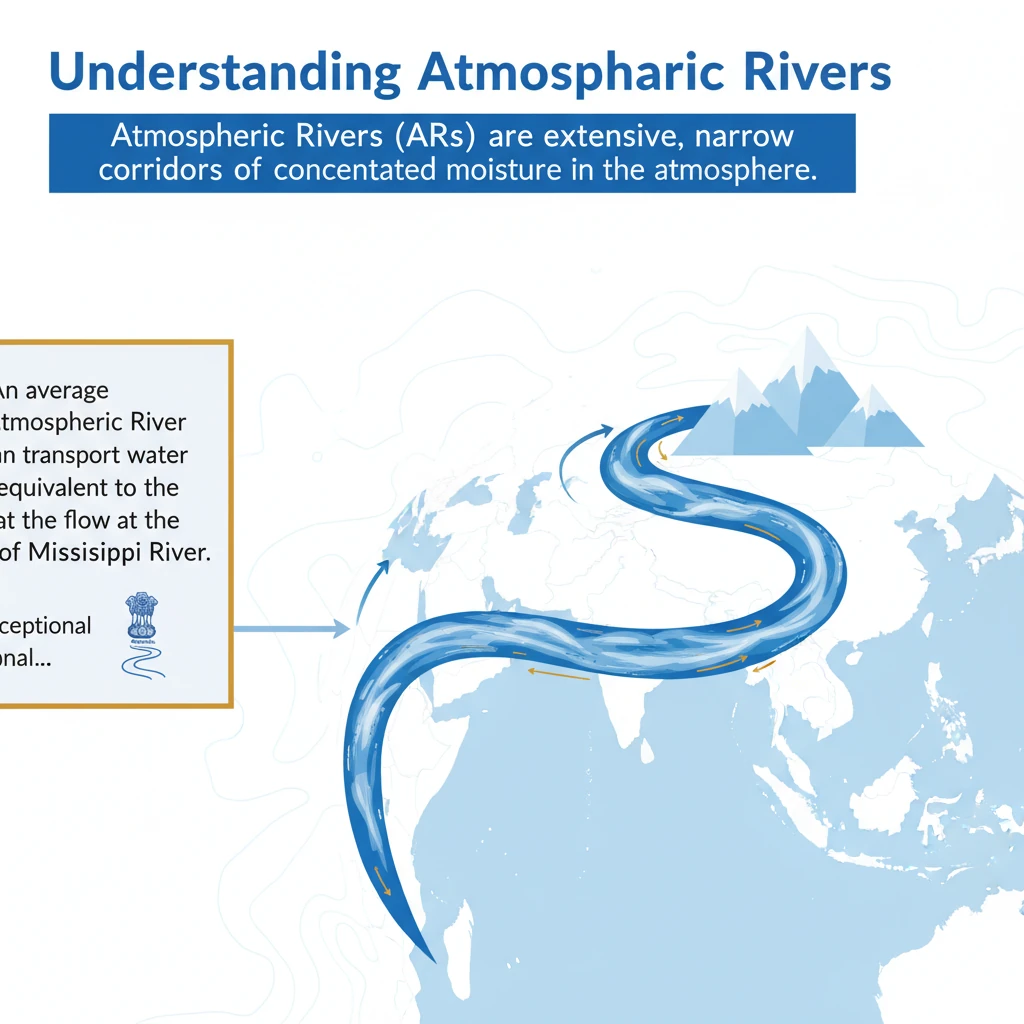
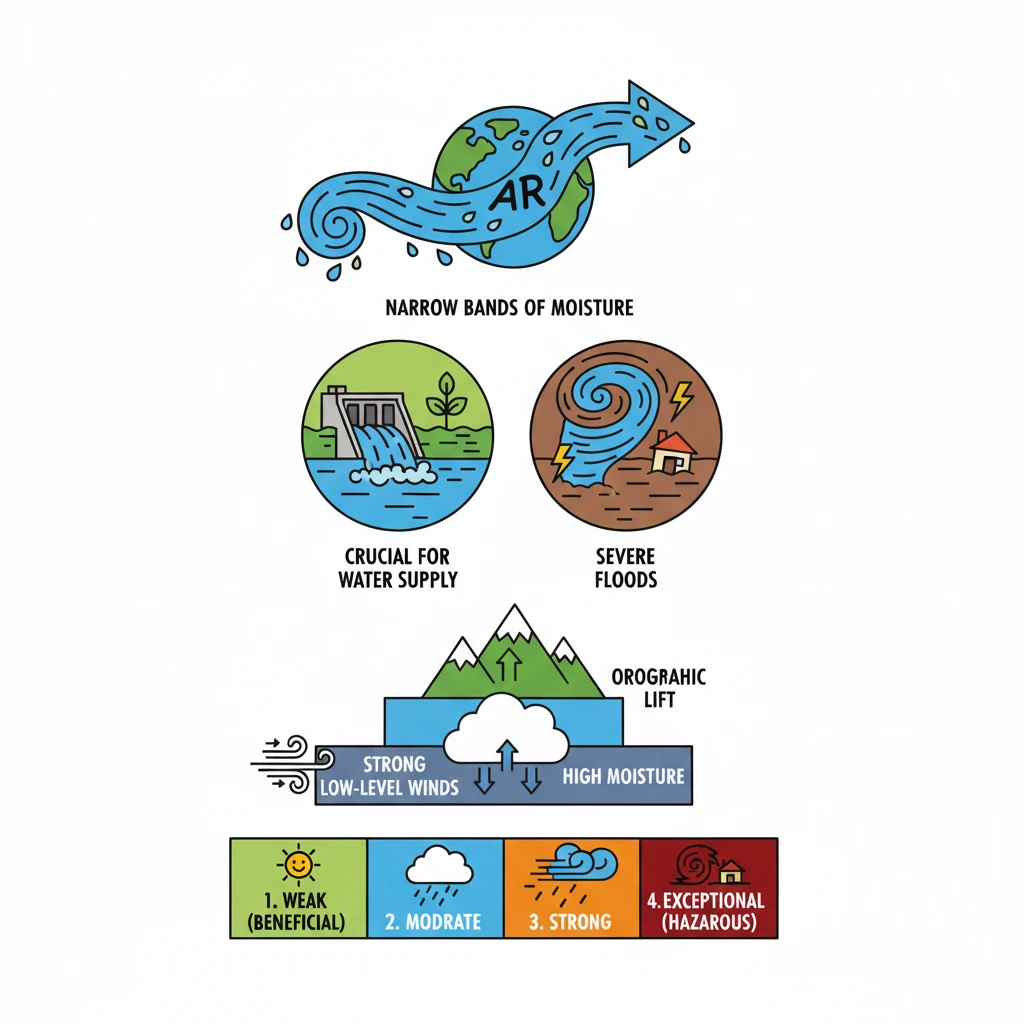
<h4>Understanding Atmospheric Rivers</h4><p><strong>Atmospheric Rivers (ARs)</strong> are extensive, narrow corridors of concentrated moisture in the atmosphere. They are responsible for transporting vast quantities of water vapour from tropical regions towards mid-latitude areas, often outside the tropics.</p><div class='info-box'><p>An average <strong>Atmospheric River</strong> can transport water vapour equivalent to the flow at the mouth of the <strong>Mississippi River</strong>. Exceptionally strong ARs can carry up to <strong>15 times</strong> this volume.</p></div><p>These 'rivers in the sky' play a dual role, bringing both beneficial rainfall crucial for water supplies and potentially destructive flooding events.</p><h4>Conditions Required for Formation</h4><p>The formation of an <strong>Atmospheric River</strong> depends on a combination of specific meteorological conditions:</p><ul><li><strong>Strong Low-Level Winds:</strong> These winds act as conduits, efficiently transporting water vapour across long distances. <strong>Jet streams</strong> in both the Northern and Southern hemispheres serve as high-speed channels, sometimes reaching velocities of up to <strong>442 km/h (275 mph)</strong>.</li><li><strong>High Moisture Levels:</strong> An abundant supply of moisture is essential to initiate and sustain precipitation processes once the AR reaches land.</li><li><strong>Orographic Lift:</strong> As moist air masses encounter and ascend over elevated terrain, such as mountain ranges, they cool. This cooling increases humidity, leading to significant cloud formation and subsequent heavy precipitation.</li></ul><h4>Key Characteristics of ARs</h4><p>Atmospheric Rivers possess several defining characteristics that influence their impact:</p><ul><li><strong>Length:</strong> Often stretching for thousands of kilometres, ARs vary considerably in size and strength, much like their terrestrial counterparts.</li><li><strong>Seasonal Occurrence:</strong> In the <strong>Northern Hemisphere</strong>, they typically manifest between <strong>December and February</strong>. Conversely, in the <strong>Southern Hemisphere</strong>, their peak activity is observed from <strong>June to August</strong>.</li><li><strong>Water Vapour Capacity:</strong> As noted, their capacity to transport moisture is immense, critical for regional water cycles.</li><li><strong>Variability:</strong> No two <strong>Atmospheric Rivers</strong> are identical. Their characteristics differ based on factors such as atmospheric instability and prevailing <strong>jet stream patterns</strong>.</li></ul><h4>Categories of Atmospheric Rivers</h4><p>Atmospheric Rivers are classified into five categories based on their intensity and potential impact, ranging from mostly beneficial to largely hazardous:</p><table class='info-table'><tr><th>Category</th><th>Intensity</th><th>Effects</th></tr><tr><td><strong>Category 1</strong></td><td>Weak</td><td>Mild, short-duration event, primarily beneficial (e.g., light rainfall over 24 hours).</td></tr><tr><td><strong>Category 2</strong></td><td>Moderate</td><td>Moderate storm with mostly beneficial, but somewhat hazardous, effects.</td></tr><tr><td><strong>Category 3</strong></td><td>Strong</td><td>Stronger, prolonged event (e.g., 5-10 inches of rain over 36 hours). Helps replenish reservoirs but may raise rivers near flood stage.</td></tr><tr><td><strong>Category 4</strong></td><td>Extreme</td><td>Primarily hazardous, with limited benefits. Intense rainfall over several days, likely pushing many rivers to flood levels.</td></tr><tr><td><strong>Category 5</strong></td><td>Exceptional</td><td>Largely hazardous. Can cause extensive damage (e.g., Central California 1996-97 event caused damages exceeding <strong>USD 100 billion</strong>).</td></tr></table><h4>Impact on Reaching Land</h4><p>When an <strong>Atmospheric River</strong> makes landfall, the moisture-laden air is forced to rise and cool as it encounters mountain ranges. This process leads to significant precipitation, which can manifest as either rain or snow.</p><p>Unlike typical cold winter storms, <strong>Atmospheric Rivers</strong> are often associated with warmer air. This can lead to rapid snowpack melting in mountainous regions, contributing to increased runoff and heightened risks of flooding. Such events profoundly impact regional water supplies and infrastructure.</p><div class='exam-tip-box'><p>UPSC often asks about natural phenomena and their impact. Understanding <strong>Atmospheric Rivers</strong> is crucial for topics related to <strong>climate change</strong>, <strong>disaster management</strong>, and <strong>water resource management</strong>.</p></div>
💡 Key Takeaways
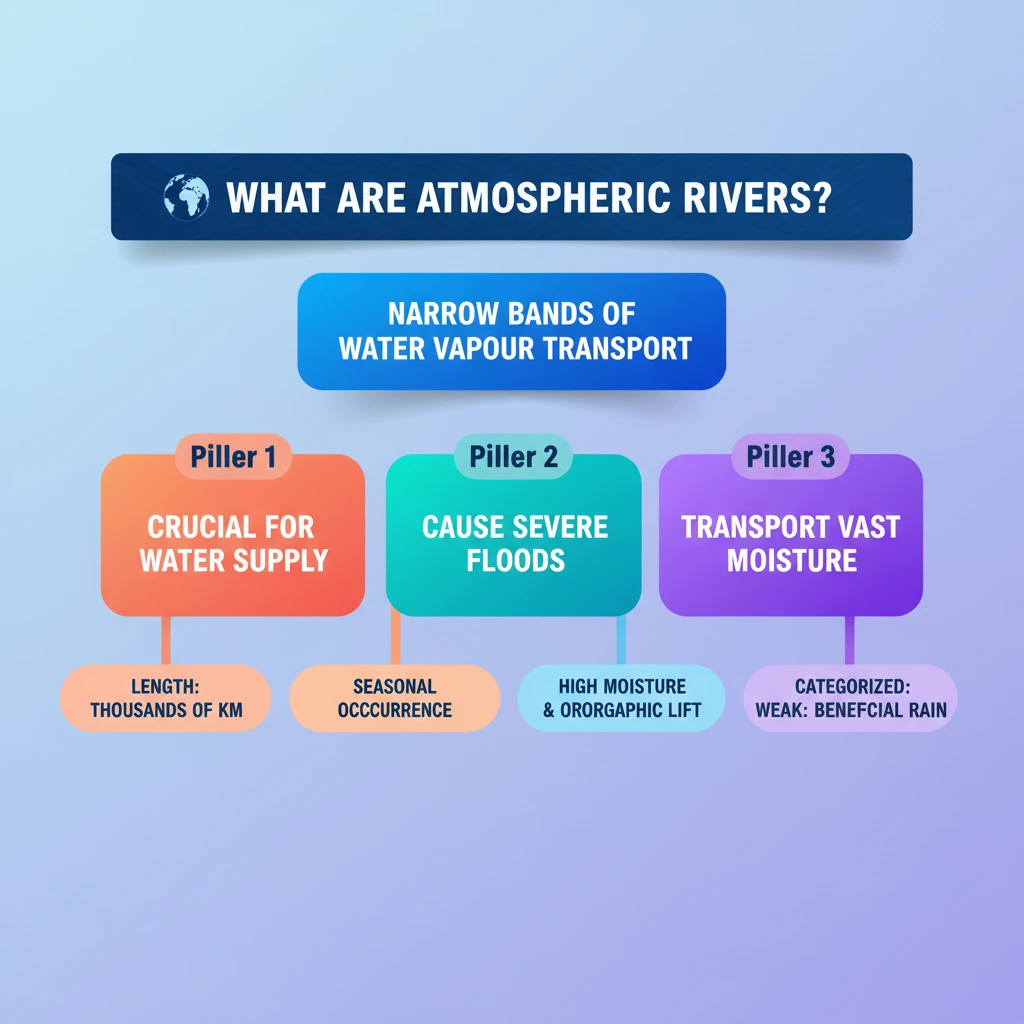
- •Atmospheric Rivers (ARs) are narrow bands of atmospheric moisture transporting vast water vapour.
- •They are crucial for water supply but also cause severe floods.
- •Formation requires strong low-level winds, high moisture, and orographic lift.
- •ARs are categorized from weak (beneficial) to exceptional (largely hazardous).
- •Key characteristics include thousands of kilometers in length, seasonal occurrence, and high water vapour capacity.
- •Climate models may underestimate AR variability, impacting weather and water forecasting.
- •Examples like the Pineapple Express and California/New Zealand events highlight their global impact.
🧠 Memory Techniques
95% Verified Content