Sahel Region: Geography, Significance, and Impact on African Hydroclimate - Geography | UPSC Learning
Topics
0 topics • 0 completed
🔍
No topics match your search
Sahel Region: Geography, Significance, and Impact on African Hydroclimate
Medium⏱️ 10 min read
geography
📖 Introduction
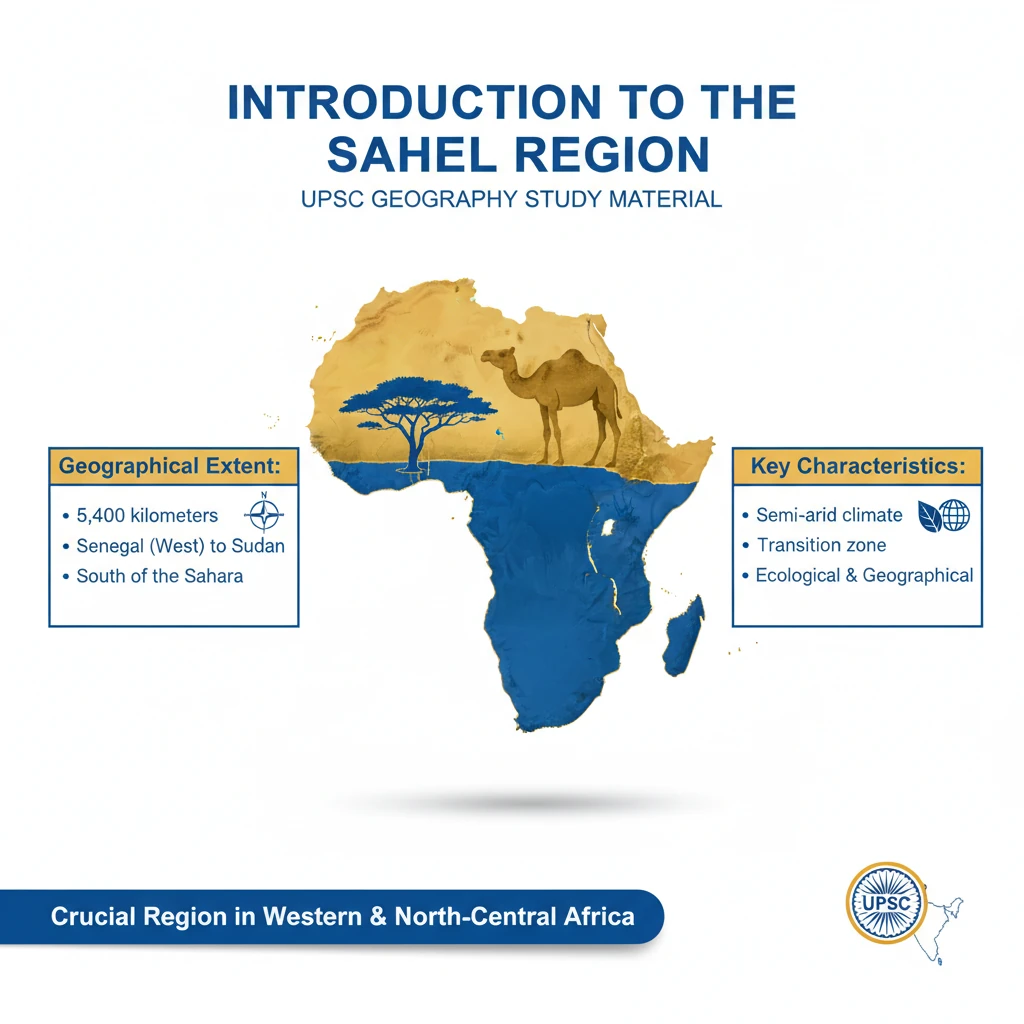
<h4>Introduction to the Sahel Region</h4><p>The <strong>Sahel</strong> is a crucial <strong>semiarid region</strong> located in <strong>western and north-central Africa</strong>. It serves as a vital ecological and geographical transition zone.</p><div class='info-box'><p><strong>Geographical Extent:</strong> The Sahel stretches approximately <strong>5,400 kilometers</strong> from <strong>Senegal</strong> in the west to <strong>Sudan</strong> in the east, encompassing a vast area south of the Sahara Desert.</p></div><h4>Geographical Characteristics and Transition Zone</h4><p>This region acts as a natural buffer, forming a transition between the arid <strong>Sahara Desert</strong> to its north and the more fertile, humid <strong>savannas</strong> of tropical Africa to its south.</p><p>Its unique position results in a distinct climate and ecosystem, characterized by significant seasonal variations in rainfall.</p><h4>Ecological Profile of the Sahel</h4><p>The Sahel features a characteristic <strong>savanna terrain</strong>. This landscape is typically defined by low-growing grass, interspersed with thorny shrubs and sparse vegetation adapted to dry conditions.</p><div class='key-point-box'><p>The vegetation density gradually increases as one moves southward towards the savannas, reflecting the increasing rainfall.</p></div><h4>The Role of African Easterly Waves (AEWs)</h4><p><strong>African Easterly Waves (AEWs)</strong> play a significant role in the Sahel's climate. These atmospheric disturbances bring much-needed <strong>rainstorms</strong> to the otherwise drought-prone areas of northern Africa.</p><p>Beyond local rainfall, AEWs are also responsible for carrying vast amounts of <strong>Saharan dust</strong> across the Atlantic Ocean. Furthermore, they act as important <strong>precursors for Atlantic hurricanes</strong>, influencing global weather patterns.</p><div class='exam-tip-box'><p>Understanding <strong>AEWs</strong> is crucial for UPSC, especially their influence on regional <strong>hydroclimate</strong> and how their behavior might change under <strong>global warming</strong>. This connects to Geography (Physical) and Environment sections.</p></div><h4>Key Countries of the Sahel</h4><p>The <strong>United Nations (UN)</strong> officially recognizes <strong>ten countries</strong> as part of the Sahel region. These nations face common environmental and socio-economic challenges.</p><ul><li><strong>Burkina Faso</strong></li><li><strong>Cameroon</strong></li><li><strong>The Gambia</strong></li><li><strong>Guinea</strong></li><li><strong>Mali</strong></li><li><strong>Mauritania</strong></li><li><strong>Niger</strong></li><li><strong>Nigeria</strong></li><li><strong>Senegal</strong></li><li><strong>Chad</strong></li></ul><h4>Major Water Sources</h4><p>A critical lifeline for the Sahel is the <strong>Niger River</strong>. It is the <strong>longest and largest river in western Africa</strong>, providing essential water resources for agriculture, fishing, and human consumption across the region.</p>
💡 Key Takeaways
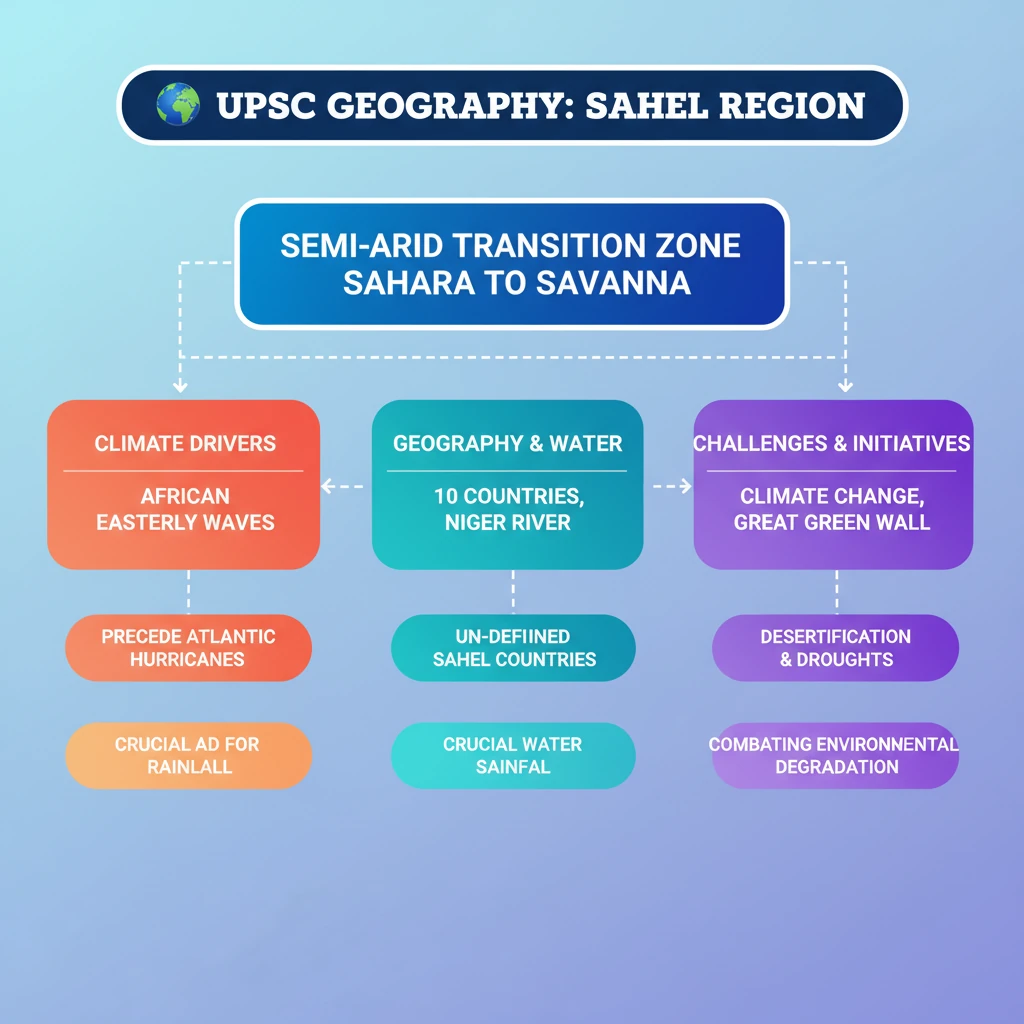
- •The Sahel is a semiarid transition zone between the Sahara Desert and humid savannas in West and North-Central Africa.
- •African Easterly Waves (AEWs) are crucial for Sahelian rainfall and are precursors to Atlantic hurricanes.
- •Ten UN-defined countries form the Sahel, with the Niger River as a major water source.
- •The region faces severe challenges from climate change (desertification, droughts) and insecurity (extremist groups).
- •Initiatives like the Great Green Wall are vital for combating environmental degradation and promoting sustainable development.
🧠 Memory Techniques
98% Verified Content
📚 Reference Sources
•United Nations Environment Programme (UNEP) reports on the Sahel
•UN-OCHA (Office for the Coordination of Humanitarian Affairs) reports on the Sahel
•National Geographic articles on the Sahel and Great Green Wall
•Encyclopaedia Britannica - Sahel