Cyclone Dana: Formation, Impact, and Significance for India (2024) - Geography | UPSC Learning
Topics
0 topics • 0 completed
🔍
No topics match your search
Cyclone Dana: Formation, Impact, and Significance for India (2024)
Medium⏱️ 8 min read
geography
📖 Introduction
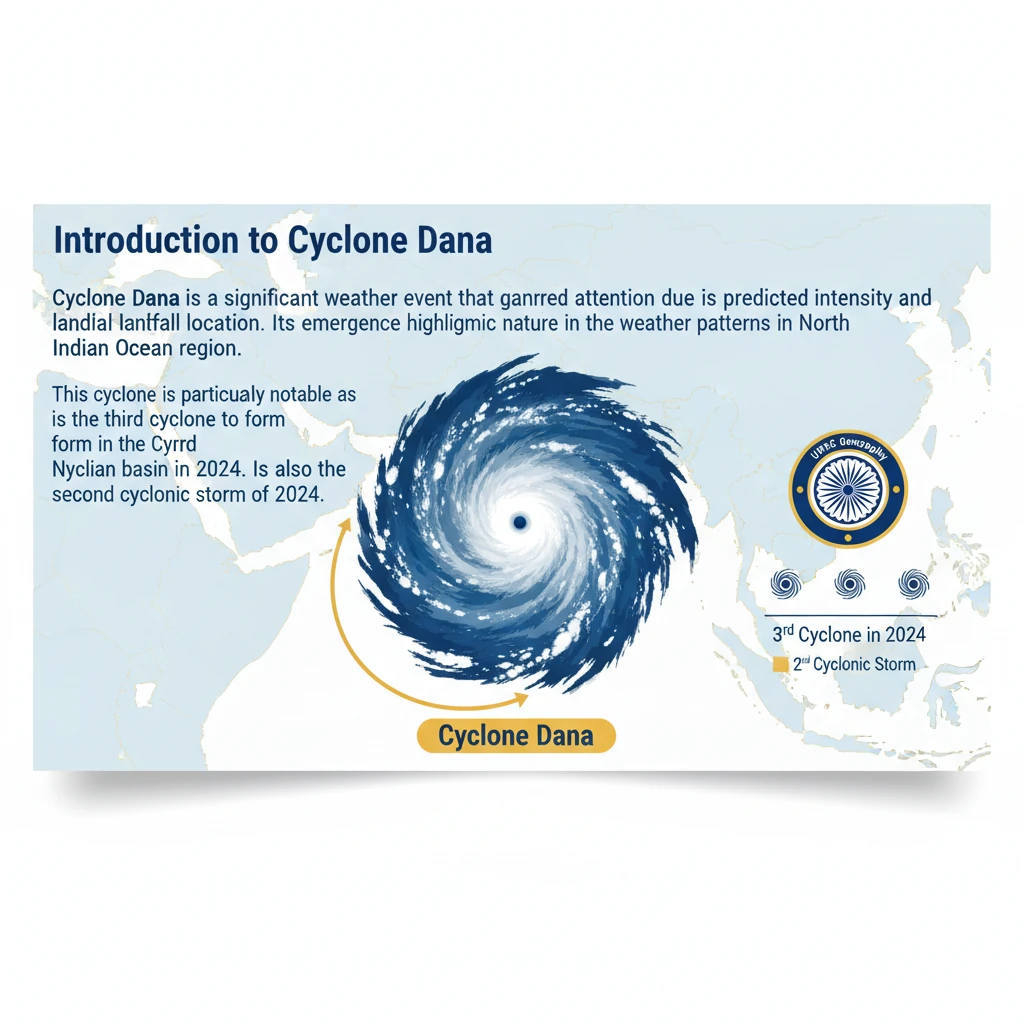
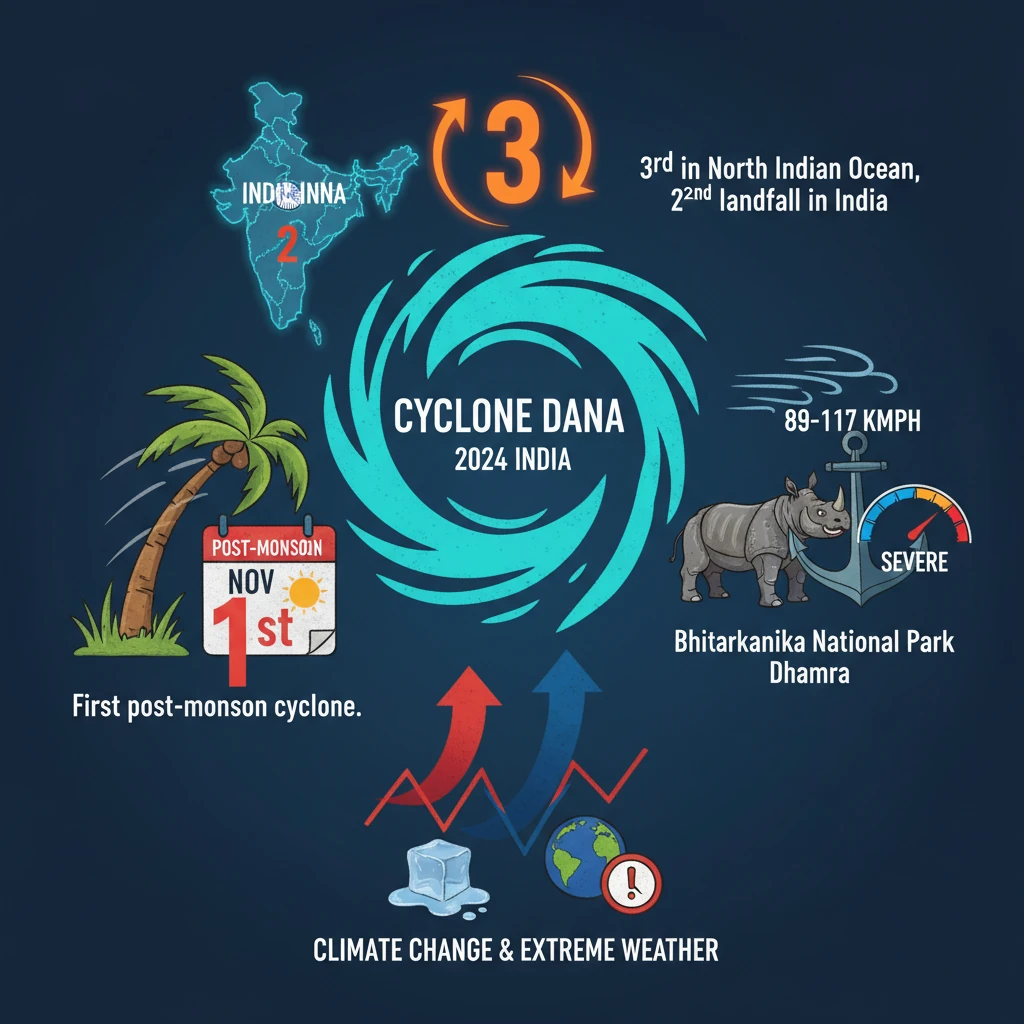
<h4>Introduction to Cyclone Dana</h4><p><strong>Cyclone Dana</strong> is a significant weather event that garnered attention due to its predicted intensity and landfall location. Its emergence highlights the dynamic nature of weather patterns in the <strong>North Indian Ocean</strong> region.</p><p>This cyclone is particularly notable as it is the <strong>third cyclone</strong> to form in the <strong>North Indian Ocean</strong> basin in <strong>2024</strong>. It is also the <strong>second cyclone</strong> to make landfall along the <strong>Indian coast</strong> in the same year, following <strong>Cyclone Remal</strong>.</p><div class='key-point-box'><p><strong>Key Point:</strong> <strong>Cyclone Dana</strong> is the <strong>first cyclone</strong> observed in the <strong>post-monsoon cyclone season</strong> of <strong>2024</strong>, indicating a shift from the pre-monsoon activity.</p></div><h4>Why in News?</h4><p>The <strong>India Meteorological Department (IMD)</strong> issued a forecast regarding <strong>Cyclone Dana</strong>, predicting its landfall as a <strong>severe cyclonic storm</strong>. This alert brought the cyclone into national focus.</p><p>The anticipated landfall location is along the <strong>Odisha coast</strong>, specifically near <strong>Bhitarkanika National Park</strong> and <strong>Dhamra Port</strong>. These areas are ecologically sensitive and economically important, necessitating high preparedness.</p><div class='info-box'><p><strong>Cyclone Classification:</strong> <strong>Cyclone Dana</strong> is classified as a <strong>severe cyclonic storm</strong>, characterized by wind speeds ranging from <strong>89 to 117 kmph</strong>.</p></div><h4>Key Characteristics of Cyclone Dana</h4><p>The formation and trajectory of <strong>Cyclone Dana</strong> underscore the recurring threat of tropical cyclones to India's eastern coastline. Its classification as 'severe' indicates a potential for significant impact.</p><ul><li><strong>Formation Sequence:</strong> It is the <strong>third cyclone</strong> in the <strong>North Indian Ocean</strong> region and the <strong>second</strong> to make landfall on the <strong>Indian coast</strong> in <strong>2024</strong>.</li><li><strong>Seasonal Context:</strong> Notably, it marks the beginning of the <strong>post-monsoon cyclone season</strong> for <strong>2024</strong>, distinguishing it from earlier pre-monsoon cyclones.</li><li><strong>Predicted Impact Zone:</strong> The primary areas of concern for landfall are <strong>Bhitarkanika National Park</strong> and <strong>Dhamra Port</strong> in <strong>Odisha</strong>.</li></ul><div class='exam-tip-box'><p><strong>UPSC Insight:</strong> Understanding the <strong>seasonal patterns</strong> (pre-monsoon, post-monsoon) and <strong>frequency</strong> of cyclones (e.g., 3rd in NIO, 2nd landfall) is crucial for questions on <strong>Geography (GS-I)</strong> and <strong>Disaster Management (GS-III)</strong>.</p></div>
💡 Key Takeaways
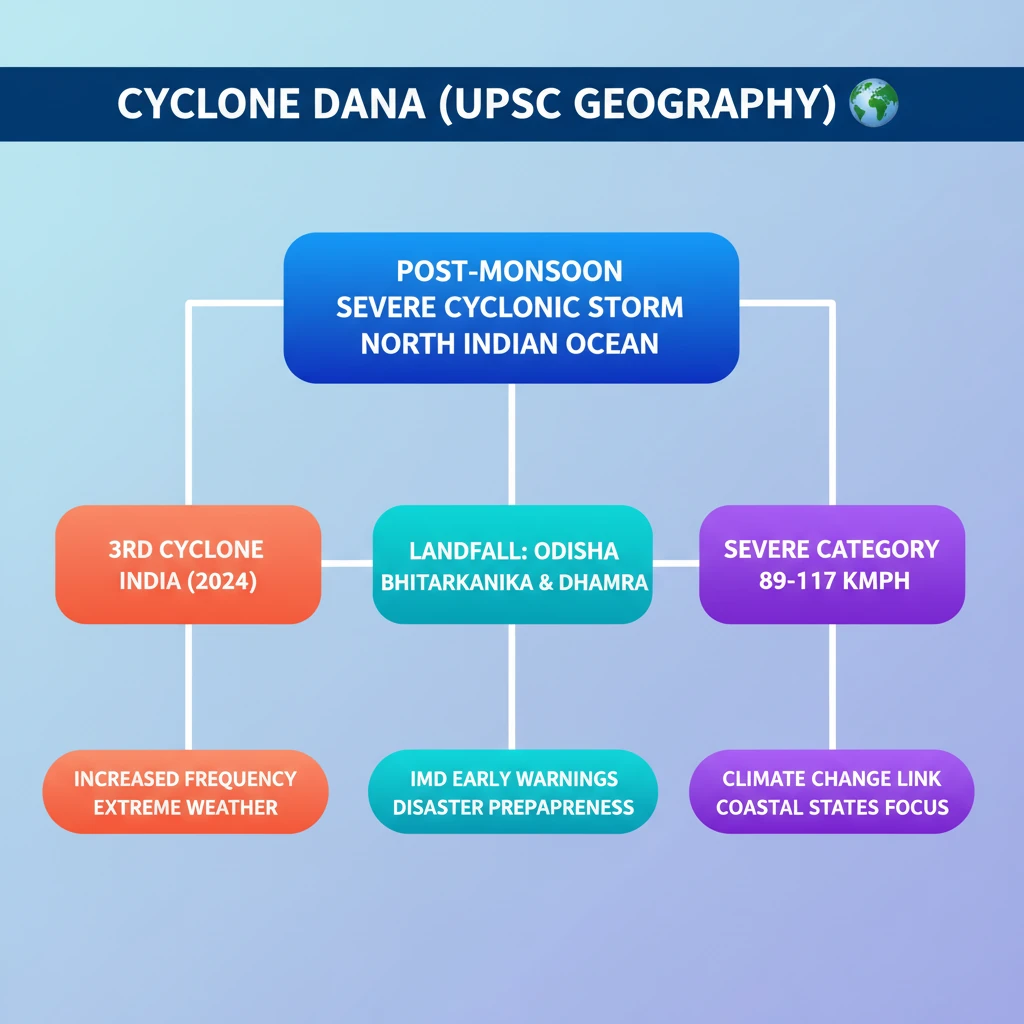
- •Cyclone Dana is the 3rd cyclone in the North Indian Ocean and 2nd to make landfall in India in 2024.
- •It is the first cyclone of the post-monsoon season of 2024.
- •Predicted to make landfall as a Severe Cyclonic Storm (89-117 kmph) near Bhitarkanika National Park and Dhamra Port, Odisha.
- •Highlights increasing frequency and intensity of extreme weather events, linked to climate change.
- •Emphasizes the critical role of IMD's early warnings and robust disaster preparedness for coastal states.
🧠 Memory Techniques
95% Verified Content
📚 Reference Sources
•Drishti IAS Summary (provided source material)
•National Disaster Management Authority (NDMA) reports (general background on cyclone management)