Bangladesh - Major river basins - Geography | UPSC Learning
Topics
0 topics • 0 completed
🔍
No topics match your search
Bangladesh - Major river basins
Medium⏱️ 6 min read
geography
📖 Introduction
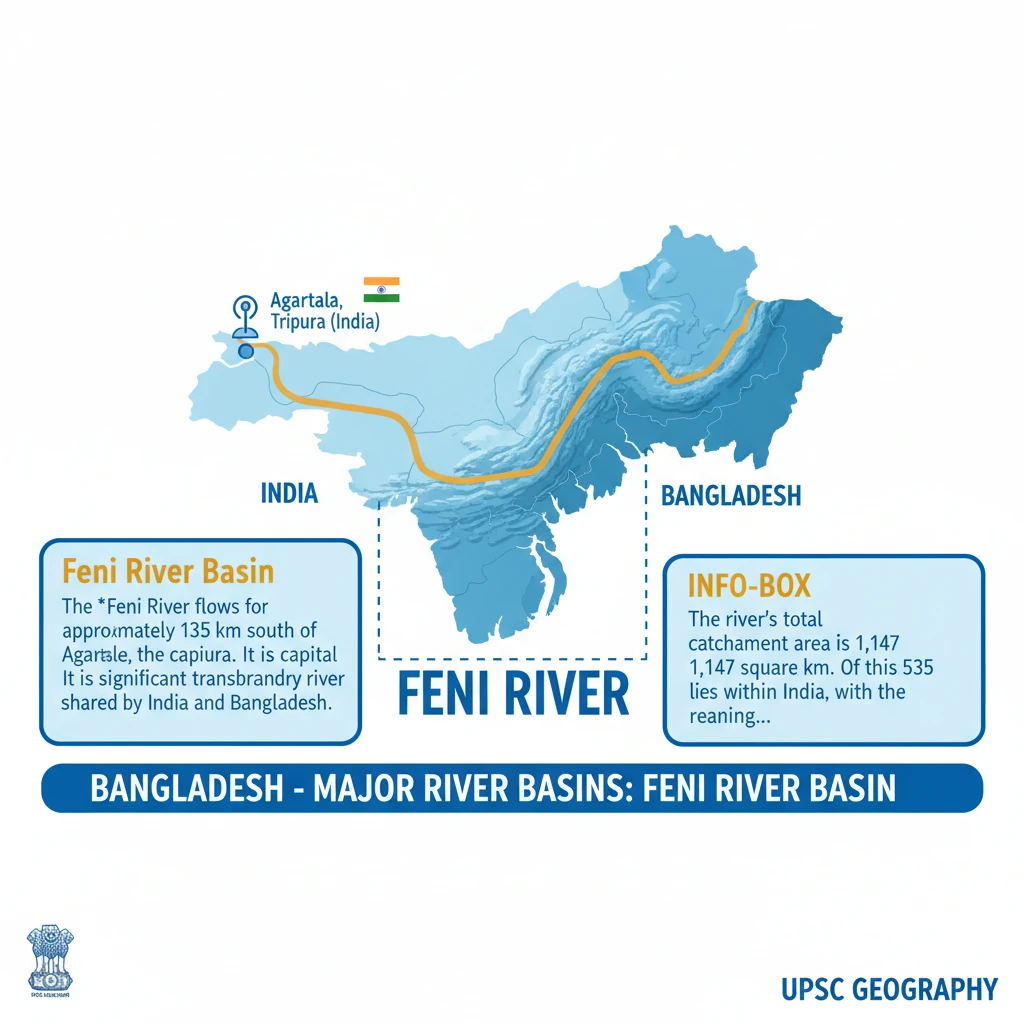
<h4>Feni River Basin</h4><p>The <strong>Feni River</strong> flows for approximately <strong>135 km</strong> south of <strong>Agartala</strong>, the capital of <strong>Tripura</strong>. It is a significant transboundary river shared by <strong>India</strong> and <strong>Bangladesh</strong>.</p><div class='info-box'><p>The river's total <strong>catchment area</strong> is <strong>1,147 square km</strong>. Of this, <strong>535 square km</strong> lies within <strong>India</strong>, with the remaining portion in <strong>Bangladesh</strong>.</p></div><p>The <strong>Feni River</strong> plays a crucial role in forming a part of the <strong>Indo-Bangladesh border</strong>, delineating the international boundary in certain stretches.</p><p>The <strong>Maitri Setu</strong>, a <strong>1.9 km long bridge</strong>, has been constructed over the <strong>Feni River</strong> in <strong>Tripura</strong>. This bridge serves as a vital link connecting <strong>India</strong> and <strong>Bangladesh</strong>, enhancing trade and connectivity.</p><ul><li><strong>Notable tributaries</strong> of the <strong>Feni River</strong> include the <strong>Muhuri River</strong>, <strong>Raidak River</strong>, <strong>Chandkhira River</strong>, <strong>Ryang River</strong>, and <strong>Kushiyara River</strong>.</li></ul><h4>Kushiyara River Basin</h4><p>The <strong>Kushiyara River</strong> is an important <strong>distributary</strong> of the <strong>Barak River</strong>. Its origin point is the <strong>Amlshid bifurcation point</strong> located on the <strong>India-Bangladesh border</strong>.</p><div class='info-box'><p>At the <strong>Amlshid bifurcation</strong>, the <strong>Barak River</strong> divides into two main streams: the <strong>Kushiyara River</strong> and the <strong>Surma River</strong>.</p></div><p>The <strong>Kushiyara River</strong> begins its journey in <strong>Assam</strong>, <strong>India</strong>, and collects water from various tributaries originating in <strong>Nagaland</strong> and <strong>Manipur</strong> before flowing into <strong>Bangladesh</strong>.</p><h4>Brahmaputra River Basin</h4><p>The <strong>Brahmaputra River</strong> is one of Asia's largest rivers, originating from the <strong>Chemayungdung glacier</strong> near <strong>Yarlung Tsangpo</strong> in <strong>Tibet</strong>, close to <strong>Mount Kailash</strong>.</p><p>It flows through <strong>Tibet</strong>, <strong>India</strong>, and <strong>Bangladesh</strong>, acting as a natural geographical feature between regions.</p><p>Within <strong>India</strong>, the <strong>Brahmaputra</strong> passes through <strong>Arunachal Pradesh</strong>, <strong>Assam</strong>, and <strong>Meghalaya</strong>. Upon entering <strong>Bangladesh</strong>, it is known as the <strong>Jamuna River</strong>.</p><ul><li><strong>Major tributaries in India</strong> include the <strong>Subansiri</strong>, <strong>Kameng</strong>, <strong>Manas</strong>, and <strong>Dhansiri rivers</strong>.</li><li>The <strong>Teesta River</strong> is a significant tributary that joins the <strong>Brahmaputra</strong> (Jamuna) in <strong>Bangladesh</strong>.</li></ul><p>In <strong>Bangladesh</strong>, the <strong>Brahmaputra River</strong> (Jamuna) merges with the <strong>Ganga River</strong>, forming the combined stream known as the <strong>Padma River</strong>. The <strong>Padma</strong> then further merges with the <strong>Meghna River</strong>.</p><div class='key-point-box'><p>The combined waters of the <strong>Padma</strong> and <strong>Meghna</strong> rivers ultimately flow into the <strong>Bay of Bengal</strong> through the extensive <strong>Meghna Estuary</strong>, forming one of the world's largest deltas.</p></div><h4>Meghna River Basin</h4><p>The <strong>Meghna River</strong> system has a complex origin. In <strong>India</strong>, specifically in <strong>Karimganj district</strong> in <strong>Assam</strong>, the <strong>Barak River</strong> splits into two distinct streams: the <strong>Surma</strong> and the <strong>Kushiyara</strong>.</p><p>These two distributaries, the <strong>Surma</strong> and <strong>Kushiyara</strong>, later rejoin in <strong>Kishoreganj district</strong> in <strong>Bangladesh</strong>. From this confluence point, the combined river is known as the <strong>Meghna</strong>.</p><div class='info-box'><p>Up to <strong>Chandpur</strong> in <strong>Bangladesh</strong>, this river is referred to as the <strong>Upper Meghna</strong>. After meeting the <strong>Padma River</strong> at <strong>Chandpur</strong>, it becomes known as the <strong>Lower Meghna</strong>.</p></div>
💡 Key Takeaways
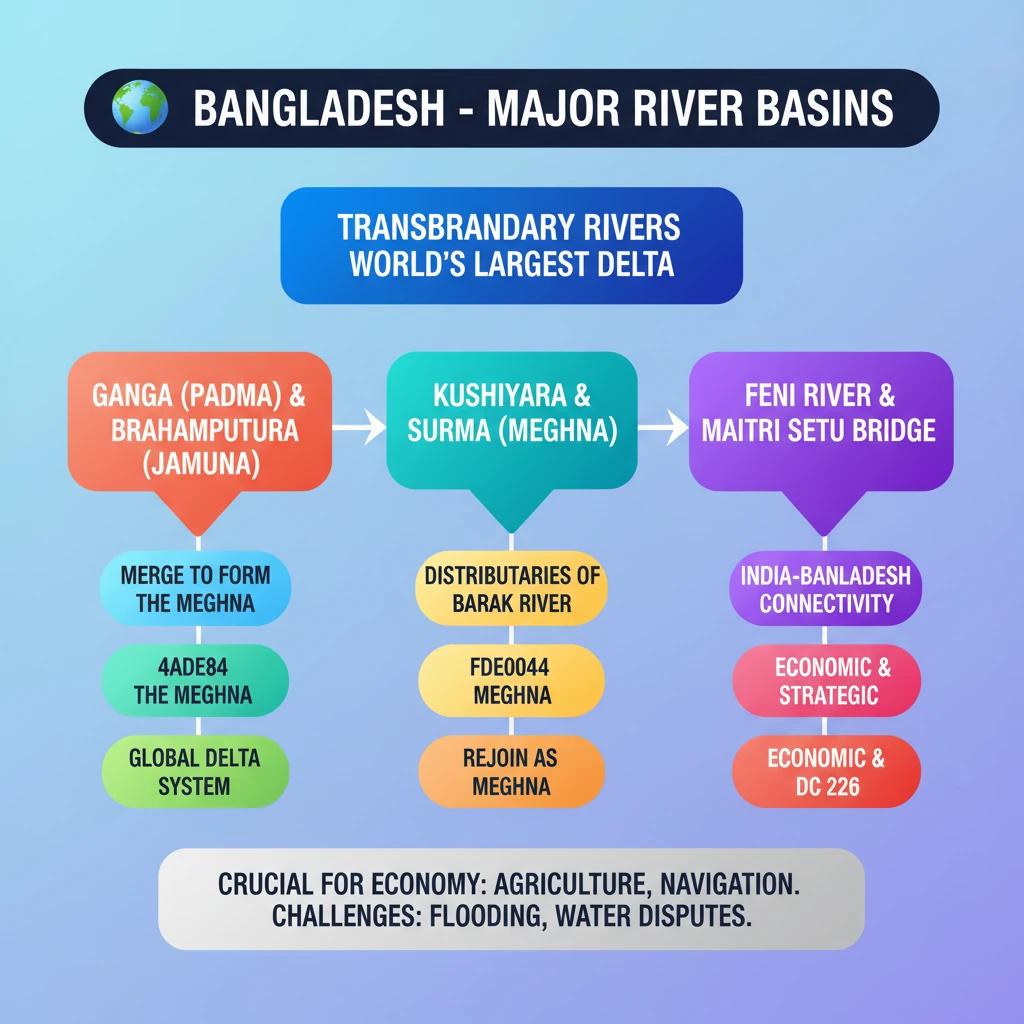
- •Bangladesh's major rivers (Feni, Kushiyara, Brahmaputra/Jamuna, Meghna) are predominantly transboundary, originating in India or Tibet.
- •The Brahmaputra (Jamuna) and Ganga (Padma) rivers merge in Bangladesh before joining the Meghna, forming the world's largest delta.
- •The Feni River hosts the Maitri Setu bridge, enhancing India-Bangladesh connectivity.
- •Kushiyara and Surma are distributaries of the Barak River, rejoining to form the Meghna.
- •River basins are crucial for Bangladesh's economy (agriculture, navigation) but also pose challenges like flooding and water sharing disputes.
🧠 Memory Techniques

95% Verified Content