What is Deccan Volcanism Theory? - Geography | UPSC Learning
Topics
0 topics • 0 completed
🔍
No topics match your search
What is Deccan Volcanism Theory?
Medium⏱️ 8 min read
geography
📖 Introduction
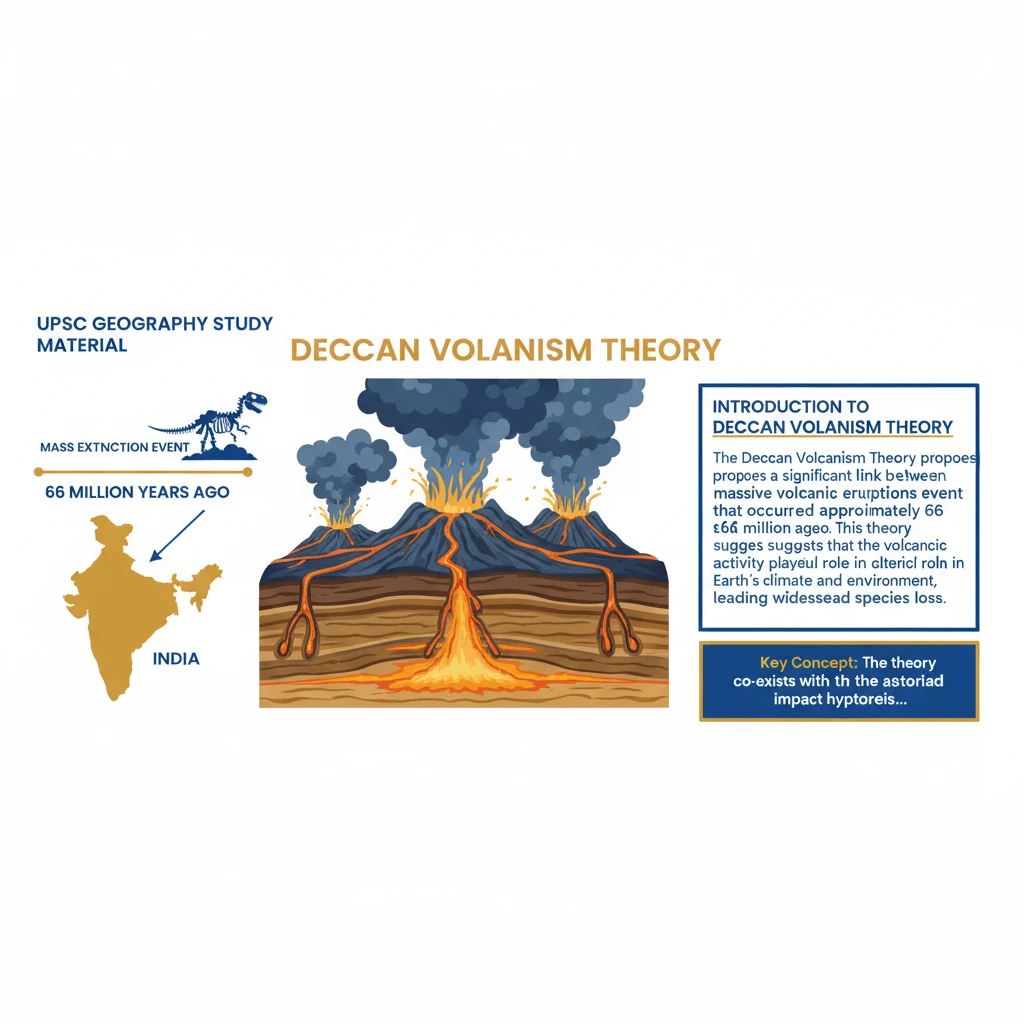
<h4>Introduction to Deccan Volcanism Theory</h4><p>The <strong>Deccan Volcanism Theory</strong> proposes a significant link between massive volcanic eruptions and the <strong>mass extinction event</strong> that occurred approximately <strong>66 million years ago</strong>. This theory suggests that the volcanic activity played a crucial role in altering Earth's climate and environment, leading to widespread species loss.</p><div class='key-point-box'><p><strong>Key Concept:</strong> The theory connects large-scale geological events (volcanism) with biological catastrophes (mass extinctions).</p></div><h4>Understanding the Deccan Traps</h4><p>The <strong>Deccan Traps</strong> constitute an expansive <strong>large volcanic plateau</strong> situated in <strong>peninsular India</strong>. This geological feature was primarily formed by a series of intense <strong>fissure volcanic eruptions</strong>.</p><div class='info-box'><p><strong>Formation:</strong> The Deccan Traps are composed of vast layers of <strong>basaltic lava flows</strong>, indicating prolonged and extensive volcanic activity.</p></div><h4>Fissure Volcanic Eruptions Explained</h4><p>Unlike eruptions from a central volcanic cone, <strong>fissure volcanic eruptions</strong> occur when molten rock, or <strong>magma</strong>, is extruded through elongated cracks or fissures in the Earth's crust. This process results in widespread lava flows rather than localized volcanic cones.</p><h4>Role of the Deccan Mantle Plume</h4><p>The formation of the <strong>Deccan Traps</strong> is attributed to vigorous volcanic activity driven by the <strong>Deccan mantle plume</strong>. This geological phenomenon involved continuous eruptions over several hundred thousand years, depositing immense volumes of lava.</p><div class='info-box'><p><strong>Mantle Plume Definition:</strong> A <strong>mantle plume</strong> is characterized as a cylindrical upwelling of extremely hot <strong>magma</strong> originating from deep within the Earth's <strong>mantle</strong>. These plumes are responsible for creating <strong>volcanic hotspots</strong> that are not directly associated with conventional <strong>plate boundaries</strong>.</p></div><h4>Connection to Indian Plate Movement</h4><p>The movement of the <strong>Indian Plate</strong> played a critical role in the formation of the <strong>Deccan Traps</strong>. Approximately <strong>200 million years ago</strong>, the landmass that is now India began its northward journey, initially situated as a large island off the <strong>Australian coast</strong>.</p><p>As the <strong>Indian Plate</strong> traversed over the stationary <strong>Réunion hotspot</strong>, the underlying <strong>mantle plume</strong> caused repeated <strong>fissure volcanic eruptions</strong>. This interaction led to the progressive formation of the extensive <strong>Deccan Traps</strong>.</p><div class='info-box'><p><strong>Réunion Hotspot:</strong> This is a prominent <strong>volcanic hotspot</strong> located in the <strong>Indian Ocean</strong>, near the island of <strong>Réunion</strong>. Its stationary nature beneath the moving Indian Plate was instrumental in the Deccan volcanism.</p></div><div class='exam-tip-box'><p><strong>UPSC Insight:</strong> Understanding the interplay between <strong>mantle plumes</strong>, <strong>plate tectonics</strong>, and their environmental consequences is crucial for both <strong>Physical Geography</strong> (GS Paper 1) and <strong>Environmental Science</strong> (GS Paper 3).</p></div>
💡 Key Takeaways
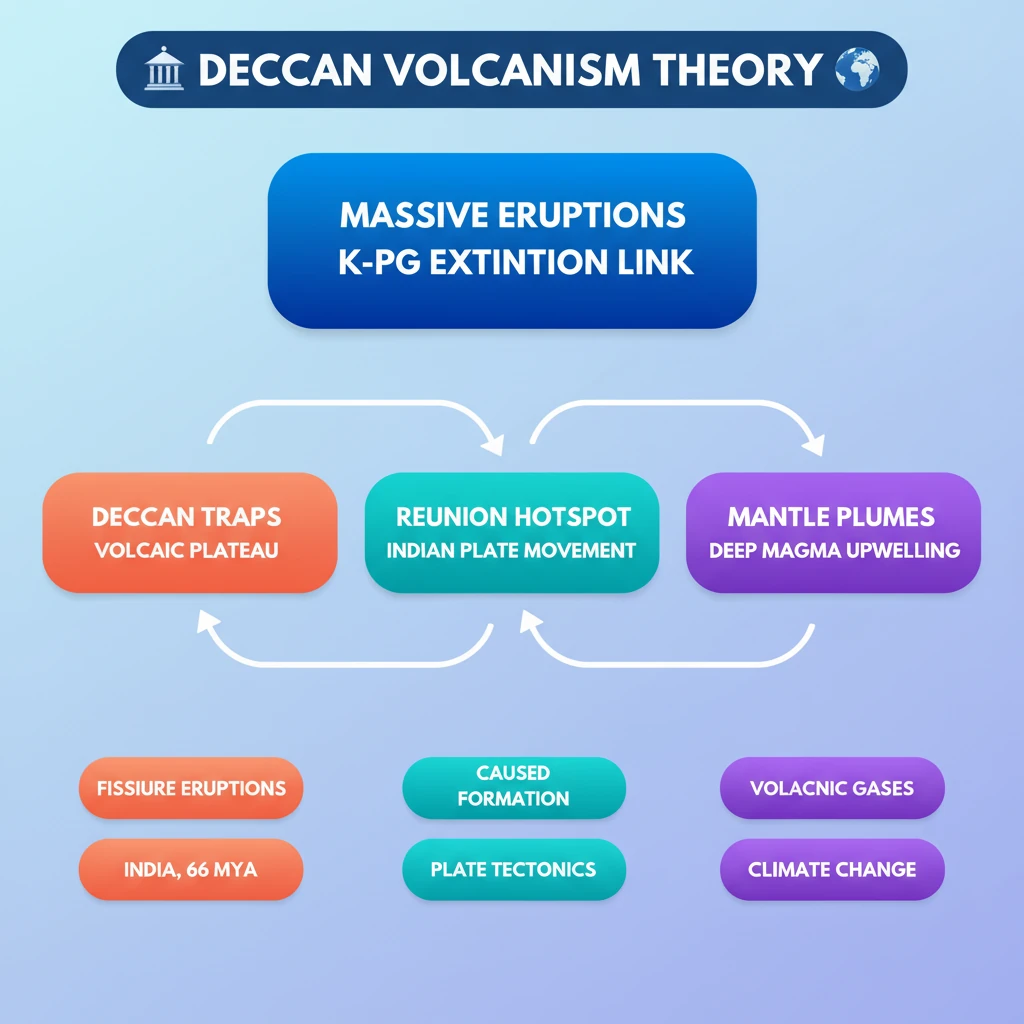
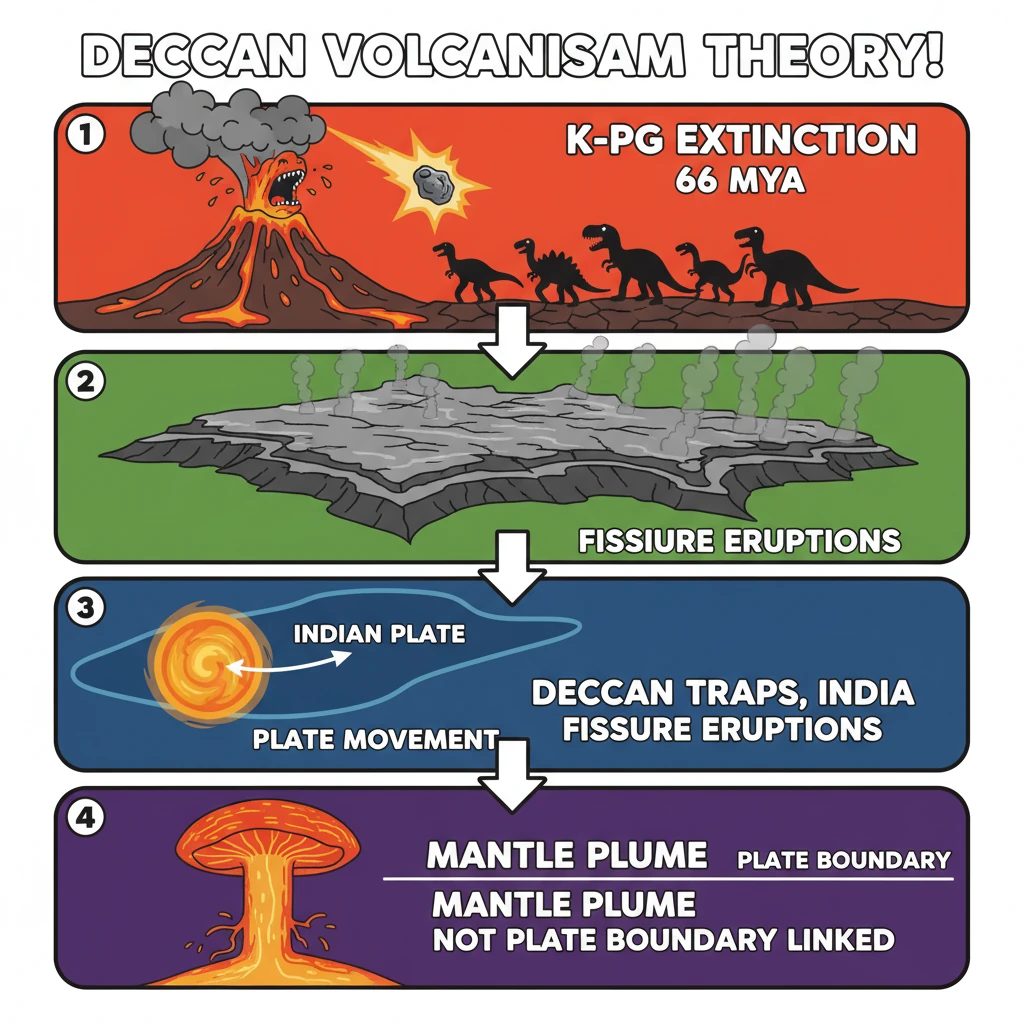
- •Deccan Volcanism Theory links massive eruptions to the K-Pg mass extinction 66 million years ago.
- •Deccan Traps are a large volcanic plateau in India formed by fissure eruptions.
- •Formation was caused by the Indian Plate moving over the Réunion mantle hotspot.
- •Mantle plumes are hot magma upwellings not linked to plate boundaries.
- •Volcanic gas emissions from the Traps likely caused significant climate and environmental changes.
🧠 Memory Techniques
98% Verified Content
📚 Reference Sources
•NCERT Geography Textbooks (Class XI, Physical Geography)
•Physical Geography by Savindra Singh
•Geological Survey of India (GSI) publications
•Scientific articles on Deccan Traps and K-Pg extinction (e.g., Science, Nature)