Keeping the Boulders - Geography | UPSC Learning
Topics
0 topics • 0 completed
🔍
No topics match your search
Keeping the Boulders
Medium⏱️ 7 min read
geography
📖 Introduction
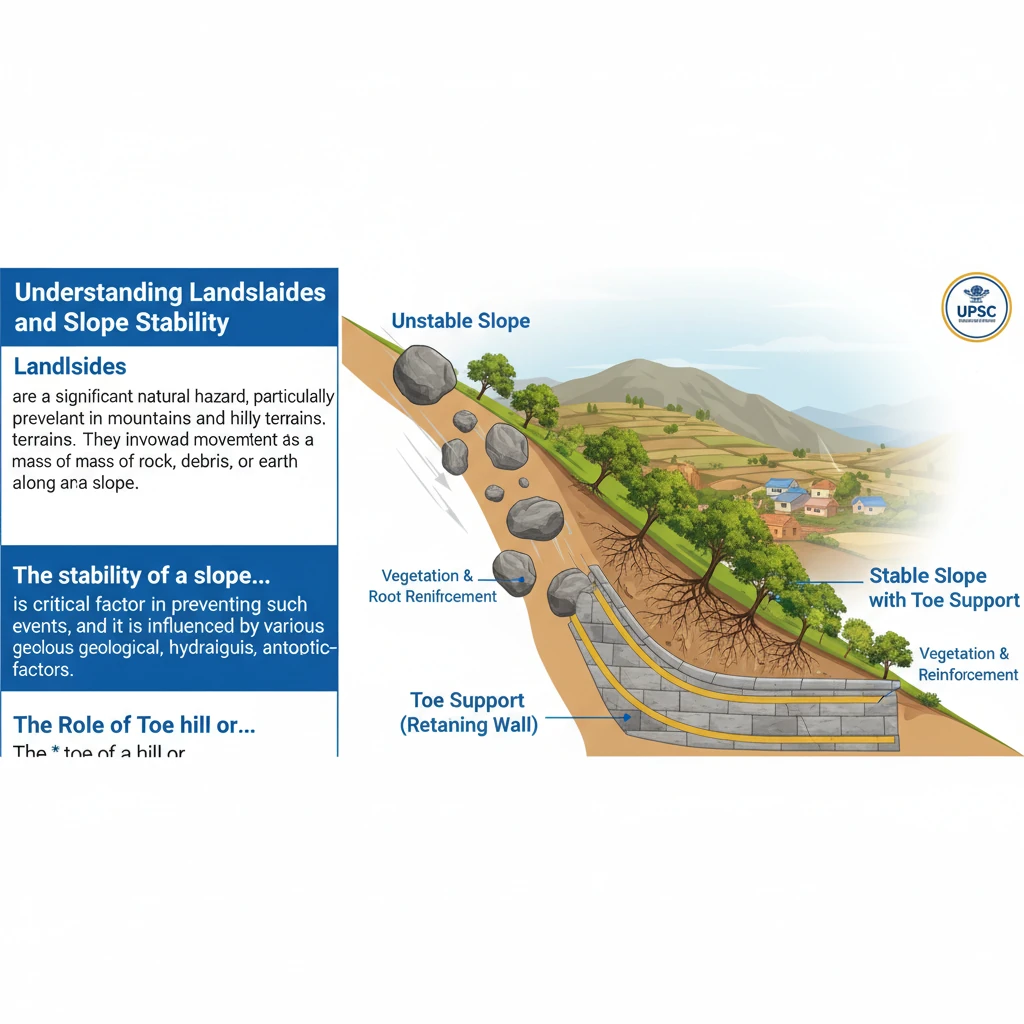
<h4>Understanding Landslides and Slope Stability</h4><p><strong>Landslides</strong> are a significant natural hazard, particularly prevalent in mountainous and hilly terrains. They involve the downward movement of a mass of rock, debris, or earth along a slope.</p><p>The stability of a slope is a critical factor in preventing such events, and it is influenced by various geological, hydrological, and anthropogenic factors.</p><h4>The Role of Toe Support</h4><p>The <strong>toe</strong> of a hill refers to the lowest part or the base of a slope. This section is fundamental in maintaining the overall <strong>stability</strong> of the entire slope above it.</p><div class='info-box'><p><strong>Toe support</strong> is defined as the resistance offered by the material at the base of a slope against the downward or outward movement of the overlying slope material. It acts as a natural buttress.</p></div><p>This support counteracts the gravitational forces that constantly pull the slope material downwards, ensuring the structural integrity of the hillside.</p><h4>Why Boulders are Essential for Slope Stability</h4><p>In many regions susceptible to landslides, large <strong>stones and boulders</strong> naturally accumulate at the base of hills. These natural formations are not merely loose debris; they serve a vital geological function.</p><p>These boulders act as a natural barrier, providing crucial <strong>toe support</strong>. They prevent the outward bulging, spreading, or sliding of the overlying soil and rock mass, thereby significantly contributing to <strong>slope stability</strong>.</p><h4>Consequences of Removing Toe Support</h4><p>The deliberate or accidental removal of these natural fortifications, such as <strong>stones and boulders</strong> from the bottom of a hill, directly compromises its inherent <strong>toe support</strong>.</p><p>This action reduces the critical resistance at the base of the slope, making the entire hillside inherently unstable. Consequently, it drastically <strong>increases the possibility of landslides</strong>.</p><div class='key-point-box'><p><strong>Key Principle:</strong> It is imperative to avoid removing natural <strong>toe support</strong> (e.g., large boulders, consolidated earth) from the base of landslide-prone slopes, as this action fundamentally destabilizes the slope and significantly escalates landslide risk.</p></div><div class='exam-tip-box'><p><strong>UPSC Insight:</strong> This concept is crucial for understanding <strong>Disaster Management (GS-III)</strong>, <strong>Physical Geography (GS-I)</strong>, and <strong>Environmental Impact Assessment (GS-III)</strong>. It highlights how seemingly minor human interventions can have profound environmental and disaster-related consequences.</p></div>
💡 Key Takeaways
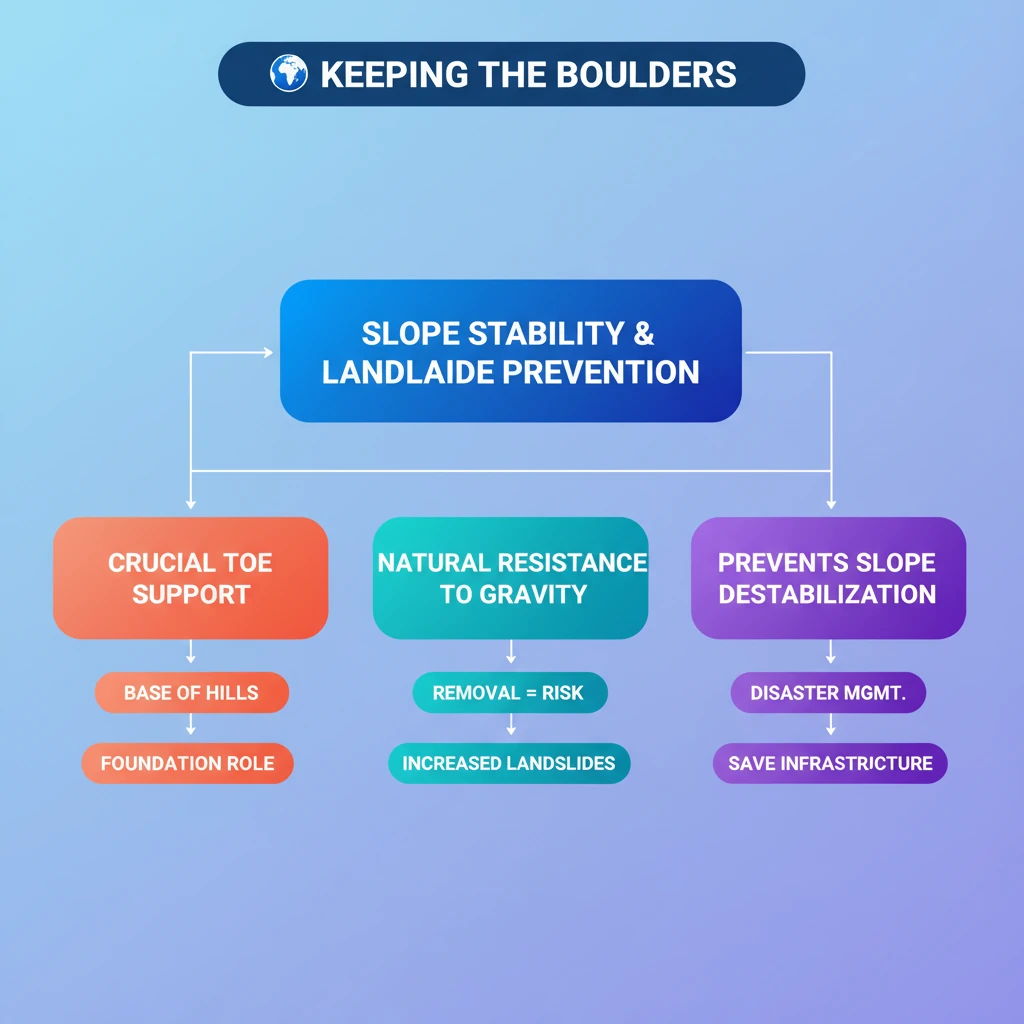
- •Boulders at the base of hills provide crucial 'toe support'.
- •Toe support is essential for maintaining overall slope stability.
- •Removing these boulders destabilizes the slope by eliminating natural resistance.
- •Such removal significantly increases the risk and possibility of landslides.
- •Preserving natural toe support is a fundamental principle of landslide prevention and disaster management.
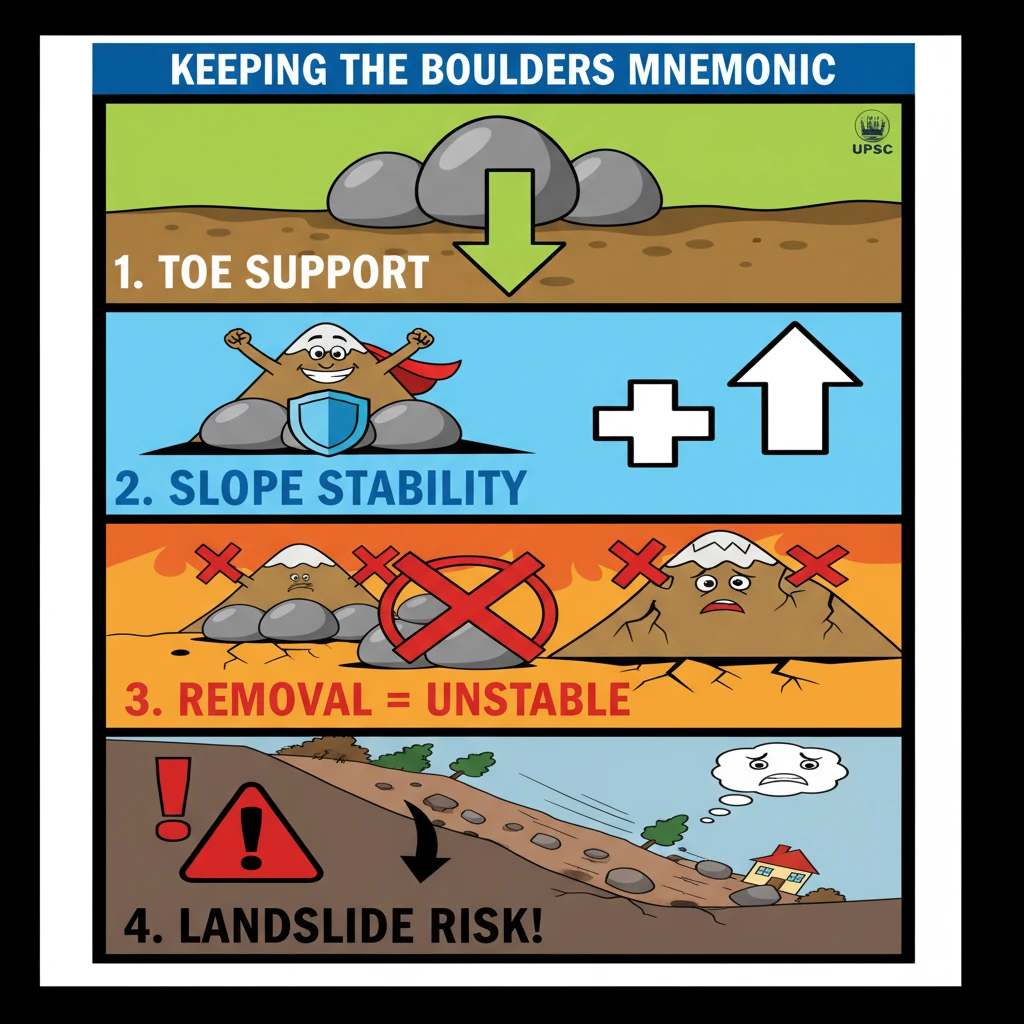
🧠 Memory Techniques
98% Verified Content
📚 Reference Sources
•National Disaster Management Authority (NDMA) guidelines on Landslide Management
•Basic principles of Geotechnical Engineering and Soil Mechanics