Warming of Great Barrier Reef Waters - Geography | UPSC Learning
Topics
0 topics • 0 completed
🔍
No topics match your search
Warming of Great Barrier Reef Waters
Medium⏱️ 6 min read
geography
📖 Introduction
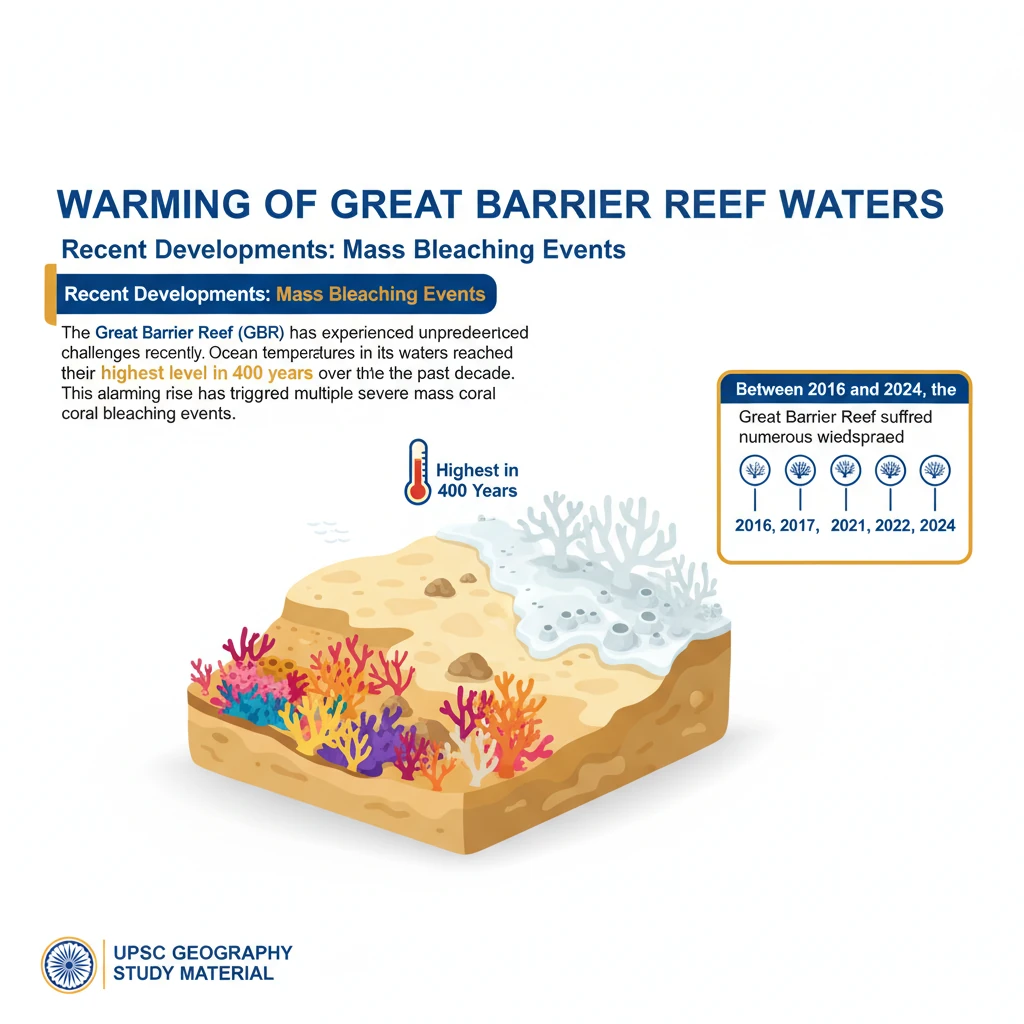
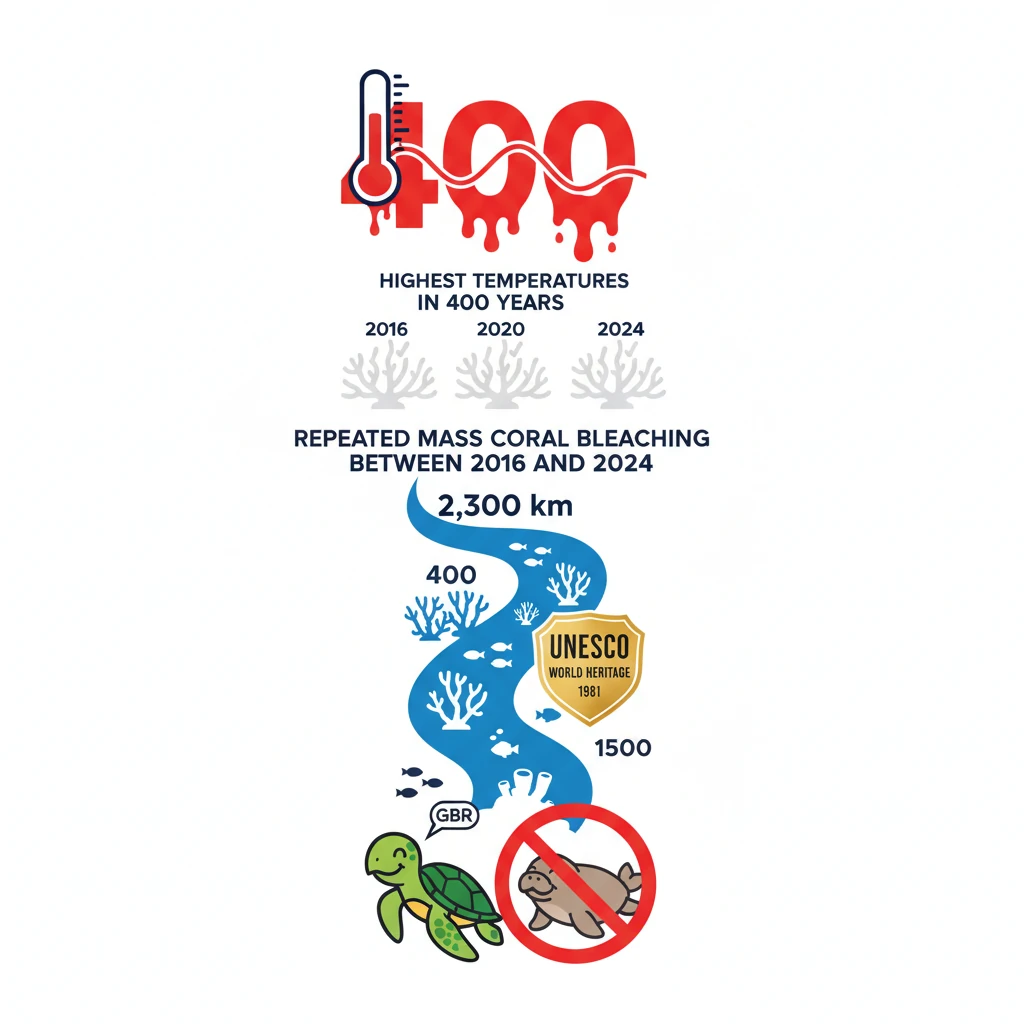
<h4>Recent Developments: Mass Bleaching Events</h4><p>The <strong>Great Barrier Reef (GBR)</strong> has experienced unprecedented challenges recently. Ocean temperatures in its waters reached their <strong>highest level in 400 years</strong> over the past decade. This alarming rise has triggered multiple severe <strong>mass coral bleaching events</strong>.</p><div class="key-point-box"><p>Between <strong>2016 and 2024</strong>, the <strong>Great Barrier Reef</strong> suffered numerous widespread <strong>mass coral bleaching events</strong>, indicating significant environmental stress.</p></div><h4>Understanding the Great Barrier Reef (GBR)</h4><p>The <strong>Great Barrier Reef</strong> is globally recognized as the <strong>world’s largest coral reef system</strong>. It is strategically located in the <strong>Coral Sea</strong>, just off the coast of <strong>Queensland, Australia</strong>.</p><div class="info-box"><ul><li><strong>Length:</strong> The reef stretches approximately <strong>2,300 km</strong>.</li><li><strong>Composition:</strong> It comprises around <strong>3,000 individual reefs</strong> and <strong>900 islands</strong>.</li><li><strong>Biodiversity:</strong> Home to over <strong>400 types of coral</strong> and <strong>1,500 species of fish</strong>.</li></ul></div><h4>Ecological Significance of GBR</h4><p>Beyond its sheer size and beauty, the <strong>GBR</strong> is a critical habitat for diverse marine life. It supports numerous species, including several that are endangered.</p><div class="info-box"><p>The reef provides sanctuary for endangered species such as the <strong>dugong</strong> and the <strong>large green turtle</strong>, highlighting its immense ecological value.</p></div><p>Recognizing its outstanding universal value, the <strong>GBR</strong> was designated a <strong>UNESCO World Heritage site</strong> in <strong>1981</strong>.</p><h4>Historical Bleaching Incidents</h4><p>While recent events are severe, <strong>mass bleaching</strong> is not entirely new to the <strong>Great Barrier Reef</strong>. The first widespread incident was recorded decades ago, with recurring events since.</p><div class="info-box"><p>Significant <strong>mass bleaching events</strong> on the <strong>Great Barrier Reef</strong> have occurred in: <strong>1998</strong>, <strong>2002</strong>, <strong>2016</strong>, <strong>2017</strong>, <strong>2020</strong>, <strong>2022</strong>, and <strong>2024</strong>. This pattern underscores a worrying trend of increasing frequency.</p></div>
💡 Key Takeaways
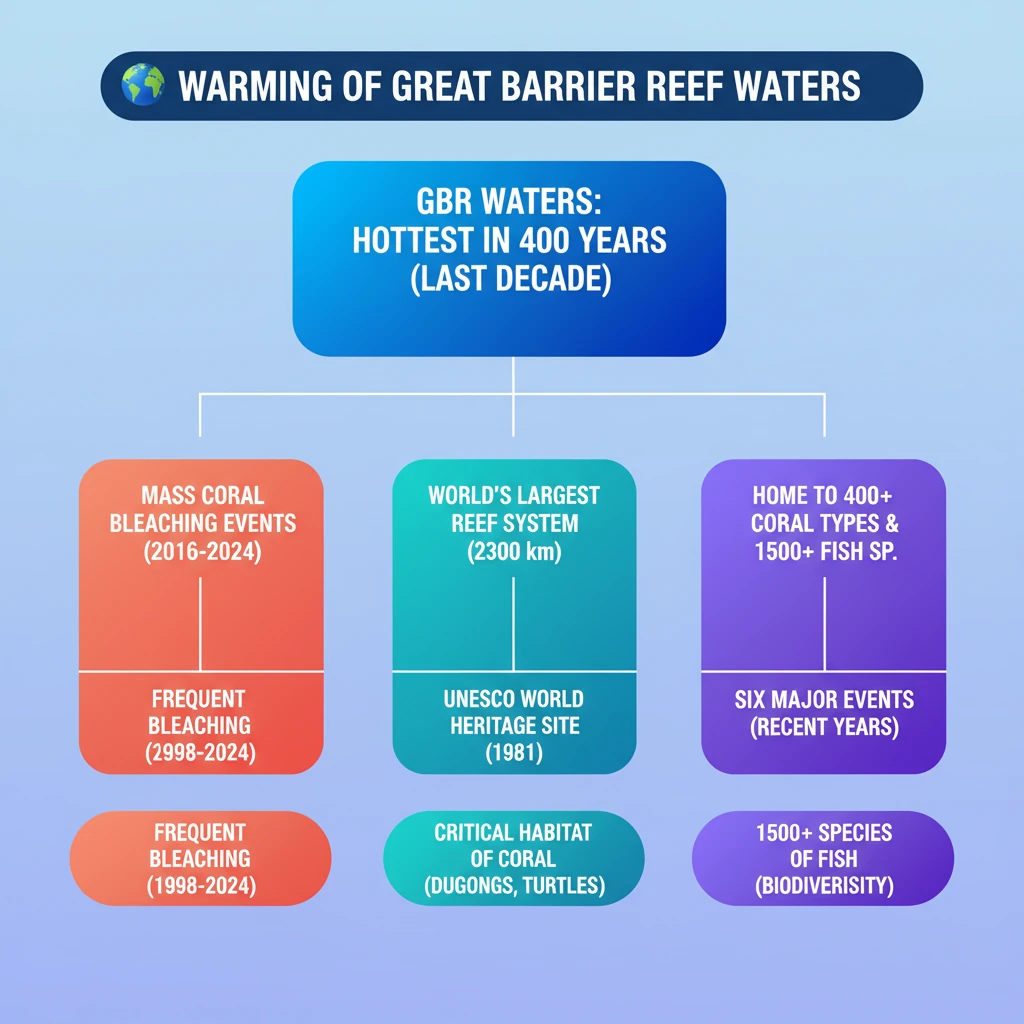
- •Great Barrier Reef (GBR) waters hit highest temperatures in 400 years over the last decade.
- •Mass coral bleaching occurred repeatedly between 2016 and 2024.
- •GBR is the world's largest coral reef system, stretching 2,300 km, home to 400 coral types and 1,500 fish species.
- •It is a UNESCO World Heritage site (inscribed 1981) and habitat for endangered species like dugongs and green turtles.
- •Widespread bleaching events have been recorded since 1998, with increasing frequency in recent years (1998, 2002, 2016, 2017, 2020, 2022, 2024).
🧠 Memory Techniques
95% Verified Content