International Asteroid Day - Geography | UPSC Learning
Topics
0 topics • 0 completed
🔍
No topics match your search

International Asteroid Day
Medium⏱️ 8 min read
geography
📖 Introduction
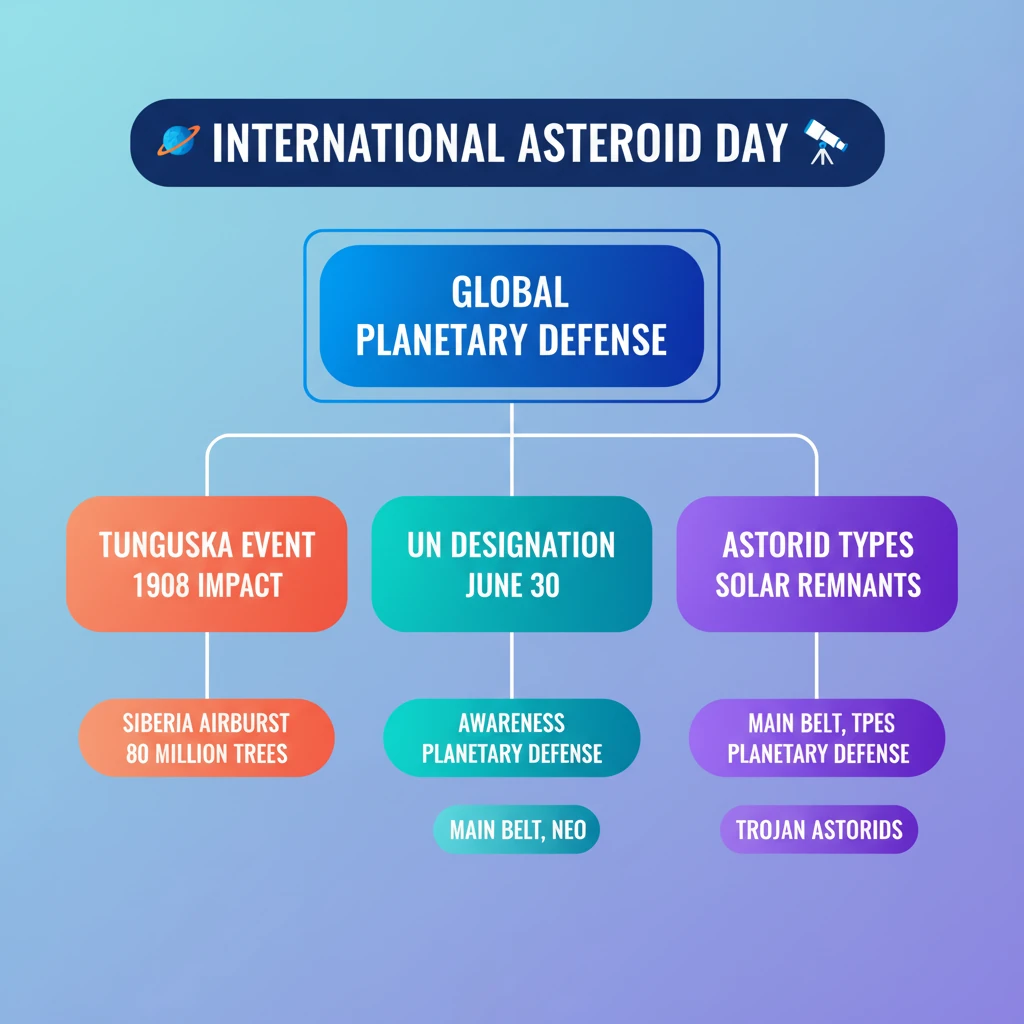
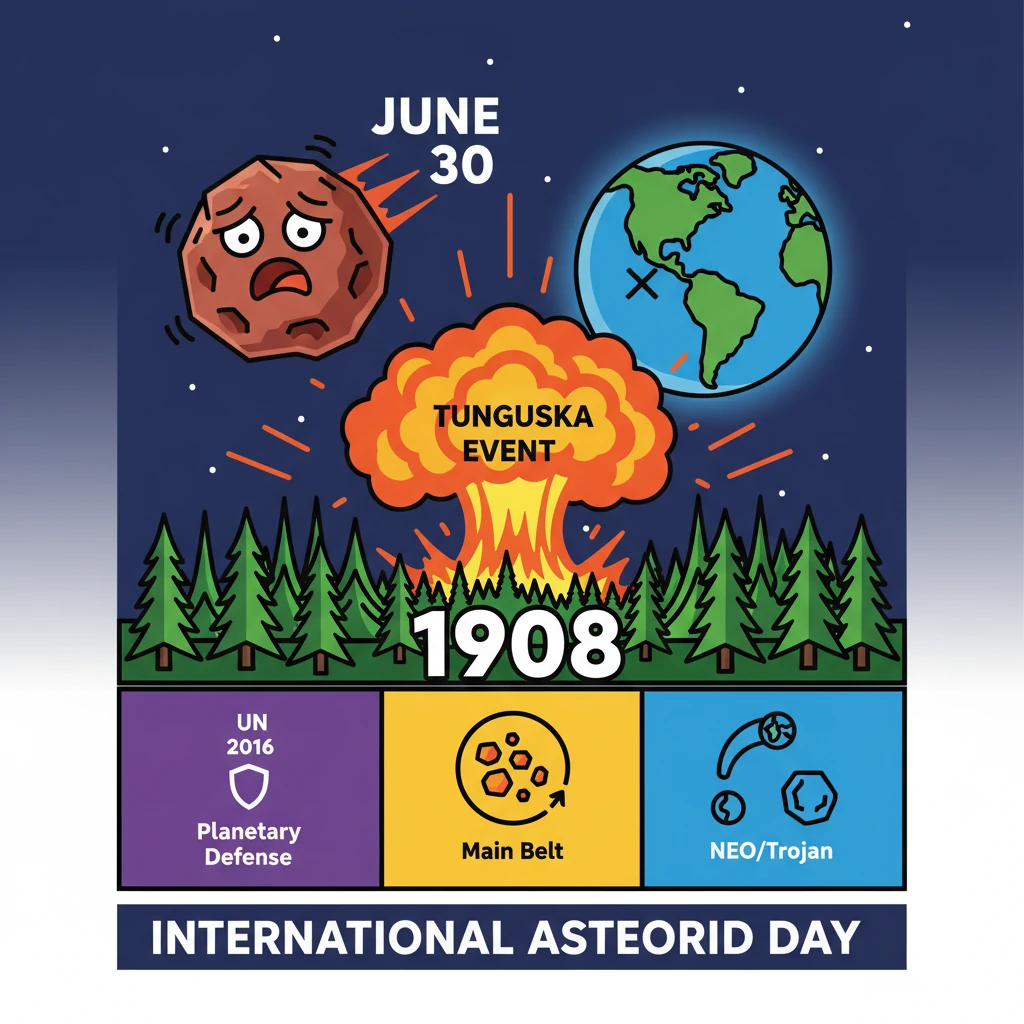
<h4>What is International Asteroid Day?</h4><p><strong>International Asteroid Day</strong> is observed annually on <strong>June 30th</strong>. Its primary purpose is to raise global awareness about the potential threat of <strong>asteroid impacts</strong> on Earth.</p><p>The date commemorates the historic <strong>Tunguska event</strong> of <strong>1908</strong>, a significant asteroid-related incident that highlighted the destructive power of such celestial objects.</p><h4>The Tunguska Event (1908)</h4><p>The <strong>Tunguska event</strong> occurred in <strong>Siberia</strong>, Russia, on <strong>June 30, 1908</strong>. It was caused by an <strong>asteroid explosion</strong> in the atmosphere, not a direct ground impact.</p><div class='info-box'><p><strong>Key Facts about Tunguska Event:</strong></p><ul><li><strong>Cause:</strong> Asteroid explosion in the atmosphere.</li><li><strong>Impact:</strong> Flattened approximately <strong>80 million trees</strong>.</li><li><strong>Area Affected:</strong> Over <strong>830 square miles</strong> (2,150 square kilometers).</li><li><strong>Casualties:</strong> Minimal human casualties due to its extremely remote location.</li><li><strong>Effect:</strong> The shock wave was reportedly felt hundreds of miles away.</li></ul></div><h4>United Nations Recognition</h4><p>The significance of asteroid impacts led to the formal designation of <strong>International Asteroid Day</strong> by the <strong>United Nations</strong> in <strong>2016</strong>. This recognition aims to promote global efforts in <strong>planetary defense</strong>.</p><div class='key-point-box'><p><strong>NASA's Perspective:</strong> The <strong>National Aeronautics and Space Administration (NASA)</strong> has emphasized that a collision of <strong>Near-Earth Objects (NEOs)</strong> with Earth is the <strong>only natural disaster</strong> humanity could potentially prevent completely.</p></div><h4>What are Asteroids?</h4><p><strong>Asteroids</strong>, often referred to as <strong>minor planets</strong>, are rocky, airless remnants left over from the early formation of our solar system. They originated approximately <strong>4.6 billion years ago</strong>.</p><div class='info-box'><p><strong>Characteristics of Asteroids:</strong></p><ul><li><strong>Shape:</strong> Predominantly exhibit <strong>irregular shapes</strong>, though some larger ones can be nearly spherical.</li><li><strong>Moons:</strong> Many asteroids are known to have small moons, with some even possessing two.</li><li><strong>Binary/Triple Systems:</strong> <strong>Binary asteroids</strong> consist of two similar-sized rocky bodies orbiting each other, and rare <strong>triple asteroid systems</strong> also exist.</li></ul></div><h4>Categorization of Asteroids</h4><p>Asteroids are broadly categorized based on their location and orbital characteristics within our solar system:</p><ul><li><strong>Main Asteroid Belt:</strong> This is the most populated region, located between the orbits of <strong>Mars</strong> and <strong>Jupiter</strong>. The vast majority of known asteroids reside here.</li><li><strong>Trojan Asteroids:</strong> These asteroids share an orbit with a larger planet, typically residing near stable gravitational points known as <strong>Lagrangian Points</strong> (specifically <strong>L4</strong> and <strong>L5</strong>). At these points, the gravitational forces of the sun and the planet are balanced, preventing collisions with the larger planet.</li><li><strong>Near-Earth Asteroids (NEAs):</strong> These asteroids have orbits that bring them relatively close to Earth's orbit. A subset of NEAs, specifically those whose orbits actually intersect Earth's orbital path, are termed <strong>Earth-crossers</strong>.</li></ul>
💡 Key Takeaways
- •International Asteroid Day, observed on June 30th, raises awareness about the threat of asteroid impacts, commemorating the 1908 Tunguska event.
- •The Tunguska event, an asteroid airburst in Siberia, flattened 80 million trees, demonstrating the destructive potential of NEOs.
- •The UN designated International Asteroid Day in 2016 to promote global planetary defense efforts.
- •Asteroids are remnants from the solar system's formation, categorized into Main Belt, Trojan, and Near-Earth Asteroids.
- •Global initiatives like DART, Hera, and ISRO's NETRA project are actively monitoring and developing strategies for Near-Earth Objects (NEOs).
- •ISRO has expressed interest in participating in the international mission to study the asteroid Apophis, which will pass close to Earth in 2029.
🧠 Memory Techniques
98% Verified Content
📚 Reference Sources
•NASA official statements on planetary defense and DART mission
•United Nations Office for Outer Space Affairs (UNOOSA) on International Asteroid Day
•European Space Agency (ESA) on Hera mission