Ninetyeast Ridge: Formation, Composition, and Significance - Geography | UPSC Learning
Topics
0 topics • 0 completed
🔍
No topics match your search
Ninetyeast Ridge: Formation, Composition, and Significance
Medium⏱️ 10 min read
geography
📖 Introduction
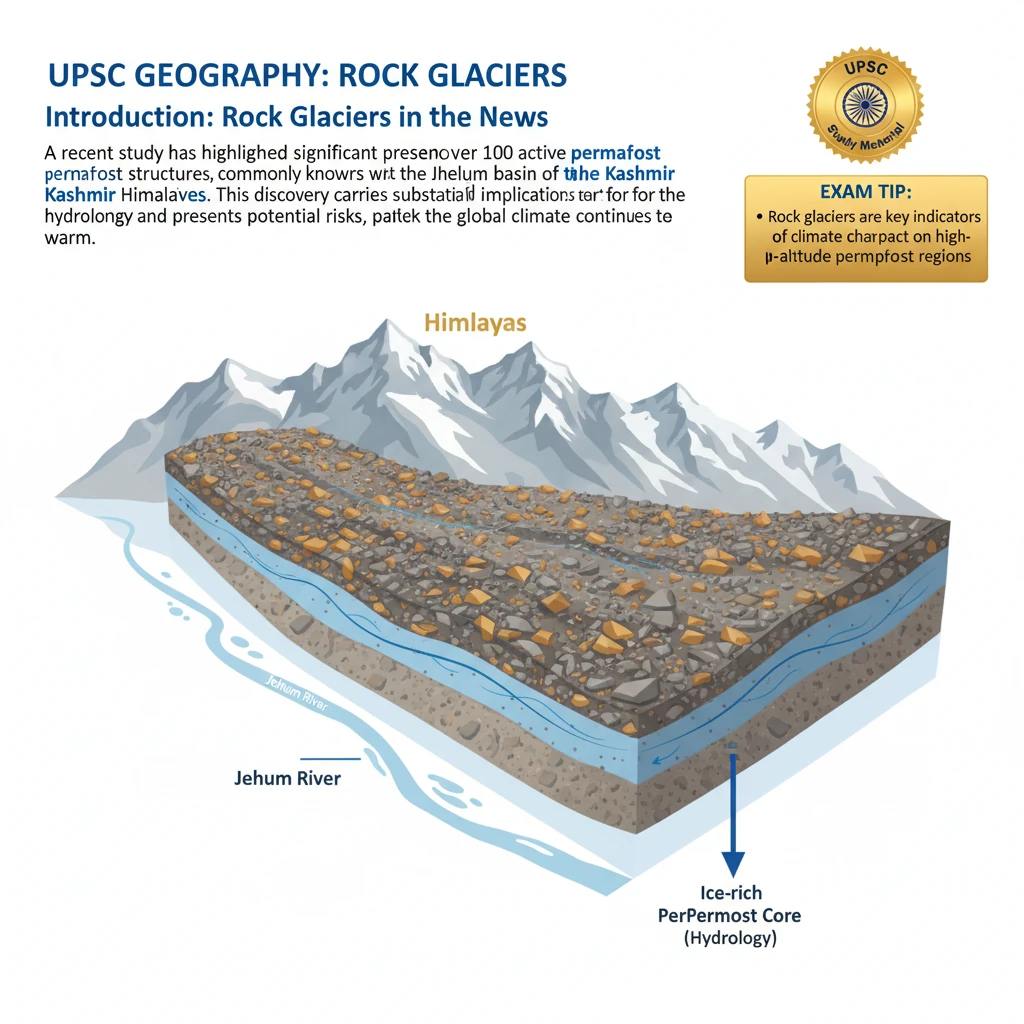
<h4>Introduction: Rock Glaciers in the News</h4><p>A recent study has highlighted the significant presence of over <strong>100 active permafrost structures</strong>, commonly known as <strong>rock glaciers</strong>, within the <strong>Jhelum basin</strong> of the <strong>Kashmir Himalayas</strong>. This discovery carries substantial implications for the region's <strong>hydrology</strong> and presents potential risks, particularly as the global climate continues to warm.</p><div class='exam-tip-box'><p>Understanding the context of "Why in News" is crucial for UPSC. It helps in linking static concepts to current affairs, often forming the basis of questions in <strong>GS Paper 1 (Geography)</strong> and <strong>GS Paper 3 (Environment & Disaster Management)</strong>.</p></div><h4>What are Rock Glaciers?</h4><p><strong>Rock glaciers</strong> are unique landforms composed of a mixture of <strong>rock fragments</strong> and <strong>ice</strong>. They are typically found in <strong>mountainous regions</strong> where specific environmental conditions prevail.</p><div class='info-box'><p><strong>Formation Conditions:</strong> Rock glaciers require a combination of <strong>permafrost</strong>, abundant <strong>rock debris</strong>, and <strong>ice</strong> to form. They occur in highly elevated regions with steep slopes.</p></div><p>One common formation scenario involves a pre-existing <strong>glacier</strong> that accumulates substantial amounts of <strong>debris and rocks</strong> during its movement. If this glacier subsequently recedes or thaws, the debris-covered ice can gradually transform into a <strong>rock glacier</strong>.</p><p>To the unaided eye, rock glaciers often resemble ordinary ground. Their proper identification necessitates a specialized <strong>geomorphological view</strong>, distinguishing them from other landforms.</p><h4>Understanding Permafrost</h4><p><strong>Permafrost</strong> is defined as a layer of ground that remains permanently frozen for at least two consecutive years. It can be found either on or beneath the Earth's surface.</p><div class='info-box'><p><strong>Composition:</strong> Permafrost primarily consists of <strong>soil, gravel, and sand</strong>, which are typically bound together by <strong>ice</strong>. This frozen matrix is fundamental to the formation and stability of rock glaciers.</p></div><h4>Classification of Rock Glaciers</h4><p>Rock glaciers are broadly categorized based on their internal ice content and movement characteristics:</p><ul><li><strong>Active Rock Glaciers:</strong> These structures contain significant amounts of <strong>ice</strong> and exhibit ongoing, albeit slow, <strong>movement</strong>. They are considered more dynamic and potentially hazardous.</li><li><strong>Relict Rock Glaciers:</strong> These are more stable and inert, having little to no ice and showing no significant movement. They represent past periods of permafrost activity.</li></ul><div class='key-point-box'><p>The distinction between <strong>active</strong> and <strong>relict</strong> rock glaciers is critical for assessing their potential impacts and risks in a changing climate.</p></div><h4>Importance of Rock Glaciers</h4><p>Rock glaciers serve as crucial indicators and reservoirs in high-altitude environments:</p><ul><li><strong>Mountain Permafrost Indicators:</strong> They are vital indicators of <strong>mountain permafrost</strong>, the permanently frozen ground underlying many high-altitude regions. Their presence signifies specific cryospheric conditions.</li><li><strong>Water Storage:</strong> Rock glaciers store substantial volumes of <strong>water</strong> within their frozen cores. This stored water could become a valuable resource, especially in regions facing increasing <strong>water scarcity</strong> and rapid <strong>glacial retreat</strong>.</li></ul><h4>Potential Impacts of Active Rock Glaciers</h4><p>The presence and potential thawing of active rock glaciers pose several significant environmental and societal risks:</p><h5>Glacial Lake Outburst Floods (GLOFs)</h5><p><strong>GLOFs</strong> are sudden and catastrophic floods resulting from the failure of a natural or artificial dam containing a <strong>glacial lake</strong>. This releases large volumes of water and debris downstream.</p><div class='info-box'><p><strong>Increased Risk:</strong> Active rock glaciers can heighten the risk of GLOFs by <strong>destabilizing slopes</strong> or compromising the integrity of natural dams holding back glacial lakes. The study specifically noted rock glaciers near <strong>Chirsar Lake</strong> and <strong>Bramsar Lake</strong> increasing GLOF risk.</p></div><h5>Landslides</h5><p><strong>Landslides</strong> involve the rapid downward movement of soil, rock, or snow along a slope, often triggered by events like earthquakes, heavy rainfall, or human activities.</p><div class='info-box'><p><strong>Trigger Mechanism:</strong> Active rock glaciers can contribute to landslides by <strong>weakening slope stability</strong>. Furthermore, their melting can release water, which acts as a lubricant, facilitating the sliding of unconsolidated mass.</p></div><h5>Thermokarst Formation</h5><p><strong>Thermokarst</strong> refers to a distinctive type of terrain characterized by irregular surfaces, marshy hollows, and small hummocks. These features form due to the thawing of <strong>ice-rich permafrost</strong>.</p><div class='info-box'><p><strong>Landscape Alteration:</strong> Active rock glaciers can lead to the formation of thermokarst features, such as <strong>ponds or lakes</strong>. These changes can significantly alter the regional <strong>hydrology, ecology, and carbon cycle</strong>.</p></div><p>The presence of water bodies near <strong>Kargil-Zanskar</strong> in <strong>Jammu and Kashmir</strong> suggests the existence of underground permafrost, resembling <strong>‘thermokarst lakes’</strong>. This phenomenon poses further risks due to the potential for collapse.</p><p>The melting of ice beneath the Earth's surface carries a high risk of ground collapse. This collapse creates a unique landscape featuring <strong>sinkholes, hummocks, caverns, and tunnels</strong>.</p><div class='highlight-box'><p>The <strong>Batagaika Crater</strong> in the <strong>Sakha Republic, Russia</strong>, is a prominent example of thermokarst. It is recognized as the world's largest <strong>permafrost crater</strong>, illustrating the scale of such phenomena.</p></div>
💡 Key Takeaways
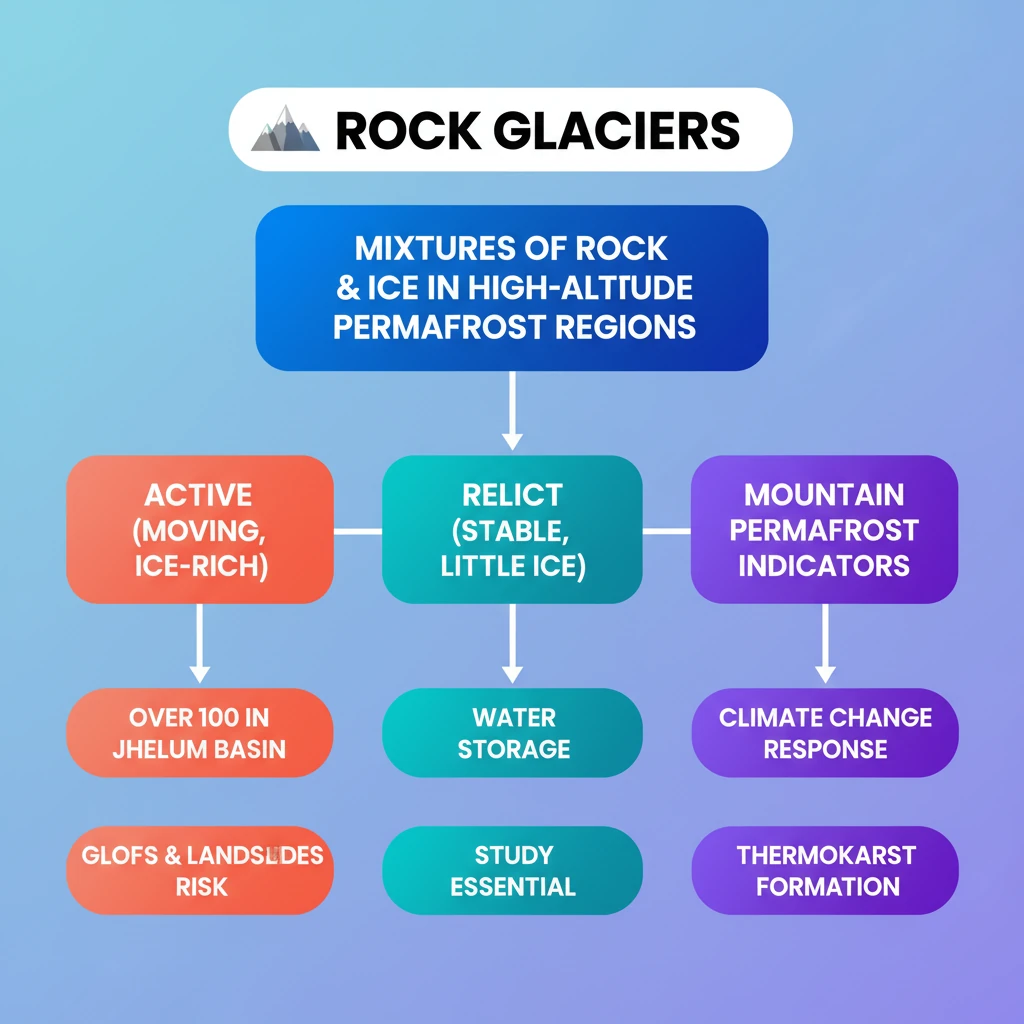
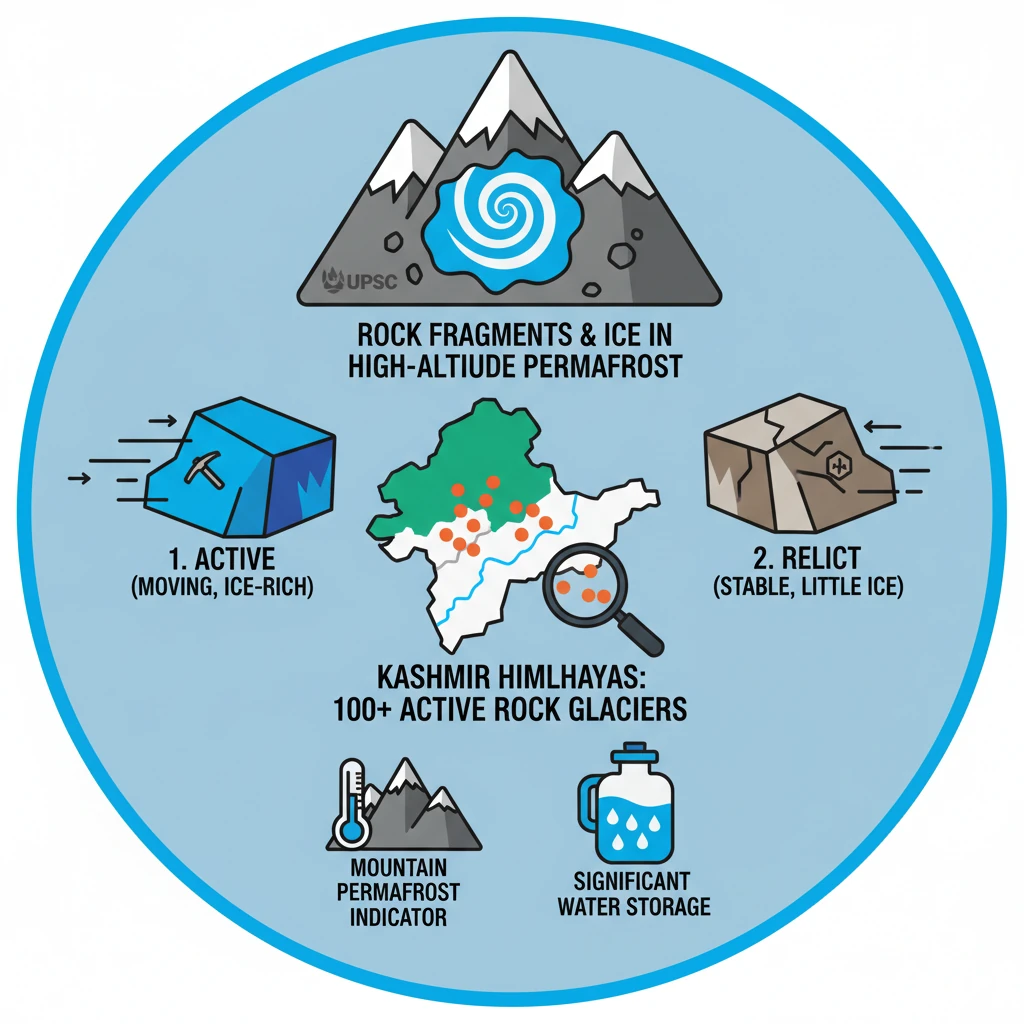
- •Rock glaciers are mixtures of rock fragments and ice, found in high-altitude permafrost regions.
- •They are classified as active (moving, ice-rich) or relict (stable, little ice).
- •Recent studies show over 100 active rock glaciers in the Jhelum basin, Kashmir Himalayas.
- •They are important indicators of mountain permafrost and store significant amounts of water.
- •Active rock glaciers pose risks of GLOFs, landslides, and thermokarst formation.
- •Thermokarst is terrain formed by thawing permafrost, exemplified by Russia's Batagaika Crater.
- •Understanding rock glaciers is crucial for climate change adaptation and disaster management in mountain regions.
🧠 Memory Techniques
85% Verified Content