What is the Indian Summer Monsoon Rainfall (ISMR)? - Geography | UPSC Learning
Topics
0 topics • 0 completed
🔍
No topics match your search

What is the Indian Summer Monsoon Rainfall (ISMR)?
Medium⏱️ 8 min read
geography
📖 Introduction
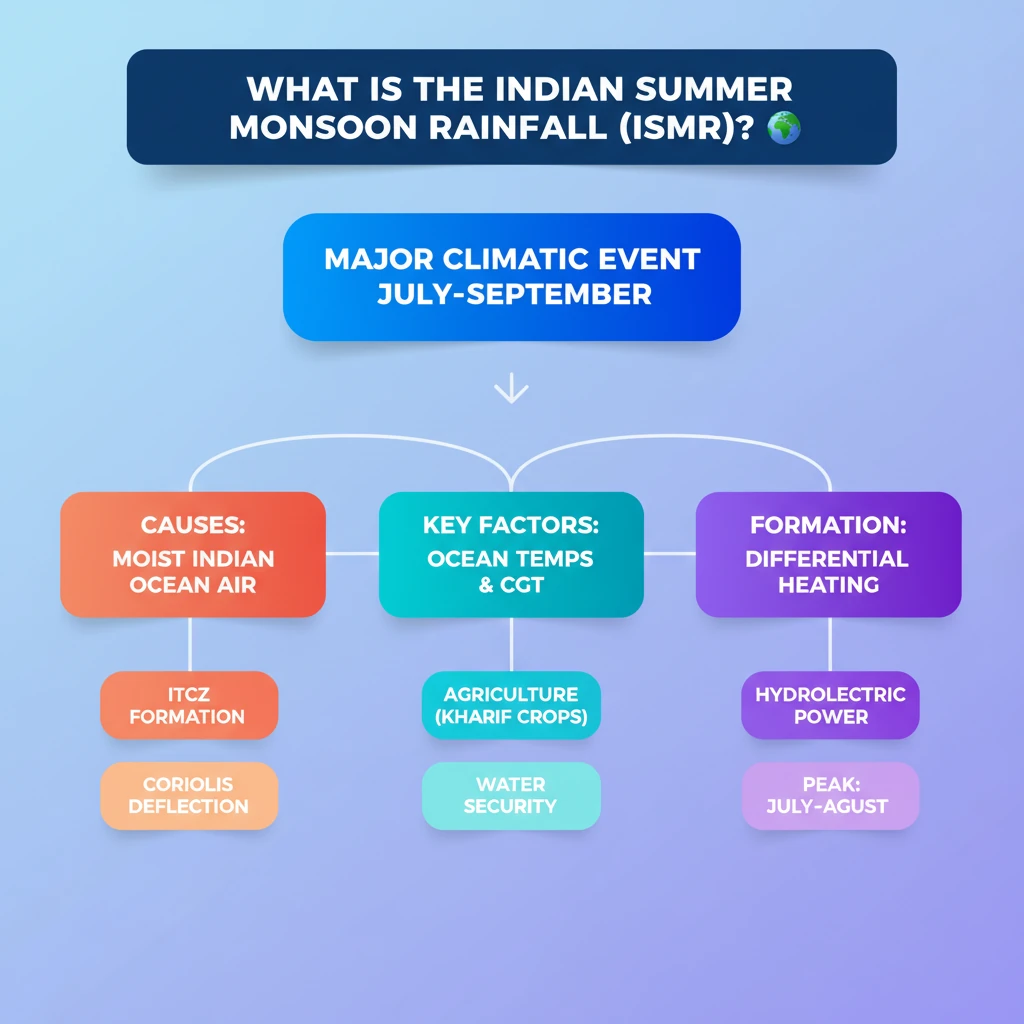
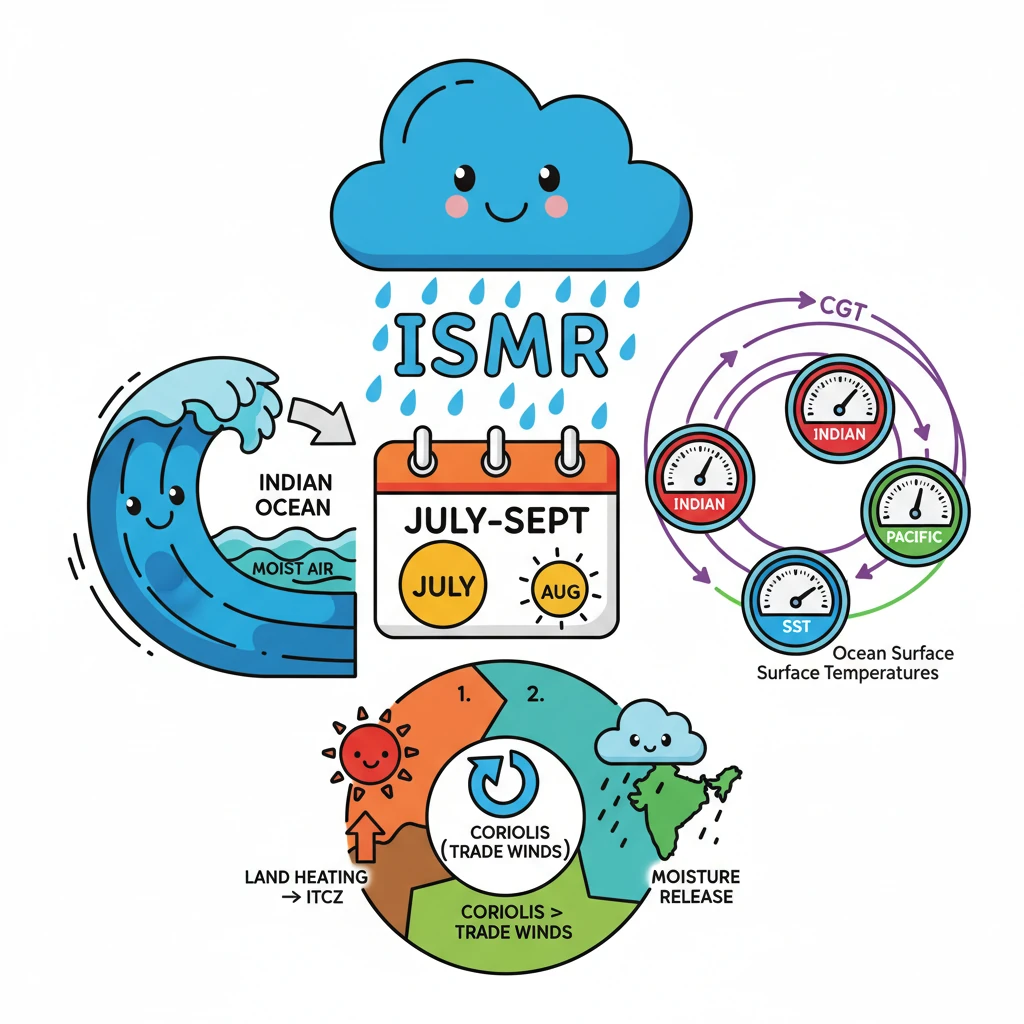
<h4>Introduction to Indian Summer Monsoon Rainfall (ISMR)</h4><p>The <strong>Indian Summer Monsoon Rainfall (ISMR)</strong> is a critical climatic phenomenon for the <strong>Indian subcontinent</strong>. It is characterized by the movement of <strong>moist air</strong> from the <strong>Indian Ocean</strong> towards the landmass.</p><div class='info-box'><p><strong>Definition:</strong> <strong>ISMR</strong> refers to the seasonal rainfall occurring over the Indian subcontinent due to the influx of moisture-laden winds from the Indian Ocean.</p></div><h4>Timing and Duration of ISMR</h4><p>This significant rainfall event primarily occurs over the <strong>Indian subcontinent</strong> during the months of <strong>July</strong> to <strong>September</strong>.</p><p>The peak rainfall activity, contributing the majority of the total precipitation, is typically recorded in <strong>July</strong> and <strong>August</strong>.</p><h4>Key Factors Influencing ISMR</h4><p>The intensity and distribution of <strong>ISMR</strong> are influenced by a complex interplay of various global and regional atmospheric and oceanic factors.</p><div class='key-point-box'><p><strong>Major Influencers:</strong></p><ul><li><strong>Surface temperatures</strong> of the <strong>Indian, Atlantic, and Pacific Oceans</strong> play a crucial role.</li><li>The <strong>circum-global teleconnection (CGT)</strong>, a large-scale atmospheric wave, impacts ISMR from the <strong>mid-latitudes</strong>.</li></ul></div><h4>Mechanism of ISMR Formation</h4><p>The formation of the <strong>Indian Summer Monsoon Rainfall</strong> is a result of differential heating between land and sea, coupled with atmospheric circulation patterns.</p><ol><li><strong>Differential Heating:</strong> During summer, the <strong>Central Asian and Indian landmass</strong> warms up significantly faster than the surrounding ocean bodies due to their lower specific heat capacity.</li><li><strong>Low-Pressure Formation:</strong> This intense heating creates a strong <strong>low-pressure band</strong> over the land, known as the <strong>Intertropical Convergence Zone (ITCZ)</strong>, which shifts northward.</li><li><strong>Wind Deflection:</strong> <strong>Trade winds</strong> originating from the southeast hemisphere are drawn towards this low-pressure area. As these winds cross the <strong>equator</strong>, the <strong>Coriolis force</strong> deflects them towards the <strong>Indian landmass</strong>.</li><li><strong>Moisture Accumulation & Release:</strong> These deflected winds, now blowing as south-westerly monsoons, traverse over the <strong>Arabian Sea</strong> and the <strong>Bay of Bengal</strong>, gathering substantial moisture. Upon reaching the Indian subcontinent, they release this moisture as widespread <strong>rainfall</strong>.</li></ol>
💡 Key Takeaways
- •ISMR is a major climatic event from July-September, peaking in July-August.
- •It is caused by moist air from the Indian Ocean moving towards the Indian subcontinent.
- •Key factors influencing ISMR include ocean surface temperatures (Indian, Atlantic, Pacific) and circum-global teleconnection (CGT).
- •Formation involves differential heating of land (creating ITCZ), Coriolis force deflecting trade winds, and moisture release over India.
- •ISMR is vital for Indian agriculture (Kharif crops), water security, and hydroelectric power.
- •Global phenomena like El Niño can significantly impact ISMR variability, often leading to weaker monsoons.
🧠 Memory Techniques
95% Verified Content
📚 Reference Sources
•NCERT Geography Textbooks (Class XI & XII)
•India Meteorological Department (IMD) general information on Monsoon
•Standard academic resources on Climatology and Indian Geography