Africa’s Afar Triangle: Birthplace of a Potential New Ocean - Geography | UPSC Learning
Topics
0 topics • 0 completed
🔍
No topics match your search
Africa’s Afar Triangle: Birthplace of a Potential New Ocean
Medium⏱️ 8 min read
geography
📖 Introduction
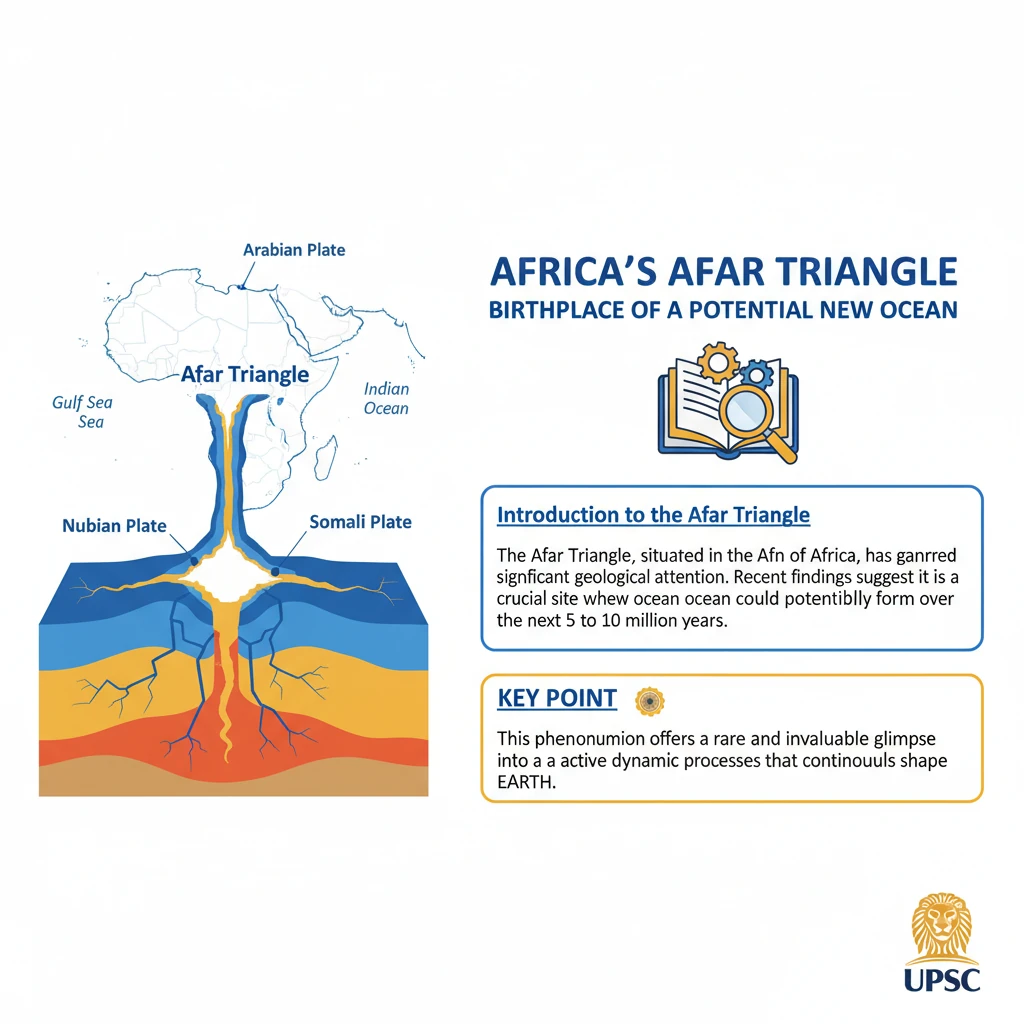
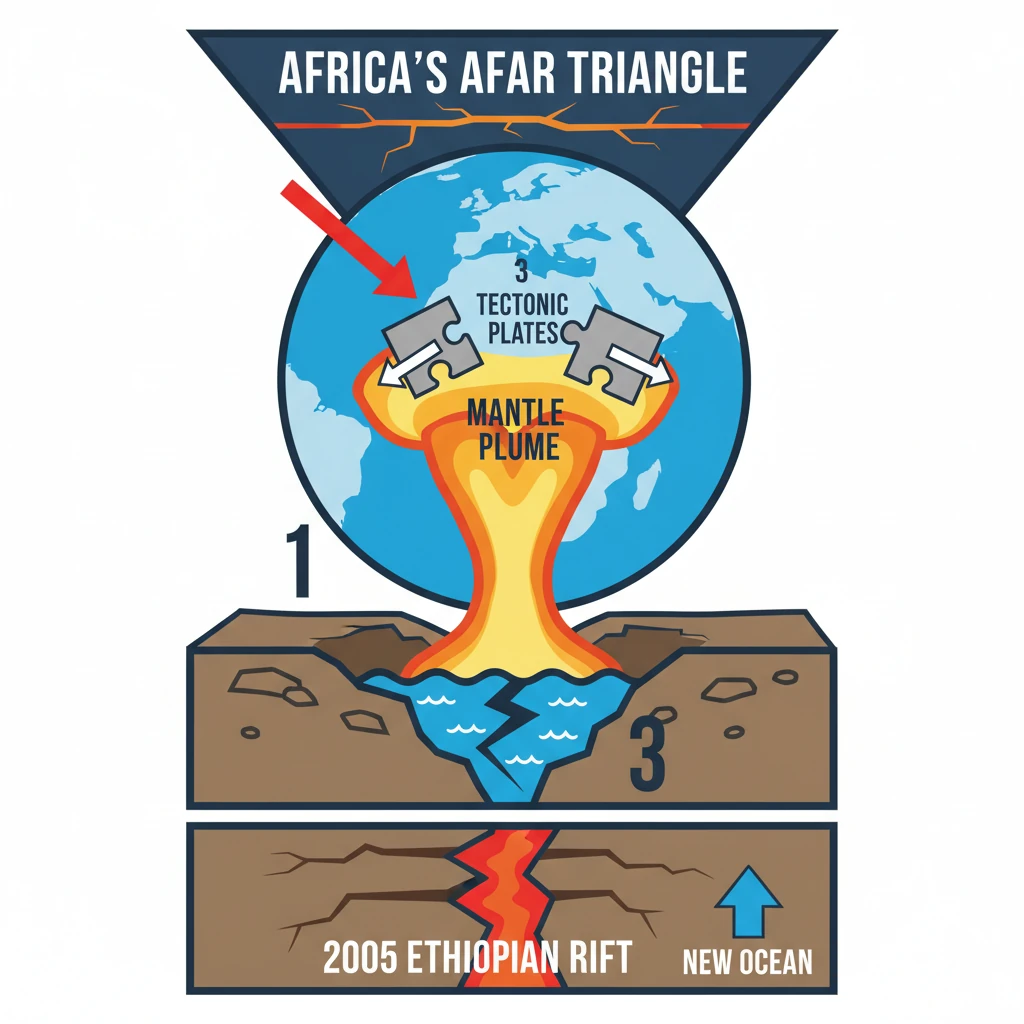
<h4>Introduction to the Afar Triangle</h4><p>The <strong>Afar Triangle</strong>, situated in the <strong>Horn of Africa</strong>, has garnered significant geological attention. Recent findings suggest it is a crucial site where a <strong>new ocean</strong> could potentially form over the next <strong>5 to 10 million years</strong>.</p><div class='key-point-box'><p>This phenomenon offers a rare and invaluable glimpse into the active <strong>dynamic processes</strong> that continuously shape <strong>Earth’s geography</strong>, highlighting the planet's ever-changing nature.</p></div><h4>Geographical and Tectonic Setting</h4><p>The <strong>Afar Triangle</strong> is a distinctive <strong>geological depression</strong>. It is the convergence point of three major <strong>tectonic plates</strong>: the <strong>Nubian Plate</strong>, the <strong>Somali Plate</strong>, and the <strong>Arabian Plate</strong>.</p><div class='info-box'><p>It forms an integral part of the larger <strong>East African Rift system</strong>. This extensive rift stretches from the <strong>Afar region</strong> in the north, extending southward through much of <strong>eastern Africa</strong>.</p></div><h4>Paleontological Significance</h4><p>Beyond its active geological processes, the <strong>Afar Triangle</strong> holds immense <strong>paleontological significance</strong>. The region has yielded numerous <strong>fossil specimens</strong>.</p><p>These discoveries include some of the <strong>earliest hominins</strong>, providing critical insights into human evolution and our ancient ancestors.</p><h4>Ongoing Tectonic Movement and Rift Expansion</h4><p>The <strong>Afar region</strong> has been subjected to continuous and gradual <strong>tectonic movements</strong> for millions of years. This prolonged activity underscores the persistent forces at play beneath the Earth's surface.</p><p>A notable event highlighting this expansion occurred in <strong>2005</strong>. A significant <strong>rift</strong> opened up in the <strong>Ethiopian desert</strong>, serving as a dramatic indicator of the ongoing <strong>continental separation</strong> at a tectonic level.</p><h4>Factors Driving Rift Expansion</h4><p>The primary driver behind the ongoing <strong>rifting process</strong> in the <strong>Afar Triangle</strong> is believed to be a massive <strong>plume of superheated rocks</strong>. This plume originates deep within the <strong>mantle</strong> beneath <strong>East Africa</strong>.</p><p>This rising plume exerts considerable <strong>pressure</strong> on the overlying <strong>crust</strong>. This pressure causes the crust to <strong>stretch</strong>, thin, and ultimately <strong>fracture</strong>, leading to the formation and expansion of the rift valley.</p>
💡 Key Takeaways
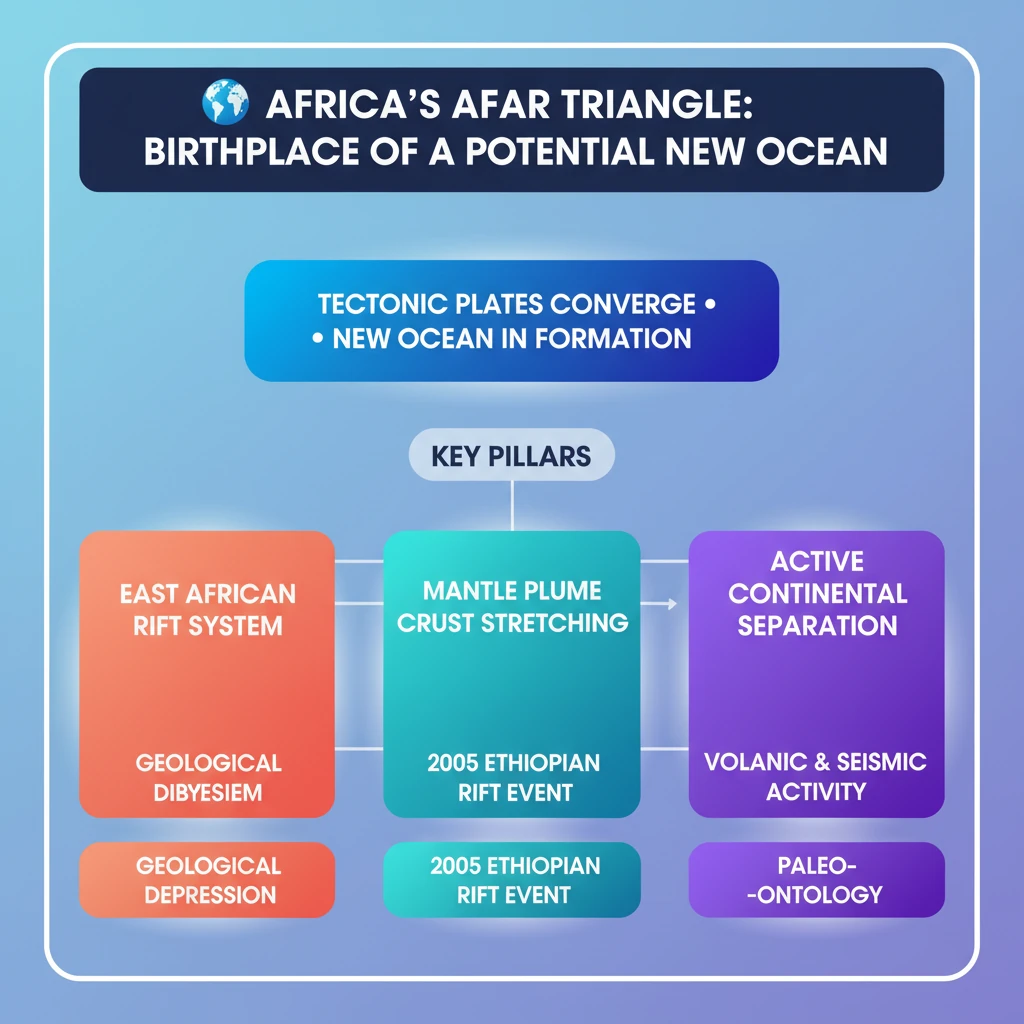
- •The Afar Triangle is a geological depression in the Horn of Africa, where three tectonic plates converge.
- •It is part of the East African Rift system and is considered the birthplace of a potential new ocean.
- •The rifting is driven by a massive mantle plume causing the crust to stretch and fracture.
- •A significant rift opened in the Ethiopian desert in 2005, demonstrating active continental separation.
- •The region is also rich in paleontological history, with fossils of early hominins.
- •It serves as a natural laboratory for studying plate tectonics and continental breakup processes.
🧠 Memory Techniques
95% Verified Content
📚 Reference Sources
•Geological surveys and scientific journals (e.g., Nature, Science)
•University research papers on East African Rift System