What is the Pacific Ring of Fire? - Geography | UPSC Learning
Topics
0 topics • 0 completed
🔍
No topics match your search
What is the Pacific Ring of Fire?
Medium⏱️ 8 min read
geography
📖 Introduction
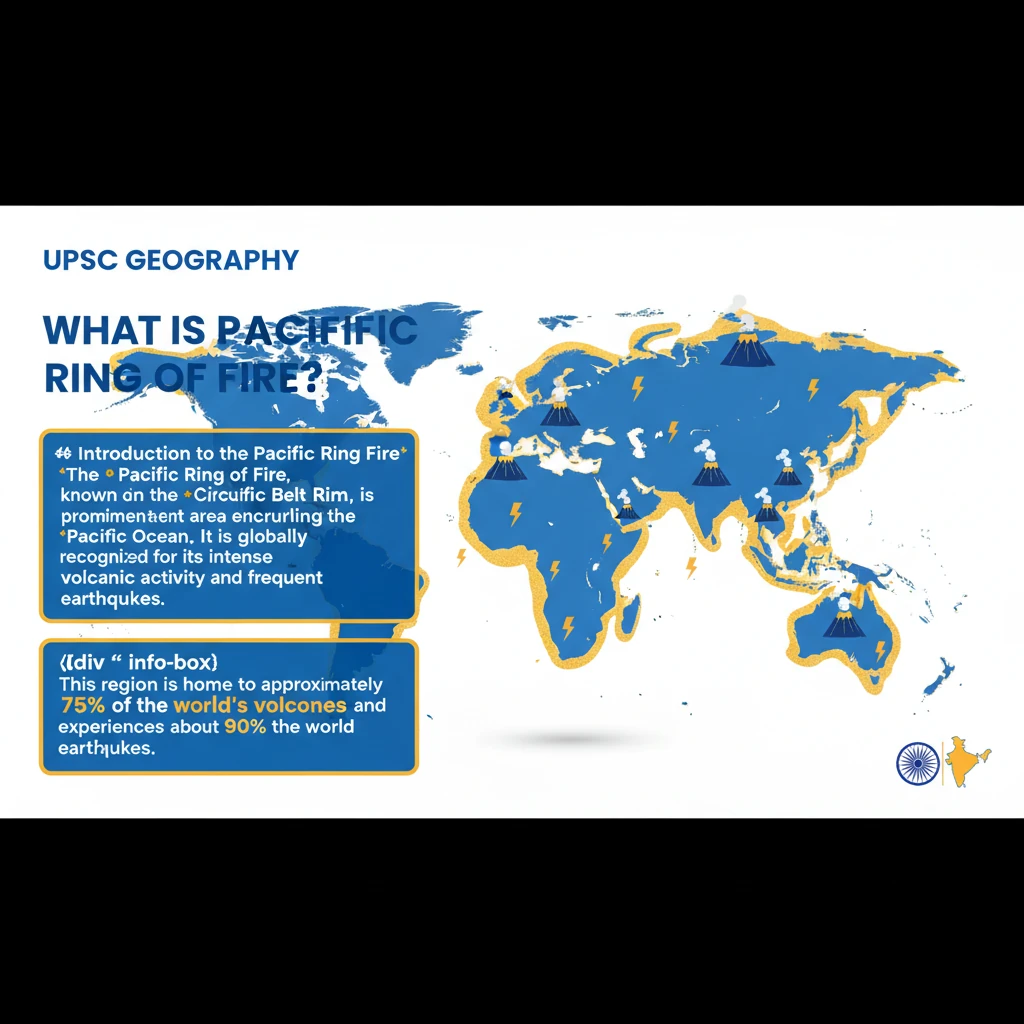
<h4>Introduction to the Pacific Ring of Fire</h4><p>The <strong>Pacific Ring of Fire</strong>, also known as the <strong>Circum-Pacific Belt</strong> or <strong>Pacific Rim</strong>, is a prominent area encircling the <strong>Pacific Ocean</strong>. It is globally recognized for its intense <strong>volcanic activity</strong> and frequent <strong>earthquakes</strong>.</p><div class='info-box'><p>This region is home to approximately <strong>75% of the world's volcanoes</strong> and experiences about <strong>90% of the world's earthquakes</strong>, making it the most seismically and volcanically active zone on Earth.</p></div><h4>Geographical Extent and Key Boundaries</h4><p>The Ring of Fire stretches for an impressive distance of approximately <strong>40,000 kilometres</strong>. It meticulously traces the boundaries between several major <strong>tectonic plates</strong>, which are the primary drivers of its geological dynamism.</p><ul><li>Key plates involved include the <strong>Pacific Plate</strong>, <strong>Juan de Fuca Plate</strong>, <strong>Cocos Plate</strong>, <strong>Indian-Australian Plate</strong>, <strong>Nazca Plate</strong>, <strong>American Plate</strong>, and <strong>Philippine Plate</strong>.</li></ul><p>The chain's path begins along the <strong>western coast of South America</strong> and extends northward along the <strong>western coast of North America</strong>. It then crosses over the <strong>Aleutian Islands in Alaska</strong>.</p><p>From there, it runs southward along the <strong>eastern coast of Asia</strong>, past <strong>New Zealand</strong>, and finally extends into the <strong>northern coast of Antarctica</strong>, forming a near-continuous arc.</p><h4>Countries within the Ring of Fire</h4><p>Numerous countries and territories are situated within this active zone, making them particularly vulnerable to geological hazards. These nations often have advanced disaster preparedness systems due to this constant threat.</p><ul><li><strong>Asian Countries:</strong> <strong>Indonesia</strong>, <strong>Philippines</strong>, <strong>Japan</strong>, <strong>Russia</strong>.</li><li><strong>Oceania:</strong> <strong>New Zealand</strong>, <strong>Papua New Guinea</strong>, <strong>Solomon Islands</strong>.</li><li><strong>North & Central America:</strong> <strong>United States</strong>, <strong>Canada</strong>, <strong>Mexico</strong>, <strong>Guatemala</strong>.</li><li><strong>South America:</strong> <strong>Chile</strong>, <strong>Peru</strong>.</li><li><strong>Antarctica</strong> is also part of this extensive geological feature.</li></ul><h4>Causes of Volcanic and Seismic Activity</h4><p>The intense geological activity in the Ring of Fire is fundamentally driven by <strong>plate tectonics</strong>, specifically the process of <strong>subduction</strong>. This occurs at convergent plate boundaries where tectonic plates move towards each other.</p><div class='key-point-box'><p>In a <strong>subduction zone</strong>, one tectonic plate is forced beneath another plate and sinks into the Earth's mantle. This is a very slow process, with movements typically occurring at just <strong>one or two inches per year</strong>.</p></div><p>As the subducting plate descends, the immense pressure and heat cause the rocks to melt, forming <strong>magma</strong>. This molten rock is less dense than the surrounding material, causing it to rise towards the Earth's surface.</p><p>When this magma reaches the surface, it erupts, leading to <strong>volcanic activity</strong>. The friction and stress accumulated during plate movement also cause sudden releases of energy, resulting in frequent and powerful <strong>earthquakes</strong>.</p><h4>Recent Scientific Insights and Research</h4><p>Recent scientific research has focused on the dynamics of the <strong>Pacific Plate</strong>, which is a major driver of tectonic activity within the Ring of Fire. Studies indicate that this massive plate is currently undergoing a process of <strong>cooling off</strong>.</p><p>This cooling process is significant because it has the potential to alter the complex dynamics of the plate boundaries. Such changes could profoundly affect <strong>subduction zones</strong> and the ongoing processes of <strong>mountain-building</strong> in the region.</p><div class='info-box'><p>Scientists have specifically observed that the <strong>youngest parts of the Pacific Plate</strong> (approximately <strong>2 million years old</strong>) are cooling and contracting at a notably faster rate compared to the older sections of the plate (around <strong>100 million years old</strong>).</p></div><div class='exam-tip-box'><p>Understanding the <strong>Pacific Ring of Fire</strong> is crucial for UPSC aspirants, especially for <strong>Geography (GS Paper I)</strong> and <strong>Disaster Management (GS Paper III)</strong>. Questions often relate to its formation, geographical extent, associated hazards, and the impact on human settlements. Be prepared to discuss <strong>plate tectonics</strong> and <strong>subduction</strong> in detail.</p></div>

💡 Key Takeaways
- •The Pacific Ring of Fire is a 40,000 km belt around the Pacific Ocean, known for intense seismic and volcanic activity.
- •It hosts ~75% of world's volcanoes and ~90% of earthquakes.
- •Activity is caused by subduction at convergent plate boundaries, where plates like the Pacific, Nazca, and Philippine Sea plates interact.
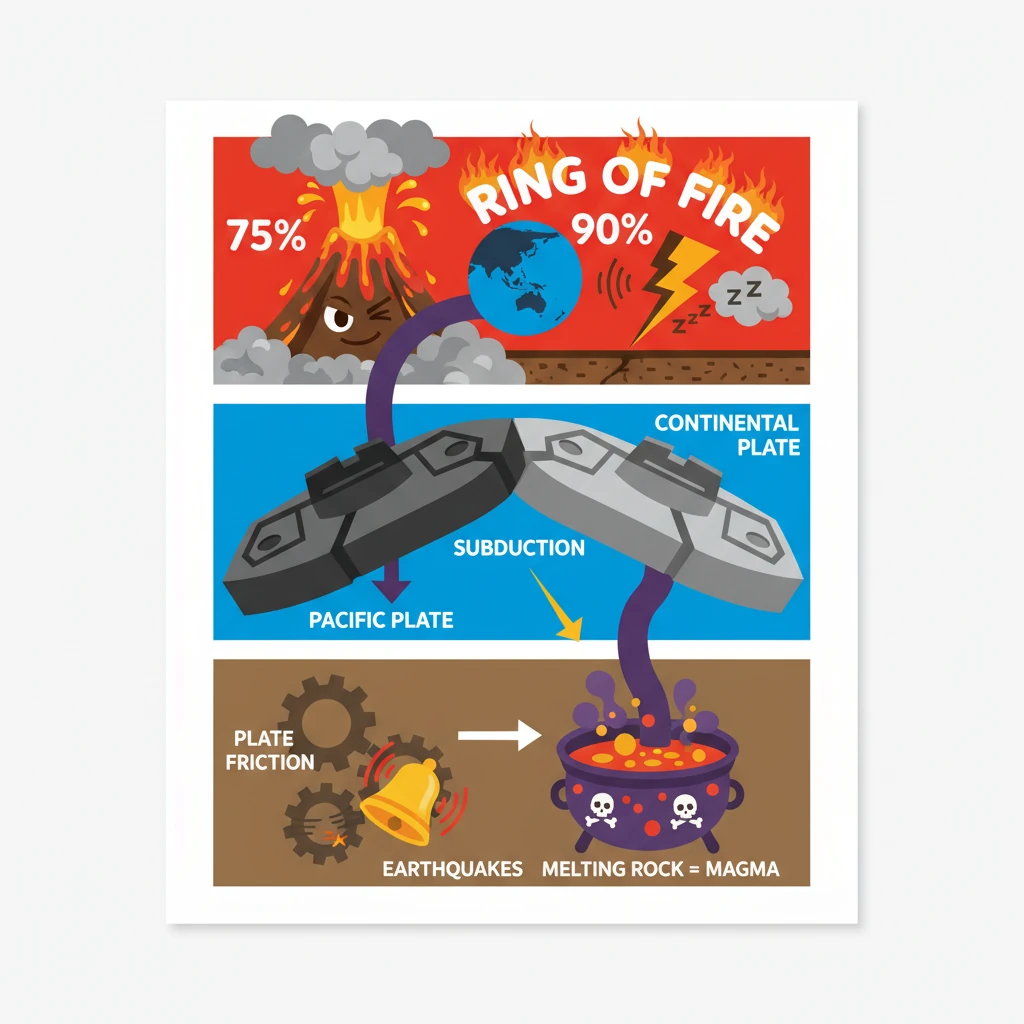
- •Subduction leads to melting rocks (magma) causing volcanoes, and plate friction causing earthquakes.
- •Countries like Japan, Indonesia, Chile, and the USA are located within this zone.
- •Recent research indicates the Pacific Plate is cooling, potentially altering future tectonic dynamics.
🧠 Memory Techniques
98% Verified Content
📚 Reference Sources
•USGS (United States Geological Survey)
•National Geographic