Landslide Prone Areas - Geography | UPSC Learning
Topics
0 topics • 0 completed
🔍
No topics match your search

Landslide Prone Areas
Medium⏱️ 10 min read
geography
📖 Introduction
<h4>Understanding Landslide Prone Areas in India</h4><p><strong>Landslides</strong> are a significant geological hazard in India, affecting a substantial portion of its landmass. These events involve the movement of a mass of rock, debris, or earth down a slope.</p><p>India's diverse topography, coupled with specific geological and climatic conditions, makes it highly susceptible to landslides.</p><div class='info-box'><p>As per the <strong>Landslide Atlas of India</strong>, approximately <strong>0.42 million sq. km</strong>, which accounts for about <strong>12.6%</strong> of India's total land area, is identified as prone to landslides.</p></div><h4>Regional Distribution of Landslide Vulnerability</h4><p>The vulnerability to landslides is not uniform across India but is concentrated in specific geographical belts. These regions are characterized by fragile geology, steep slopes, and intense weather patterns.</p><div class='info-box'><ul><li><strong>North East Himalaya</strong>: Covers <strong>0.18 million sq. km</strong>, making it the most extensive landslide-prone region.</li><li><strong>North West Himalaya</strong>: Accounts for <strong>0.14 million sq. km</strong>, another highly vulnerable area.</li><li><strong>Western Ghats and Konkan Hills</strong>: Spans <strong>0.09 million sq. km</strong>, known for monsoon-triggered landslides.</li><li><strong>Eastern Ghats of Andhra Pradesh</strong>: Constitutes <strong>0.01 million sq. km</strong>, experiencing localized landslide incidents.</li></ul></div><div class='exam-tip-box'><p><strong>UPSC Insight</strong>: Remember the relative proportions and specific regions. Questions often ask about geographical distribution and causative factors. Mapping these regions in your mind can help in answer articulation for <strong>GS Paper I Geography</strong>.</p></div><h4>Primary Causes of Landslides: Gravitational Forces</h4><p>The fundamental trigger for any landslide is the force of <strong>gravity</strong>. When the downward pull of gravity on a slope material exceeds the internal strength (shear strength) of that material, a landslide occurs.</p><div class='key-point-box'><p><strong>Gravitational Forces</strong>: This is the overarching principle. When the inherent strength of materials like <strong>rocks, sand, silt, and clay</strong> is overcome by gravitational pull, the slope fails, leading to downhill movement.</p></div><h4>Natural Factors Influencing Landslides</h4><p>Beyond gravity, several natural factors act as catalysts, reducing the stability of slopes and making them prone to failure.</p><h5>Impact of Rainfall</h5><p><strong>Rainfall</strong> is a critical natural factor, especially in monsoon-dominated regions. Heavy or prolonged precipitation significantly alters the properties of slope materials.</p><div class='info-box'><ul><li><strong>Increased Soil Moisture</strong>: Water saturates the soil, reducing friction between particles.</li><li><strong>Weakened Cohesion</strong>: Water acts as a lubricant, decreasing the binding forces within the soil and rock mass.</li><li><strong>Added Weight</strong>: The absorbed water significantly increases the overall weight of the slope material, further enhancing the gravitational pull.</li></ul></div><h5>Role of Earthquakes</h5><p><strong>Earthquakes</strong> are potent triggers, particularly in tectonically active zones like the <strong>Himalayas</strong>. Seismic vibrations can instantaneously destabilize slopes.</p><div class='info-box'><p>Earthquakes destabilize slopes by intense <strong>ground shaking</strong>, which weakens the integrity of <strong>geomaterials</strong>. This shaking can lead to liquefaction in saturated soils or cause fractures in rock masses, precipitating landslides.</p></div><h5>Influence of Hydrological Factors</h5><p>Beyond direct rainfall, other hydrological processes contribute to slope instability. The movement and presence of water within the slope material are crucial.</p><div class='info-box'><p><strong>Water seepage</strong> through porous materials within a slope increases the <strong>pore water pressure</strong>. This elevated pressure reduces the effective normal stress within the soil or rock, thereby significantly weakening the overall shear strength of the slope and making it susceptible to failure.</p></div>
💡 Key Takeaways
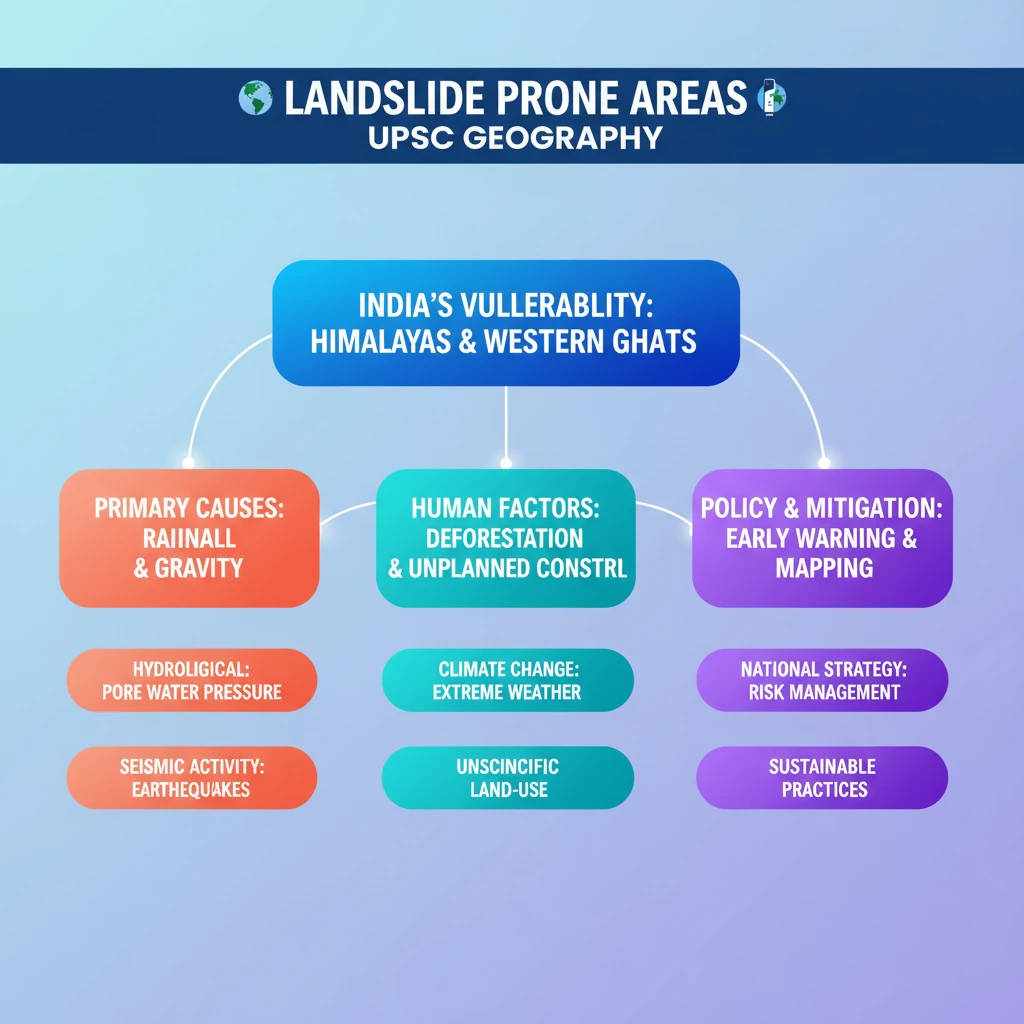
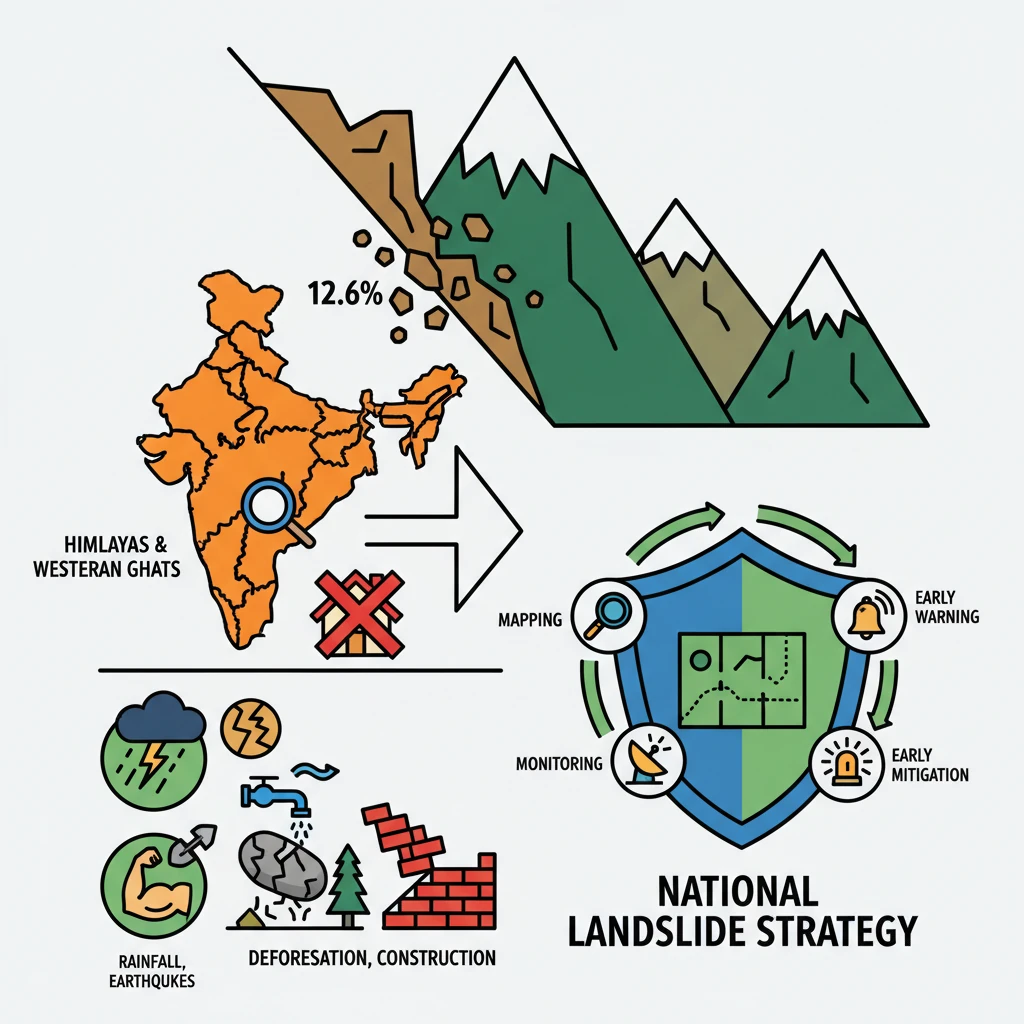
- •Approximately 12.6% of India's land area (0.42 million sq. km) is prone to landslides, with the Himalayas and Western Ghats being most vulnerable.
- •Primary causes include gravitational forces, heavy rainfall, earthquakes, and hydrological factors like increased pore water pressure.
- •Anthropogenic activities (deforestation, unscientific construction) and climate change exacerbate landslide risk.
- •Government initiatives like the National Landslide Risk Management Strategy focus on mapping, monitoring, early warning, and mitigation.
- •Understanding regional geology and implementing sustainable land-use practices are crucial for effective landslide management.
🧠 Memory Techniques
95% Verified Content
📚 Reference Sources
•Landslide Atlas of India (Geological Survey of India)
•National Disaster Management Authority (NDMA) reports and guidelines on landslides
•Ministry of Earth Sciences publications on Himalayan geology and hazards