Why is Kallakkadal Different from Tsunami? - Geography | UPSC Learning
Topics
0 topics • 0 completed
🔍
No topics match your search
Why is Kallakkadal Different from Tsunami?
Medium⏱️ 6 min read
geography
📖 Introduction
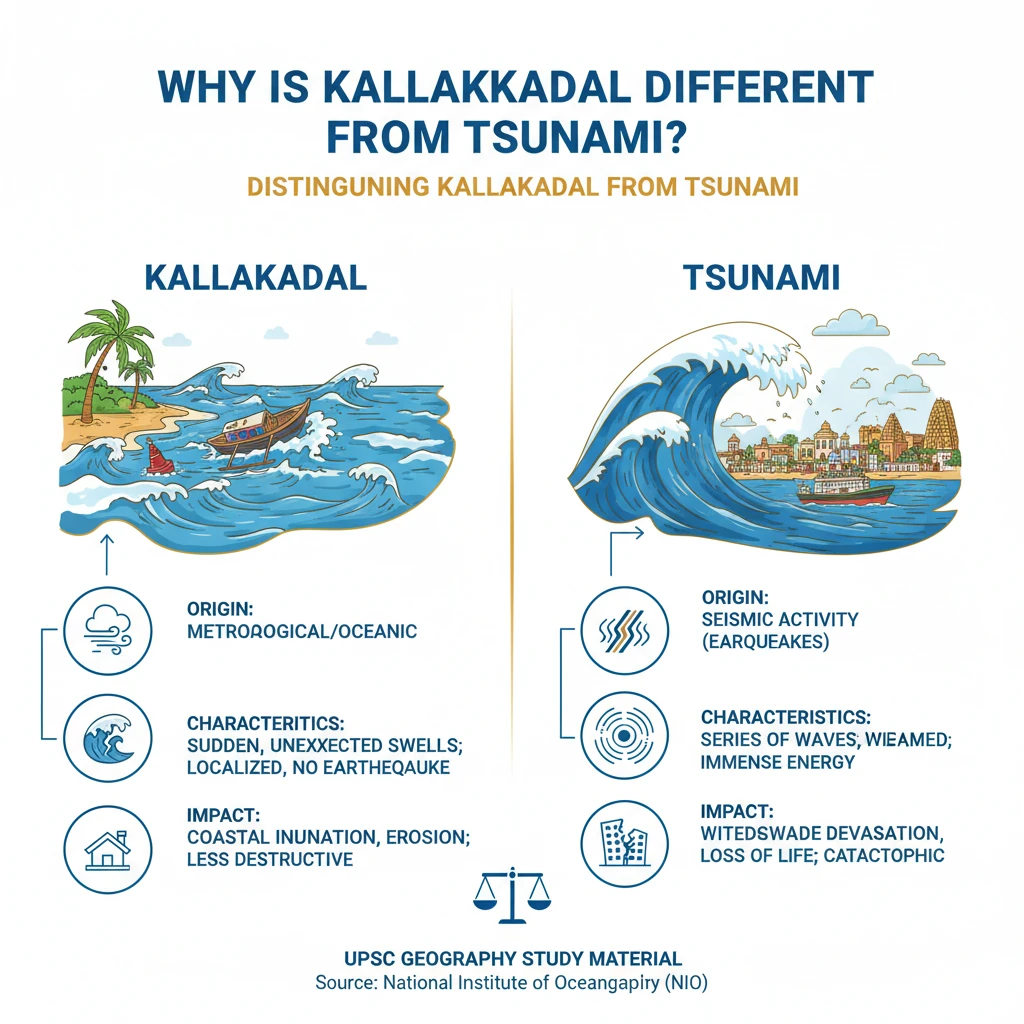
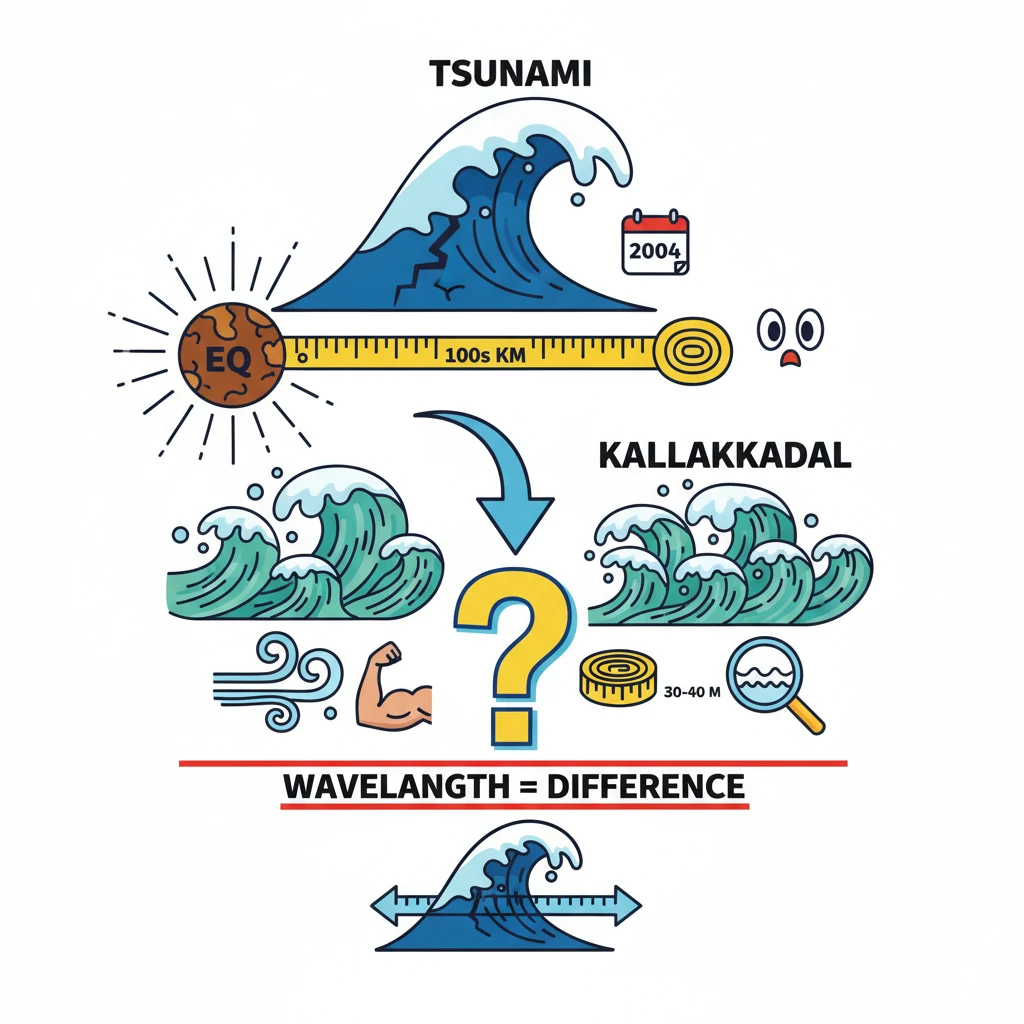
<h4>Introduction: Distinguishing Kallakkadal from Tsunami</h4><p>The terms <strong>Kallakkadal</strong> and <strong>Tsunami</strong> are often confused, especially after the devastating <strong>2004 Indian Ocean Tsunami</strong>. While both involve large waves affecting coastal areas, their origins, characteristics, and scale are fundamentally different.</p><p>Understanding these distinctions is crucial for accurate disaster preparedness and geographical knowledge.</p><h4>Understanding a Tsunami</h4><p>A <strong>tsunami</strong> is a series of extremely long waves caused by a large-scale displacement of a body of water, typically an ocean. These powerful waves are generated by sudden movements on the seafloor.</p><div class='info-box'><p><strong>Primary Cause:</strong> <strong>Underwater disturbances</strong>, most commonly large <strong>subduction zone earthquakes</strong> occurring beneath or near the ocean floor. Other causes can include volcanic eruptions, landslides, or meteoroid impacts.</p></div><p>Unlike normal ocean waves, tsunamis involve the entire water column, from the surface to the seabed, making them incredibly destructive.</p><h4>Characteristics of Kallakkadal (Ocean Waves)</h4><p><strong>Kallakkadal</strong>, a phenomenon observed particularly along the <strong>Kerala coast</strong>, refers to sudden, unexpected sea surges or 'rogue waves' that can inundate coastal areas. These are essentially very large <strong>ocean waves</strong>.</p><div class='info-box'><p><strong>Origin:</strong> <strong>Kallakkadal</strong> events are generally attributed to meteorological conditions, such as strong winds and ocean currents, rather than seismic activity. They are a form of extreme wind-generated ocean wave.</p></div><p>While potentially dangerous, their underlying mechanisms are distinct from those of tsunamis.</p><h4>Key Differentiator: Wavelength</h4><p>The most significant physical difference between a <strong>tsunami</strong> and typical <strong>ocean waves</strong> (like <strong>Kallakkadal</strong>) lies in their <strong>wavelength</strong>.</p><div class='key-point-box'><p><strong>Wavelength Definition:</strong> The distance between two consecutive crests or troughs of a wave.</p></div><ul><li><strong>Ocean Waves (Kallakkadal):</strong> These waves typically have a relatively <strong>short wavelength</strong>, often around <strong>30 to 40 meters</strong>. Their energy is confined to the surface layers of the ocean.</li><li><strong>Tsunamis:</strong> In stark contrast, tsunamis possess an extremely <strong>long wavelength</strong>, which can extend for <strong>hundreds of kilometers</strong> in the open ocean. This immense wavelength allows them to carry vast amounts of energy across entire ocean basins.</li></ul><div class='exam-tip-box'><p><strong>UPSC Insight:</strong> Understanding the difference in <strong>wavelength</strong> is critical. While <strong>ocean waves</strong> have a period of seconds and a wavelength of tens of meters, <strong>tsunamis</strong> have periods of minutes to hours and wavelengths of hundreds of kilometers, making them behave differently as they approach the coast. This distinction is a common point of confusion for aspirants.</p></div>
💡 Key Takeaways
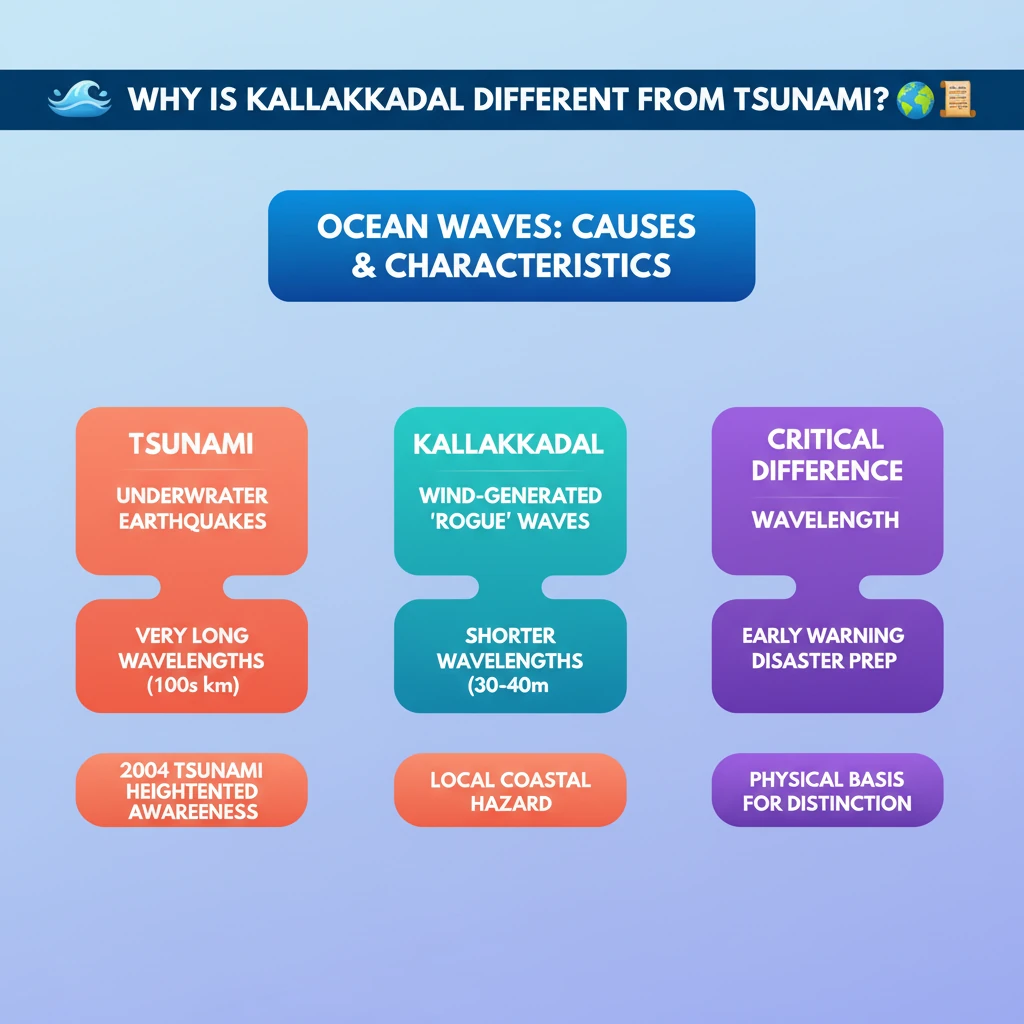
- •Tsunamis are caused by underwater disturbances, primarily earthquakes, and have very long wavelengths (hundreds of km).
- •Kallakkadal refers to powerful 'rogue' ocean waves, typically wind-generated, with much shorter wavelengths (30-40 meters).
- •The 2004 Tsunami heightened awareness and led to clearer differentiation of coastal hazards.
- •Wavelength is the fundamental physical characteristic distinguishing tsunamis from normal ocean waves like Kallakkadal.
- •Accurate distinction is crucial for effective early warning and disaster preparedness.
🧠 Memory Techniques
95% Verified Content