Other Geothermal Features Similar to Hydrothermal Vents - Geography | UPSC Learning
Topics
0 topics • 0 completed
🔍
No topics match your search
Other Geothermal Features Similar to Hydrothermal Vents
Easy⏱️ 7 min read
geography
📖 Introduction
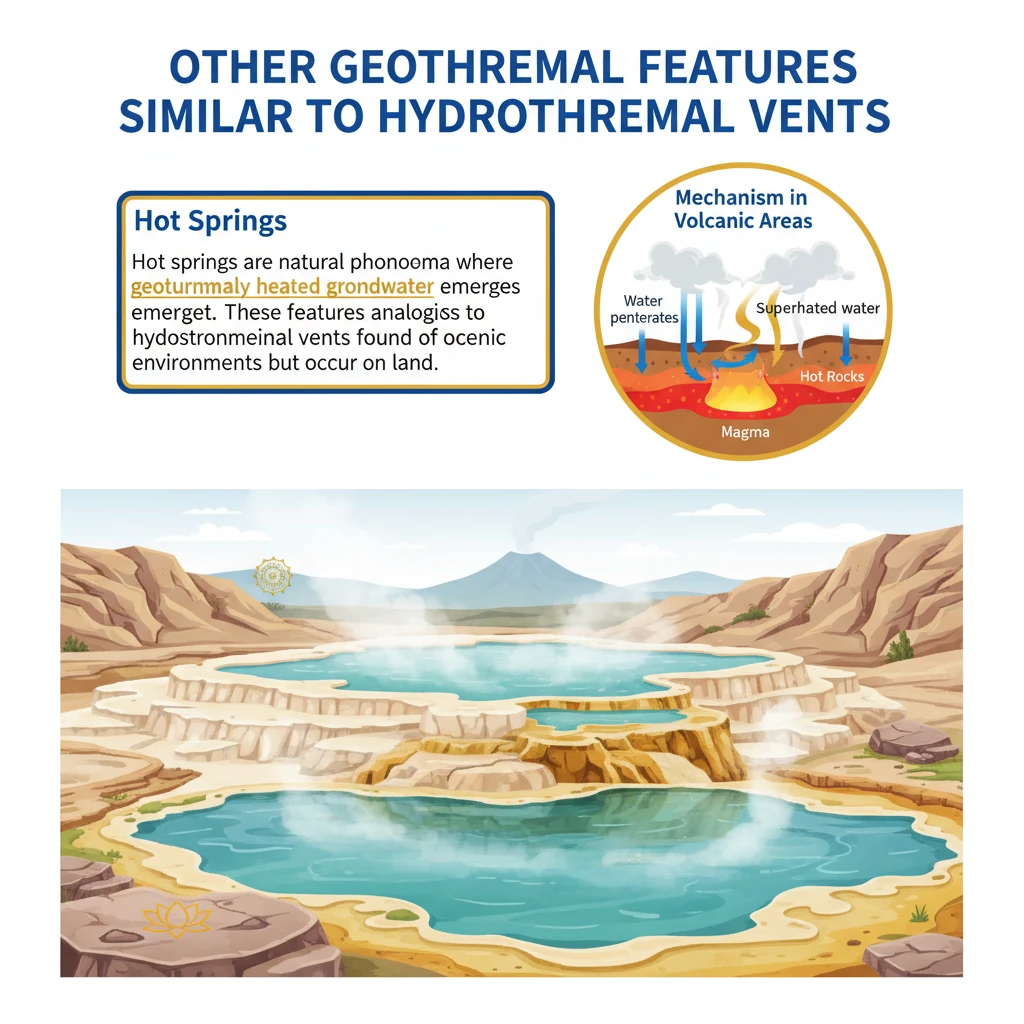
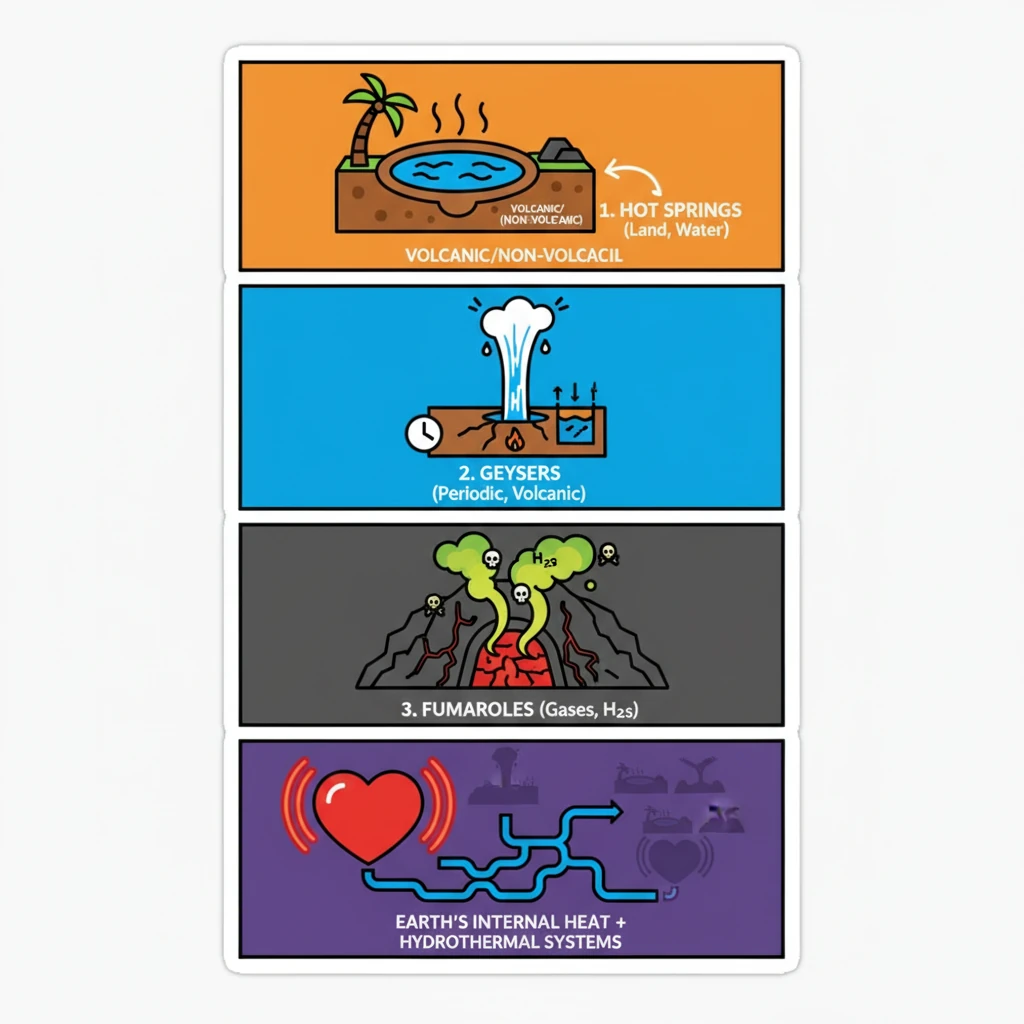
<h4>Hot Springs</h4><p><strong>Hot springs</strong> are natural phenomena where <strong>geothermally heated groundwater</strong> emerges from the Earth's crust. These features are analogous to <strong>hydrothermal vents</strong> found in oceanic environments but occur on land.</p><div class='info-box'><p><strong>Mechanism in Volcanic Areas:</strong> Water penetrates the ground, comes into contact with <strong>hot rocks</strong> heated by nearby <strong>magma</strong>, and becomes superheated before rising to the surface.</p></div><div class='info-box'><p><strong>Mechanism in Non-Volcanic Areas:</strong> The Earth's <strong>geothermal gradient</strong> causes rock temperature to increase with depth. Water percolates deep enough to be heated by these hot rocks and then circulates upwards.</p></div><p><strong>Examples:</strong> Notable hot springs in India include <strong>Manikaran</strong> in <strong>Himachal Pradesh</strong> and <strong>Gaurikund</strong> in <strong>Uttarakhand</strong>.</p><h4>Geysers</h4><p><strong>Geysers</strong> are a specific type of hot spring characterized by their periodic eruption of <strong>hot water</strong> and <strong>steam</strong>. They require unique geological conditions, primarily found in <strong>volcanic areas</strong> with substantial underground water reservoirs.</p><div class='info-box'><p><strong>Formation Process:</strong> Underground cavities fill with <strong>groundwater</strong>. When this water is superheated by adjacent <strong>magma</strong>, it rapidly flashes into <strong>steam</strong>, creating pressure that forces an eruption.</p></div><p><strong>Example:</strong> The most famous example globally is <strong>Yellowstone National Park</strong> in the <strong>United States</strong>, home to numerous active geysers.</p><h4>Fumaroles</h4><p><strong>Fumaroles</strong> are openings in the Earth's crust that primarily release <strong>volcanic gases</strong> and <strong>steam</strong>. Unlike hot springs or geysers, the emphasis here is on the expulsion of gases rather than large volumes of water.</p><div class='info-box'><p><strong>Mechanism:</strong> They form when <strong>magma</strong> passes through the <strong>water table</strong>. The heat from the magma converts the water into <strong>steam</strong>, which then rises, carrying various <strong>volcanic gases</strong> to the surface.</p></div><p><strong>Key Gas:</strong> A common gas released from fumaroles is <strong>hydrogen sulfide (H2S)</strong>, often identifiable by its distinctive rotten-egg smell.</p>
💡 Key Takeaways
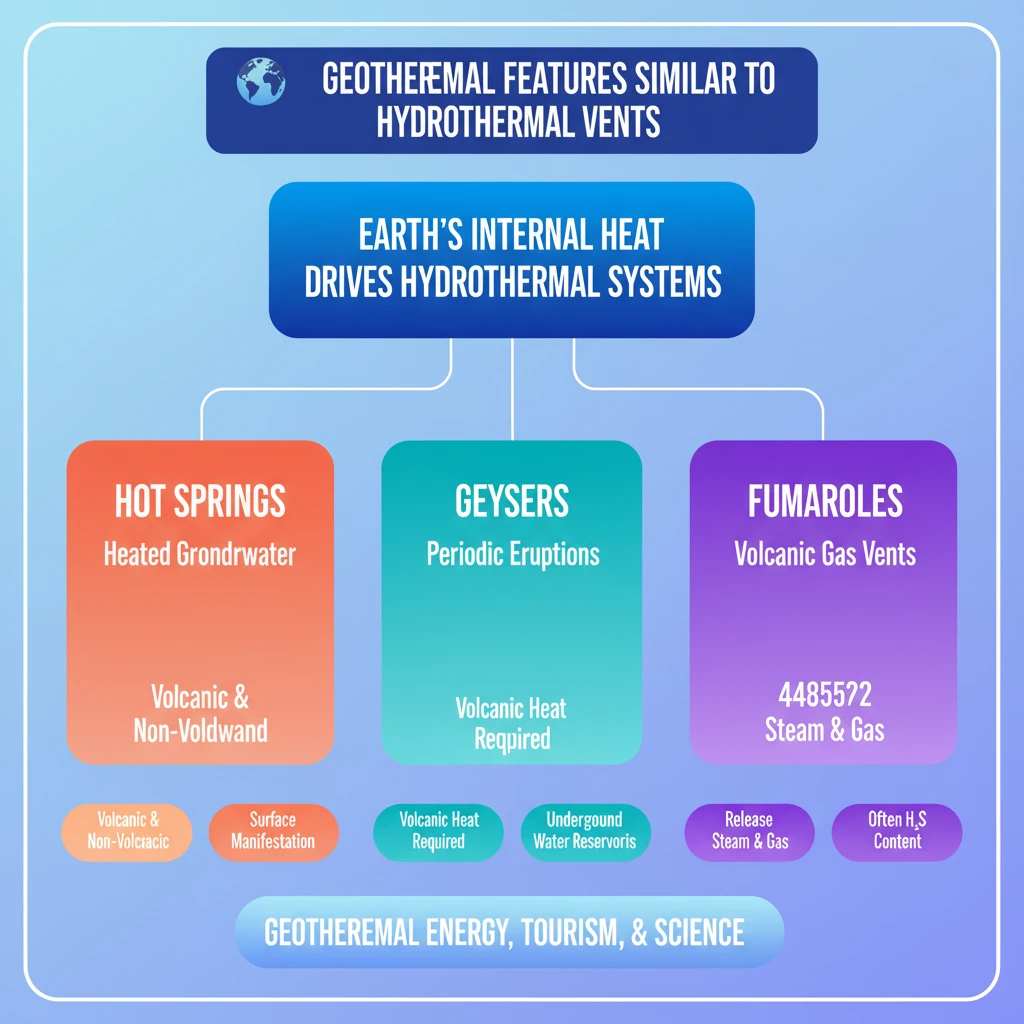
- •Hot springs are geothermally heated groundwater emerging on land, found in both volcanic and non-volcanic areas.
- •Geysers are periodic eruptions of hot water and steam, requiring volcanic heat and underground water reservoirs.
- •Fumaroles are vents releasing volcanic gases and steam, often containing hydrogen sulfide.
- •All these features are driven by Earth's internal geothermal heat, a manifestation of hydrothermal systems.
- •They are important for geothermal energy, tourism, and scientific understanding of Earth's dynamics.
🧠 Memory Techniques
95% Verified Content