Rossby Waves: Formation, Characteristics, and Impact on Global Weather - Geography | UPSC Learning
Topics
0 topics • 0 completed
🔍
No topics match your search
Rossby Waves: Formation, Characteristics, and Impact on Global Weather
Medium⏱️ 6 min read
geography
📖 Introduction
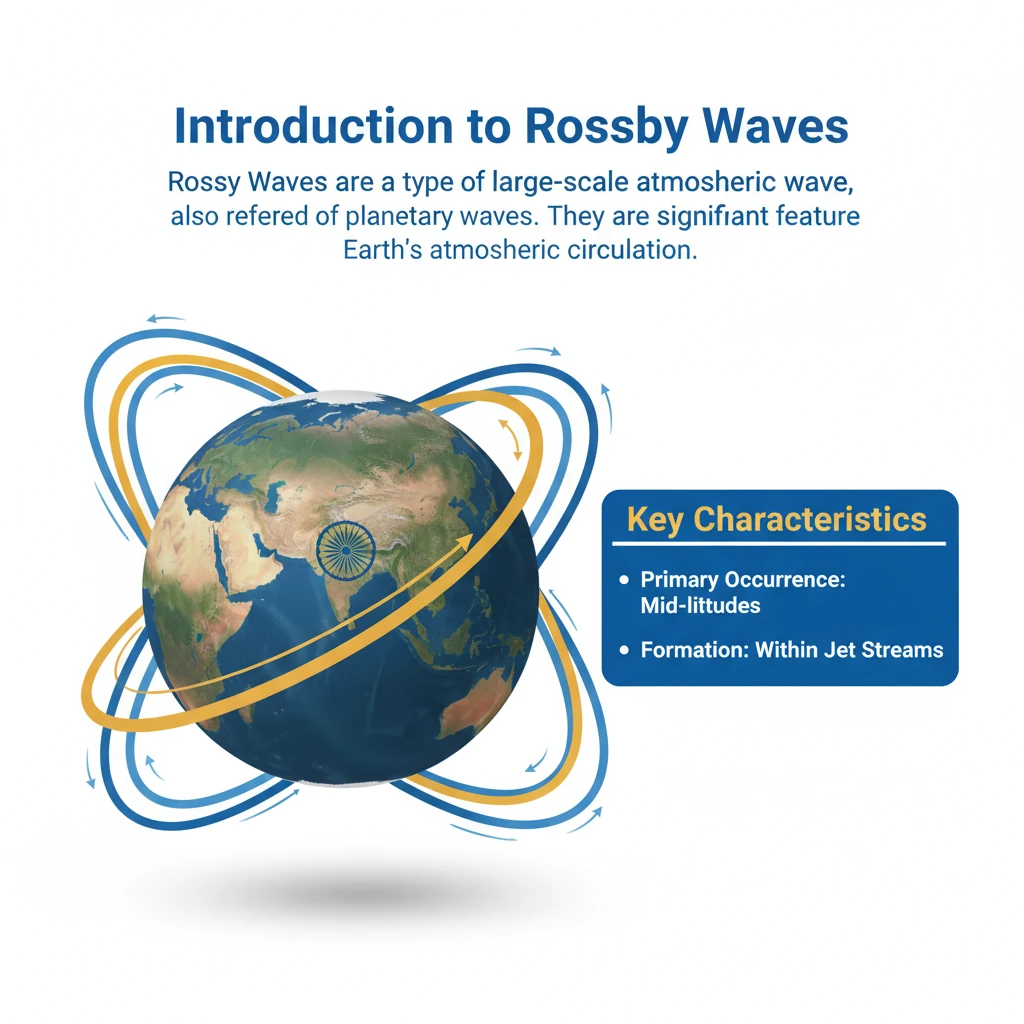
<h4>Introduction to Rossby Waves</h4><p><strong>Rossby Waves</strong> are a type of <strong>large-scale atmospheric wave</strong>, also referred to as <strong>planetary waves</strong>. They are a significant feature of Earth's atmospheric circulation.</p><div class='info-box'><ul><li><strong>Primary Occurrence:</strong> These waves occur predominantly in the <strong>mid-latitudes</strong> of the Earth’s atmosphere.</li><li><strong>Formation:</strong> They form within <strong>jet streams</strong>, which are high-altitude air currents.</li><li><strong>Flow Direction:</strong> The air currents within which they form flow from <strong>west to east</strong>.</li><li><strong>Pattern:</strong> They exhibit a distinctive <strong>meandering pattern</strong>.</li></ul></div><h4>Formation and Key Characteristics</h4><p>The formation of <strong>Rossby waves</strong> is most prominent in regions where there is a substantial <strong>temperature contrast</strong>. This contrast typically exists between the <strong>equator</strong> and the <strong>poles</strong>.</p><p>Their meandering pattern is crucial as it influences <strong>weather patterns</strong> across both the <strong>Northern</strong> and <strong>Southern Hemispheres</strong>.</p><div class='key-point-box'><p>The amplitude and wavelength of <strong>Rossby waves</strong> are directly influenced by the strength of the <strong>Coriolis effect</strong> and the latitudinal temperature gradient.</p></div><h4>Influence on Global Weather Patterns</h4><p><strong>Rossby waves</strong> play a pivotal role in shaping <strong>global weather patterns</strong>. Their movement and characteristics directly affect regional weather conditions.</p><p>They are instrumental in determining various atmospheric phenomena, including <strong>temperature extremes</strong> and overall <strong>precipitation levels</strong> across different regions.</p><h4>Role in Global Heat Distribution</h4><p>A critical function of <strong>Rossby waves</strong> is their contribution to balancing <strong>global heat distribution</strong>. They act as a natural mechanism for thermal regulation.</p><p>These waves prevent <strong>polar regions</strong> from becoming excessively cold and similarly prevent <strong>equatorial regions</strong> from experiencing extreme overheating, maintaining a more balanced planetary climate.</p><div class='exam-tip-box'><p>Understanding <strong>Rossby waves</strong> is essential for topics like <strong>atmospheric circulation</strong>, <strong>jet streams</strong>, and <strong>climate dynamics</strong>, which are frequently tested in <strong>UPSC GS Paper 1 (Geography)</strong>.</p></div>
💡 Key Takeaways
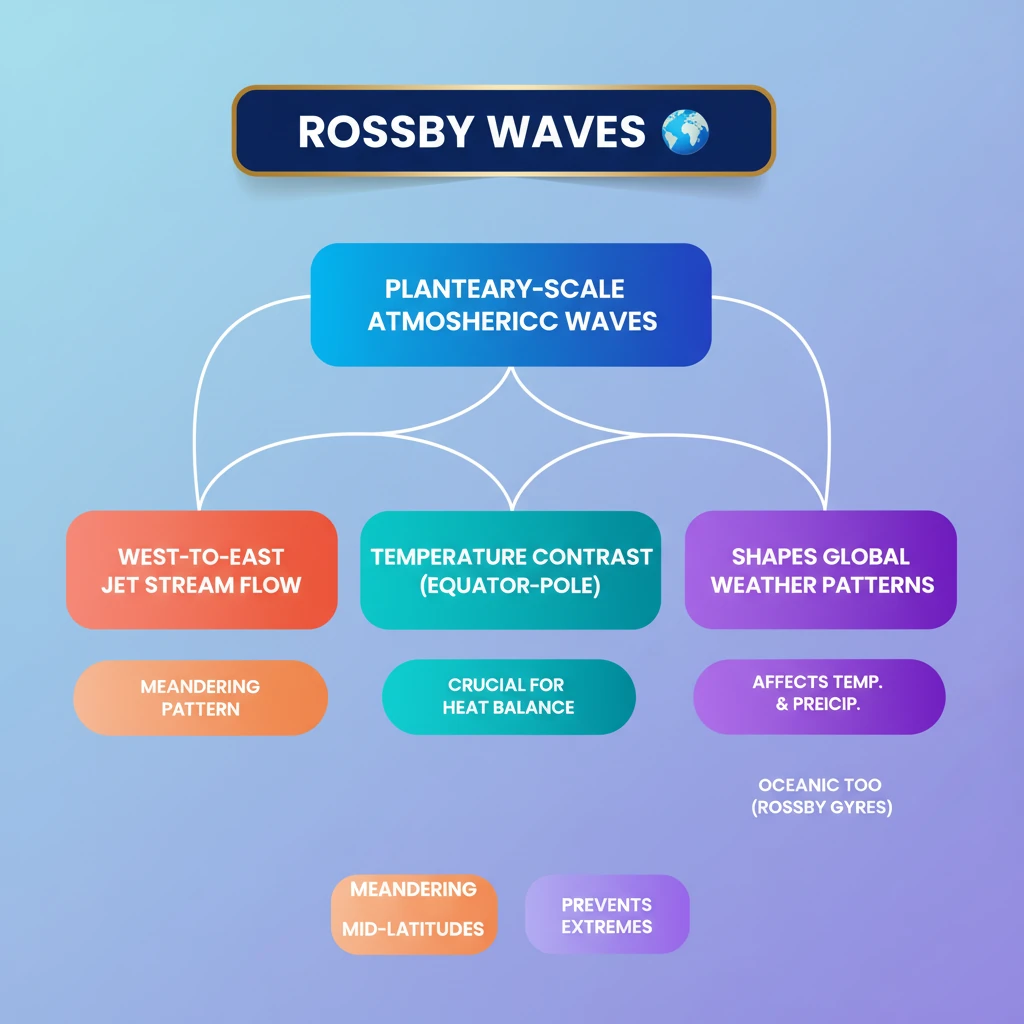
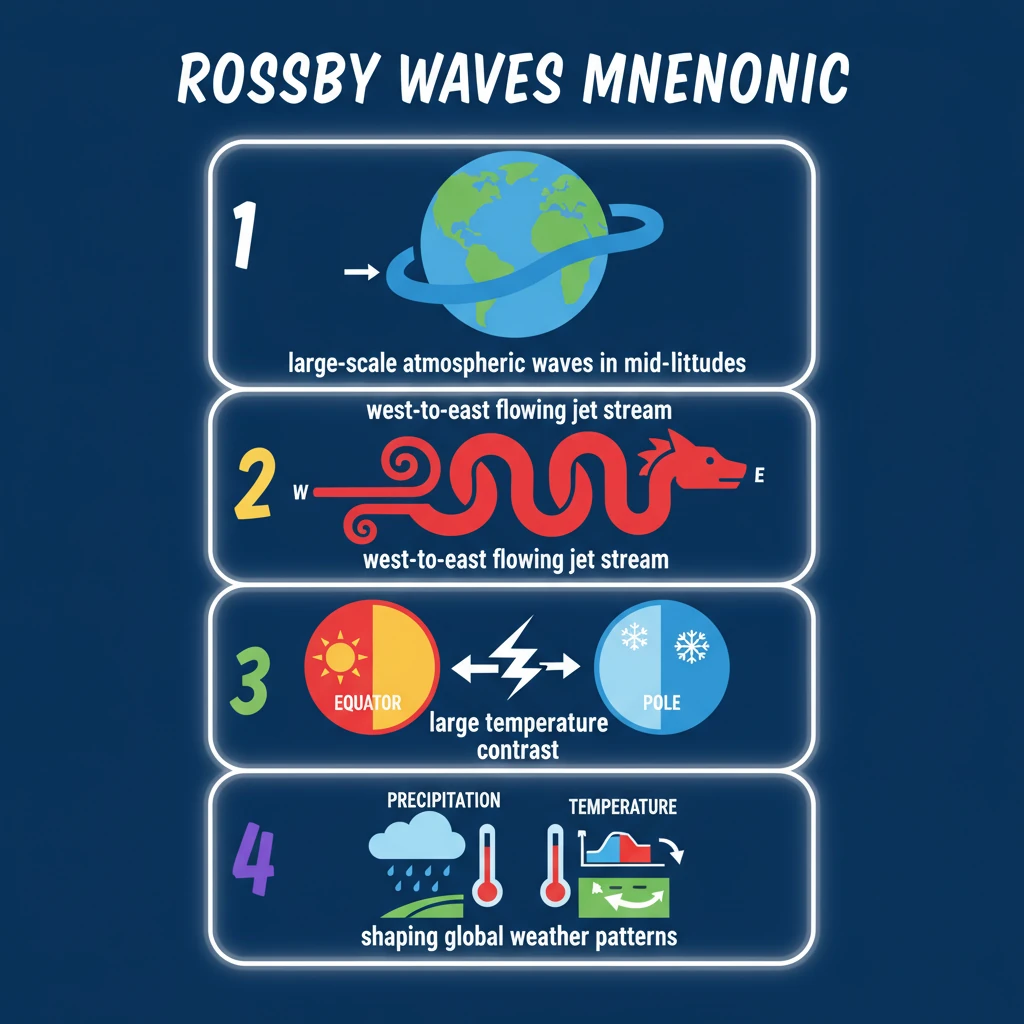
- •Rossby Waves are large-scale atmospheric (planetary) waves in mid-latitudes.
- •They form in west-to-east flowing jet streams, exhibiting a meandering pattern.
- •Most prominent where there's a large temperature contrast between equator and poles.
- •Crucial for shaping global weather patterns, affecting temperature and precipitation.
- •Play a key role in balancing global heat distribution, preventing extremes.
🧠 Memory Techniques
98% Verified Content
📚 Reference Sources
•NCERT Geography Textbooks (Class XI, XII)
•Standard Meteorology Textbooks (e.g., Ahrens, Wallace & Hobbs)
•National Oceanic and Atmospheric Administration (NOAA) resources
•World Meteorological Organization (WMO) publications