What are the Potential Impacts of the Active Rock Glaciers on the Region? - Geography | UPSC Learning
Topics
0 topics • 0 completed
🔍
No topics match your search
What are the Potential Impacts of the Active Rock Glaciers on the Region?
Medium⏱️ 7 min read
geography
📖 Introduction
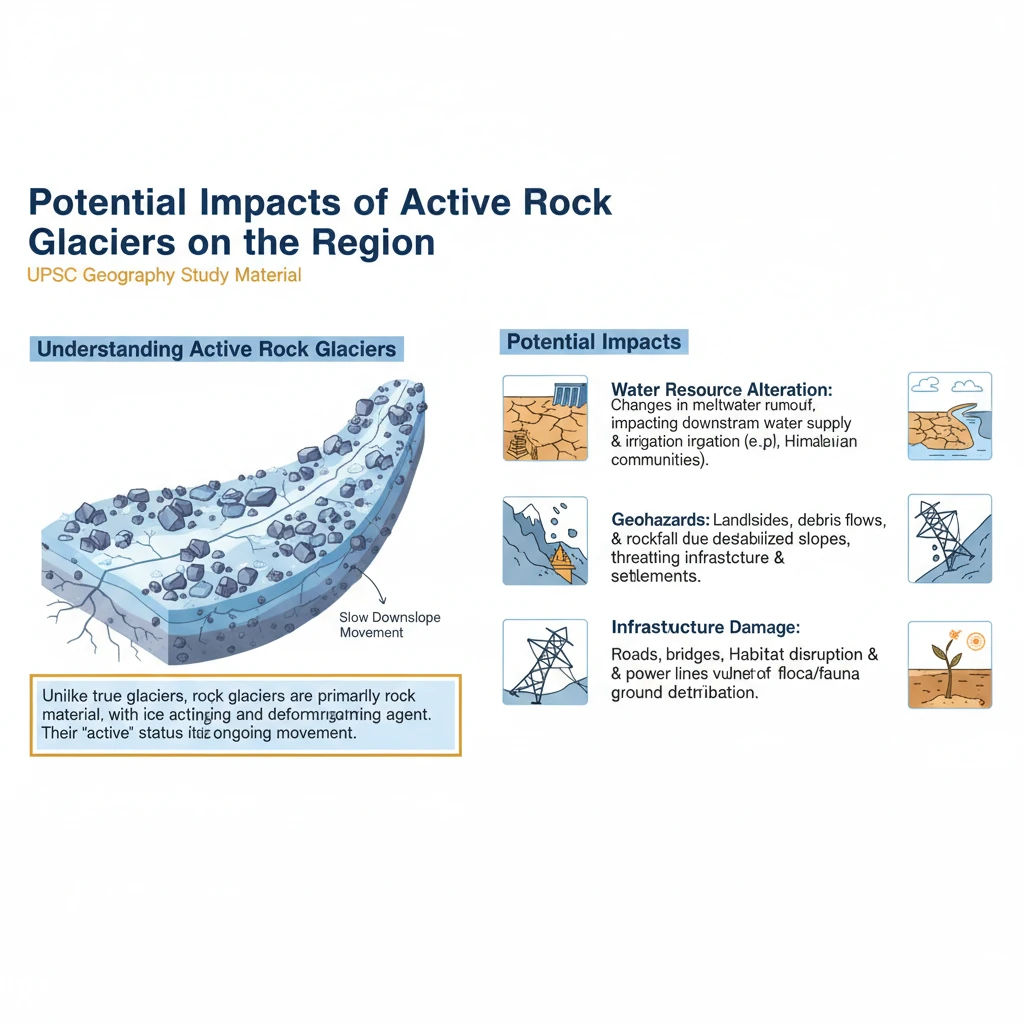
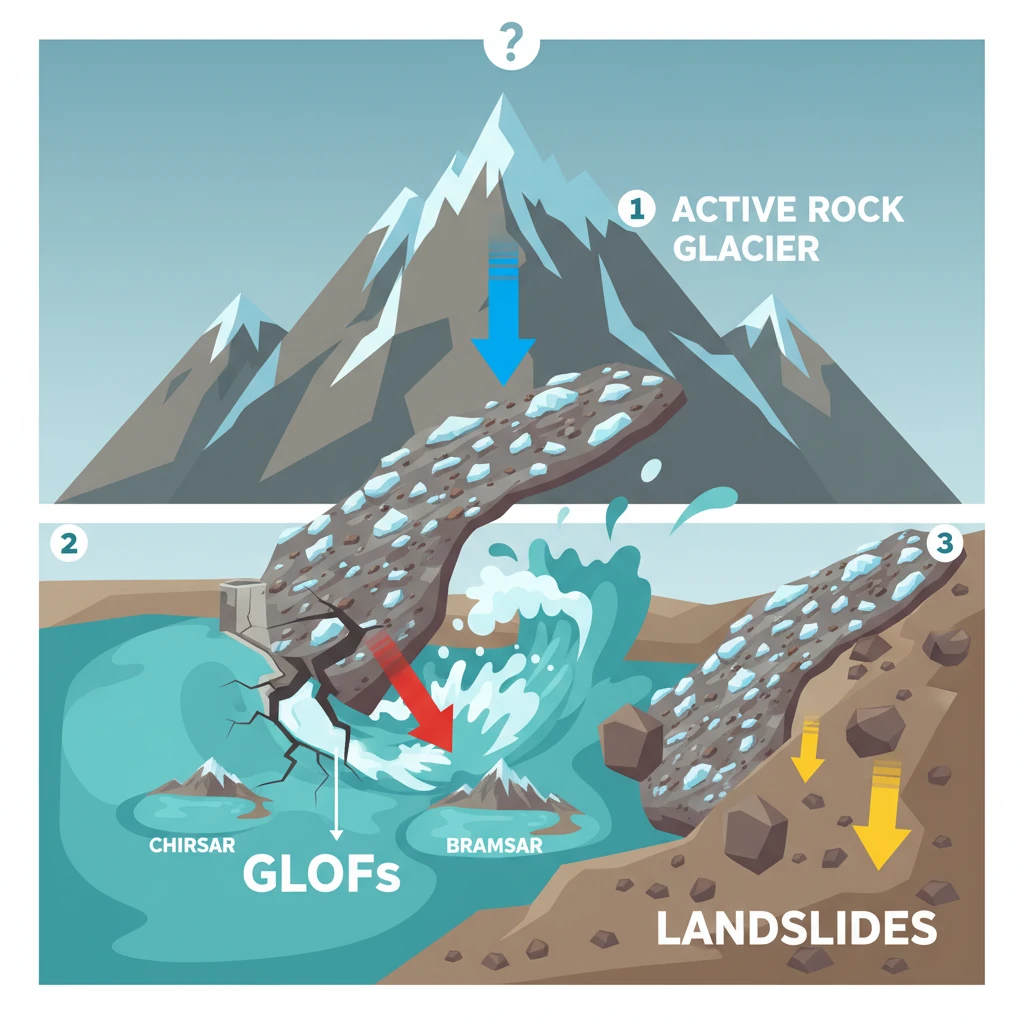
<h4>Understanding Active Rock Glaciers</h4><p><strong>Active rock glaciers</strong> are distinct periglacial landforms composed of rock debris, ice, and interstitial ice, which move downslope under the influence of gravity and the deformation of ice within them.</p><div class='info-box'><p>Unlike true glaciers, <strong>rock glaciers</strong> are primarily rock material, with ice acting as a cementing and deforming agent. Their 'active' status indicates ongoing movement.</p></div><h4>Potential Impacts on the Region</h4><p>The presence and activity of <strong>rock glaciers</strong> can have significant and often hazardous impacts on mountainous regions, particularly in the Himalayas and other periglacial environments.</p><div class='key-point-box'><p>These impacts are exacerbated by climate change, which can alter the stability and movement rates of these landforms.</p></div><h4>Impact 1: Glacial Lake Outburst Floods (GLOFs)</h4><p>One of the most severe potential impacts of <strong>active rock glaciers</strong> is their contribution to the risk of <strong>Glacial Lake Outburst Floods (GLOFs)</strong>.</p><div class='info-box'><p><strong>GLOFs</strong> are sudden and catastrophic floods that occur when a <strong>glacial lake</strong> bursts its natural or artificial dam, releasing large volumes of water and debris downstream.</p></div><p><strong>Active rock glaciers</strong> can significantly increase the risk of <strong>GLOFs</strong> by destabilizing the slopes surrounding <strong>glacial lakes</strong> or directly impacting the structural integrity of their natural dams.</p><ul><li>The movement of a <strong>rock glacier</strong> can cause landsliding into a lake, creating displacement waves or overtopping the dam.</li><li>Subsurface ice melt within the <strong>rock glacier</strong> can also contribute to slope instability near lake boundaries.</li></ul><p>Specific examples highlight this risk, such as <strong>Chirsar Lake</strong> and <strong>Bramsar Lake</strong>, where nearby <strong>rock glaciers</strong> elevate the potential for catastrophic flooding events.</p><div class='exam-tip-box'><p>UPSC often asks about natural disasters in mountainous regions. Understanding the role of <strong>rock glaciers</strong> in <strong>GLOFs</strong> adds depth to answers on disaster management and climate change impacts.</p></div><h4>Impact 2: Landslides</h4><p>Beyond contributing to <strong>GLOFs</strong>, <strong>active rock glaciers</strong> also pose a direct risk of triggering <strong>landslides</strong> in their vicinity.</p><div class='info-box'><p><strong>Landslides</strong> are rapid movements of soil, rock, or snow down a slope, often triggered by various factors.</p></div><p>The continuous, albeit slow, movement of a <strong>rock glacier</strong> can inherently destabilize surrounding slopes, making them more susceptible to collapse.</p><ul><li>Triggers for such <strong>landslides</strong> include natural phenomena like <strong>earthquakes</strong> and heavy <strong>rainfall</strong>.</li><li><strong>Human activities</strong>, such as infrastructure development or mining in unstable periglacial zones, can also exacerbate the risk.</li></ul><div class='key-point-box'><p>The interaction between <strong>rock glacier</strong> movement and external triggers creates a complex hazard scenario, particularly in seismically active and precipitation-prone mountainous regions.</p></div>
💡 Key Takeaways
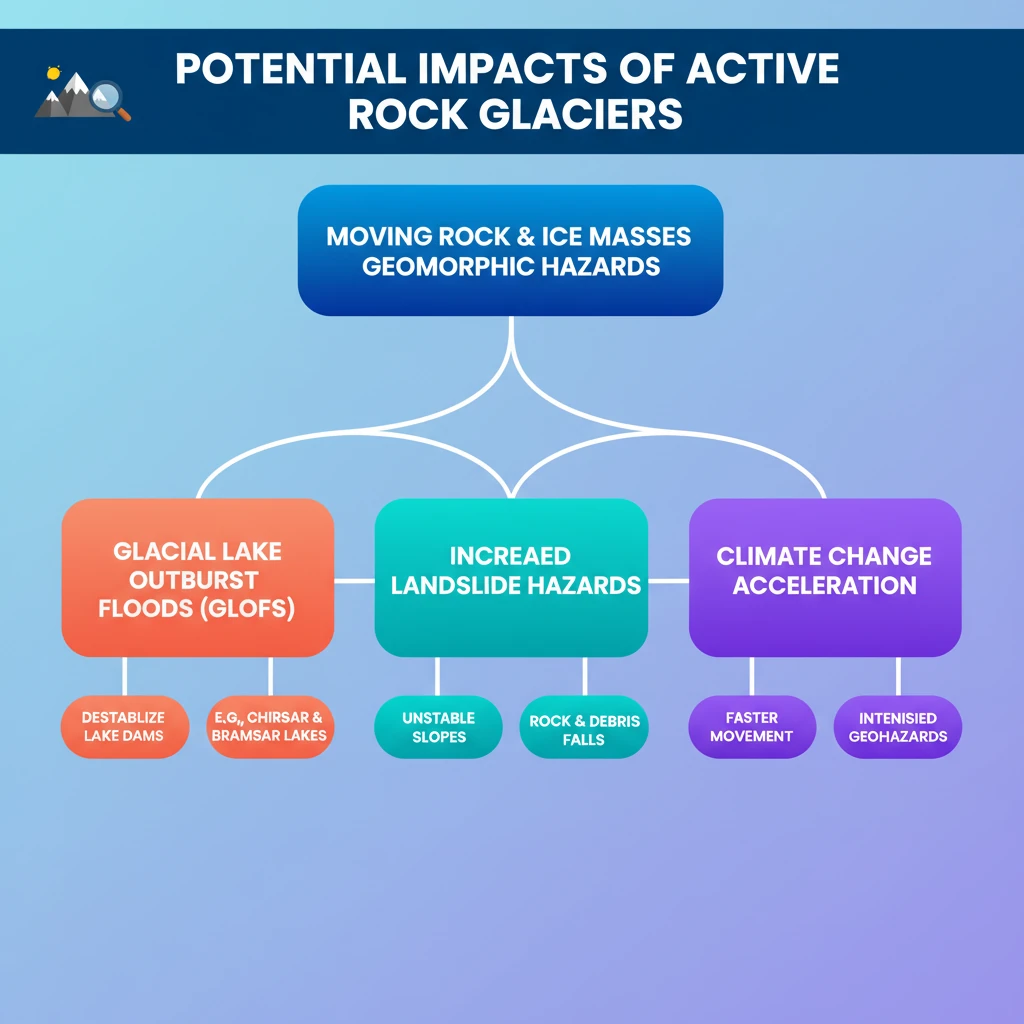
- •Active rock glaciers are moving masses of rock and ice, distinct from true glaciers.
- •They significantly increase the risk of Glacial Lake Outburst Floods (GLOFs) by destabilizing lake dams.
- •Examples like Chirsar and Bramsar Lakes highlight the GLOF risk due to nearby rock glaciers.
- •Rock glaciers also directly contribute to landslide hazards by making slopes unstable.
- •Climate change is accelerating rock glacier movement, intensifying these geohazards.
- •Monitoring and early warning systems are crucial for disaster risk reduction in affected regions.
🧠 Memory Techniques
95% Verified Content