India’s Deep Drill Mission - Geography | UPSC Learning
Topics
0 topics • 0 completed
🔍
No topics match your search
India’s Deep Drill Mission
Medium⏱️ 5 min read
geography
📖 Introduction
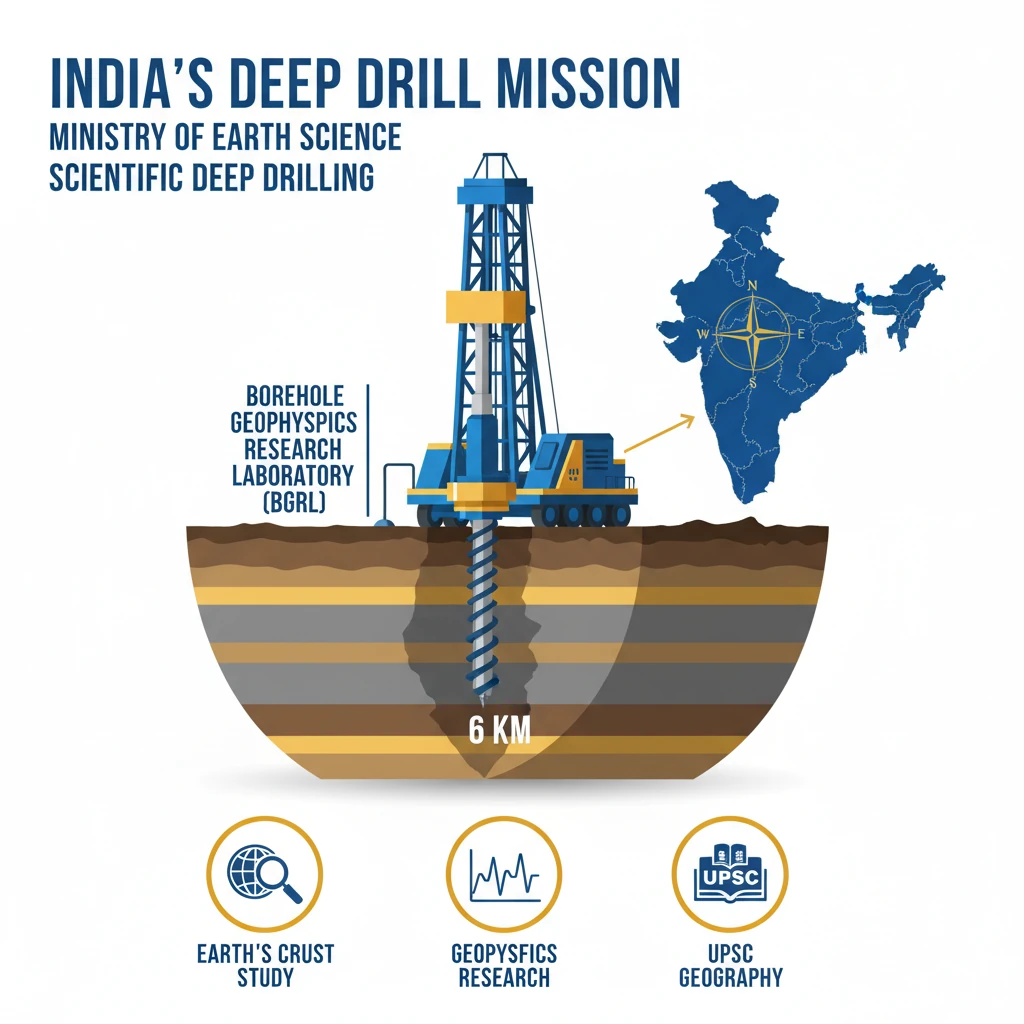
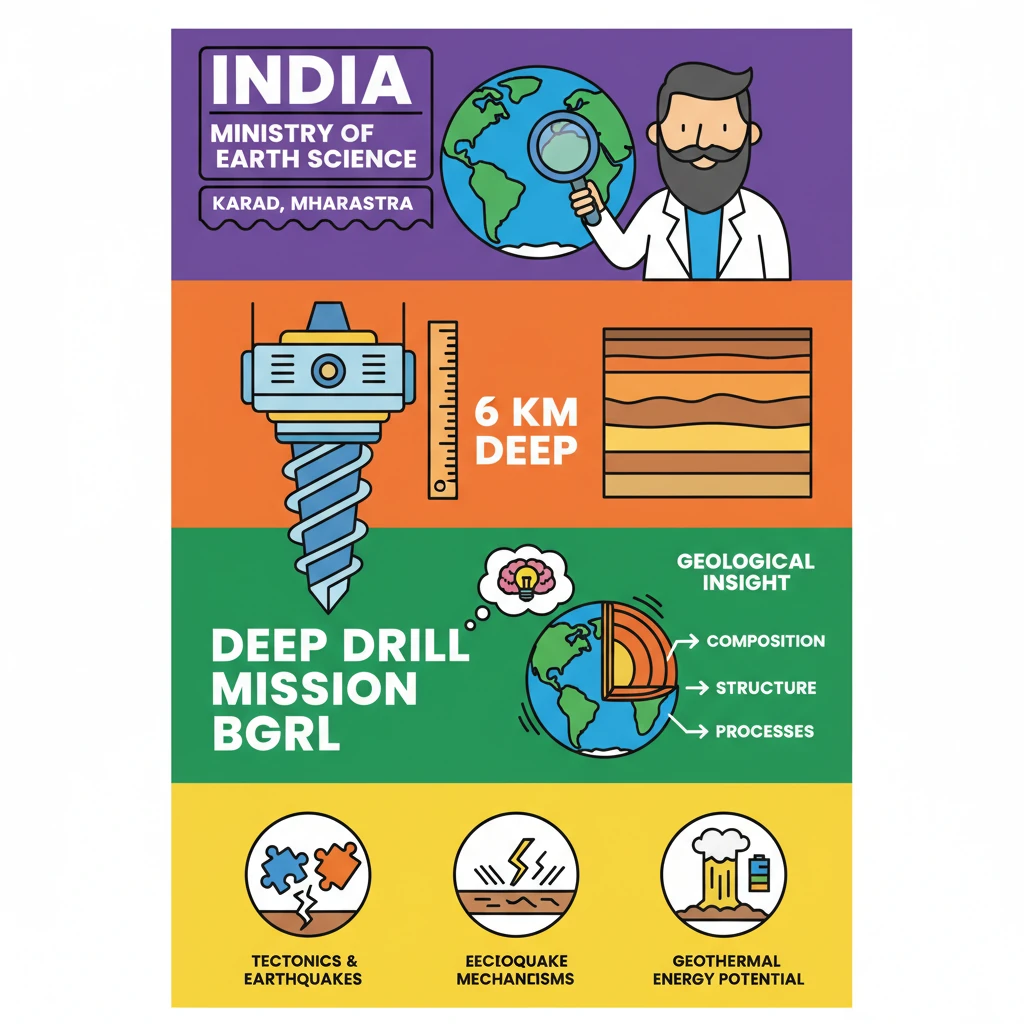
<h4>Introduction to India's Deep Drill Mission</h4><p>The <strong>Ministry of Earth Science</strong> has launched a significant initiative: <strong>India's Deep Drill Mission</strong>. This project involves <strong>Scientific Deep Drilling</strong> into the Earth's crust.</p><p>The mission aims to reach an impressive depth of <strong>6 km</strong>. It utilizes a specialized machine known as the <strong>Borehole Geophysics Research Laboratory (BGRL)</strong>.</p><p>The drilling operations are being carried out in <strong>Karad, Maharashtra</strong>, a strategically chosen location for geological studies.</p><div class='info-box'><p><strong>Current Status:</strong> The mission has already successfully completed drilling to a depth of <strong>3 km</strong>, marking a significant milestone in its progress.</p></div><div class='exam-tip-box'><p><strong>UPSC Relevance:</strong> This mission is crucial for <strong>GS Paper 1 (Geography)</strong> for understanding Earth's internal structure and <strong>GS Paper 3 (Science & Technology)</strong> for advancements in Earth Sciences and resource exploration.</p></div><h4>What is Scientific Deep Drilling?</h4><div class='key-point-box'><p><strong>Definition:</strong> <strong>Scientific Deep Drilling</strong> is a specialized process that involves drilling deep into the <strong>Earth's crust</strong> to thoroughly investigate its composition, structure, and ongoing geological processes.</p></div><p>This advanced research methodology is vital for gaining profound insights into various aspects of our planet.</p><ul><li>Understanding <strong>geological formations</strong> and their evolution over millennia.</li><li>Identifying potential <strong>natural resources</strong> hidden within the Earth's depths.</li><li>Reconstructing <strong>Earth's history</strong> by analyzing ancient rock samples and geological layers.</li></ul><p>Deep drilling projects are primarily designed to significantly enhance our scientific comprehension in several critical areas:</p><ul><li>Advancing the understanding of <strong>plate tectonics</strong> and crustal dynamics.</li><li>Elucidating <strong>earthquake mechanisms</strong> and improving seismic hazard assessment.</li><li>Assessing the immense potential for <strong>geothermal energy</strong>, a sustainable power source.</li></ul><div class='info-box'><p><strong>Key Objectives:</strong> Beyond exploration, these missions contribute to fundamental research, helping scientists model Earth's interior and predict future geological events.</p></div>
💡 Key Takeaways
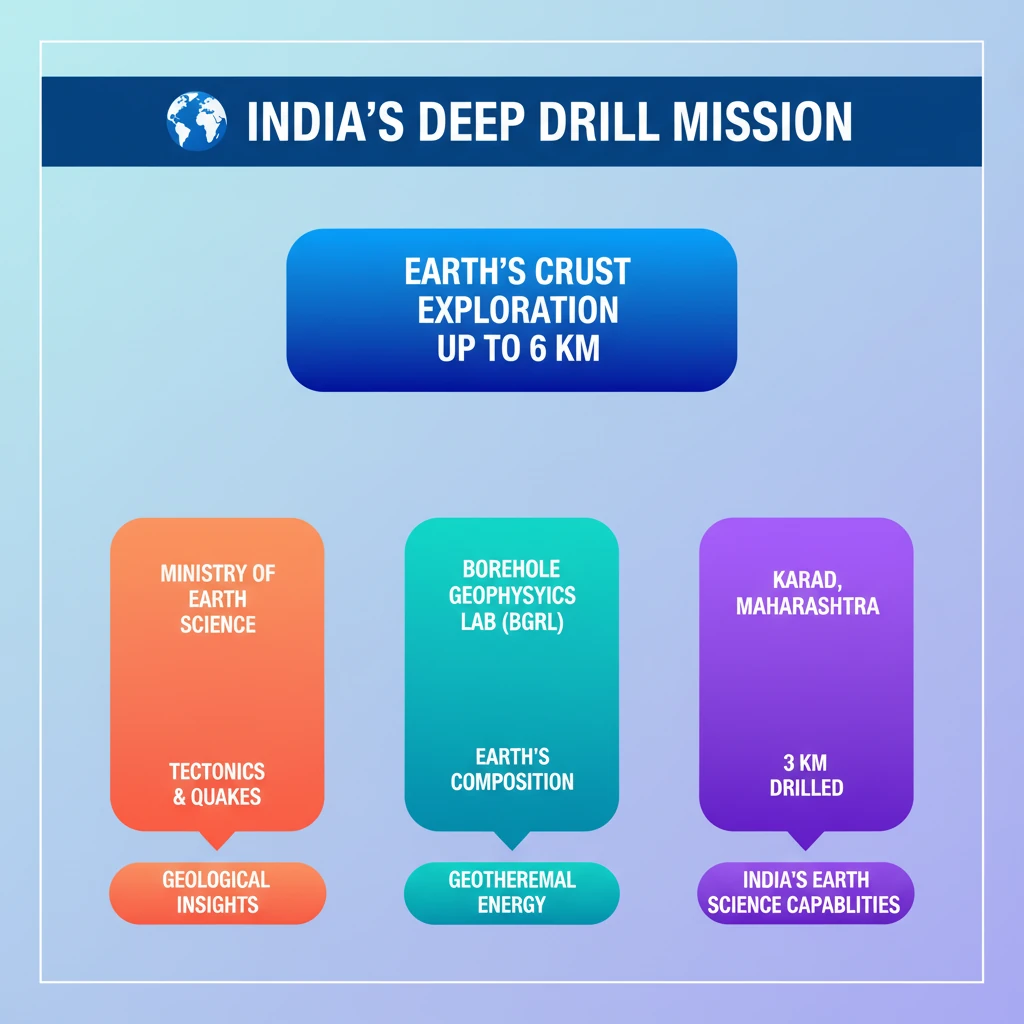
- •India's Deep Drill Mission is led by the Ministry of Earth Science in Karad, Maharashtra.
- •The mission aims to drill 6 km deep into the Earth's crust using the Borehole Geophysics Research Laboratory (BGRL).
- •Scientific Deep Drilling studies Earth's composition, structure, and processes for geological insights.
- •Key objectives include understanding tectonics, earthquake mechanisms, and geothermal energy potential.
- •The project has already completed 3 km of drilling, contributing to India's Earth Science capabilities.
🧠 Memory Techniques
95% Verified Content
📚 Reference Sources
•Ministry of Earth Sciences, Government of India official reports
•Geological Survey of India publications
•National Centre for Seismology (NCS) documents