What is the Polar Vortex? - Geography | UPSC Learning
Topics
0 topics • 0 completed
🔍
No topics match your search
What is the Polar Vortex?
Medium⏱️ 8 min read
geography
📖 Introduction
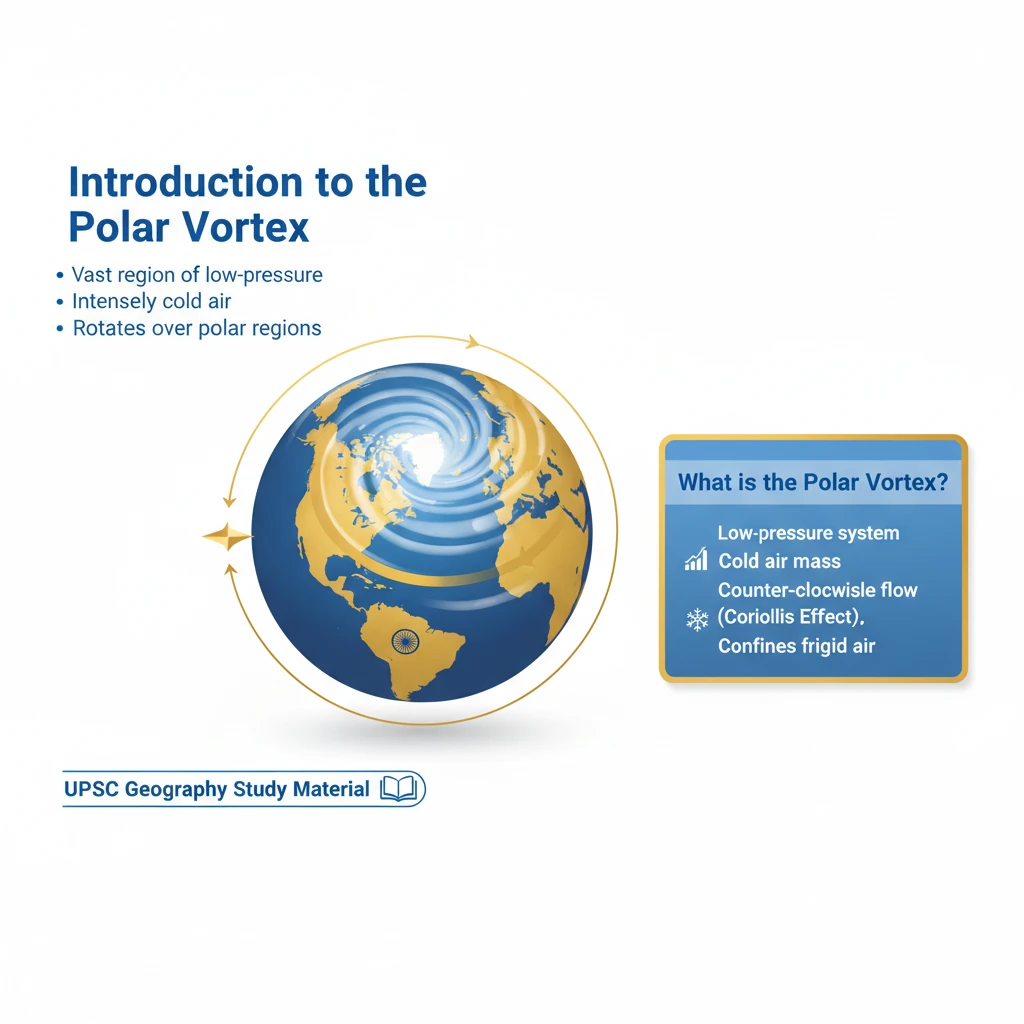
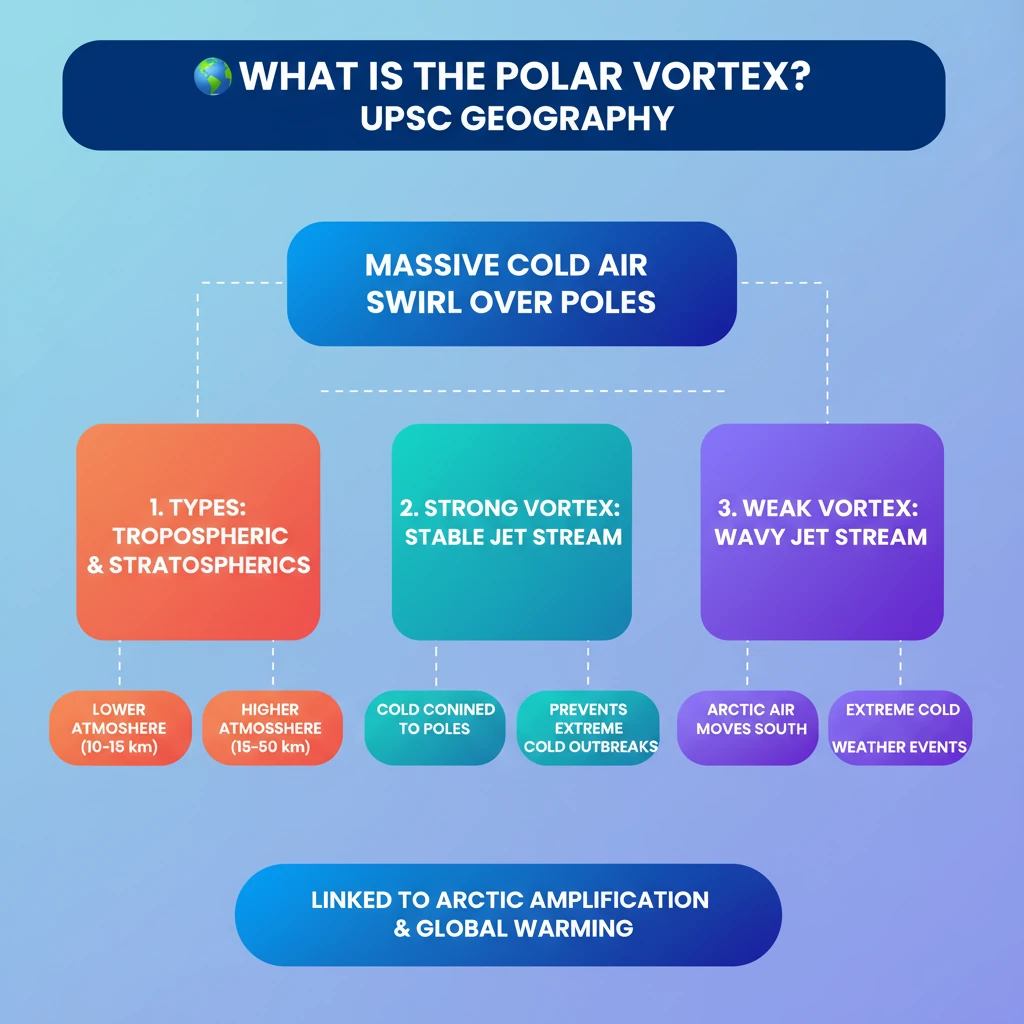
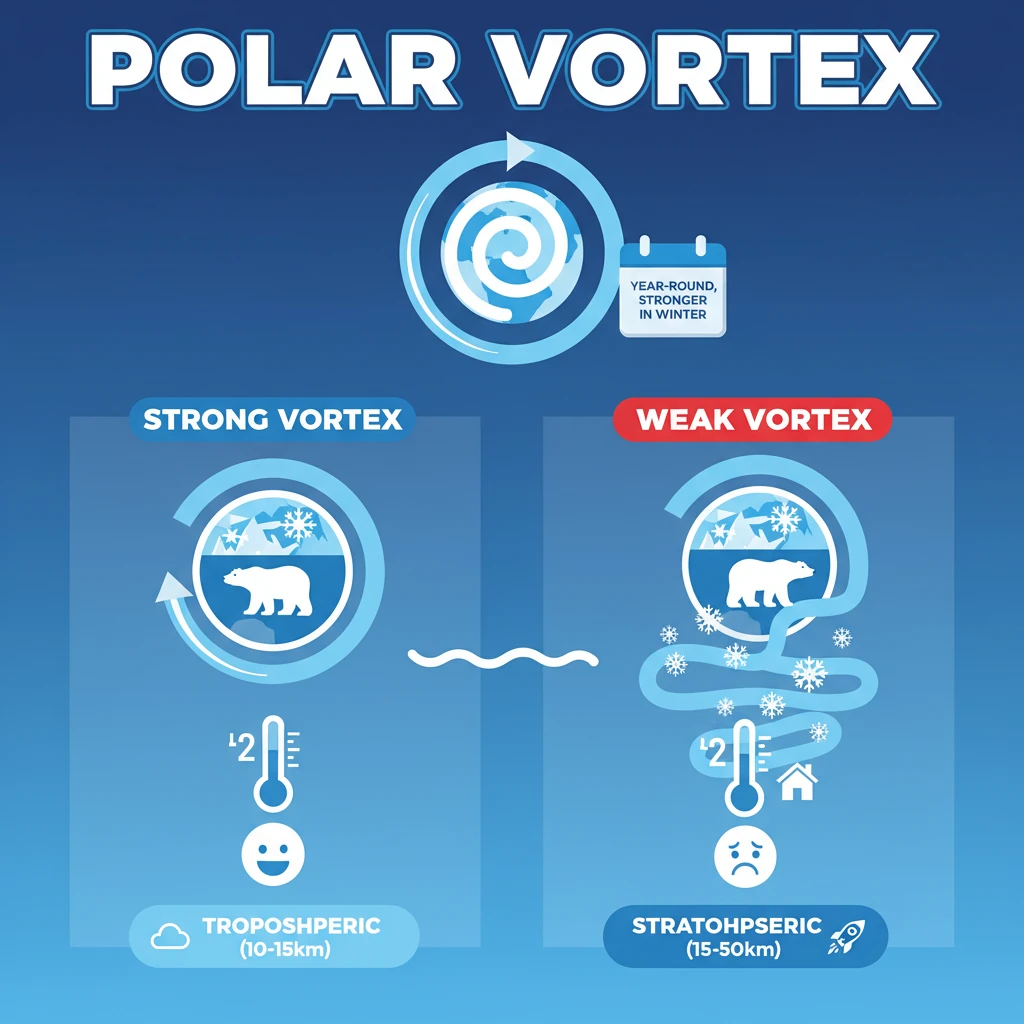
<h4>Introduction to the Polar Vortex</h4><p>The <strong>polar vortex</strong> is a vast region of <strong>low-pressure</strong> and intensely <strong>cold air</strong> that consistently rotates over the Earth’s <strong>polar regions</strong>.</p><p>The term "<strong>vortex</strong>" accurately describes the characteristic <strong>counter-clockwise flow of air</strong>. This rotational movement is crucial as it effectively traps and confines the frigid air near the poles.</p><div class='info-box'><p>The <strong>polar vortex</strong> is a permanent atmospheric feature, existing throughout the year. However, its strength fluctuates seasonally, becoming significantly <strong>weaker in summer</strong> and much <strong>stronger in winter</strong>.</p></div><h4>Types of Polar Vortex</h4><p>The <strong>polar vortex</strong> is observed at different altitudes within the Earth's atmosphere, leading to its classification into two primary types:</p><ul><li><strong>Tropospheric Polar Vortex</strong>: This type is situated in the <strong>lowest layer of the atmosphere</strong>, extending from the Earth's surface up to an altitude of approximately <strong>10-15 km</strong>. Most common <strong>weather phenomena</strong> occur within this layer.</li><li><strong>Stratospheric Polar Vortex</strong>: Occurring at much higher altitudes, this vortex is found between <strong>15 km to 50 km</strong> above the Earth's surface. It reaches its peak strength during <strong>autumn</strong> and typically dissipates by the <strong>summer months</strong>.</li></ul><div class='info-box'><p>Changes in the <strong>stratospheric polar vortex</strong> are heavily influenced by the movement of air and the transfer of heat within the polar regions. During <strong>autumn</strong>, circumpolar winds intensify, which strengthens the vortex and helps form a cohesive, rotating mass of polar air in the stratosphere.</p></div><h4>Mechanism of Extreme Cold Weather</h4><p>The behavior of the <strong>polar vortex</strong> directly impacts weather patterns, particularly the movement of cold air. A <strong>strong polar vortex</strong> plays a critical role in maintaining a stable atmospheric condition.</p><div class='key-point-box'><p>When the <strong>polar vortex is strong</strong>, it effectively keeps the <strong>jet stream</strong> stable and relatively straight. This stability acts as a barrier, preventing the intensely cold Arctic air from migrating southward into lower latitudes.</p></div><p>Conversely, a <strong>weakening of the polar vortex</strong> can lead to significant atmospheric disturbances. This weakening causes the <strong>jet stream</strong>, normally a narrow band of strong winds flowing in a relatively straight path, to become highly <strong>wavy and disrupted</strong>.</p><p>This disruption allows the frigid <strong>Arctic air</strong> to escape its usual confines and flow much farther south than typical. The consequence is a surge of extremely low temperatures, often accompanied by severe storms, heavy snowfall, and freezing rain in affected regions.</p><h4>Global Warming and Arctic Amplification</h4><p>Contemporary research highlights a crucial connection between <strong>global warming</strong> and the behavior of the <strong>polar vortex</strong>. Scientists observe that the <strong>Arctic region</strong> is experiencing warming at a rate significantly faster than the global average.</p><div class='info-box'><p>This accelerated warming phenomenon in the Arctic is termed <strong>Arctic amplification</strong>. It is a key area of study for understanding how climate change might influence extreme weather events linked to the polar vortex.</p></div><div class='exam-tip-box'><p>Understanding the interplay between <strong>Arctic amplification</strong>, the <strong>jet stream</strong>, and the <strong>polar vortex</strong> is crucial for UPSC exams, especially in questions related to <strong>climate change impacts</strong> and <strong>extreme weather patterns</strong> (<strong>GS Paper 1: Geography, GS Paper 3: Environment</strong>).</p></div>
💡 Key Takeaways
- •The <strong>polar vortex</strong> is a large low-pressure, cold air system rotating over the poles, present year-round but strongest in winter.
- •It exists in two types: <strong>Tropospheric</strong> (lower atmosphere, 10-15 km) and <strong>Stratospheric</strong> (higher atmosphere, 15-50 km).
- •A <strong>strong polar vortex</strong> keeps the <strong>jet stream</strong> stable, confining cold air to the poles.
- •A <strong>weak polar vortex</strong> leads to a wavy <strong>jet stream</strong>, allowing frigid <strong>Arctic air</strong> to move southward, causing extreme cold.
- •This phenomenon is increasingly linked to <strong>Arctic amplification</strong>, where the Arctic warms faster than the global average, a key aspect of <strong>global warming</strong>.
🧠 Memory Techniques
95% Verified Content
📚 Reference Sources
•National Oceanic and Atmospheric Administration (NOAA) - Arctic Report Card
•National Aeronautics and Space Administration (NASA) - Earth Observatory
•Intergovernmental Panel on Climate Change (IPCC) Reports