What are Key Highlights About Aurora Sightings? - Geography | UPSC Learning
Topics
0 topics • 0 completed
🔍
No topics match your search
What are Key Highlights About Aurora Sightings?
Medium⏱️ 6 min read
geography
📖 Introduction
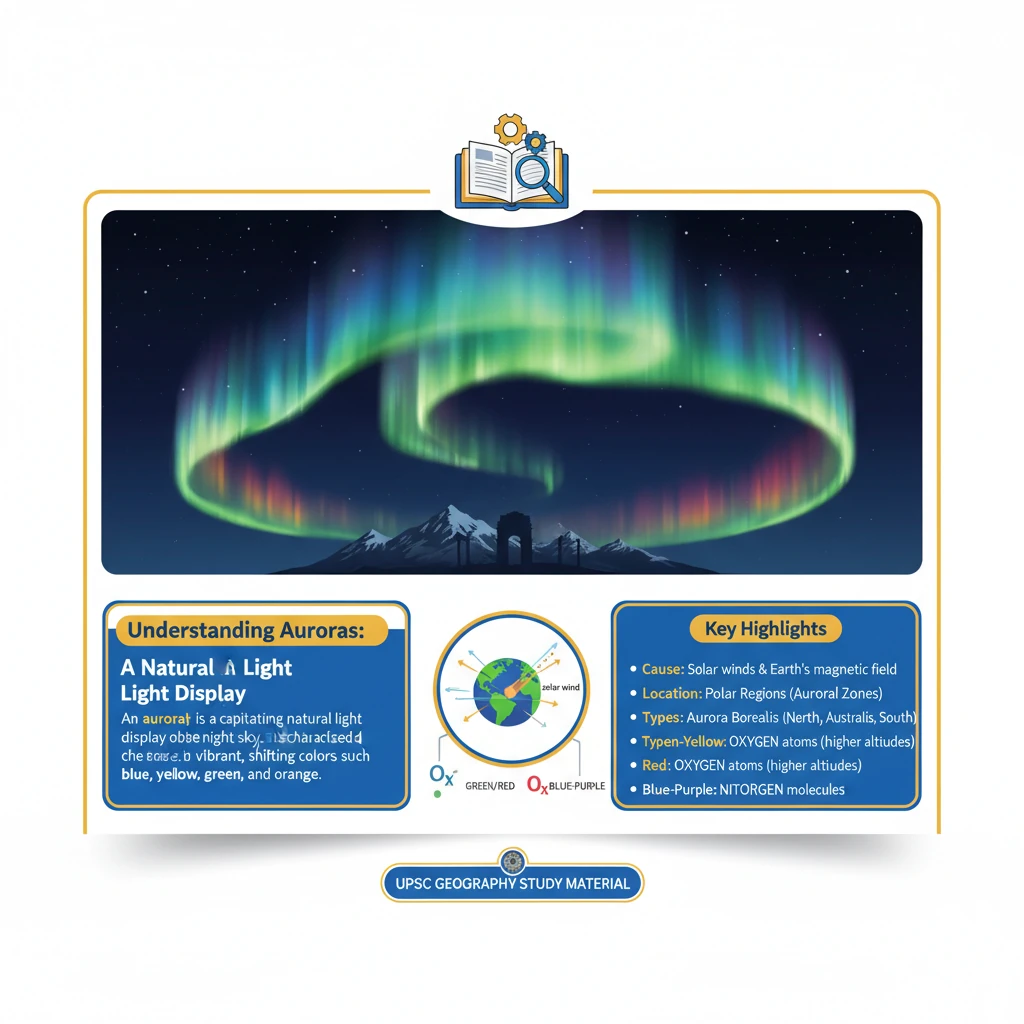
<h4>Understanding Auroras: A Natural Light Display</h4><p>An <strong>aurora</strong> is a captivating natural light display observed in the night sky. It is characterized by vibrant, shifting colors such as <strong>blue</strong>, <strong>red</strong>, <strong>yellow</strong>, <strong>green</strong>, and <strong>orange</strong>.</p><div class='info-box'><p>The most common <strong>greenish-yellow auroras</strong> are produced when <strong>ions</strong> strike <strong>oxygen atoms</strong> at lower altitudes in Earth's atmosphere.</p></div><p><strong>Reddish</strong> and <strong>bluish lights</strong>, often visible at the lower edges of auroras, are a result of <strong>ions interacting with nitrogen atoms</strong>.</p><p>Collisions involving <strong>hydrogen</strong> and <strong>helium atoms</strong> can generate <strong>blue</strong> and <strong>purple auroras</strong>. However, these particular colors are rarely discernible to the naked eye.</p><h4>Geographical Occurrence of Auroras</h4><p>Auroras are predominantly observed near the <strong>Arctic</strong> and <strong>Antarctic Circles</strong>. These regions are situated approximately <strong>66.5 degrees north</strong> and <strong>south of the Equator</strong>, respectively.</p><div class='info-box'><p>The aurora seen in the <strong>Northern Hemisphere</strong> is known as <strong>aurora borealis</strong>, commonly referred to as the <strong>northern lights</strong>.</p><p>Conversely, its counterpart in the <strong>Southern Hemisphere</strong> is called <strong>aurora australis</strong>, or the <strong>southern lights</strong>.</p></div><h4>Aurora and the Solar Activity Cycle</h4><p><strong>Auroras</strong> occur due to the interaction of <strong>coronal mass ejections (CMEs)</strong> with Earth’s <strong>magnetosphere</strong>. <strong>CMEs</strong> are powerful bursts of plasma and magnetic field from the Sun.</p><div class='key-point-box'><p>These <strong>coronal mass ejections</strong> are an integral part of the <strong>solar activity cycle</strong>. This cycle typically spans around <strong>11 years</strong>.</p></div><p>The current solar cycle, designated as <strong>Solar Cycle 25</strong>, is anticipated to reach its peak intensity in the year <strong>2024</strong>. This peak activity often correlates with increased aurora sightings.</p><h4>Lower Latitude Aurora Sightings</h4><p>Recent aurora sightings in <strong>lower-latitude regions</strong> have been attributed to a <strong>severe solar storm</strong>. This particular storm was initially categorized as a <strong>level 4</strong> event on a scale ranging from 1 to 5.</p><p>Typically, auroras are observed in high-latitude northern regions. These include countries and territories such as <strong>Canada</strong>, <strong>Norway</strong>, <strong>Sweden</strong>, <strong>Finland</strong>, <strong>Alaska</strong>, <strong>Russia</strong>, <strong>Iceland</strong>, and <strong>Greenland</strong>.</p><h4>Impact of Severe Solar Storms</h4><p><strong>Severe solar storms</strong> possess the capability to trigger spectacular aurora displays. Beyond their visual appeal, they can also accelerate the <strong>decay of satellites</strong> in orbit.</p><div class='exam-tip-box'><p>For UPSC, understanding the broader implications of <strong>space weather</strong> is crucial. <strong>Extreme solar storms</strong> pose significant threats, potentially leading to the <strong>destruction of satellites</strong>, widespread <strong>disruption of power grids</strong>, and extensive <strong>communication blackouts</strong>.</p></div>
💡 Key Takeaways
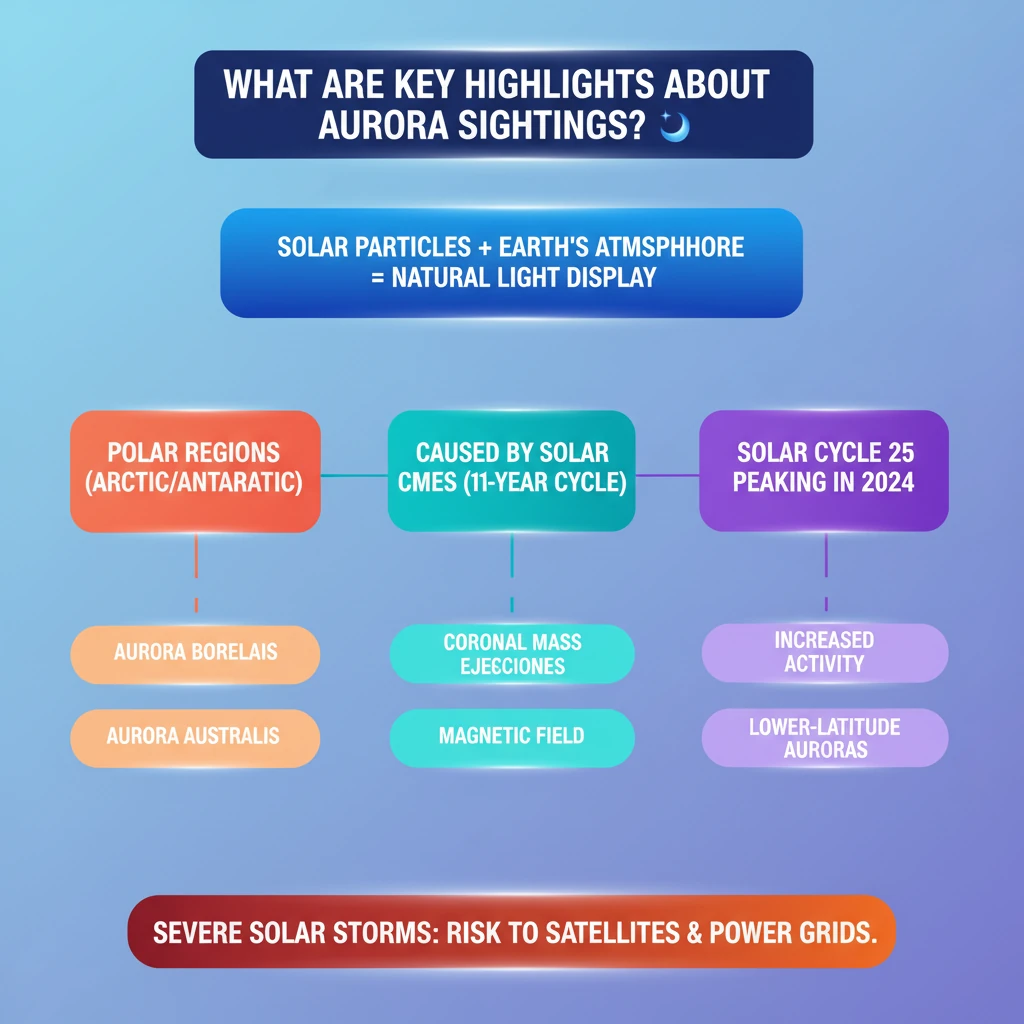
- •Auroras are natural light displays caused by solar particles interacting with Earth's atmosphere.
- •They are primarily seen near the Arctic and Antarctic Circles (aurora borealis and australis).
- •Coronal Mass Ejections (CMEs) from the Sun, part of the 11-year solar cycle, cause auroras.
- •The current Solar Cycle 25 is peaking in 2024, leading to increased aurora activity.
- •Severe solar storms can trigger lower-latitude auroras and pose risks to satellites, power grids, and communications.
🧠 Memory Techniques
95% Verified Content