Red Sea & Gulf of Aden: Location, Economic Significance, and Red Sea Rift - Geography | UPSC Learning
Topics
0 topics • 0 completed
🔍
No topics match your search
Red Sea & Gulf of Aden: Location, Economic Significance, and Red Sea Rift
Medium⏱️ 8 min read
geography
📖 Introduction
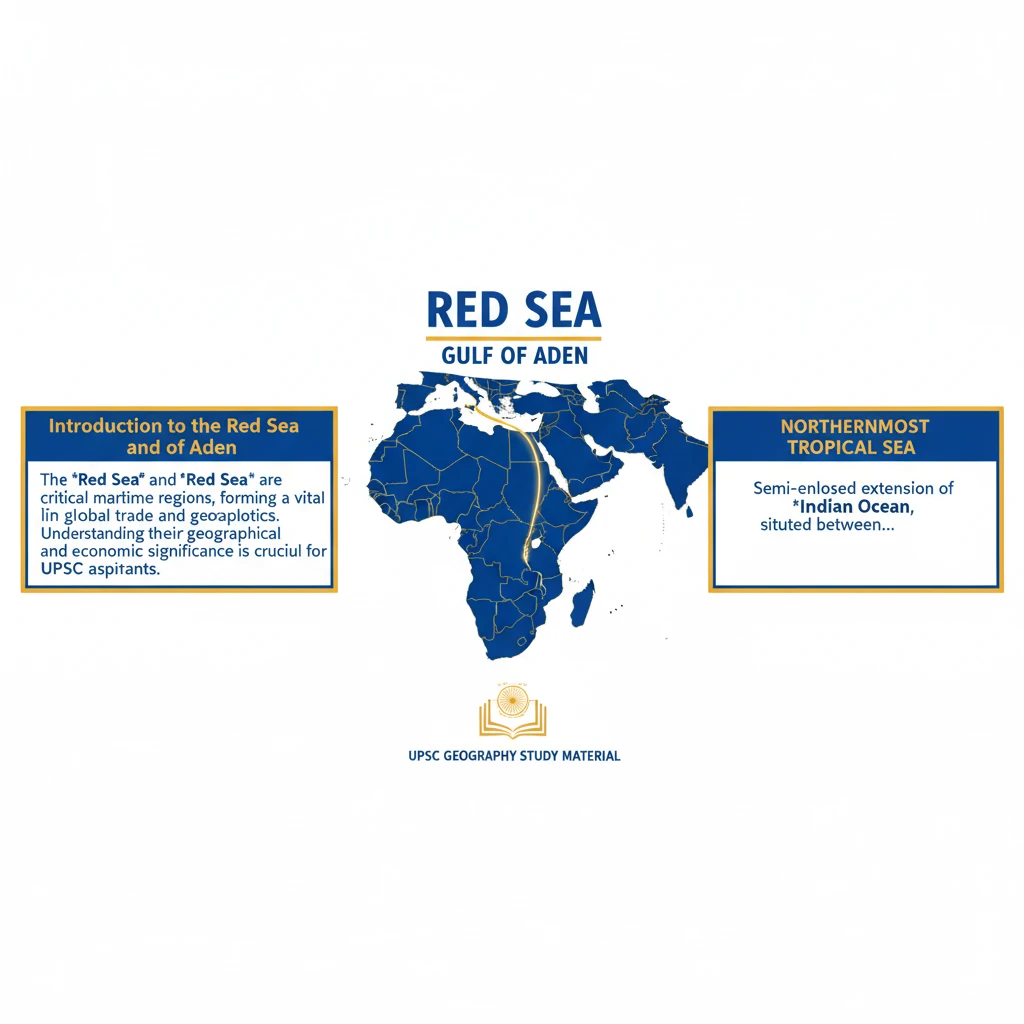
<h4>Introduction to the Red Sea and Gulf of Aden</h4><p>The <strong>Red Sea</strong> and <strong>Gulf of Aden</strong> are critical maritime regions, forming a vital link in global trade and geopolitics. Understanding their geographical and economic significance is crucial for UPSC aspirants.</p><div class='info-box'><p>The <strong>Red Sea</strong> is the world’s <strong>northernmost tropical sea</strong>. It is a semi-enclosed extension of the <strong>Indian Ocean</strong>, situated between <strong>Africa</strong> and <strong>Asia</strong>.</p></div><h4>Geographical Location and Connections of the Red Sea</h4><p>The <strong>Red Sea</strong> is strategically positioned, connecting major continents. Its unique geographical features make it a significant waterway.</p><div class='info-box'><ul><li><strong>Southern Connection:</strong> It connects to the <strong>Indian Ocean</strong> and <strong>Arabian Sea</strong> via the <strong>Bab el Mandeb Strait</strong> and the <strong>Gulf of Aden</strong>.</li><li><strong>Northern Bifurcation:</strong> In the north, it splits into two major gulfs: the <strong>Gulf of Aqaba</strong> and the <strong>Gulf of Suez</strong>, located at the <strong>Sinai Peninsula</strong>.</li><li><strong>Mediterranean Link:</strong> The <strong>Gulf of Suez</strong> is connected to the <strong>Mediterranean Sea</strong> through the historic <strong>Suez Canal</strong>.</li></ul></div><h4>Geological Formation: The Red Sea Rift</h4><p>The <strong>Red Sea</strong> is underlain by the <strong>Red Sea Rift</strong>, a significant geological feature. This rift is a testament to ongoing tectonic activity in the region.</p><div class='key-point-box'><p>The <strong>Red Sea Rift</strong> represents a <strong>divergent boundary</strong> between the <strong>African Plate</strong> and the <strong>Arabian Plate</strong>. It is an integral part of the larger <strong>Great Rift Valley system</strong>, which extends from <strong>East Africa</strong> all the way to the <strong>Middle East</strong>.</p></div><h4>Etymology of the Name 'Red Sea'</h4><p>The origin of the name <strong>Red Sea</strong> is often debated, but a prominent theory links it to natural phenomena.</p><div class='info-box'><p>The name <strong>Red Sea</strong> is believed to originate from the seasonal blooms of a specific red-colored <strong>cyanobacteria</strong>, known scientifically as <strong>Trichodesmium erythraeum</strong>. These blooms can tint the water's surface reddish.</p></div><h4>The Gulf of Aden: Location and Connections</h4><p>The <strong>Gulf of Aden</strong> is another crucial body of water, adjacent to the <strong>Red Sea</strong> and equally important for maritime activities.</p><div class='info-box'><ul><li><strong>Eastern Boundary:</strong> It is bounded by <strong>Somalia</strong> and the <strong>Socotra Islands</strong> to the east, and <strong>Yemen</strong> to the north.</li><li><strong>Western Boundary:</strong> <strong>Djibouti</strong> lies to its west.</li><li><strong>Northern Boundary:</strong> The <strong>Arabian Sea</strong> is situated to its east.</li><li><strong>Connections:</strong> It connects to the <strong>Somali Sea</strong> via the <strong>Guardafui Channel</strong> and to the <strong>Red Sea</strong> through the <strong>Strait of Bab el Mandeb</strong>.</li></ul></div><h4>Economic Importance of the Gulf of Aden</h4><p>The <strong>Gulf of Aden</strong> serves as a critical maritime corridor, facilitating a significant portion of global trade, particularly in energy resources.</p><div class='info-box'><p>Approximately <strong>10% of global seaborne petroleum</strong> passes through the <strong>Gulf of Aden</strong>. Furthermore, trade worth over <strong>USD 110 billion</strong> for <strong>India</strong> transits through this vital waterway annually.</p></div><div class='exam-tip-box'><p><strong>UPSC Insight:</strong> Questions on strategic waterways like the <strong>Red Sea</strong> and <strong>Gulf of Aden</strong> often appear in <strong>Geography (GS Paper 1)</strong> and <strong>International Relations (GS Paper 2)</strong>. Focus on their geographical features, economic significance, and geopolitical implications.</p></div>
💡 Key Takeaways
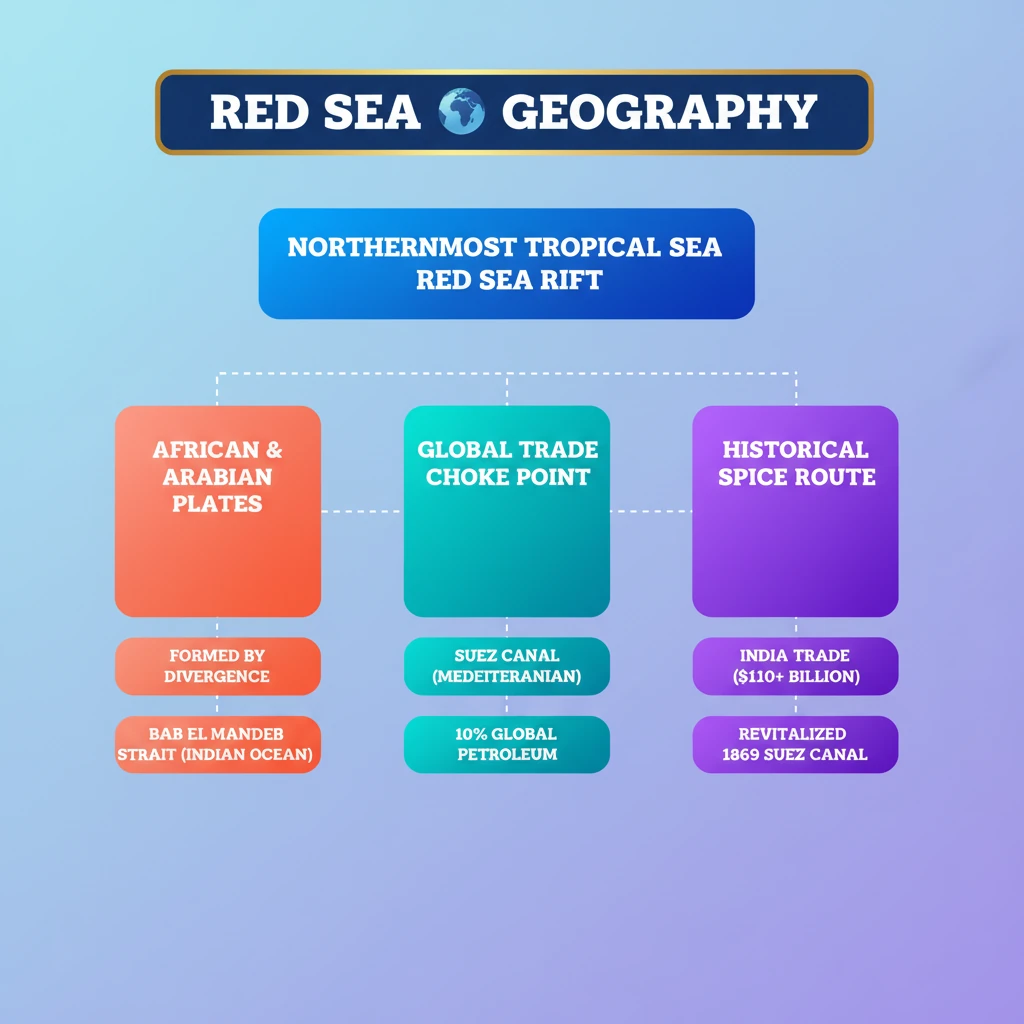
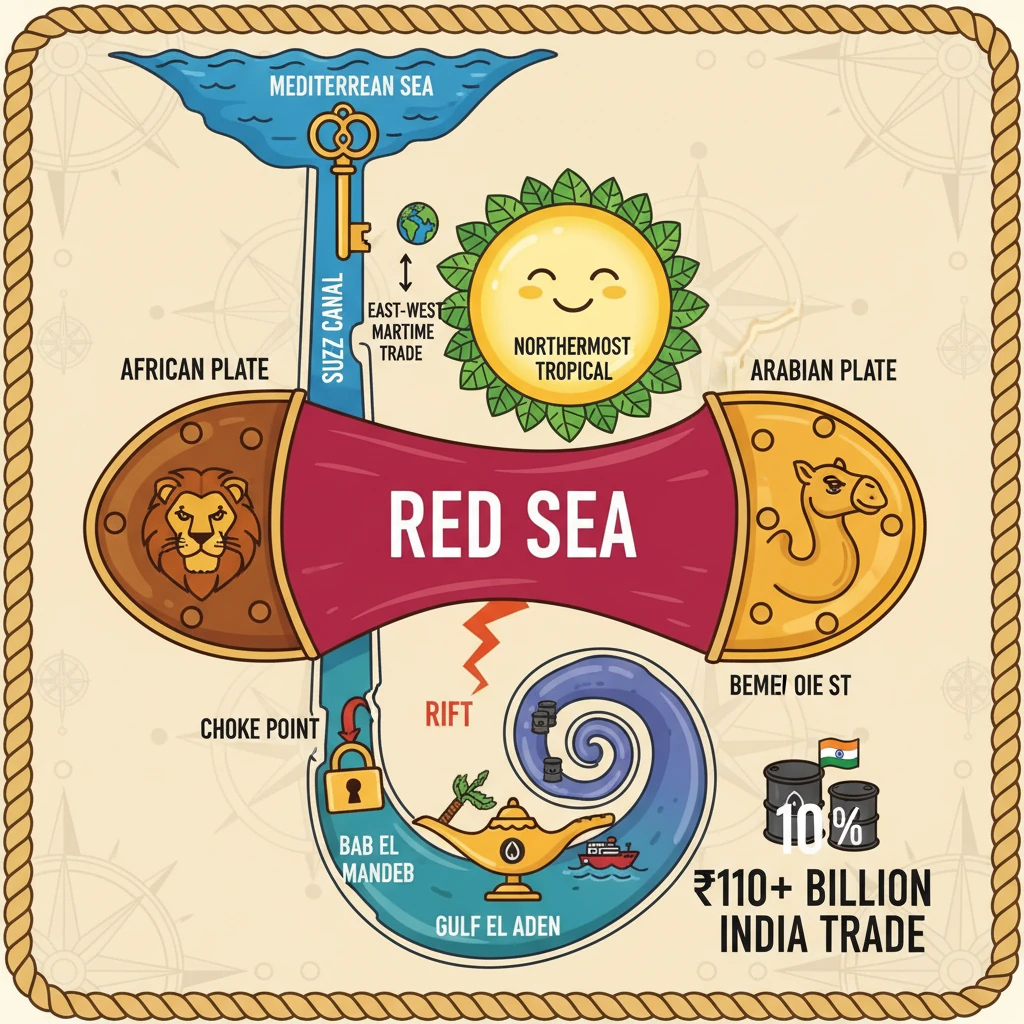
- •The Red Sea is the world's northernmost tropical sea, formed by the Red Sea Rift (African and Arabian Plates diverging).
- •It connects to the Indian Ocean via Bab el Mandeb Strait/Gulf of Aden and to the Mediterranean via the Suez Canal.
- •The Gulf of Aden is crucial for global seaborne petroleum (10%) and India's trade (over USD 110 billion).
- •Bab el Mandeb Strait is a critical choke point, essential for East-West maritime trade.
- •Historically, the Red Sea was a key part of the Spice Route, revitalized by the Suez Canal in 1869.
- •Current relevance includes global energy security, India's trade, and maritime security challenges like piracy and regional tensions.
🧠 Memory Techniques
95% Verified Content
📚 Reference Sources
•National Geographic (for geological context)
•EIA (Energy Information Administration) for trade data confirmation