Origin of Magnetofossils - Geography | UPSC Learning
Topics
0 topics • 0 completed
🔍
No topics match your search

Origin of Magnetofossils
Medium⏱️ 5 min read
geography
📖 Introduction
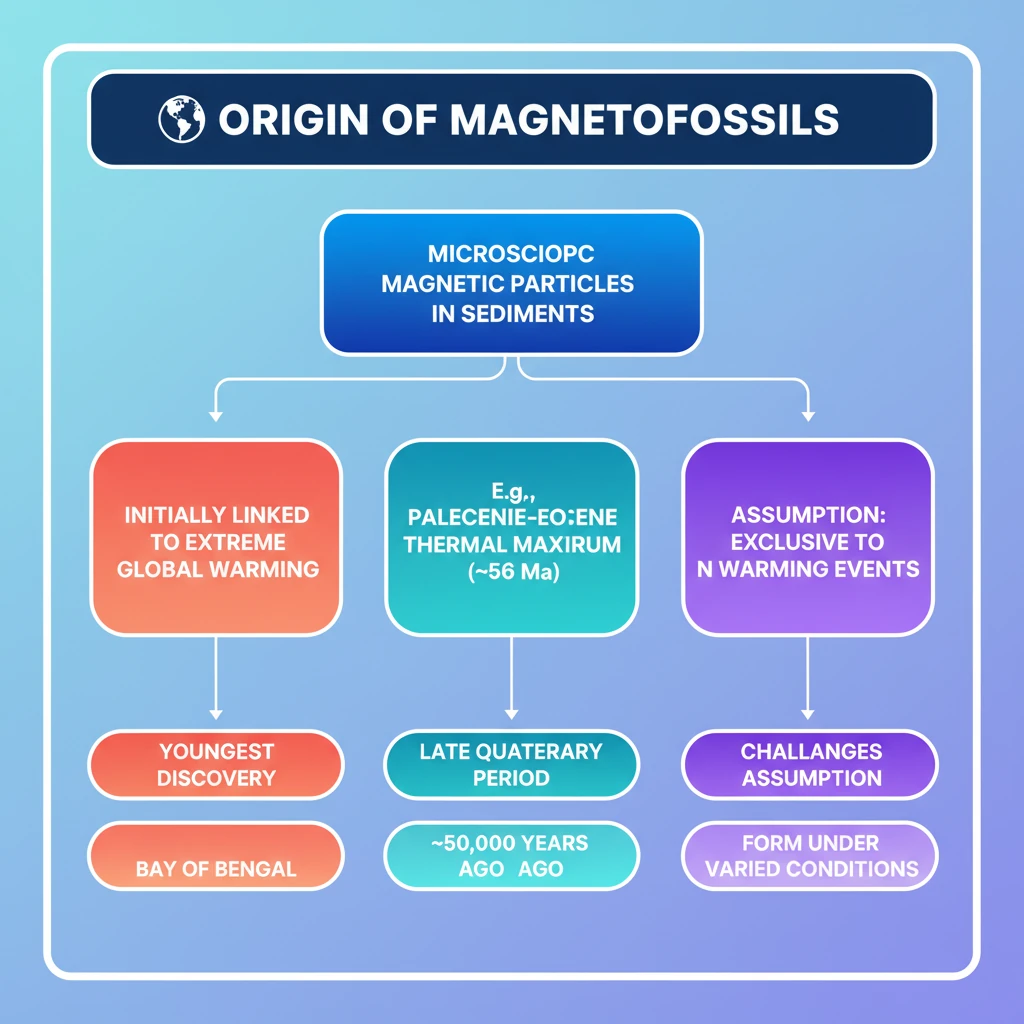
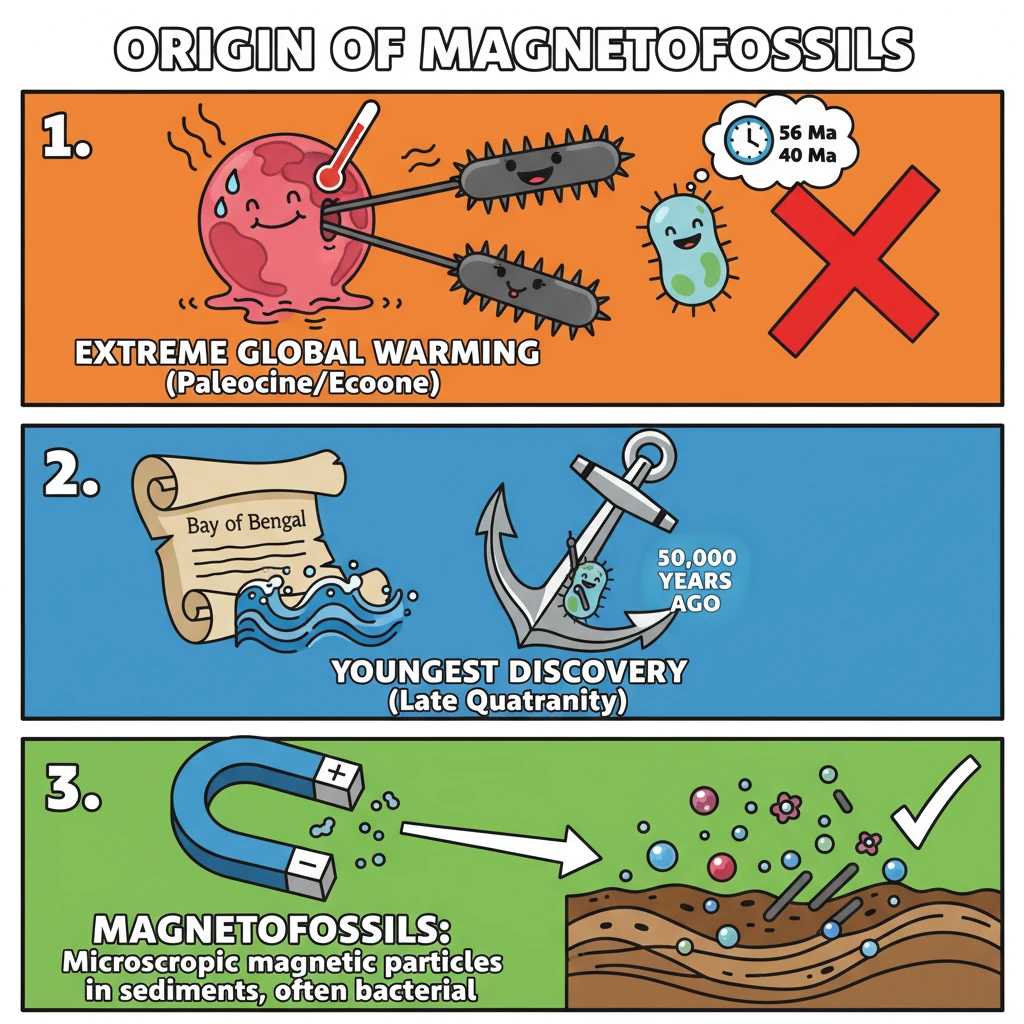
<h4>Introduction to Magnetofossils</h4><p><strong>Magnetofossils</strong> are microscopic magnetic particles found preserved in geological sediments. They are typically formed by <strong>magnetotactic bacteria</strong>, which produce these particles within their cells. These unique biological formations serve as valuable proxies for studying Earth's past climate and magnetic field.</p><div class='info-box'><p><strong>Magnetotactic bacteria</strong> orient themselves along magnetic field lines, and the magnetofossils they produce are often aligned, providing insights into ancient geomagnetic conditions.</p></div><h4>Initial Hypothesis: Extreme Warming Link</h4><p>Early research on giant magnetofossils identified them primarily in sediments from two distinct geological periods. These periods were known for significant increases in <strong>global temperatures</strong>.</p><div class='info-box'><p>The two key periods were the <strong>Paleocene-Eocene Thermal Maximum</strong> (roughly <strong>56 million years ago</strong>) and the <strong>Middle Eocene Climatic Optimum</strong> (about <strong>40 million years ago</strong>).</p></div><p>This observation led to the strong assumption that the formation of these giant magnetofossils was exclusively linked to periods of <strong>extreme global warming</strong>. The prevailing scientific view was that such conditions were necessary for their proliferation and preservation.</p><h4>Challenging the Assumption: Bay of Bengal Discovery</h4><p>A significant discovery of giant magnetofossils in the <strong>Bay of Bengal</strong> has challenged this long-held hypothesis. These newly found magnetofossils were dated to a much more recent period.</p><div class='info-box'><p>The Bay of Bengal magnetofossils were determined to be from the <strong>late Quaternary period</strong>, approximately <strong>50,000 years ago</strong>. This makes them the <strong>youngest giant magnetofossils</strong> discovered to date.</p></div><div class='key-point-box'><p>The discovery of these younger magnetofossils directly contradicts the assumption that their formation occurs <strong>only during periods of extreme warming</strong>. It suggests that other environmental factors or conditions might also facilitate their genesis.</p></div><div class='exam-tip-box'><p>For <strong>UPSC Mains (GS Paper 1: Geography)</strong>, understanding such evolving scientific theories is crucial. Be prepared to discuss how new evidence can refine or challenge existing paleoclimate models.</p></div>
💡 Key Takeaways
- •Magnetofossils are microscopic magnetic particles found in sediments, often formed by magnetotactic bacteria.
- •Initially, giant magnetofossils were strongly associated with periods of extreme global warming, such as the Paleocene-Eocene Thermal Maximum (~56 Ma) and Middle Eocene Climatic Optimum (~40 Ma).
- •This led to the assumption that their formation was exclusive to extreme warming conditions.
- •A recent discovery in the Bay of Bengal revealed the youngest giant magnetofossils, dating to the late Quaternary period (~50,000 years ago).
- •This new finding challenges the previous assumption, suggesting magnetofossils can form under conditions not necessarily involving extreme global warming.
🧠 Memory Techniques
95% Verified Content