Hydrothermal Vents in Indian Ocean - Geography | UPSC Learning
Topics
0 topics • 0 completed
🔍
No topics match your search
Hydrothermal Vents in Indian Ocean
Medium⏱️ 8 min read
geography
📖 Introduction
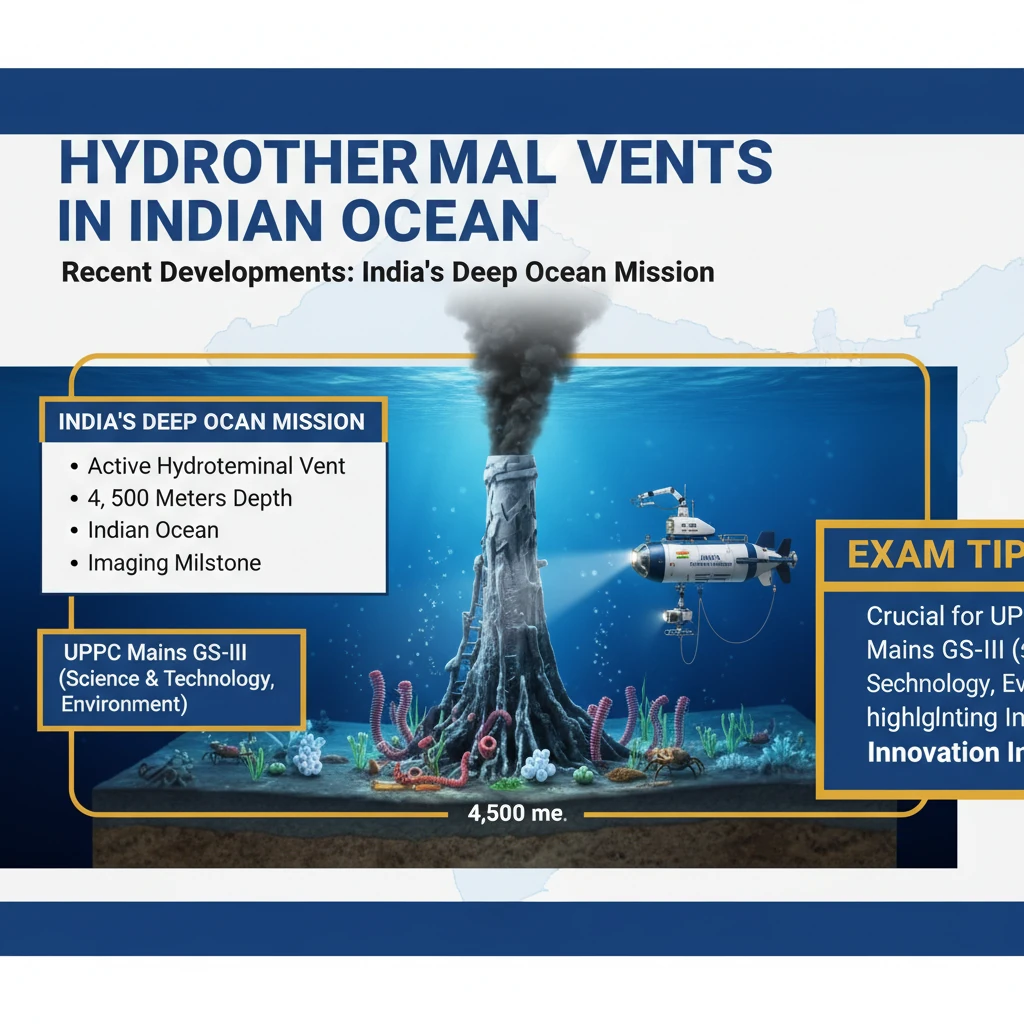
<h4>Recent Developments: India's Deep Ocean Mission</h4><p>India has recently achieved a significant milestone through its <strong>Deep Ocean Mission</strong>. This involves imaging an <strong>active hydrothermal vent</strong> located at an impressive depth of <strong>4,500 meters</strong> beneath the surface of the <strong>Indian Ocean</strong>.</p><div class='exam-tip-box'><p>This development is crucial for <strong>UPSC Mains GS-III (Science & Technology, Environment)</strong>, highlighting India's growing capabilities in deep-sea exploration and its strategic implications.</p></div><p>This breakthrough is set to significantly enhance India’s efforts in <strong>mineral exploration</strong> and advanced <strong>deep-sea research</strong>. It holds substantial potential for the ongoing <strong>Samudraayan mission</strong> and future oceanic exploration initiatives.</p><h4>Understanding Hydrothermal Vents</h4><p><strong>Hydrothermal vents</strong> are unique geological features found on the ocean floor. They are essentially <strong>underwater hot springs</strong> that expel superheated water and minerals.</p><p>These vents are typically located in areas of intense geological activity, primarily near <strong>tectonic plate boundaries</strong>. They represent a direct link between the Earth's interior and the ocean.</p><h4>Definition of Hydrothermal Vents</h4><div class='info-box'><p><strong>Definition:</strong> <strong>Hydrothermal vents</strong> are fissures in the Earth's surface, typically found near <strong>tectonic plates</strong>, from which geothermally heated water and dissolved minerals emerge into the ocean.</p></div><h4>Discovery of Hydrothermal Vents</h4><p>The existence of <strong>hydrothermal vents</strong> was first scientifically confirmed in <strong>1977</strong>. This landmark discovery occurred near the <strong>Galapagos Islands</strong>, off the coast of <strong>Ecuador</strong>.</p><h4>Formation Process of Hydrothermal Vents</h4><p>The formation of <strong>hydrothermal vents</strong> begins with <strong>seawater percolation</strong>. Cold ocean water seeps down through cracks and fissures in the oceanic crust.</p><p>These fissures typically form in regions where <strong>tectonic plates</strong> are either spreading apart (<strong>spreading ridges</strong>) or moving towards one another (<strong>subduction zones</strong>).</p><p>As the cold seabed water, which is approximately <strong>2°C</strong>, descends, it comes into direct contact with extremely hot <strong>magma</strong> beneath the Earth's crust. This interaction causes the water to heat up dramatically, reaching temperatures as high as <strong>370°C</strong>.</p><div class='key-point-box'><p>Despite reaching temperatures over <strong>700°F (370°C)</strong>, the water expelled from <strong>hydrothermal vents</strong> does not boil. This is due to the immense <strong>high pressure</strong> exerted by the vast amount of water at such extreme depths.</p></div><p>The superheated, mineral-rich seawater then reemerges from the ocean floor. This expulsion of hot fluids forms the distinctive structures known as <strong>hydrothermal vents</strong>.</p>
💡 Key Takeaways
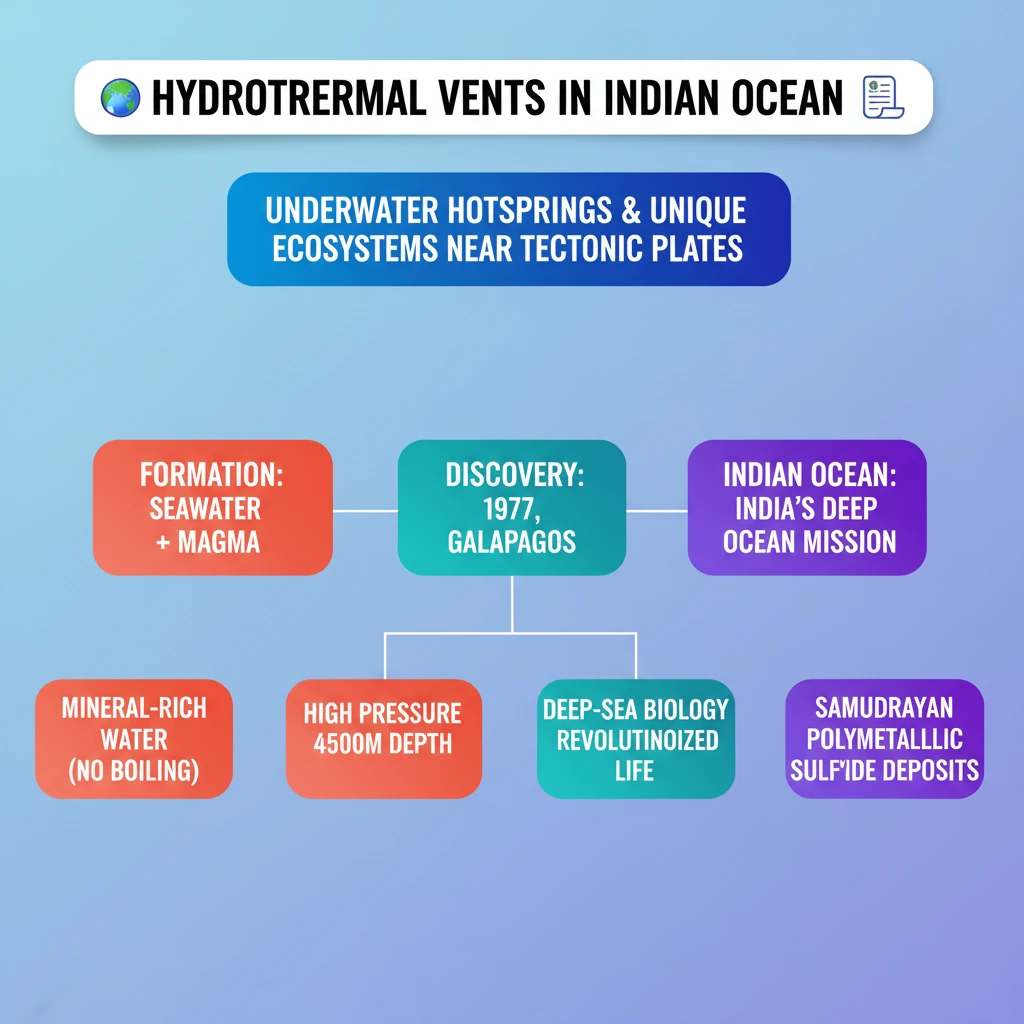
- •Hydrothermal vents are underwater hot springs near tectonic plates, expelling superheated, mineral-rich water.
- •They form when cold seawater percolates, heats up by magma, and re-emerges under high pressure (no boiling).
- •First discovered in 1977 near the Galapagos Islands, revolutionizing deep-sea biology.
- •India's Deep Ocean Mission recently imaged an active vent at 4,500m in the Indian Ocean, enhancing mineral exploration and Samudraayan.
- •Vents host unique chemosynthetic ecosystems and are significant sources of polymetallic sulfide deposits.
🧠 Memory Techniques
98% Verified Content
📚 Reference Sources
•National Oceanic and Atmospheric Administration (NOAA) - Ocean Explorer
•Woods Hole Oceanographic Institution (WHOI) - Deep Sea Vents
•Geological Survey of India (GSI) - Deep Ocean Mission related reports