WMO’S Greenhouse Gas Bulletin 2023 - Environment And Ecology | UPSC Learning
Topics
0 topics • 0 completed
🔍
No topics match your search

WMO’S Greenhouse Gas Bulletin 2023
Medium⏱️ 10 min read
environment and ecology
📖 Introduction
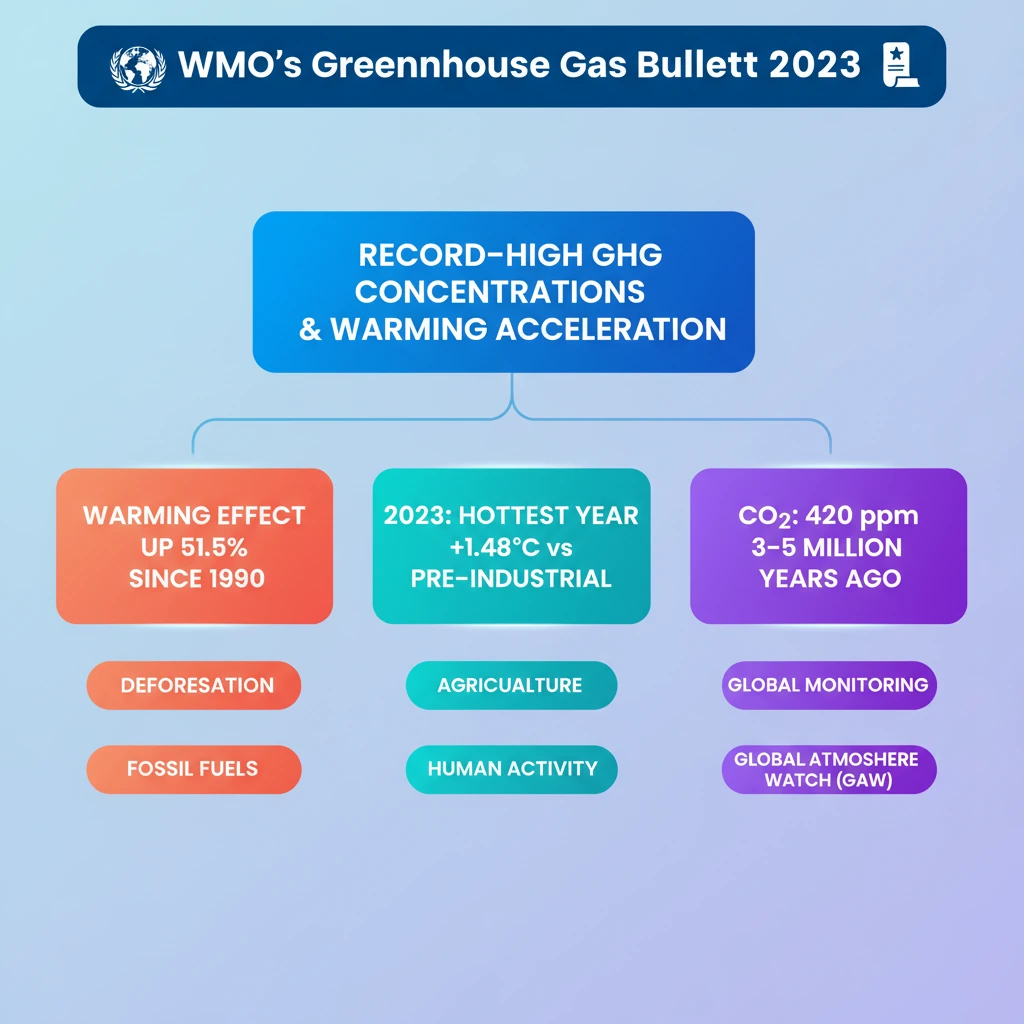
<h4>Introduction to WMO's Greenhouse Gas Bulletin 2023</h4><p>The <strong>World Meteorological Organization (WMO)</strong> recently released its annual <strong>Greenhouse Gas (GHG) Bulletin for 2023</strong>. This report provides a crucial update on global atmospheric concentrations.</p><p>This bulletin serves as a critical analysis from the <strong>WMO Global Atmosphere Watch (GAW)</strong> program. It focuses on the latest atmospheric concentrations of various <strong>Greenhouse Gases (GHGs)</strong>, offering vital data for climate science and policy.</p><div class='exam-tip-box'><p>Understanding the <strong>WMO GHG Bulletin</strong> is crucial for <strong>UPSC Mains GS-III (Environment & Ecology)</strong>. It provides foundational data for questions on climate change, global warming trends, and international environmental agreements.</p></div><h4>Understanding Greenhouse Gases (GHGs)</h4><p><strong>Greenhouse Gases (GHGs)</strong> are atmospheric gases that possess the unique ability to <strong>trap heat from the sun</strong>. This natural process is essential for maintaining Earth's surface temperature, making it habitable for life.</p><p>However, an increase in their concentration, primarily due to <strong>human activities</strong>, intensifies this natural process. This amplification leads to the phenomenon known as the <strong>enhanced greenhouse effect</strong>, resulting in <strong>global warming</strong> and subsequent <strong>climate change</strong>.</p><div class='info-box'><p><strong>Key Concept:</strong> The <strong>Greenhouse Effect</strong> is the process by which radiation from a planet's atmosphere warms the planet's surface to a temperature above what it would be without its atmosphere.</p></div><h4>Key Greenhouse Gases and Their Sources</h4><h5>Carbon Dioxide (CO2)</h5><p><strong>Carbon Dioxide (CO2)</strong> is a primary GHG, largely entering the atmosphere through the <strong>burning of fossil fuels</strong>. This includes coal, natural gas, and oil, as well as the incineration of solid waste and industrial processes.</p><div class='info-box'><p><strong>Main Sources:</strong> Combustion of fossil fuels (coal, natural gas, oil), industrial processes, deforestation, solid waste incineration.</p></div><h5>Methane (CH4)</h5><p><strong>Methane (CH4)</strong> levels in the atmosphere have significantly increased due to various human activities. These include intensive <strong>cattle farming</strong> (enteric fermentation), decomposition in <strong>landfill waste</strong>, extensive <strong>rice farming</strong>, and the extraction of <strong>fossil fuels</strong>.</p><div class='info-box'><p><strong>Main Sources:</strong> Agriculture (livestock, rice paddies), waste management (landfills), fossil fuel extraction.</p></div><h5>Nitrous Oxide (N2O)</h5><p><strong>Nitrous Oxide (N2O)</strong> is emitted from a range of activities. These include various <strong>agricultural practices</strong> (e.g., fertilizer use), changes in <strong>land use</strong>, and diverse <strong>industrial activities</strong>. It also results from the combustion of fossil fuels and solid waste.</p><div class='info-box'><p><strong>Main Sources:</strong> Agricultural activities, land use changes, industrial processes, combustion of fossil fuels and solid waste.</p></div><h5>Water Vapour (H2O)</h5><p><strong>Water Vapour (H2O)</strong> is recognized as the <strong>most abundant GHG</strong> in Earth's atmosphere. Unlike other GHGs, it has a very short atmospheric residence time, typically existing for only a few days.</p><div class='key-point-box'><p><strong>Important Distinction:</strong> While most abundant, its direct human emission impact is less compared to CO2, CH4, N2O, as its concentration is largely controlled by temperature and climate feedback loops.</p></div><h5>Industrial Fluorinated Gases</h5><p>This category encompasses synthetic gases such as <strong>hydrofluorocarbons (HFCs)</strong>, <strong>perfluorocarbons (PFCs)</strong>, and <strong>sulphur hexafluoride (SF6)</strong>. These gases are primarily industrial byproducts or used in specific applications.</p><p>A critical characteristic of these gases is their exceptionally <strong>high Global Warming Potential (GWP)</strong>. For instance, <strong>SF6</strong> has a GWP that is approximately <strong>23,000 times greater than CO2</strong>, making them extremely potent contributors to global warming despite their lower atmospheric concentrations.</p><div class='info-box'><p><strong>Examples:</strong> HFCs (refrigerants), PFCs (aluminum production), SF6 (electrical insulation in power transmission).</p></div><h4>Global Warming Potential (GWP) Explained</h4><p>The concept of <strong>Global Warming Potential (GWP)</strong> is a crucial metric used to compare the heat-trapping abilities of different GHGs. It indicates how much heat a specific GHG traps in the atmosphere over a defined period, relative to the heat trapped by an equivalent mass of <strong>Carbon Dioxide (CO2)</strong>.</p><div class='key-point-box'><p><strong>GWP Baseline:</strong> <strong>CO2</strong> is used as the reference gas, with a GWP of 1. Gases with higher GWP values contribute more significantly to warming per unit mass over a specified timeframe (e.g., 100 years).</p></div><div class='exam-tip-box'><p>Questions on <strong>GWP</strong> and the relative impact of different GHGs are common in <strong>UPSC Prelims</strong>. Remember the high GWP of industrial fluorinated gases like <strong>SF6</strong> and their disproportionate warming effect.</p></div>
💡 Key Takeaways
- •WMO's 2023 Greenhouse Gas Bulletin provides critical data on rising atmospheric GHG concentrations.
- •Human activities, like burning fossil fuels and agriculture, are significantly increasing GHGs, intensifying global warming.
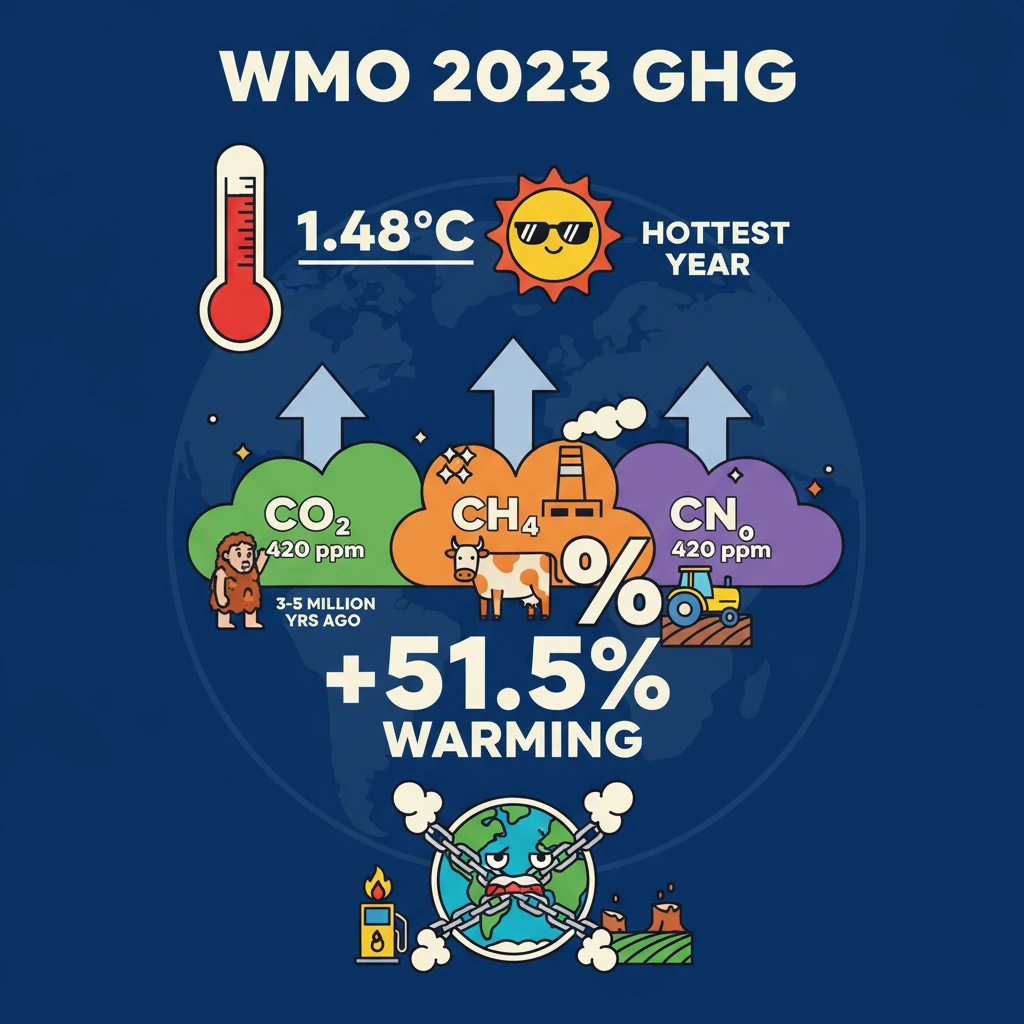
- •Key GHGs include Carbon Dioxide (CO2), Methane (CH4), Nitrous Oxide (N2O), Water Vapour (H2O), and potent industrial fluorinated gases (HFCs, PFCs, SF6).
- •Global Warming Potential (GWP) measures a GHG's heat-trapping ability relative to CO2, with SF6 having an exceptionally high GWP (23,000 times CO2).
- •The bulletin highlights the urgent need for accelerated and more effective global climate action and emission reductions to meet climate targets.
🧠 Memory Techniques
98% Verified Content
📚 Reference Sources
•World Meteorological Organization (WMO) official Greenhouse Gas Bulletin reports (implied primary source)