What are the Key Facts About the Golden Tiger? - Environment And Ecology | UPSC Learning
Topics
0 topics • 0 completed
🔍
No topics match your search
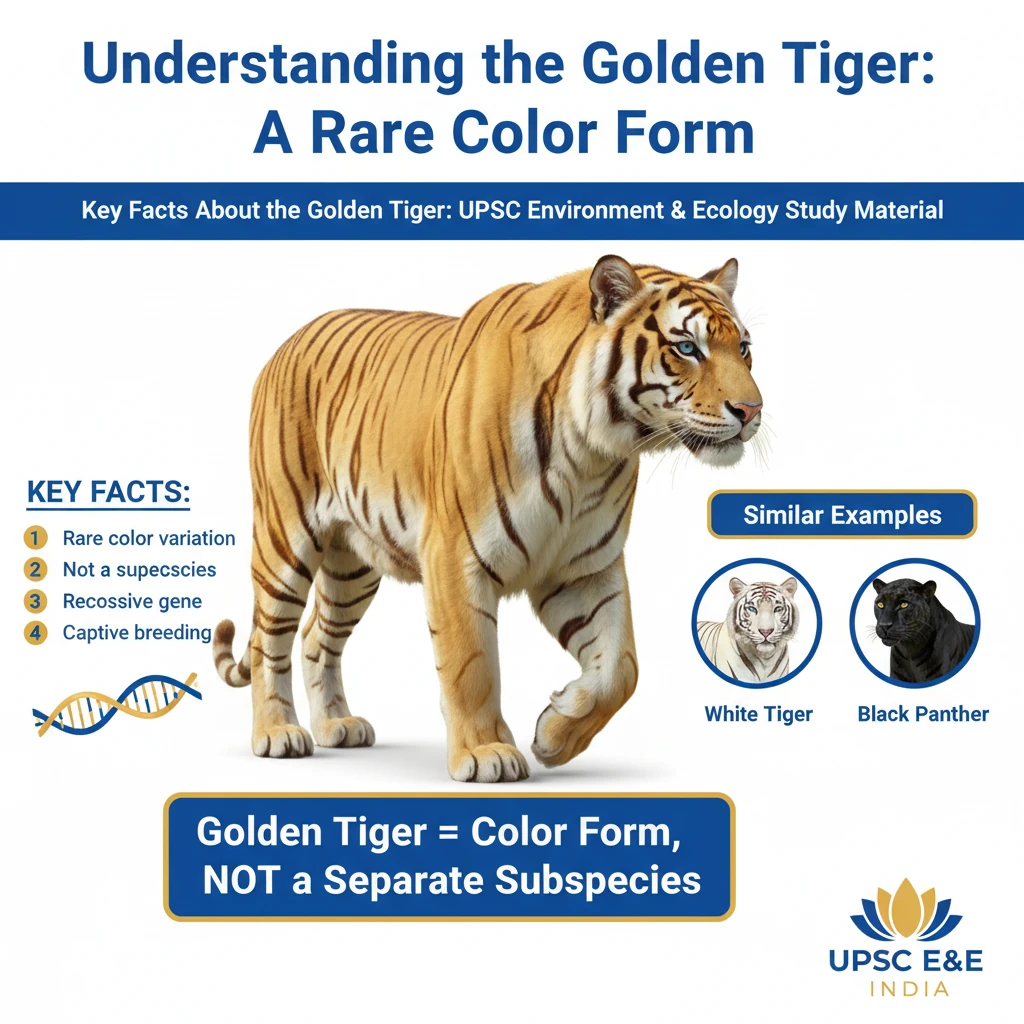
What are the Key Facts About the Golden Tiger?
Medium⏱️ 6 min read
environment and ecology
📖 Introduction
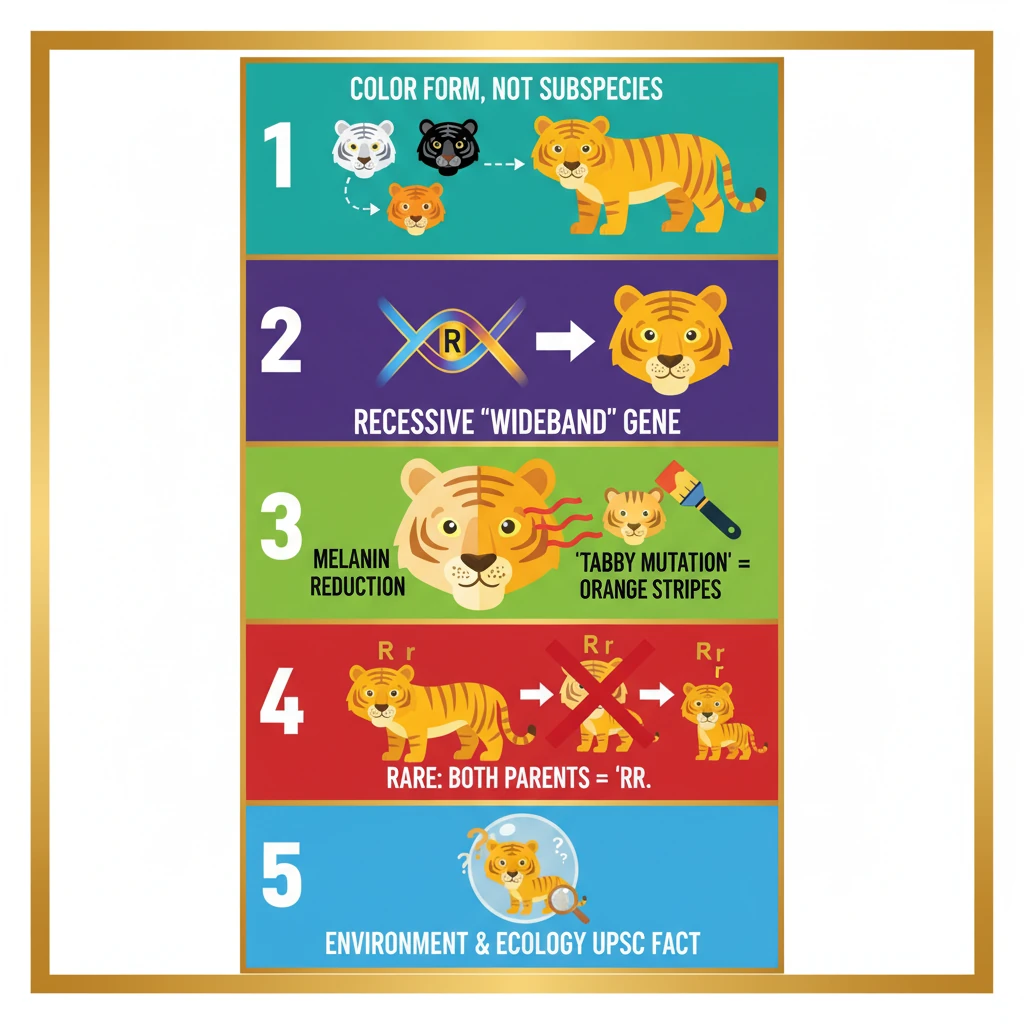
<h4>Understanding the Golden Tiger: A Rare Color Form</h4><p>The <strong>Golden Tiger</strong>, also known as the <strong>golden tabby tiger</strong>, is a unique color variation of the tiger. It is crucial to understand that it is a <strong>color form</strong> and not a distinct <strong>subspecies</strong>, similar to how white and black tigers are categorized.</p><div class='key-point-box'><p><strong>Key Point:</strong> Golden tigers are a <strong>color form</strong>, not a separate <strong>subspecies</strong>. This distinction is vital for understanding their biological classification.</p></div><p>These majestic animals are exceptionally <strong>rare in the wild</strong> and even more uncommon in captivity. Their scarcity highlights the specific genetic conditions required for their appearance.</p><h4>Genetic Basis of the Golden Tiger's Coloration</h4><p>The distinctive golden coloration observed in tigers, such as those spotted in <strong>Kaziranga National Park (KNP)</strong>, is attributed to the presence of a <strong>recessive gene</strong>. This specific gene is known as the <strong>“wideband” gene</strong>.</p><div class='info-box'><p><strong>Wideband Gene:</strong> This recessive gene plays a critical role by reducing the production of <strong>melanin</strong>, the pigment responsible for dark coloration, during the hair growth cycle.</p></div><p>The reduced melanin production leads to the expression of the <strong>agouti mutation</strong>. This mutation is responsible for producing a protein typically expressed in the skin, resulting in the characteristic <strong>blond or golden skin</strong> of these tigers.</p><p>While the agouti mutation gives the golden hue, the distinct <strong>orange stripes</strong> are a result of the <strong>“tabby mutation”</strong>. This tabby gene is also responsible for various coat patterns seen in domestic cats, indicating a shared genetic mechanism across feline species.</p><h4>Recessive Gene Expression and Rarity</h4><p>The existence of both golden and black tigers is fundamentally linked to the concept of <strong>recessive genes</strong>. These genes are only expressed when a dominant gene, which would typically suppress their trait, is absent.</p><p>When two individuals carrying <strong>dominant traits</strong> breed, the recessive genes they might carry are usually masked. However, if two individuals both possess and pass on the <strong>recessive gene</strong>, the recessive trait becomes expressed.</p><div class='exam-tip-box'><p><strong>UPSC Insight:</strong> Understanding the difference between <strong>dominant and recessive genes</strong> is crucial for topics related to biodiversity, evolution, and conservation genetics in <strong>GS Paper III</strong>. Questions might involve genetic variations in endangered species.</p></div><p>This mechanism explains the rarity of golden and black tigers: the specific combination of recessive genes needed for their coloration to manifest is uncommon in the general tiger population.</p>
💡 Key Takeaways
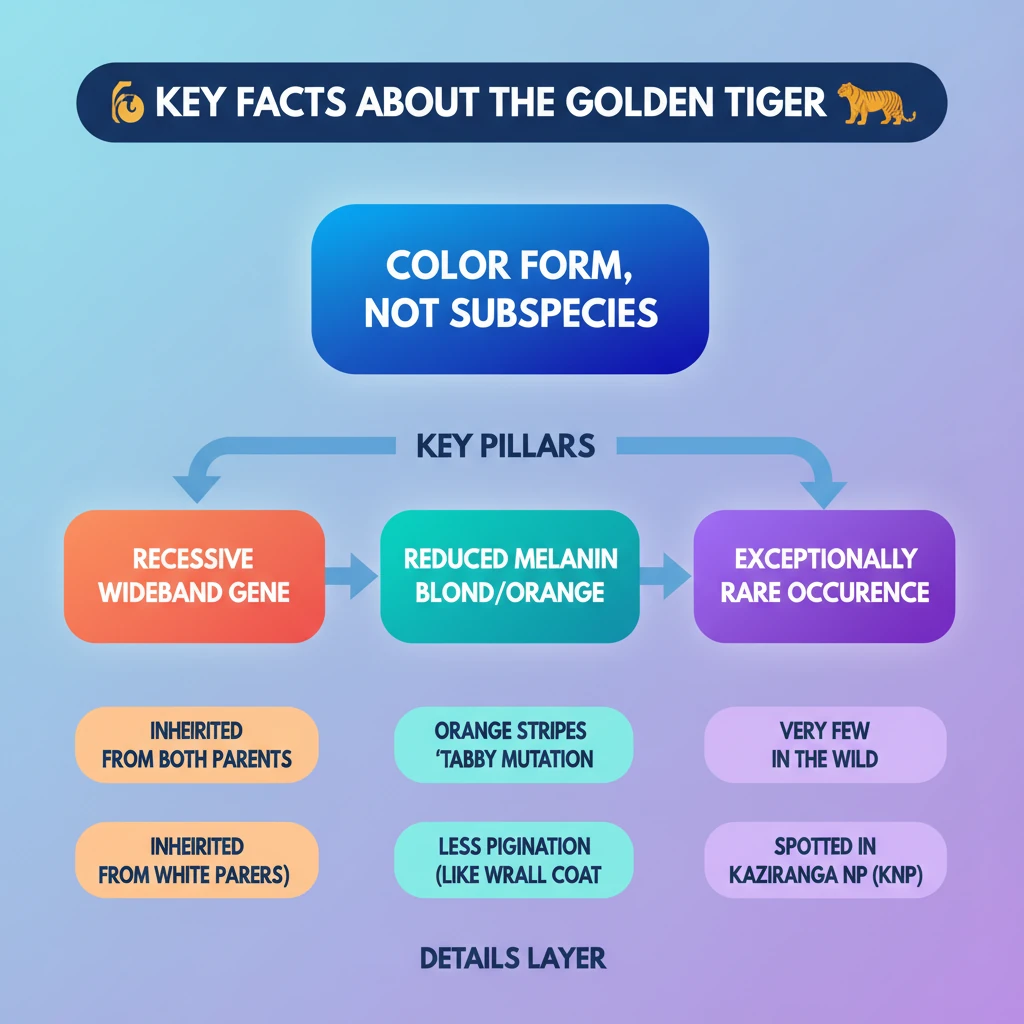
- •Golden tigers are a 'color form,' not a separate subspecies, like white and black tigers.
- •Their unique coloration is caused by a recessive 'wideband' gene.
- •The wideband gene reduces melanin production, leading to blond/golden skin, while orange stripes are due to a 'tabby mutation'.
- •They are exceptionally rare because the recessive gene must be inherited from both parents to be expressed.
- •A Golden Tiger was notably spotted in Kaziranga National Park (KNP).
- •Understanding these genetic variations is important for biodiversity conservation and genetic research.
🧠 Memory Techniques
95% Verified Content
📚 Reference Sources
•General knowledge on tiger genetics and conservation biology.