Salt-water Crocodiles - Environment And Ecology | UPSC Learning
Topics
0 topics • 0 completed
🔍
No topics match your search
Salt-water Crocodiles
Medium⏱️ 6 min read
environment and ecology
📖 Introduction
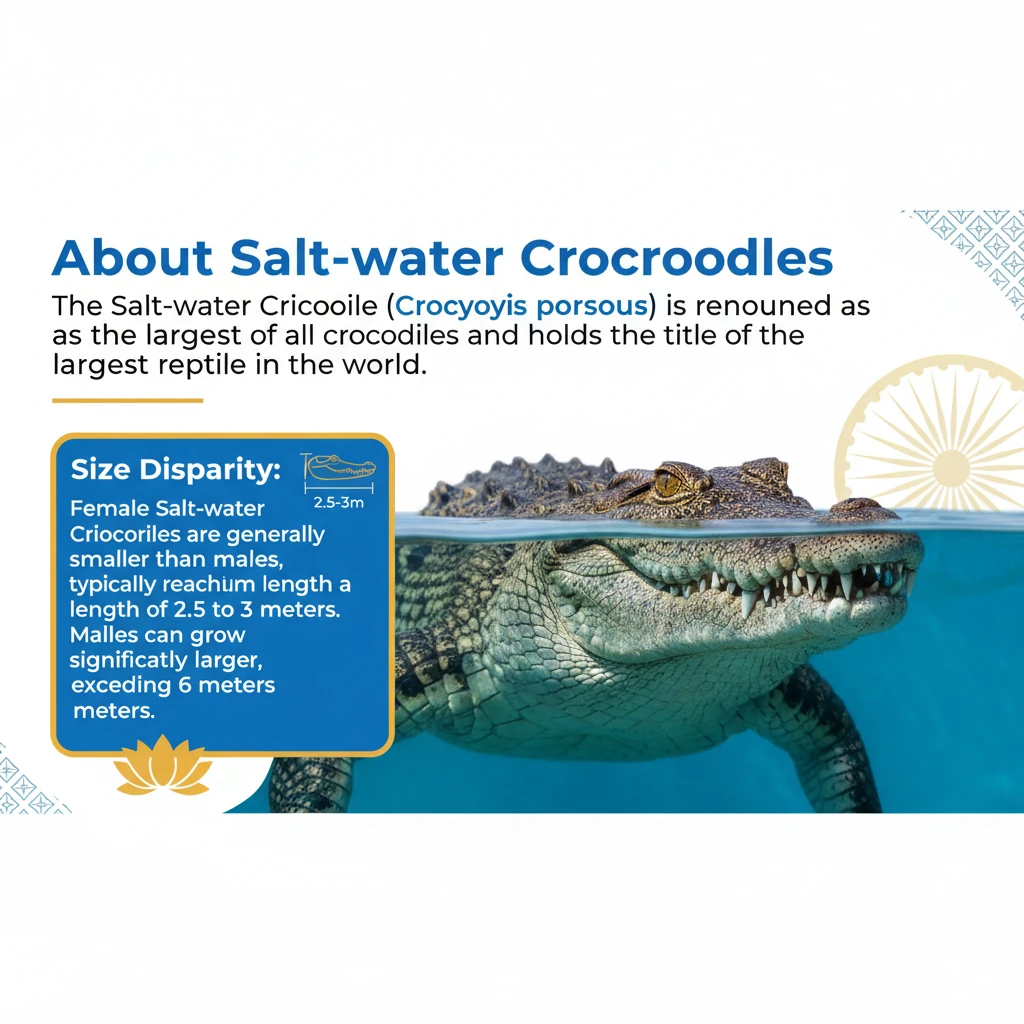
<h4>About Salt-water Crocodiles</h4><p>The <strong>Salt-water Crocodile</strong> (<em>Crocodylus porosus</em>) is renowned as the <strong>largest of all crocodiles</strong> and holds the title of the <strong>largest reptile in the world</strong>.</p><div class='info-box'><p><strong>Size Disparity:</strong> Female <strong>Salt-water Crocodiles</strong> are generally smaller than males, typically reaching a maximum length of <strong>2.5 to 3 meters</strong>. Males can grow significantly larger, often exceeding 6 meters.</p></div><h4>Habitat and Salinity Tolerance</h4><p>A defining characteristic of <strong>Salt-water Crocodiles</strong> is their remarkable tolerance to varying salinity levels. This allows them to thrive in diverse aquatic environments.</p><p>They are predominantly found in <strong>coastal waters</strong>, estuaries, and near river mouths. However, their adaptability also sees them inhabiting <strong>freshwater areas</strong> adjacent to rivers and swamps.</p><h4>Communication Methods</h4><p><strong>Salt-water Crocodiles</strong> employ a range of vocalizations for communication within their species. These sounds are crucial for territorial defense, mating, and warning.</p><ul><li><strong>Barking:</strong> Often used for territorial displays or warnings.</li><li><strong>Hissing:</strong> A common sound indicating aggression or discomfort.</li><li><strong>Growling:</strong> Employed during disputes or as a threat.</li><li><strong>Chirps:</strong> Frequently used by hatchlings and juveniles to communicate with their mother.</li></ul><h4>Geographical Distribution</h4><p>The distribution of <strong>Salt-water Crocodiles</strong> spans across tropical to warm temperate latitudes. Their range primarily covers the regions of the <strong>eastern Indian Ocean</strong> and the <strong>western Pacific Ocean</strong>.</p><div class='info-box'><p><strong>Key Regions:</strong> This includes parts of India, Southeast Asia, Northern Australia, and various Pacific islands.</p></div>
💡 Key Takeaways
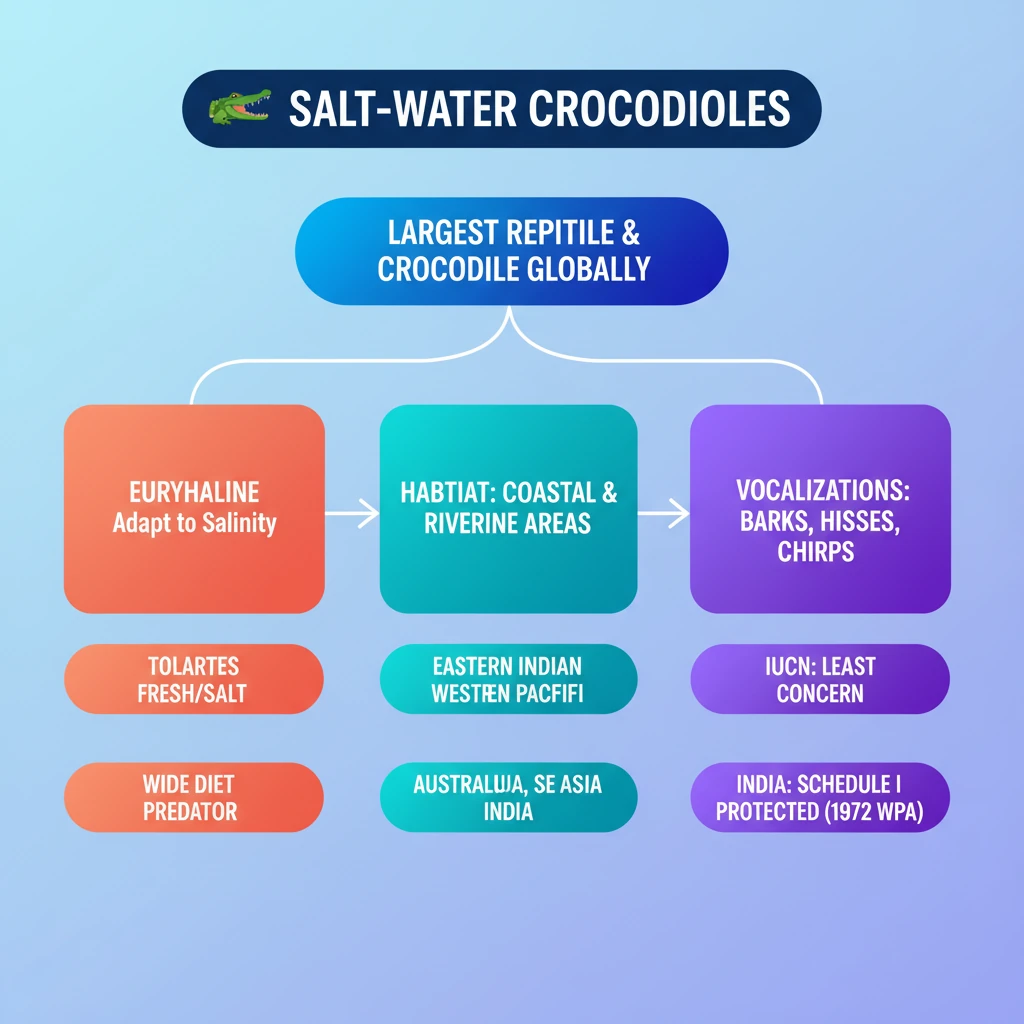
- •Salt-water Crocodile is the largest reptile and largest crocodile globally.
- •They are euryhaline, tolerating both fresh and saltwater environments.
- •Found in coastal and riverine areas of the eastern Indian and western Pacific oceans.
- •Communicate through barking, hissing, growling, and chirps.
- •Globally 'Least Concern' (IUCN), but Schedule I protected in India (Wildlife Protection Act, 1972).
- •Apex predators crucial for ecosystem balance in mangrove and estuarine habitats.
🧠 Memory Techniques
98% Verified Content
📚 Reference Sources
•IUCN Red List of Threatened Species
•Wildlife Protection Act, 1972 (India)
•National Geographic
•Australian Government Department of Environment and Energy