Radioactive Isotopes in Sediments: Caesium, Strontium & Tritium - Environment And Ecology | UPSC Learning
Topics
0 topics • 0 completed
🔍
No topics match your search

Radioactive Isotopes in Sediments: Caesium, Strontium & Tritium
Medium⏱️ 7 min read
environment and ecology
📖 Introduction
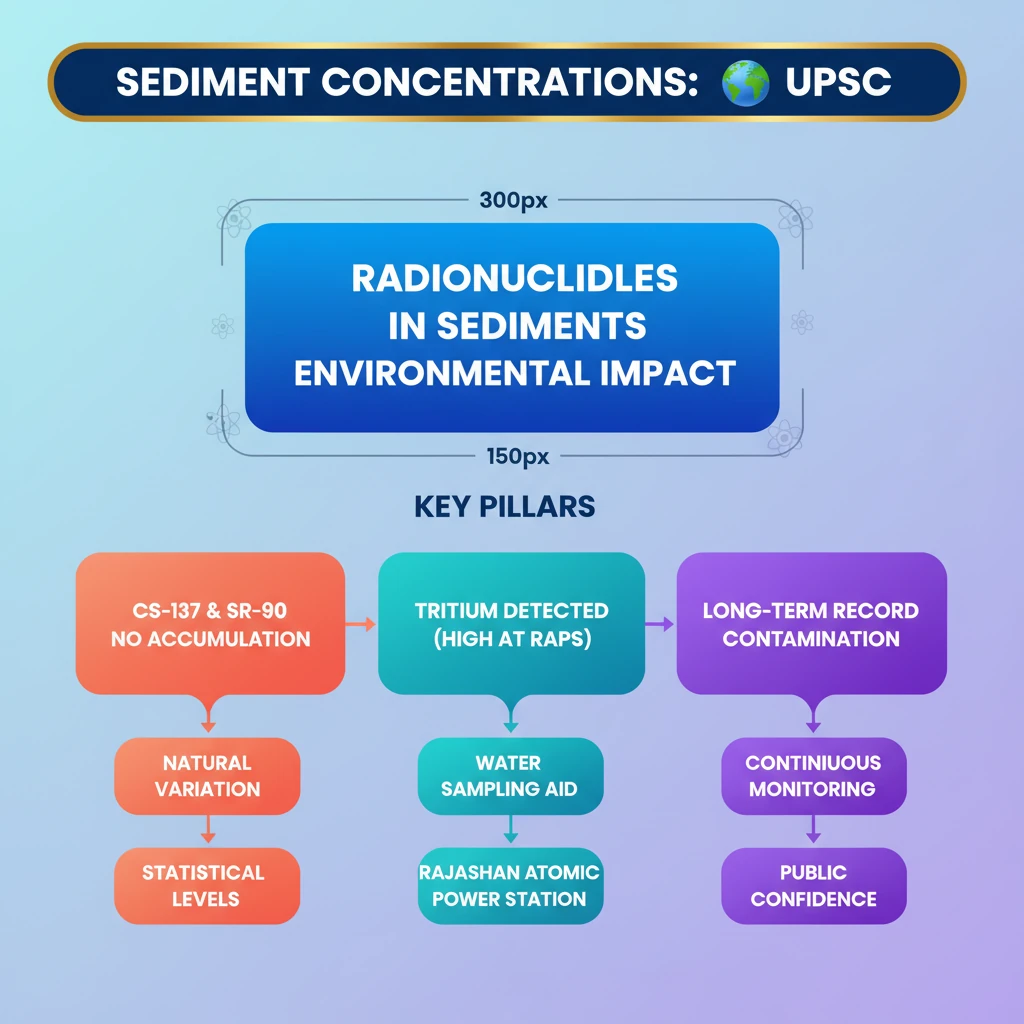
<h4>Understanding Sediment Concentrations in Environmental Monitoring</h4><p><strong>Sediment concentrations</strong> refer to the levels of specific substances, often pollutants or radionuclides, found within the sediment layers of water bodies like rivers, lakes, or oceans. Monitoring these concentrations is crucial for assessing environmental health and the impact of human activities.</p><div class='info-box'><p><strong>Sediments</strong> act as a sink for many contaminants. Analyzing them provides a historical record of pollution and indicates long-term accumulation trends, which might not be apparent from water samples alone.</p></div><h4>Caesium-137 and Strontium-90 in Sediments</h4><p>A study on environmental monitoring examined the concentrations of two significant radionuclides: <strong>caesium-137</strong> (Cs-137) and <strong>strontium-90</strong> (Sr-90) in sediments.</p><p>The findings indicated that the levels of these radionuclides were consistent with natural variations. This suggests no unusual deposition or accumulation trends were observed in the monitored sediments.</p><div class='key-point-box'><p>The concentrations of <strong>caesium-137</strong> and <strong>strontium-90</strong> in sediments were within the <strong>statistical variation of values observed in natural sediments</strong>, showing no trend of deposition or accumulation.</p></div><h4>Tritium Detection and Concentrations</h4><p>Another key aspect of the study involved the detection of <strong>tritium</strong> (H-3), a radioactive isotope of hydrogen, in various locations.</p><p><strong>Tritium</strong> was found to be detectable above the minimum detectable activity at most monitoring sites. This indicates its presence, albeit often at low levels.</p><div class='info-box'><p><strong>Tritium</strong> was detectable above the minimum detectable activity at <strong>all sites except the Kudankulam Nuclear Power Station</strong>.</p></div><p>Interestingly, higher concentrations of <strong>tritium</strong> were specifically noted at one particular location, suggesting localized variations in its presence.</p><div class='highlight-box'><p><strong>Tritium concentrations were relatively higher at the Rajasthan Atomic Power Station</strong>.</p></div><div class='exam-tip-box'><p>For <strong>UPSC Mains GS3 (Environment & Ecology, Science & Technology)</strong>, understanding the significance of monitoring radionuclides like <strong>Caesium-137</strong>, <strong>Strontium-90</strong>, and <strong>Tritium</strong> is vital. These are key indicators of nuclear safety and environmental contamination.</p></div>
💡 Key Takeaways
- •Sediment concentrations of radionuclides (Cs-137, Sr-90, Tritium) are key indicators of environmental impact.
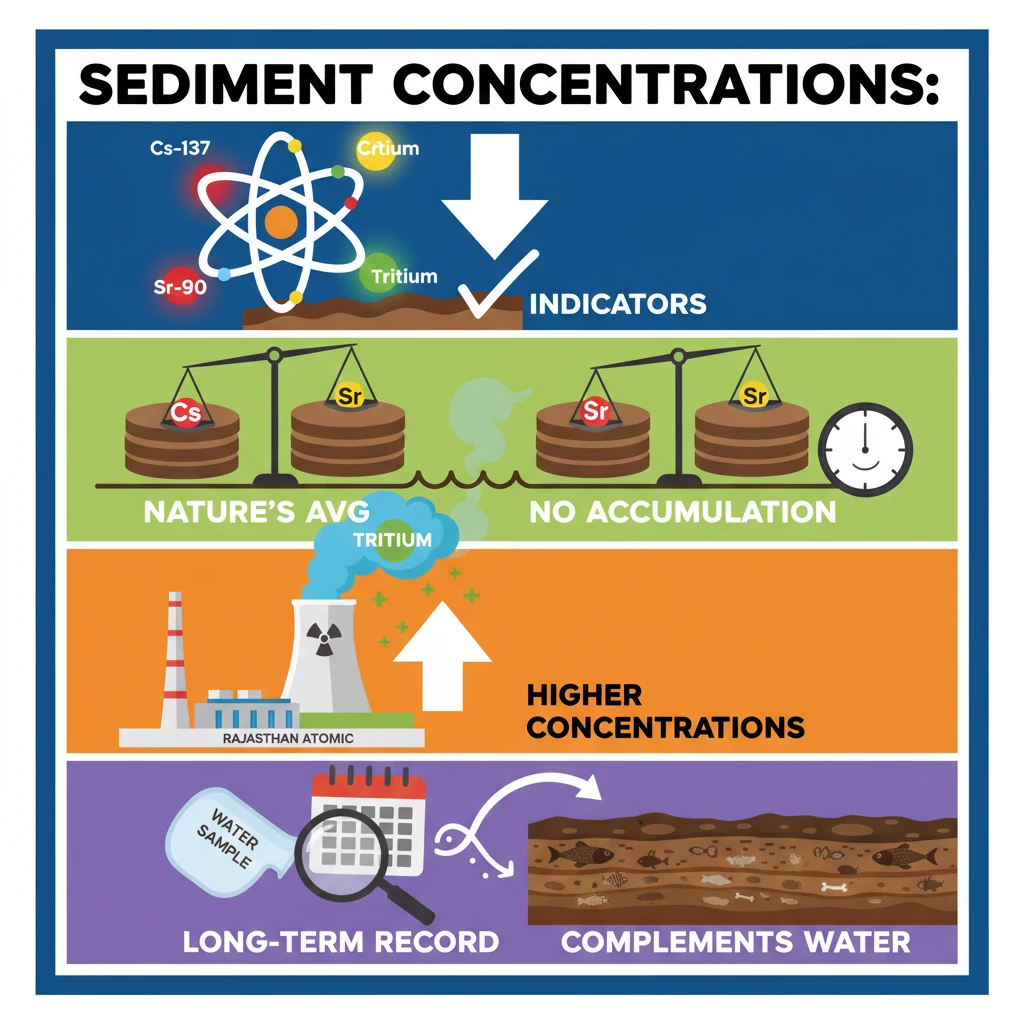
- •Caesium-137 and Strontium-90 levels in sediments were within natural statistical variation, showing no accumulation.
- •Tritium was detectable at most sites, with higher concentrations specifically noted at Rajasthan Atomic Power Station.
- •Sediments provide a long-term record of contamination, complementing water sampling.
- •Continuous monitoring is vital for nuclear safety, environmental protection, and public confidence.
🧠 Memory Techniques
98% Verified Content
📚 Reference Sources
•General knowledge on nuclear safety and environmental monitoring in India (BARC, AERB publications)